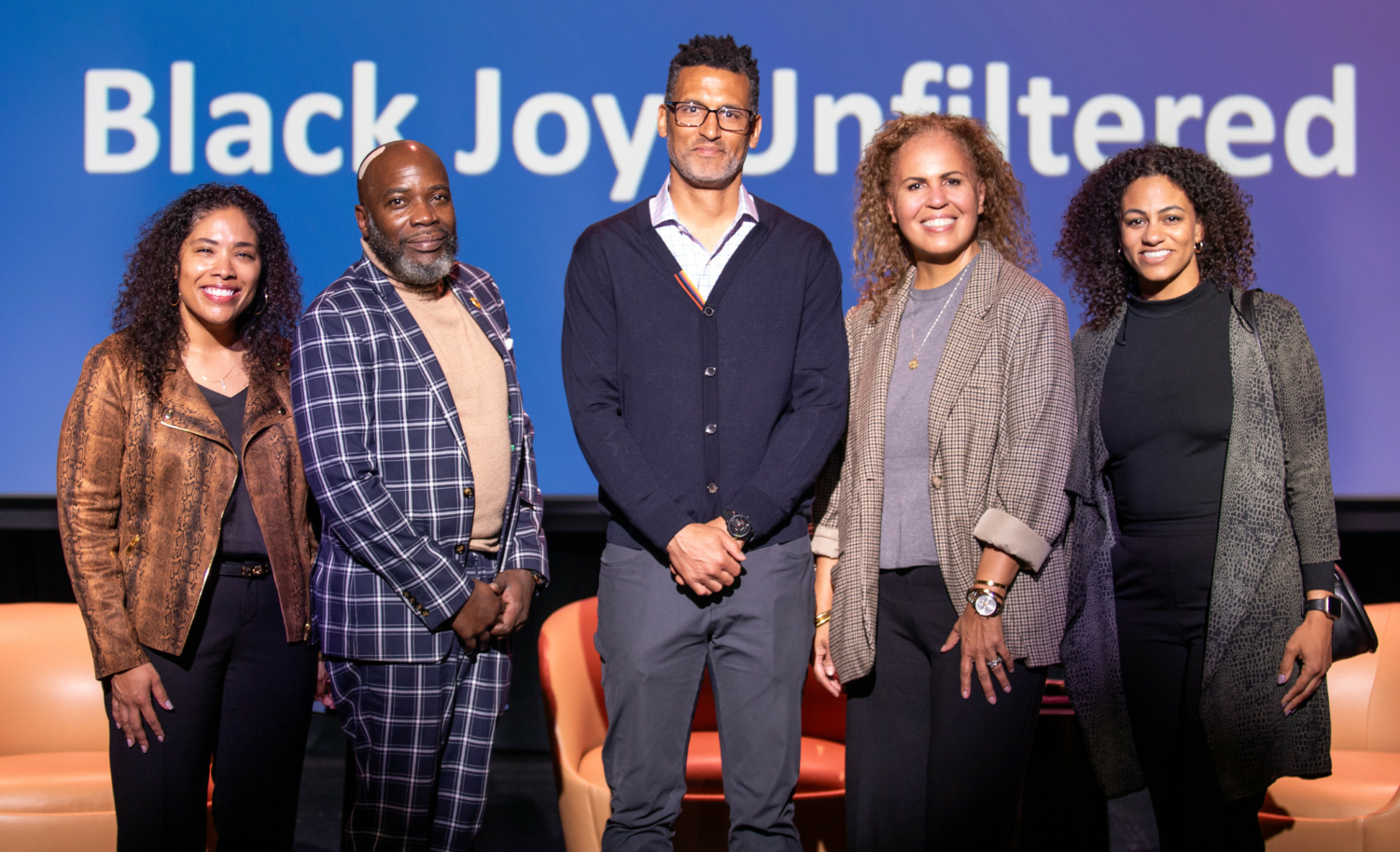
“Black Joy Unfiltered” Draws Packed House at UCLA Nimoy Theater Michael Harriot and Michael Lens reflect on Black history, neighborhoods, and lived experience during a Black History Month Luskin Lecture Series event.
A line of people stretched down Westwood Boulevard before the doors even opened for “Black Joy Unfiltered: A Conversation with Michael Harriot and Michael Lens” on February 25. By 6 p.m., students, faculty, and community members packed the UCLA Nimoy Theater for a Luskin Lecture Series event presented in partnership with the UCLA Ralph J. Bunche Center for African American Studies.
The evening brought together two distinct voices examining Black history and Black neighborhoods — one through public storytelling and cultural critique, the other through decades of research on segregation and urban policy — in a candid, wide-ranging conversation about the lived experiences of Black communities.
The discussion was moderated by Safiya U. Noble, the David O. Sears Presidential Endowed Chair of Social Sciences at UCLA and a MacArthur Fellow known for her scholarship on algorithmic discrimination.
“I wanted to write a book about the history of America from the eyes of Black people, and gives us a version of our history that centers us.”
Harriot, author of the New York Times bestseller “Black AF History: The Un-Whitewashed Story of America,” spoke about his motivation to reframe American history. “I wanted to write a book about the history of America from the eyes of Black people,” he said. “I wanted to examine America through that lens, not through the language of academia, but write a book that gives us a version of our history that sounds like us, that centers us, without filtering it through another perspective.”
Lens, whose book “Where the Hood At? Fifty Years of Change in Black Neighborhoods” examines long-term patterns in Black communities, reflected on his scholarly approach to segregation and neighborhood change. “I have long been interested in how neighborhoods shape our lives, and it’s one area of research I try to build on.” He noted that so much of segregation research has historically been shaped by white scholars and often frames Black neighborhoods primarily in relation to whiteness. “Black neighborhoods were never really the main character in this kind of research, and I really wanted to make the Black neighborhoods the main characters in the book I wrote,” Lens said.
“Events like this matter because before we talk about solutions, we have to understand historical context.”
Throughout the evening, Noble guided the discussion through themes of economic and political transformation, structural inequality and the resilience embedded within Black communities.
For many students in attendance, the conversation offered both reflection and affirmation. “I appreciated how the discussion stayed unfiltered, using humor to navigate difficult truths about American history and Black neighborhoods,” said Public Affairs undergraduate major Sheryl Samala. “Events like this matter because before we talk about solutions, we have to understand historical context. We already have research that reveals the legacy of discrimination — the real challenge is making sure meaningful change is actually implemented.”
Following the discussion, guests lined up for a book signing where Harriot and Lens greeted readers, signed copies of their books and continued informal conversations late into the evening.
The Luskin Lecture Series is designed to enhance public discourse on topics relevant to today’s societal needs. Bringing renowned public intellectuals and scholars together with national and local leaders, the Luskin Lecture Series presents issues that are changing the way our country addresses its most pressing problems. For more information on upcoming Luskin Lecture Series events, please click here.






Leave a Reply
Want to join the discussion?Feel free to contribute!