
How DemocraShe Builds Civic Engagement for All How UCLA Luskin alumna Sarah Jakle combines trauma-informed practice, public policy, and mentorship to prepare young women for civic leadership.
Sarah Jakle M.P.P. ’04 (she/her) has always believed that leadership must support the whole human being. Her commitment to women’s civic empowerment began long before she founded her organization DemocraShe, but the seeds were planted in the classrooms and mentorship circles she experienced as a graduate student at UCLA.
Jakle studied literature as an undergraduate before beginning her early career working with unhoused communities and individuals living with mental illness. This included an internship at U.S. VETS in Long Beach, where she worked directly with veterans experiencing homelessness, trauma and complex behavioral health needs. The work highlighted the barriers that individuals face when navigating unstable housing, mental health challenges and limited resources.

“I was working with unhoused veterans who had survived extraordinary adversity,” Jakle said. “Trauma was everywhere. It became clear that understanding trauma was essential to understanding how to really help people.”
Although she was making an impact one person at a time, Jakle saw how structural policies often determined whether meaningful change was possible. That realization brought her to graduate school, where she sought to understand the systems that shape people’s lives.
She earned a master’s in public policy from the UCLA Luskin School of Public Affairs and later completed a master’s in social work at USC with a concentration in military social work. The dual training created what she describes as a “Venn diagram” of her interests. The public policy curriculum equipped her with analytical and quantitative tools, while her social work training gave her trauma-informed frameworks for understanding the emotional experiences of people navigating public systems.
At UCLA, Jakle took several courses that fundamentally shifted her perspective, including the statistics and evaluation courses that she initially found intimidating as a non-STEM student.
“I was a literature major, so taking calculus-based economics and statistics was a shock,” she said. “But those classes transformed me. They taught me that you cannot assume you have impact. You have to measure it.”
Another defining experience came from her mentorship with former Massachusetts Governor Michael Dukakis, one of her professors at UCLA Luskin. Dukakis invited her to his home, where she met his wife, Kitty Dukakis. Learning about Kitty’s treatment in the press during the 1988 presidential election had a lasting influence on Jakle.
“Kitty was brilliant and compassionate, but she had been deeply mistreated during the campaign,” Jakle said. “It was the first time I truly understood that the emotional experience of being in politics could be as consequential as any policy outcome.”
The experience opened Jakle’s eyes to how women experience public scrutiny, and how often their emotional well-being is overlooked in discussions about civic leadership. This realization stayed with her as she continued her work after graduate school.
From Theory to Practice
Jakle’s graduate training and early career experiences directly shaped the creation of DemocraShe, a nonpartisan leadership program for young women. The organization serves a diverse group of students, with the majority identifying as girls of color and many as first-generation Americans.
DemocraShe teaches students foundational civic knowledge, leadership skills and what Jakle calls “amygdala skills,” which are basic neuroscience tools that help young women regulate fear, discomfort and internalized barriers when stepping into unfamiliar or high-pressure spaces.
“Women are socialized to be perfect, and stepping out of your comfort zone can trigger the amygdala,” Jakle said. “That discomfort often shows up as hesitation or self-doubt, which people call imposter syndrome. We teach girls how to regulate those feelings so they can pursue opportunities that match their ambition.”
Grounding and resourcing are two of the trauma-informed techniques that students learn. Grounding involves returning to the present moment through sensory awareness. Resourcing involves cultivating an inner supportive voice to counteract internalized criticism. Both practices are drawn from trauma research and help to calm the amygdala, allowing the prefrontal cortex to re-engage.
“We teach girls that the brain is constantly scanning for threat and safety,” she said. “If they can regulate the amygdala, they can make choices from a place of confidence and clarity.”
DemocraShe integrates rigorous evaluation into its programming, a discipline Jakle attributes to her training at UCLA Luskin. Students complete anonymous pre-program and post-program surveys so the team can track changes over time. For the full 2025 cohort, 37% of students reported understanding how to move forward as active participants in American democracy before the 10-week flagship program. After completing the program, that figure rose to 99%.
Another key metric asks whether DemocraShe helped students do something they were previously afraid to try; 92% say yes. Examples range from delivering public remarks in religious spaces, to running for school leadership positions, to asserting themselves in instances of workplace conflict.
“These findings tell us that our work is shifting both leadership skills and resilience skills,” Jakle said. “We are helping young women navigate adversity while stepping into the roles they deserve.”
Mentorship and Civic Leadership
Although UCLA shaped her academic foundation, one of Jakle’s most influential mentors came through her political organizing work. She credits Ada Briceño, labor leader and former chair of the Democratic Party of Orange County, as someone who demonstrated what courageous leadership looks like.
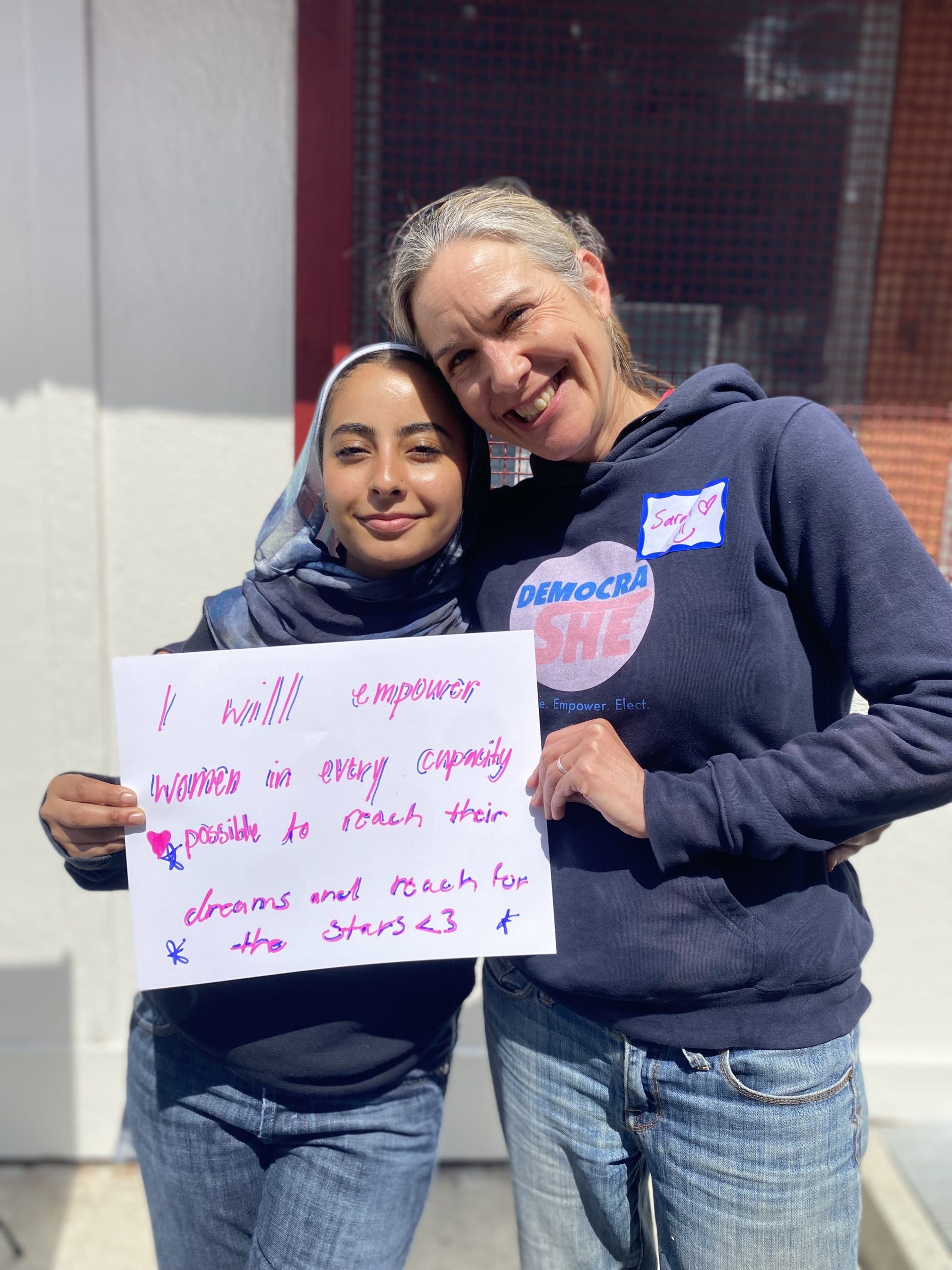
“Watching Ada, I saw firsthand how women, especially women of color, experience systemic pushback in civic spaces,” Jakle said. “It made me passionate not only about strengthening our democracy but also about protecting the emotional lives of the women who lead.”
Jakle has also worked as the Get Out the Vote director for the California National Organization for Women. During that time, she heard many women receive vague warnings that political life would be difficult, without being offered any tangible tools to manage the challenges ahead.
“For me, that felt like a missed opportunity,” she said. “We have decades of research on how people can self-regulate during stress. We should not send women into public life without these tools.”
Navigating the Present and Looking Ahead
Jakle believes that civic engagement extends far beyond voting. She encourages students from all academic backgrounds to understand how policy affects their educational pathways, professional fields and daily lives. She also believes that higher education institutions can play a significant role in preparing the next generation of civic leaders.
One of her priorities is advocating for paid opportunities for students to participate in policy work. She notes that many early political pipeline programs are unpaid, which often prevents students who need to work from participating.
“There are meetings happening right now about the future of the UC system,” she said. “Students should be in those rooms, and they should be paid for their time. Otherwise, only students with financial flexibility will get access to those spaces.”

As part of that commitment, DemocraShe pays all participants who take part in its 10-week program or its one-day summer intensives held live on Zoom.
Jakle also recognizes that many young people feel overwhelmed by political uncertainty and social change. She emphasizes the importance of joy as a protective factor for the brain. She teaches a practice called “savoring,” in which individuals spend a few moments each morning noticing two joyful or beautiful things to counter the brain’s negativity bias.
“When there is so much suffering, it can feel like experiencing joy is a betrayal,” she said. “But joy protects the brain. It helps people stay engaged instead of burning out.”
Her advice for those seeking to remain informed and active is simple. She encourages people to find community, participate in local action, and take small, consistent steps that contribute to positive change. She also recommends looking at diverse sources of information and listening to students and young organizers who are at the center of campus activism.
“Democracy is woven through everyday life,” she said. “Small actions matter. Community matters. And every person has a role in shaping the world around them.”
Jakle’s journey from social work to public policy and civic empowerment illustrates how trauma-informed leadership can strengthen democracy. Through DemocraShe, she continues to uplift young women and equip them with tools that support both their public leadership and their inner resilience.
This article was originally published by UCLA Alumni. Read the full article here.



Leave a Reply
Want to join the discussion?Feel free to contribute!