• Public Policy
  • Social Welfare
  • Real Estate Development
  • Urban Planning
  • Luskin Home
  • Undergraduate Program
  • Stay in Touch
  • Events Calendar
  • Give Now
  • About
    • Our Dean
    • Board of Advisors
    • Contact Us
    • Visit Us
    • Diversity, Disparities and Difference
    • Communications
      • UCLA Luskin in the News
      • Luskin Forum Online
  • Departments
    • Public Policy
    • Real Estate Development
    • Social Welfare
    • Undergraduate Program
    • Urban Planning
  • Apply
    • Master of Public Policy
    • Master of Real Estate Development
    • Master of Social Welfare
    • Master of Urban and Regional Planning
      • Double Degree With Sciences Po
    • PhD in Social Welfare
    • PhD in Urban Planning
    • Undergraduate Programs
  • Faculty
    • All
    • Public Policy
    • Social Welfare
    • Urban Planning
    • Real Estate Development
    • Faculty Executive Committee
    • Open Positions
  • Student Affairs & Alumni
    • Career Services
      • Employers
      • Fellowships
    • Student Support
    • Graduate Resource Library
    • Alumni Relations
  • Support
  • Programs
    • Research Centers & Affiliated Research
    • CA Title IV-E Education Program
    • Global Public Affairs (GPA)
    • Data Analytics Certificate
    • Luskin Lecture Series
    • Luskin Summit
    • UCLA Luskin California Policy Briefing
    • Public Service Weekend
    • Commencement
  • Administration
    • Financial Services
    • Events Office
    • Information Technology
  • Search
  • Menu Menu

Archive for category: Education

Mayoral Roundtable Highlights Launch of Luskin Summit 2022 With a theme of “Research in Action,” the fourth annual series resumes with five webinars spotlighting UCLA’s role in understanding and solving issues of current public concern 

January 19, 2022/0 Comments/in Business and the Environment, Climate Change, Development and Housing, Diversity, Education, Environment, For Faculty, For Policymakers, For Students, For Undergraduates, Global Public Affairs, Health Care, Latinos, Politics, Public Policy, Public Policy News, Research Projects, School of Public Affairs, Social Welfare, Social Welfare News, Social Welfare PhD, Transportation, Urban Planning /by Les Dunseith

By Les Dunseith

A roundtable discussion about the upcoming election of a new mayor in Los Angeles and four other sessions focusing on timely policy issues made up the agenda when the UCLA Luskin School of Public Affairs launched its fourth annual Luskin Summit.

Of the 10 currently declared mayoral candidates, U.S. Rep. Karen Bass has the advantage of name recognition and national political experience, panelists agreed. But City Councilman Kevin de León was also cited as a favorite of many voters based on his prior experience in Sacramento and name recognition from an unsuccessful 2018 bid for U.S. Senate. 

The panelists included Steve Soboroff and Wendy Greuel, former mayoral candidates themselves. 

Soboroff, who ran for mayor in 2001 in a race won by James K. Hahn, said, “At this point, I think it’s Karen, plus one. And everybody else is trying to be that one.”

He cited Bass’ experience as an elected official at both the state and national levels. “A lot has to do with bringing resources from D.C. and from Sacramento to Los Angeles. And she has the best chance of bringing resources that the others can’t.”

Greuel, who ran for mayor in 2013 in a race won by Eric Garcetti, sees this year’s mayoral election as very close, with even greater uncertainty because of COVID-19 and its ever-evolving impact on society and public opinion. 

“Normally, if you were ahead [in polls] five months out, you’re good, you know, and it’s not going to change,” Greuel said about speculating on a political candidate’s prospects for victory. “Now, it changes on a weekly basis.”

Like the mayor’s race, the Luskin Summit was impacted by COVID-19, with the launch event taking place on a remote platform after having been originally planned as an in-person conference. This year’s theme is “Research in Action,” and the sessions include recent research from the Luskin School that relates to current policy issues. The Summit series will continue through April.

The other sessions on Jan. 19 were moderated by faculty members at UCLA Luskin whose areas of expertise include housing policy, climate change, transportation, and class and racial inequality. Recordings of all five sessions are available online.

Author and UCLA Luskin faculty member Jim Newton, the editor of UCLA Blueprint magazine, led the questioning during the mayoral panel. The panelists were Soboroff, Greuel, longtime officeholder and current UCLA faculty member Zev Yaroslavsky and Antonia Hernandez, the president and CEO of the California Community Foundation.

They agreed that homelessness is likely to remain a dominant issue as the mayoral candidates vie for voter attention and approval prior to the June 7 primary and a likely Nov. 8 runoff election.

“I think in every public opinion survey that’s been done in town for candidates … homelessness is No. 1 and nothing else comes close,” Yaroslavsky said. “But it’s more than just homelessness. From my point of view, many people just feel that the wheels are coming off the city and it’s just not working.”

Hernandez said voters are eager for leadership and trustworthiness. 

“They want to have a sense of the person —  not the political person but the real person. You’re electing a whole package, a whole human being,” she said. “I think the public is really tired of platitudes, you know: ‘I’m going to solve homelessness in the first year.’ Well, it took us 40 years to get to where we are.”

Yaroslavsky said candidates also must navigate sometimes unrealistic voter expectations. 

“It’s better to underpromise and overdeliver,” he said. “You’ve got to be honest with the people. One of the lessons I learned in 40 years in politics is that the electorate has a very sensitive BS-sniffing meter. They know when they’re being conned.”

Hernandez expressed similar thoughts:  “If it’s not honest, it’s not realistic, then the platitudes aren’t going to get you any votes,” she said.

Homelessness was also the focus of the Luskin Summit session led by Ananya Roy, a professor of urban planning, social welfare and geography who is director of the UCLA Luskin Institute on Inequality and Democracy.

In opening remarks, Miguel Santana of the Weingart Foundation set the stage for a discussion about expanding housing security for L.A.’s unhoused population without losing sight of each individual’s right to self-determination. 

“The thing that’s been missing at the heart of homeless service solutions are the actual voices of the people who have been impacted,” said UCLA alumna Ashley Bennett, a founding member of the community organization Ground Game LA. 

Joining Roy and Bennett was Gary Blasi, a UCLA professor emeritus of law whose scholarship has shed light on the plight of renters in California. 

“Homelessness begins with eviction,” he said. “These are not two separate things, they’re tightly linked.”   

A third session taking place during the Summit launch event focused on another issue of huge current public concern: climate change. The session zeroed in on the dangers of rising heat.

Climate change has increased the frequency and lethality of wildfires, floods and hurricanes, said moderator Kirsten Schwarz, associate professor of urban planning. “This session will explore design and policy interventions that can create more livable and resilient cities, specifically focusing on interventions aimed at protecting the most vulnerable populations,” she said.

Among the panelists was Kelly Turner, assistant professor of urban planning and the interim co-director of the Luskin Center for Innovation at UCLA. She spoke about possible mitigation strategies and the importance of partnering with communities that are most vulnerable to extreme heat.

“The burden of heat is incredibly inequitable,” Turner said. “We learn more from talking to the community members about all the pernicious ways heat can impact people and their daily lives. Involving these community groups is going to be essential to any solution.”

Other panelists were Veronica Padilla-Campos MURP ’06, executive director of the nonprofit Pacoima Beautiful; Kristen Torres Pawling MURP ’12, sustainability program director at the Los Angeles County Chief Sustainability Office, and Helen Dowling, data manager for the Public Health Alliance of Southern California. 

The Luskin School of Public Affairs is well-known for its research on transportation issues, and Adam Millard-Ball, associate professor of urban planning, moderated a session that included new research on the widespread impact of Uber, Lyft and other ride-hailing companies on a community’s economic, environmental and equity goals.

 “How can ride-hailing best serve the public interest?” he asked. “Certainly, on the positive side, ride-hailing is an important mobility option, particularly for people who don’t have a car or perhaps people who can’t drive. But at the same time Uber and Lyft mean more traffic and more local air pollution.”

About a fifth of drivers simply drive around, burning more gasoline and creating more congestion and pollution, according to Millard-Ball and fellow presenter Joe Castiglione, deputy director for technology, data and analysis at the San Francisco County Transportation Authority. 

Also participating in this panel was Saba Waheed, research director at the UCLA Labor Center, who noted that gig workers have few employment protections.

The fifth panel discussion of the Summit launch event focused on the impacts of the COVID-19 pandemic on systemic class and racial inequality.

Paul Ong, research professor and director of the Center for Neighborhood Knowledge at UCLA Luskin, was joined by Silvia González, a former colleague at CNK who now works with the UCLA Latino Policy and Politics Initiative; Karen Umemoto, a professor of urban planning and director of the UCLA Asian American Studies Center; and Vickie Mays, a professor of psychology and health services at UCLA.

“Clearly we all understand the last two years has transformed the way we live, work and socialize,” Ong said. “The pandemic has been a once-in-a-century public health crisis, but beyond that, it’s also a pandemic that has generated dramatic economic disruption.”

He noted that racial disruption has been another byproduct, including a rise in hate crimes directed at Asians and health disparities experienced by other races.

The panelists also discussed the so-called digital divide and how unequal access to high-speed internet connections have impacted education, social and racial relationships during the pandemic. 

“I think one of the things that we don’t really know exactly the impact of yet is the impact on children for those who don’t have internet access,” Umemoto said.  

Leading the city toward solutions to such issues is an expectation of the Los Angeles mayor. Among voters’ biggest concerns is rising crime and how the LAPD should approach it. Los Angeles is among the cities increasingly turning to community policing tactics. 

“It’s preventative policing. It’s getting involved with the communities. It’s having a hundred different programs to keep kids from submitting to gangs and submitting to the influences that make them break laws,” said Soboroff, a longtime member of L.A.’s Board of Police Commissioners. “A candidate needs to understand that.”

Yaroslavsky, whose legacy as an officeholder includes police reform, is interested in seeing how the mayoral candidates talk about crime. 

“How will the candidates frame it? Are you going to land on one end or the other?” he asked. “I’ve always maintained that good community and police relations, and public safety, are not mutually exclusive.”

The choice of mayor is important, the panelists said, even though the mayor of Los Angeles has limited authority to enact unilateral change.

“In Los Angeles, we have 21 people — 15 council members, one mayor and five supervisors — that control everything,” Soboroff said. “The issue is not about taking power; it’s about giving up power … so something can get done.” 

Hernandez said candidates like Bass, de León, City Attorney Mike Feuer and City Councilman Joe Buscaino all have solid records as public servants. 

“They are good, decent people. They have served in different positions in government, and … you know that they care deeply about the place,” she said. “So, the real issue is how are they going to bring us together and make us believe that government can work for the people.”

Greuel, whose deep public service experience includes being the current chair of the Board of Advisors at UCLA Luskin, said winning the San Fernando Valley remains pivotal to the mayor’s race. Yaroslavsky agreed, but noted that changing demographics in the Valley, and throughout Los Angeles, mean that strategies that won past elections may not hold true anymore.

“It’s a much more complicated electorate now,” he said. 

The Luskin Summit is scheduled to resume Feb. 15 with a session focusing on voter suppression attempts. Sessions to follow will look at policy issues from a global perspective. Details about the Luskin Summit series can be found online, and interested parties may register at this link. 

Luskin Summit 2022 will close April 22 with a two-session event focusing on the Quality of Life Index, a project under the direction of Yaroslavsky in his role with the Los Angeles Initiative at UCLA, and a roundtable discussion about the importance of governors in California moderated by Newton. It will be presented both virtually and in-person on the UCLA campus if COVID-19 protocols allow. 

This year’s Luskin Summit sponsors are the Weingart Foundation, the Wasserman Foundation, the David Bohnett Foundation, the California Wellness Foundation and the Los Angeles Rams. The media partner is ABC7 in Los Angeles.

Stan Paul and Mary Braswell also contributed to this story.

A Platform for Elevating Student Voices As UCLA's student body president, public affairs major Breeze Velazquez embraces the role as an advocate for her peers

October 12, 2021/0 Comments/in Education, For Students, For Undergraduates, School of Public Affairs Meredith Phillips /by Mary Braswell

By Mary Braswell

During UCLA’s year of remote learning, Breeze Velazquez spent much of her time advocating for other Bruins.

Working one-on-one with students who believed they had been unfairly accused of academic dishonesty was not a role she had ever expected to play.

But it was one step on a surprising journey that led the senior public affairs major to seek and win the office of president of the UCLA Undergraduate Students Association Council.

“The crazy thing is, I never saw myself ever running for USAC,” Velazquez said. “I was an introvert. I had no social media up until last year.”

But in her public affairs coursework, as well as through internships with organizations like JusticeLA, MALDEF and Unite-LA, Velazquez found her own voice by helping others find theirs.

Her campaign for student body president focused on meeting the unique needs of first-generation, low-income students of color.

“I drew upon my own experiences and the experiences of my peers,” she said. “I grew up with a single mom. I grew up low-income, as well. And you know, I’m the first in my family to attend college.”

Those experiences helped shape a platform based on listening to the concerns of a wide range of students, then helping them connect with the right contacts in the UCLA administration. So far this year, this has included helping undocumented students navigate the university’s financial aid system and advocating for the creation of a special office to provide resources to those accused of academic dishonesty.

During the COVID-19 lockdown last year, UCLA saw an uptick in these cases, with students struggling to defend themselves over Zoom, said Velazquez, who at the time was the student body’s academic affairs commissioner. While providing guidance in these cases was not a formal part of her responsibilities, she decided to step in.

“One of the things I liked most about the role was the work that I got to do one-on-one with students,” she said. “I really fell in love with this project because I really see myself advocating for students in the future.”

Velazquez acknowledged that managing her academic workload, juggling several part-time jobs and serving in student government — which can be a lightning rod for criticism — has been physically and emotionally draining, especially during the pandemic.

She has leaned on friends and a tight-knit family, and has drawn support from the public affairs department she joined as a freshman pre-major.

“I just really found a community within the major. The students are so compassionate,” she said.

“And I look back on some of the professors I had who really supported me. Meredith Phillips, she was amazing,” Velazquez said of the undergraduate program’s founding chair. “I have gone to her for advice time and time again, even right now.”

Her coursework in public affairs, as well as Chicana/o and Central American studies — both intimate, interdisciplinary programs — has also helped bring her life goals into focus. Each department encouraged her to engage in the community and take advantage of course offerings from across campus, including in policy, education and law — fields she is interested in pursuing after graduation.

Until then, she’ll spend her year as student body president working to elevate the voices of students and helping them access UCLA resources.

“As difficult as it has been and as much as I never pictured myself taking on this role, … I know that I care about this and I’m strong enough because I was raised the right way,” she said. “My mom taught me that I’m a strong woman and no one’s going to deter what I need to get done.”

A New Approach to Preventing Weapons-Related Violence at California Schools Study gauges the prevalence of weapons on campuses and provides a comprehensive look at factors that put schools at risk

June 30, 2021/0 Comments/in Education, For Faculty, For Policymakers, For Students, For Undergraduates, School of Public Affairs, Social Welfare, Social Welfare PhD Ron Avi Astor /by Mary Braswell

By Mary Braswell

At some schools in California, nearly 1 in 5 students say they have either carried a weapon or been injured or threatened with one, according to a new study co-authored by UCLA Social Welfare Professor Ron Avi Astor that examines the presence of weapons in the state’s public middle and high schools and recommends focusing on campus-level conditions that could serve as warning signs for violence.

“Although tragic incidents of shootings in schools are rare and directly affect only a small number of students, tens of thousands of students report bringing weapons to school, and many more see other students in their school carrying weapons,” said Astor, who holds joint appointments at the UCLA Luskin School of Public Affairs and UCLA School of Education and Information Studies.

The study, co-authored with Rami Benbenishty of Hebrew University of Jerusalem, was published recently in the Journal of School Violence.

Based on surveys of nearly 890,000 California students in grades 7, 9 and 11, the research focuses on all types of weapons — not only guns — and assesses how factors such as the level of crime in a school’s surrounding neighborhood, students’ feelings of belongingness or victimization at school, their relationships with teachers and staff, and their perceptions about whether disciplinary practices are fair can heighten or lower the potential for weapons-carrying and violence.

This holistic or school-wide approach represents a significant departure from previous school-violence studies, which have typically sought to identify risk factors around individual students who might pose a threat, Astor noted.

“A major limitation of current ‘shooter’ studies is that they tend to maintain a narrow focus on individual perpetrators,” the authors write. “Although it is very difficult to detect students who perpetrate school shootings, it is possible to identify schools that have many students who are involved with weapons.”

The number of students who reported seeing weapons on campus is very low at many schools, according to the study, which included a representative sample of students from every county in the state who completed the California Healthy Kids Survey between 2013 and 2015.

However, in 3.3% of schools, more than 15% of students reported carrying a weapon, and in 5.8% of schools, at least 15% of students said they had been injured by a weapon or threatened with one. It is at these schools in particular, Astor and Benbenishty say, that an approach focused on improving campuswide conditions can bear the most fruit.

“It is imperative to develop a monitoring system to identify such schools and channel resources to this vulnerable group of students, educators and parents,” said Astor, who teaches a UCLA undergraduate course on ways to improve school safety. “We must create opportunities to hear their voices and explore local solutions that make their schools safer.”

Fostering a warm, supportive school environment is key to reducing the presence of weapons and creating a truly safe campus, according to the authors, whose previous research has demonstrated that prioritizing a culture of care, funneling more resources to vulnerable schools and elevating the voices of students, teachers and students leads to a drop in the number of weapons at schools.

“Students who trust that teachers support them and have a sense of safety in school may be less inclined to bring weapons to school,” the authors write.

In this new study, Astor and Benbenishty also focus on the unintended negative consequences of past efforts to deter individual shooters by “hardening” schools with metal detectors, security cameras and armed staff, as well as “active shooter” drills and harsh mandatory punishments that research shows often demonstrated bias against students of color.

These measures, they noted, frequently created fortress-like campuses that greatly diminished students’ well-being, heightened the fear of violence on school grounds and sent more of the nation’s children into the school-to-prison pipeline.

“Schools,” the authors conclude, “could develop a variety of caring and supportive approaches to reduce weapons-related behaviors … that do not include law enforcement methods and do not increase the school-to-prison pipeline.”

Serious Impacts of Coronavirus Felt Broadly Across Los Angeles County UCLA Luskin survey details effect of falling incomes, COVID-19 health issues and pandemic-related restrictions on Angelenos’ quality of life

April 19, 2021/0 Comments/in Development and Housing, Digital Technologies, Diversity, Education, Environment, For Faculty, For Policymakers, For Students, For Undergraduates, Health Care, Latinos, Politics, Public Policy, Public Policy News, Research Projects, School of Public Affairs, Social Welfare, Social Welfare News, Social Welfare PhD, The Lewis Center, Urban Planning Zev Yaroslavsky /by Les Dunseith

By Les Dunseith

Residents of Los Angeles County have been deeply affected by the COVID-19 crisis, with significant numbers citing the pandemic’s adverse impact on their finances, health and children’s education, according to UCLA’s sixth annual Quality of Life Index.

“A year ago we speculated about how resilient our region would be in the year to follow,” said Zev Yaroslavsky, director of the Los Angeles Initiative at the UCLA Luskin School of Public Affairs, who oversees the index. “We now know that Los Angeles County has demonstrated robust resilience, but a significant toll has been exacted on our residents by the tumultuous events. Many of our residents — especially younger ones — are anxious, angry and steadily losing hope about their future in Los Angeles.”

This year’s Quality of Life Index, or QLI, was based on interviews with 1,434 county residents over a 20-day period beginning on March 3, just as vaccinations were beginning to fuel optimism about a possible return to more normal life. Last year’s survey, conducted in the earliest stages of the pandemic, found high levels of anxiety about the possible impacts of COVID-19. Twelve months later, respondents said many of those fears had come to pass:

  • More than half of those surveyed (54%) reported that they or a close family member or friend had tested positive for the coronavirus.
  • Forty percent said their income went down because of the pandemic, with 22% saying it dropped “a lot” and 18% reporting “some” decline. Roughly 1 in 5 (18%) said they had lost their job at some point during the COVID-19 crisis.
  • Three-quarters of parents (76%) with school-age children felt their kids had been “substantially hurt, either academically or socially,” by pandemic-related distance learning and quarantine experiences.

In addition, nearly a fifth (17%) of all respondents reported that their income declined “a lot” in the past year and that they also suffered at least two specific negative impacts, such as a job loss, a wage or salary reduction, a decline in work hours or difficulty paying their rent or mortgage. This group was disproportionately composed of women under age 50, single people, renters, those without college degrees and those with household incomes of less than $60,000.

“These are among the most vulnerable individuals living in our county,” Yaroslavsky said.

The QLI, a joint project of the UCLA Luskin Los Angeles Initiative and The California Endowment with major funding provided by Meyer and Renee Luskin, asks a cross-section of Los Angeles County residents each year to rate their quality of life in nine categories and 40 subcategories. Full results of this year’s survey were made available April 19 as part of UCLA’s Luskin Summit, which is taking place virtually.

Mirroring last year’s result, this year’s overall quality-of-life rating held steady at 58 (on a scale of 10 to 100), which is slightly more positive than negative. But researchers noted that marked changes emerged among specific racial and ethnic groups, especially with younger residents.

Younger Angelenos: Sinking optimism, tempered by race

Reflecting a trend seen in recent QLI surveys, the county’s younger population — those between the ages of 18 and 49 — rated their quality of life lower than older residents, and the pandemic seems to have exacerbated that disparity.

“The varied manifestations of COVID-19,” Yaroslavsky said, “fell most heavily on the shoulders of younger county residents.”

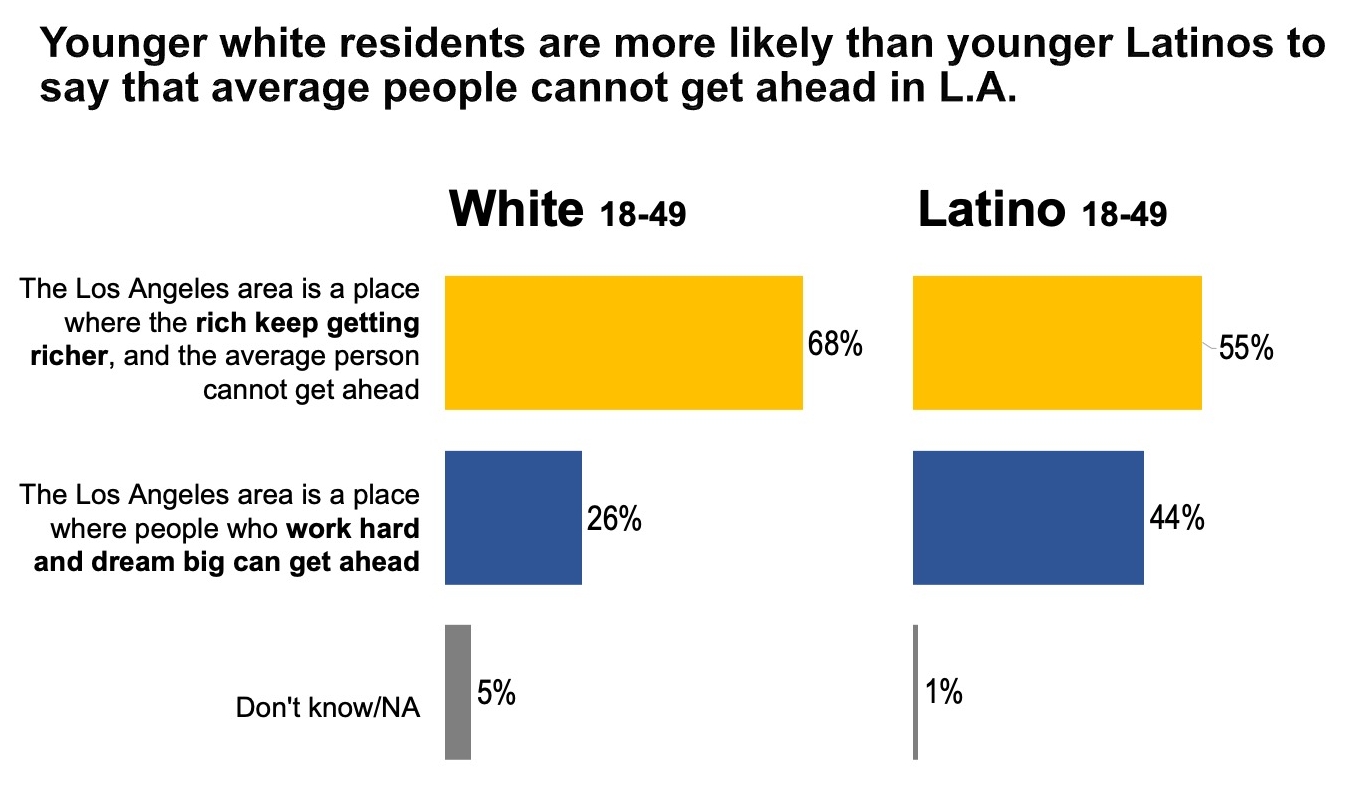
In particular, researchers observed a growing belief by younger Angelenos that the cost of living in the region is threatening their ability to make ends meet, get ahead or gain some sort of financial security.Yet even among this demographic, the survey revealed a distinct divergence in views between Latinos and whites, the two largest racial/ethnic groups in the county. While they have faced demonstrably harder challenges in the region, Latino residents overall were more positive about their quality of life than whites — and this was particularly pronounced among younger residents.

“Repeatedly, younger Latinos are more positive about their own conditions and express greater approval and positivity toward the variety of public officials and governmental entities that affect their lives,” said Paul Maslin, a public opinion and polling expert with Fairbank, Maslin, Maullin, Metz & Associates (FM3 Research) who has overseen the QLI survey process since 2016. “Among younger white residents in Los Angeles County, a greater sense of frustration and even bitterness is apparent.”

The survey uncovered a number of noteworthy differences in these two groups’ views of the pandemic, public officials and the opportunities available in the region:

  • Younger white residents were evenly split over whether the handling of the pandemic had been fair or unfair to “people like them” (48% vs. 49%), whereas younger Latinos reported that it had been fair to them by a 2-to-1 margin (65% vs. 33%).
  • About two-thirds (68%) of younger whites believe the Los Angeles area is a place where the rich get richer and the average person can’t get ahead, compared with only 55% of younger Latinos.
  • Younger Latinos had more favorable views of Los Angeles Mayor Eric Garcetti (57%) and Gov. Gavin Newsom (53%) than younger whites, 57% of whom had unfavorable views of Garcetti and 62% unfavorable views of Newsom.
  • Younger white residents rated the response to the pandemic — across all levels of government — much more harshly than younger Latinos. Only about a third of whites approved of the response of federal, state and county governments and local school districts. Latinos’ ratings of approval were at least 20 points higher for every level of government and for local school districts.
  • However, in terms of paying their rent, more younger Latinos (43%) reported falling behind than did young whites (31%).

The 2021 QLI: Resilience and change

While this year’s quality-of-life rating remained at 58 overall, reflecting a remarkable resilience among county residents, several significant shifts within the nine major categories that make up the survey tell a different story.

This was most noticeable in the education category, where the satisfaction rating of respondents with children in public schools dropped from 58 last year to 52 this year, one of the most dramatic one-year declines in any category in the QLI’s history.

Satisfaction ratings for public safety also fell over the past year, from 64 to 60, influenced significantly by a growing concern over violent crime. And respondents’ rating of the quality of their neighborhoods dropped from 71 to 68.

On the other hand, satisfaction with transportation and traffic rose from 53 to 56, which researchers attribute to a significant reduction in commuter traffic caused by pandemic-related workplace shutdowns.

With regard to the workplace, 57% of employed respondents said they currently work from home or split time between home and their place of work. As to the future, 77% said they would prefer a mix of working from home and their workplace when the pandemic ends, with just 16% wanting to “almost always work at home.”

The 2021 UCLA Luskin Quality of Life Index is based on interviews with a random sample of residents conducted in both English and Spanish, with a margin of error of plus or minus 2.6%. The QLI was prepared in partnership with the public opinion research firm Fairbank, Maslin, Maullin, Metz & Associates (FM3 Research).  The full reports for 2021 and previous years are posted online by the UCLA Lewis Center for Regional Policy Studies.

Undergrads Come Together During a Year of Staying Apart UCLA Luskin student group works to build peer-to-peer connections guided by the major's public service ethos

March 22, 2021/0 Comments/in Education, For Students, For Undergraduates, School of Public Affairs, Trailblazers /by Mary Braswell

By Mary Braswell

In the fall of 2020, Kaylen Gapuz was excited to begin her life as a Bruin but anxious about how to make campus connections at a time when COVID-19 demanded learning from afar.

So when she spotted an email invitation to pair up with a mentor through the Luskin Undergraduate Student Association, she quickly applied.

Throughout the first months of her freshman year, the public affairs pre-major talked weekly with senior Hannah Feller, who answered questions, offered advice and became “a good mentor, resource and friend, all in one, which I will forever appreciate,” Gapuz said.

This year, more than 70 students were matched with mentors, one of several initiatives launched by the association to strengthen the bonds among UCLA Luskin’s undergraduates, even as the pandemic kept them apart.

LUSA, as the group is known, came into existence in 2019, not long after the public affairs major debuted at UCLA. This year, by necessity, it greatly expanded its virtual reach.

A new website includes a blog inviting members to share their own takes on the issues that move them, and the group has hosted several remote gatherings guided by the public service ethos the major is known for. 

Throughout the year, members have come together for conversations on topics such as policing, environmental justice, gentrification and, of course, the tumultuous 2020 election. In the fall, a panel of candidates running for local office across California — including Nithya Raman, who would go on to win a seat on the Los Angeles City Council — appeared at a LUSA event to share personal stories of why they chose politics as an avenue for change-making. 

To draw Luskin undergrads to these gatherings at a time of chronic Zoom fatigue, LUSA’s leaders have been careful to choose timely topics while also offering social contacts, insights on navigating the major and advice on preparing for the working world. 

“The whole point of LUSA is to be a peer-to-peer environment,” said Feller, a public affairs and economics double-major who serves as the group’s president. 

At one LUSA session, Feller shared tips from her personal experience landing several internships — well before she was placed with the nonprofit World Trade Organization Los Angeles for her senior capstone experience.

“I’m by no means an expert on this topic, but I have had a fair share of finding internships, and a lot of this is information that older students taught me while I was going through the process,” Feller told the gathering. 

This type of programming offers a student’s eye view that complements the major’s curriculum and the resources offered by UCLA.

As one strategy to keep members engaged during an age of virtual connections, LUSA expanded its leadership team, Feller said. In addition to five elected executive board members, several other students stepped up to edit the blog, manage an active social media presence and organize special events.

Third-year public affairs major Samantha Schwartz was inspired to take on the mentorship initiative, an outreach to first- and second-year students at UCLA interested in learning more about the public affairs program.

In her weekly check-ins with Feller, Gapuz said, “Hannah was very much able to tailor the experience to the two of us,” and the women would chat about classes and professors, how to juggle the workload, and their shared interest in business consulting. 

“Especially this year, because of the remote nature of everything, it was just good to have a link to someone at a regular time when you know you can ask questions and not have to wonder what to do,” Gapuz said.

“Our mentorship pairing is what convinced me that the public affairs major is right for me.”

Journal Explores Power of Youth to Effect Political Change Special issue featuring UCLA Luskin contributions aims to amplify the voices of youth within a system that often ignores them

February 3, 2021/1 Comment/in Education, For Faculty, For Policymakers, For Students, For Undergraduates, Politics, Public Policy, Public Policy News, School of Public Affairs, Social Welfare, Social Welfare News Carlos Santos, Laura Wray-Lake /by Mary Braswell

A new issue of the Journal of Applied Developmental Psychology sheds light on the power of young people to effect political change even as their contributions are devalued or disregarded.

Published in the wake of the tumultuous 2020 election year, the special issue includes seven research papers and two commentaries that expand our understanding of political engagement among American youth, said Associate Professor of Social Welfare Laura Wray-Lake, who co-edited the issue with Benjamin Oosterhoff of Montana State University.

“Rapid changes in technology, growing political division and persistent experiences of racial injustice create a civic landscape that will have lasting effects on how young people approach politics for years to come,” Wray-Lake and Oosterhoff wrote.

The volume aims to amplify the voices of youth within a system that often ignores them and provide guidance to policymakers seeking to promote civic responsibility.

“Investment in young people’s political development should be an ongoing endeavor to improve the democratic health and functioning of our nation,” the editors wrote.

The special issue includes a commentary by Associate Professor of Social Welfare Carlos Santos, who argued for expanding the use of qualitative research methods to capture lived experiences of youth and “uncover the unique interplay between multiple sources of oppression and privilege.”

Research led by Veronica Terriquez, who will join the Urban Planning faculty this fall, is also featured in the volume. Terriquez’s study of Latino youth in California’s Central Valley shows how peer-to-peer organizing can be effective in mobilizing political movements even in regions hostile to immigrants and other communities of color.

Other contributors weigh in on structural barriers to youth political participation, including voting age restrictions and socioeconomic inequalities; the ability of Black youth to use critical reflection and political action to cope with individual, cultural and structural racism; the different ways that young people are affected by political polarization; and the importance of digital spaces in civic education.

Assembly Speaker Anthony Rendon Opens UCLA Luskin Summit Legislative priorities relating to police reform and climate change are topics of focus in the keynote webinar to begin the third annual conference

January 20, 2021/0 Comments/in Alumni, Business and the Environment, Development and Housing, Diversity, Education, Environment, For Faculty, For Policymakers, For Students, For Undergraduates, Politics, Public Policy, Public Policy News, Resources, School of Public Affairs, Social Welfare, Social Welfare News, Sustainable Energy, Transportation, Urban Planning Gary Segura, Zev Yaroslavsky /by Les Dunseith

By Les Dunseith

California Assembly Speaker Anthony Rendon spoke about California’s policy priorities during remarks Jan. 28 when the UCLA Luskin School of Public Affairs opened its third annual Luskin Summit.

As one of the state’s top political leaders, Rendon outlined his legislative priorities for 2021 — police reform, climate change and broadband internet access —  as the first presenter in a virtual series of discussions set to continue in February, March and April.

Dean Gary Segura said Rendon was invited to open the Summit in part because his background and political views are of interest to UCLA students, faculty and alumni. “In his career as educator, child well-being advocate and policy innovator, Rendon represents the best values of the Luskin School and our mission.”

Addressing the COVID-19 pandemic, Rendon, a Democrat, said Californians are already seeing benefits from the election of Joe Biden as president.

“One thing we can be sure about is the importance of having a plan. Throughout 2020, when COVID first appeared on our radar, we did not have a national plan,” Rendon said. “Biden came in, and he released a plan in his first week.”

He noted the tension that existed on many issues between the Trump administration and California officials, which led state leaders to work independently of the federal government on issues such as immigration and climate change.

“With Biden in the White House … I think we’re going to have a little bit more help and more opportunities to work with this administration instead of against it,” Rendon said.

As a legislative leader, Rendon has stressed inclusion and diversity, and he noted that more women hold committee chairs today in the state assembly than at any time in the past. He also pointed to his appointment of the first Muslim, Imam Mohammad Yasir Khan, to serve as assembly chaplain.

His leadership style emphasizes sharing of responsibility, Rendon told the online audience of more than 100 scholars, social services advocates, philanthropic and public leaders, and other interested parties. 

“I believe that the assembly works best when the individual members of the assembly, particularly the chairs, are able to utilize their skills, to utilize their life experiences,” he said. For example, Rendon said he has sought to embolden the chairs of legislative committees related to health and education whose expertise exceeds his own. “That’s been my philosophy, that I can be the best leader if I’m enabling others to do their jobs.”

In terms of legislative priorities, Rendon acknowledged that California lawmakers “fell short” on police reform in 2020, including failing to pass a bill that would have changed the disciplinary processes for police officers.

“We need to change those processes so that public safety is not just about officer protection,” he said. “Of course, we want to make sure that we’re not endangering the people we trust with patrolling our streets and neighborhoods, but we also have to make sure that they are careful.”

Rendon said California is already a national and international leader in dealing with climate change, but more work can be done.

“We need to ask if our climate change actions benefit disadvantaged communities,” he said, noting that his assembly district includes some of the most densely populated areas in the nation. “Southeast L.A. communities have around 17,000 people per square mile, but we have severe park shortages.”

Parts of his district were once farmland, but when they were developed for housing, the emphasis was placed on building high-density apartment dwellings without retaining open spaces. “Parks and vegetation are really important ways to reduce the heat island effect that drives warming in urban communities,” Rendon said.

His third legislative priority for 2021 also focuses on disadvantaged communities. In the past, discussions about a lack of broadband internet access centered around rural communities in the extreme north and south of the state.

“When COVID happened and when folks started having to go online for schooling, we discovered that there was a lack of broadband access all over the place,” Rendon said. “And those problems really started to manifest themselves, particularly in disadvantaged communities.”

He views the internet today as a critical public utility. “It’s not just a rich and poor issue; not just an urban and rural issue,” Rendon said. “It’s an issue that affects every single part of the state.”

In answer to a question posed by Segura about housing affordability, Rendon talked about visiting a neighborhood where he had once lived and noticing a flurry of housing construction. He reached out to a local official to praise the effort, only to be told to take a closer look at the upper floors of the newly occupied buildings.

“Those are all dark, right? Nobody lives there.”

In Rendon’s view, this example illustrates an ongoing problem in a state in which high-end housing continues to be built without enough pressure being brought on developers to balance their projects with affordable units.

When he first got to Sacramento, Rendon said, he noticed a disconnect in people’s minds between housing and homelessness. Over time, this misconception has slowly changed, in part because of “incredible data that show the number of people who would become homeless if they missed one month of pay, if they missed two months of pay.”

To further illustrate his point, Rendon noted that as assembly speaker he serves on the UC Board of Regents and the Cal State Board of Trustees. The statistics on housing scarcity among university students are staggering, he said, noting that many students can be found sleeping in their cars or couch surfing with friends from one night to the next.

“We know that housing and homelessness are linked,” said Rendon, whose 20 years of work in the nonprofit sphere often leads him to look for solutions in service delivery mechanisms. “I think if we’re going to solve the housing crisis, we need to address homelessness. And if we’re going to address homelessness, we really need to think about comprehensive services for homeless folks and for near-homeless folks.”

Additional information about the Luskin Summit, including previews of other sessions and a registration link, can be found online. Sponsors include the Los Angeles Rams, Gensler, the Weingart Foundation and the California Wellness Foundation. The media partner is ABC7 in Los Angeles.

In late April, the final event of Luskin Summit 2021 will be unveiling of the 6th annual Quality of Life Index, a project at UCLA Luskin that is supported by The California Endowment and Meyer and Renee Luskin under the direction of Zev Yaroslavsky, director of the Los Angeles Initiative. The survey asks county residents to rate their quality of life in a range of categories and to answer questions about important issues. Last year’s survey happened to coincide with the early stages of the pandemic.  

Watch a recording of the keynote session:

UCLA Professors Win $956,000 Award to Tackle Rising Heat in L.A. Communities Scholars from Urban Planning, Institute of Transportation Studies and Luskin Center for Innovation join cross-campus effort to find climate solutions

January 6, 2021/0 Comments/in Climate Change, Education, Environment, For Faculty, For Policymakers, For Students, For Undergraduates, Public Policy, Resources, School of Public Affairs, Urban Planning Gregory Pierce, Juan Matute, Kirsten Schwarz, V. Kelly Turner, Walker Wells /by Mary Braswell
By Katharine Davis Reich

A team of 10 UCLA professors has earned a $956,000 award for a project that will combine their expertise in engineering, urban planning, public health and environmental law to address the rapid increase in the number of extreme heat days in Los Angeles.

The prize is funded by a 2015 donation from the Anthony and Jeanne Pritzker Family Foundation.

The project, called Heat Resilient L.A., will over the next two years determine where and when people moving around the city are most vulnerable to the effects of extreme heat — a problem being caused by climate change — and assess which communities most need cooling interventions.

Based on their findings, the team will design new cooling structures and work with local stakeholders to determine where they should be installed. The team has designed a prototype structure that resembles a bus stop shelter, but in addition to a roof that provides shade, it also uses a combination of radiant and evaporative cooling technologies to provide “passive cooling” for those nearby.

Throughout the project, the researchers plan to engage directly with communities to produce the best possible design for the cooling structures and choose the best possible locations. Among the elements that helped the project stand out: its focus on equity and community engagement, and its use of devices other than shade and trees to provide cooling for local hot spots.

“What’s unique right now is that we have access to a portfolio of solutions and technologies that hadn’t been either thought of as plausible solutions or, frankly, available even just a few years ago,” said Aaswath Raman, a member of the Heat Resilient L.A. team and an assistant professor of materials science and engineering at the UCLA Samueli School of Engineering. Raman, who is designing the cooling structures using technology that has been developed in recent years at UCLA and elsewhere, said the project is an opportunity to explore the real-world use of emerging cooling technologies and materials.

That should not only help Los Angeles communities but also provide insights that he and others can use to continue building better technologies.

‘We wanted to bring together brilliant minds at UCLA who had never collaborated before, and push them to bring fresh ideas to the table.’ — Cassie Rauser, executive director of the UCLA Sustainable LA Grand Challenge

The winning project was chosen through a new UCLA initiative that upended the traditional model for conceiving and funding research projects. The program, called the Sustainable LA Grand Challenge Sandpit, emphasized connection, experimentation and blue-sky thinking.

In all, eight teams made up of more than 60 faculty members from 27 UCLA departments participated.

The program culminated in December with an online pitch event that worked more like the TV show “Shark Tank” than a typical call for proposals. Instead of preparing dense written submissions, the teams had to sell their research projects — all focused on sustainability — to a panel of jurors that included UCLA deans as well as chief sustainability officers from the city and county.

The Heat Resilient L.A. pitch was led by Raman; V. Kelly Turner, an assistant professor of urban planning at UCLA Luskin; and David Eisenman, a professor in residence at the David Geffen School of Medicine at UCLA and at the UCLA Fielding School of Public Health.

The other members of the winning team are Cara Horowitz, co-executive director of the UCLA Emmett Institute on Climate Change and the Environment; Sungtaek Ju, professor of mechanical and aerospace engineering, and of bioengineering; Travis Longcore, associate adjunct professor at the UCLA Institute of the Environment and Sustainability; Juan Matute, deputy director of the UCLA Institute of Transportation Studies; Gregory Pierce, associate director of the UCLA Luskin Center for Innovation; Kirsten Schwarz, associate professor of urban planning; and Walker Wells, lecturer in urban planning.

“The sandpit was definitely not business as usual, and that was the point,” said Cassie Rauser, executive director of the UCLA Sustainable LA Grand Challenge, a campuswide initiative to help transform Los Angeles into the world’s most sustainable megacity by 2050. “We wanted to bring together brilliant minds at UCLA who had never collaborated before, and push them to bring fresh ideas to the table. This type of interdisciplinary problem-solving is absolutely critical for addressing Los Angeles’ complex sustainability challenges.”

Competitors were invited to develop projects that directly address goals outlined in sustainability plans put forward by Los Angeles County and the city of Los Angeles, while paying particular attention to environmental justice and equity. The “sandpit” name was meant to encourage participants to bring a childlike sense of curiosity, openness and possibility into the process.

Teams and research concepts formed over the course of three months of online workshops designed to push participants out of their disciplinary bubbles and intellectual comfort zones — a critical aspect of the experience, according to Turner, who has studied what makes interdisciplinary collaborations work.

“So often it is about the informal interactions that get folks comfortable with being uncomfortable with each other, so that they can come up with the really innovative ideas,” she said.

The seven teams that did not win the grand prize will each receive $25,000 in seed funding from the Sustainable LA Grand Challenge, which will also provide continued research development support to help the teams further develop their ideas and pursue full funding from external organizations.

“One of the most exciting aspects of the sandpit is that we heard eight fantastic pitches,” said Eric Hoek, a UCLA professor of civil and environmental engineering and director of the Sustainable LA Grand Challenge. “Any of those projects could make a significant, tangible contribution toward our city’s and county’s sustainability goals, and we’re excited to help them all realize their potential.”

Despite Improved Access, Digital Divide Persists for Minority, Low-Income Students UCLA research shows battle for educational equity has shifted into a new space

December 8, 2020/0 Comments/in Digital Technologies, Education, School of Public Affairs Paul Ong /by Stan Paul

By John McDonald

While students’ access to computers and the internet improved during the pandemic-affected and largely remote fall school term, a clear digital divide persists, especially among Black, Latino and low-income students, according to a new report by the UCLA Center for Neighborhood Knowledge.

“It appears that the lack of access has become less severe this fall than it was last spring, as schools have made adjustments to support remote learning,” said Paul Ong, the center’s director and an author of the report. “But it is also clear that a lack of access and real and troubling divide remains.”

This digital divide, the authors say, translates into students missing lessons, being unable to access materials and struggling to complete assignments — all of which have significant implications for long-term learning and success later in life.

The researchers used data from the U.S. Census Bureau’s Household Pulse Survey to provide a current look at household access to computers and the internet. Their findings show that the rate of limited digital access for households fell from a high of 42% during the panic and chaos of school closures last spring to about 31% this fall.

But the data also make clear that during the fall term, racial and economic inequality has remained significant, with African American and Latino households being 1.3 to 1.4 times as likely as white households to experience limited accessibility. Low-income households are most impacted by digital unavailability, with more than 2 in 5 having limited access to a computer or the internet.

In addition, since mid-October, the rate of digital inaccessibility has increased slowly but unmistakably. The researchers are concerned that the divide may worsen amid the current surge in COVID-19 infections and resulting restrictions.

“This new research details a persistent and troubling digital divide among students, with far-reaching implications for educational access and equitable opportunities,” said Tina Christie, the Wasserman Dean of the UCLA School of Education and Information Studies, which co-published the report with the Center for Neighborhood Knowledge at the UCLA Luskin School of Public Affairs.

“The pandemic has brought into focus the intimate connection between education and technological connectivity and, with it, the connection between connectivity and social justice,” Christie said. “The battleground for educational equity has now, and perhaps forever, shifted into a new space.”

According to Ong, a UCLA Luskin research professor, persistent digital inequality threatens to widen disparities in achievement as minority and low-income children become adults, contributing to an intergenerational reproduction of inequality.

“The disparities in limited technological resources for virtual learning are not just today’s education crisis,” Ong said. “Falling behind increases the achievement gap, which has long-term social and economic implications. To avoid this tragedy, we must act immediately and decisively to close the digital divide.”

COVID-19 and the Digital Divide in Virtual Learning, fall 2020, is a publication of the Center for Neighborhood Knowledge at the UCLA Luskin School of Public Affairs. The research brief was published in collaboration with the UCLA School of Education and Information Studies. Read the full research brief.

Contact: John McDonald
jmcdonald@gseis.ucla.edu

Former HUD Secretary Julián Castro on Future of Federal Housing Webinar with the former Democratic presidential candidate includes UCLA Luskin housing experts in a discussion of urgent policy priorities

November 24, 2020/0 Comments/in Development and Housing, Diversity, Education, For Faculty, For Policymakers, For Students, For Undergraduates, Politics, Public Policy, Public Policy News, School of Public Affairs, Social Welfare, Social Welfare News, Urban Planning Michael Lens /by Claudia Bustamante

By Bret Weinberger

Former U.S. Secretary of Housing and Urban Development Julián Castro characterized the seriousness with which American society ought to address the nationwide housing crisis by saying during a recent UCLA virtual event, “All of us have a responsibility to solve this challenge.”

Castro said there is no time to waste in facing this issue, with an eviction crisis looming because of economic fallout from the coronavirus pandemic. The Nov. 5 webinar focused on the future of federal housing policy as part of the Housing, Equity and Community Series, a joint endeavor of the UCLA Lewis Center for Regional Policy Studies and the UCLA Ziman Center for Real Estate.

Castro and Michael Lens, associate faculty director of the Lewis Center, spoke amid uncertainty regarding the nation’s political landscape just days before major news outlets called the race for President-elect Joe Biden. They delved into the interconnectedness of multiple ongoing crises and came ready with policy solutions.

Regarding protections for those who struggle to remain housed, Castro said that local governments should be empowered to enact rent control measures, even if it isn’t a one-size-fits-all remedy. And the federal government should robustly enforce the Fair Housing Act by working with local governments to put together implementation plans, as was the practice when he served in the Obama administration.

Castro, who unsuccessfully ran for president in 2020, also suggested changing the tax code to favor non-homeowners by offering a renters’ tax credit.

When Lens brought up the infusion of racial politics into housing policy, Castro castigated the Trump administration for assuming that racism exists among suburbanites and ignoring the realities of diversifying suburbs. He said their rhetoric translated into policy changes, such as removing protections against housing discrimination and underfunding key programs, that have exacerbated the housing crisis.

Castro raised cause for hope on the topic of homelessness when he said that both parties could agree on tackling veteran homelessness. He shared an experience of visiting Los Angeles’ Skid Row while HUD secretary.

“You can’t tell, just by looking at someone, why they’re there. You can’t stereotype them,” he said.

Lens also joined a second portion of the event that featured a roundtable discussion about topics covered by Castro, joining Cecilia Estolano MA UP ’91, founder and CEO of the urban planning firm Estolano Advisors, and José Loya, assistant professor of urban planning at UCLA Luskin.

“We need to be strategic, and we need to work fast,” Estolano said. She argued that incomes need to rise for people to afford high housing costs. Policies helping minority-owned businesses could have a major impact, she said.

Like Castro, Loya focused on how the tax code could be rewritten to help renters and low-income homeowners. This centered on granting tax credits to these groups rather than to wealthier homeowners.

One theme resonated with all the speakers: The new government, whatever its composition, must face housing head on. Americans — whether rural, suburban or city-dwelling — can’t afford otherwise.

View a video of the session on YouTube:

Page 5 of 11«‹34567›»

Recent Posts

  • Stoll on the Factors Influencing Migration Patterns within the U.S. January 9, 2026
  • Northern California Maintains Nation’s Lowest ICE Arrest Rate Despite National Surge January 9, 2026
  • One Year After the Fires, Recovery Remains Uneven January 8, 2026
  • Oil and Gas Companies Sacrificing Plastic-Burdened Communities January 7, 2026
  • A sixth-generation Altadena resident presents a community recovery roadmap after the fires January 7, 2026

Contact

UCLA Luskin School of Public Affairs

3250 Public Affairs Building - Box 951656
Los Angeles, CA 90095-1656

Campus Resources

  • Maps, Directions, Parking
  • Directory
  • Contact
  • Academic Calendar
  • Careers
  • Diversity
  • University of California
  • Terms of Use

Follow

The statements on this page represent the views of people affiliated with the Luskin School of Public Affairs and do not necessarily represent the views of the University of California, or UCLA or its Chancellor.

Posts and comments by individuals at UCLA on social media channels may not reflect the opinions or policies of UCLA, the University of California or the Luskin School, nor its benefactors and academic partners.

Scroll to top