• Public Policy
  • Social Welfare
  • Real Estate Development
  • Urban Planning
  • Luskin Home
  • Undergraduate Program
  • Stay in Touch
  • Events Calendar
  • Give Now
  • About
    • Our Dean
    • Board of Advisors
    • Contact Us
    • Visit Us
    • Diversity, Disparities and Difference
    • Communications
      • UCLA Luskin in the News
      • Luskin Forum Online
  • Departments
    • Public Policy
    • Real Estate Development
    • Social Welfare
    • Undergraduate Program
    • Urban Planning
  • Apply
    • Master of Public Policy
    • Master of Real Estate Development
    • Master of Social Welfare
    • Master of Urban and Regional Planning
      • Double Degree With Sciences Po
    • PhD in Social Welfare
    • PhD in Urban Planning
    • Undergraduate Programs
  • Faculty
    • All
    • Public Policy
    • Social Welfare
    • Urban Planning
    • Real Estate Development
    • Faculty Executive Committee
    • Open Positions
  • Student Affairs & Alumni
    • Career Services
      • Employers
      • Fellowships
    • Student Support
    • Graduate Resource Library
    • Alumni Relations
  • Support
  • Programs
    • Research Centers & Affiliated Research
    • CA Title IV-E Education Program
    • Global Public Affairs (GPA)
    • Data Analytics Certificate
    • Luskin Lecture Series
    • Luskin Summit
    • UCLA Luskin California Policy Briefing
    • Public Service Weekend
    • Commencement
  • Administration
    • Financial Services
    • Events Office
    • Information Technology
  • Search
  • Menu Menu

Archive for category: Electric Vehicles and Alternative Fuels

Government Leaders, Scholars Discuss Policy Solutions During UCLA Luskin Summit Congresswoman Karen Bass opens the inaugural convening of a research-informed, cross-sector conference about issues facing the region

May 1, 2019/0 Comments/in Alumni, Business and the Environment, Climate Change, Complete Streets, Development and Housing, Diversity, Education, Electric Vehicles and Alternative Fuels, Environment, For Faculty, For Policymakers, For Students, For Undergraduates, Global Public Affairs, Latinos, Luskin Center, Politics, Public Policy, Public Policy News, Research Projects, School of Public Affairs, Smart Water Systems, Social Welfare, Social Welfare News, Sustainable Energy, The Lewis Center, Transportation, Urban Planning Zev Yaroslavsky /by Les Dunseith

By Les Dunseith

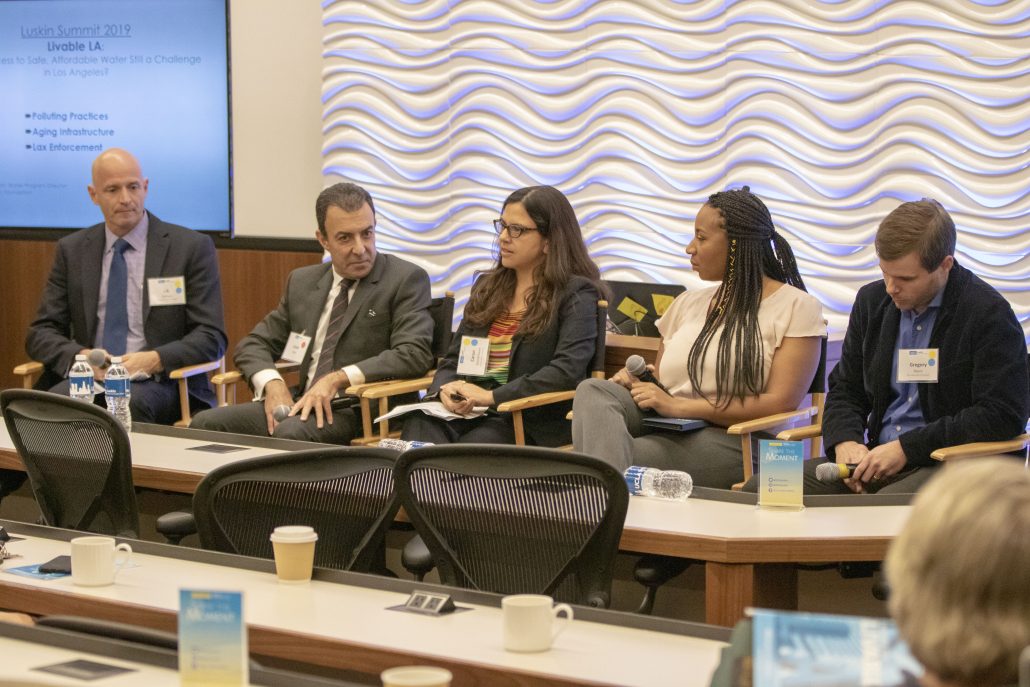
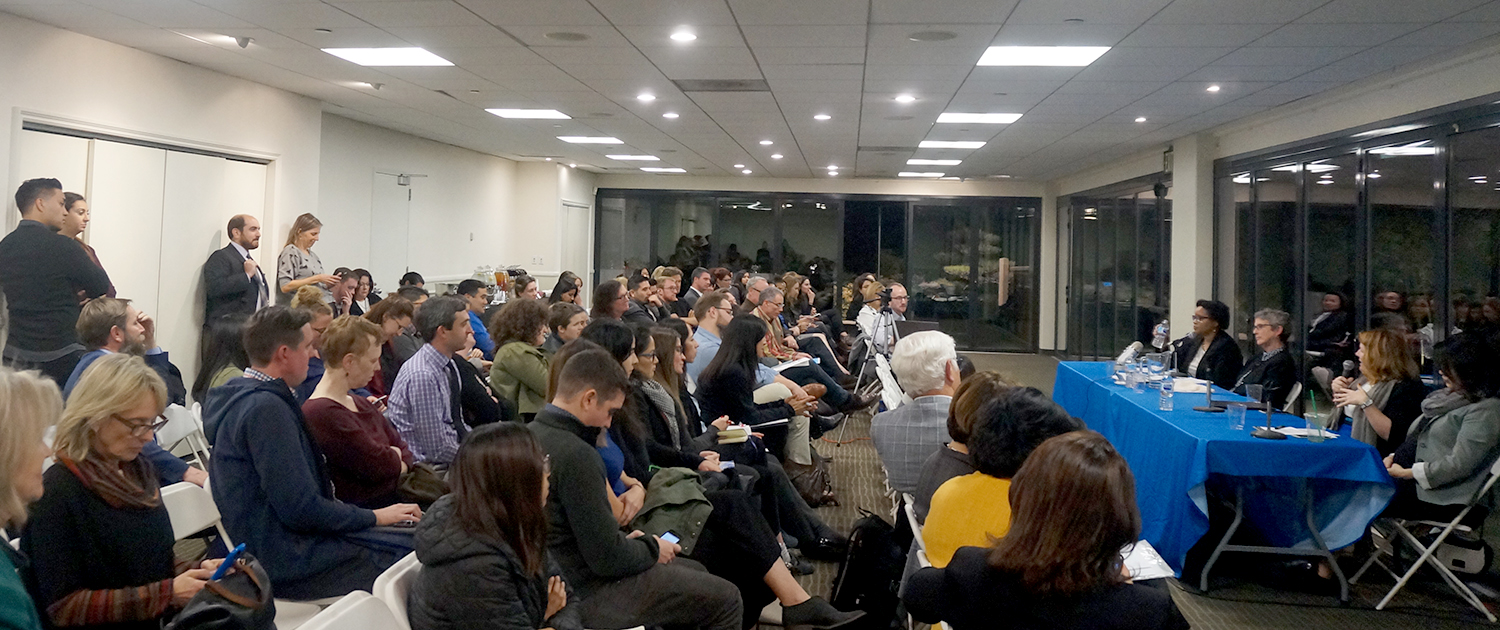
Elected officials, scholars, civic leaders, and difference-makers in the nonprofit and philanthropic spheres came together April 24 to learn the results of the annual Quality of Life Index and discuss policy issues during a half-day conference put together by the UCLA Luskin School of Public Affairs.

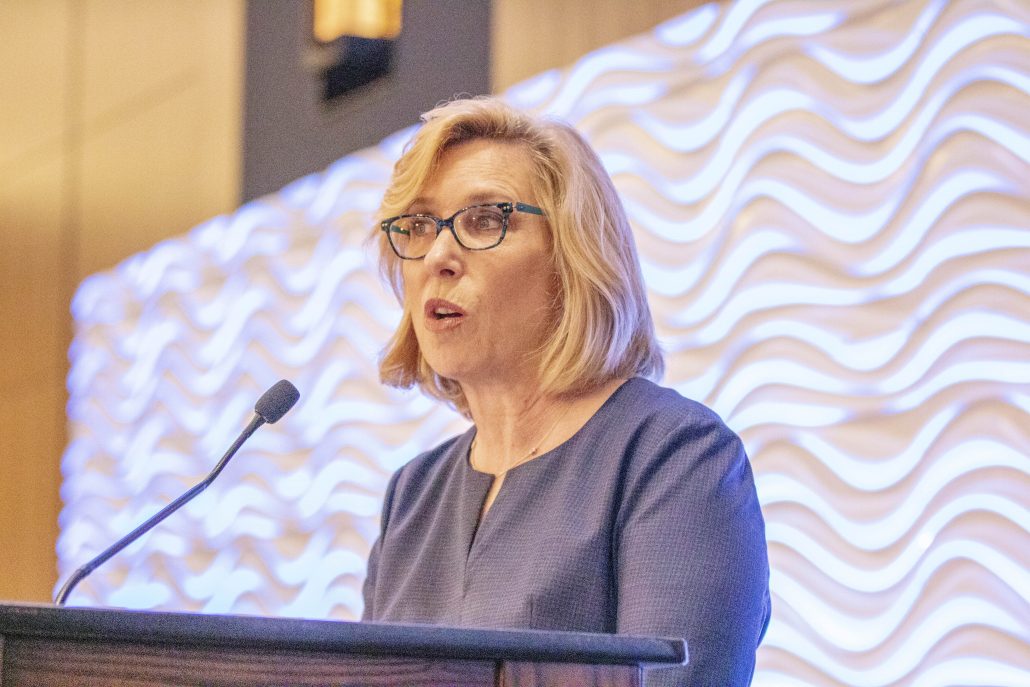
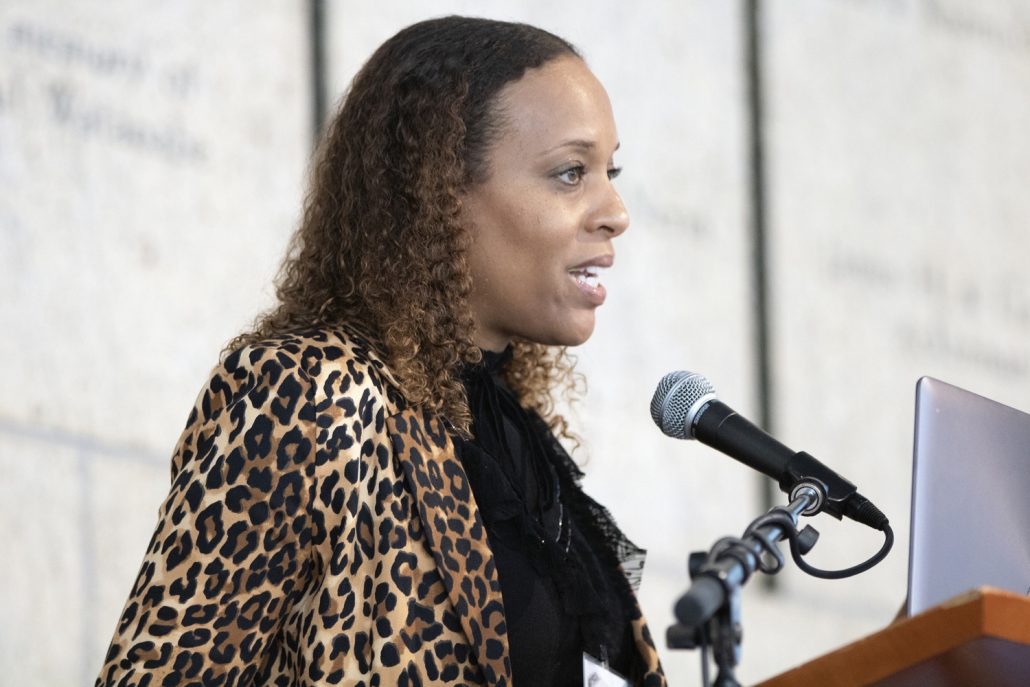
Congresswoman Karen Bass provided the morning’s keynote address for “Luskin Summit 2019: Livable L.A.,” an event that also kicked off the 25th anniversary celebration at the Luskin School.

Bass opened the conference by jokingly telling more than 300 people in attendance at the UCLA Luskin Conference Center that she “wanted to tell you about what we are doing in D.C. because, if you watch some TV news, you have no idea what we are doing in D.C.”

Bass has served in the U.S. House of Representatives since 2011. She said that “Democrats and Republicans actually do work together” in the nation’s capital.

“We don’t hate each other,” Bass said, smiling broadly. “Our accomplishments unfortunately don’t sustain media attention. So you might hear that we passed legislation on something like gun control … and then somebody tweets, and that’s all you hear about for the next several hours.”

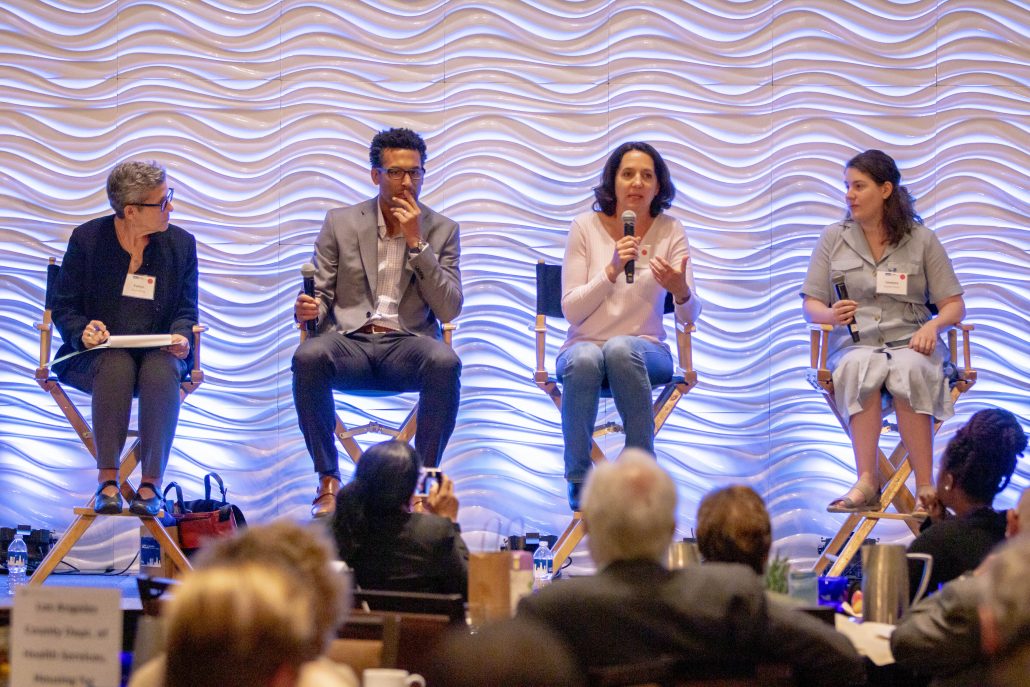
The congresswoman’s remarks set a cooperative tone for the inaugural Luskin Summit, which focused on finding solutions through research and policy change. The conference emphasized a Los Angeles perspective during breakout sessions moderated by UCLA faculty members that focused on issues such as public mobility, climate change, housing and criminal justice.
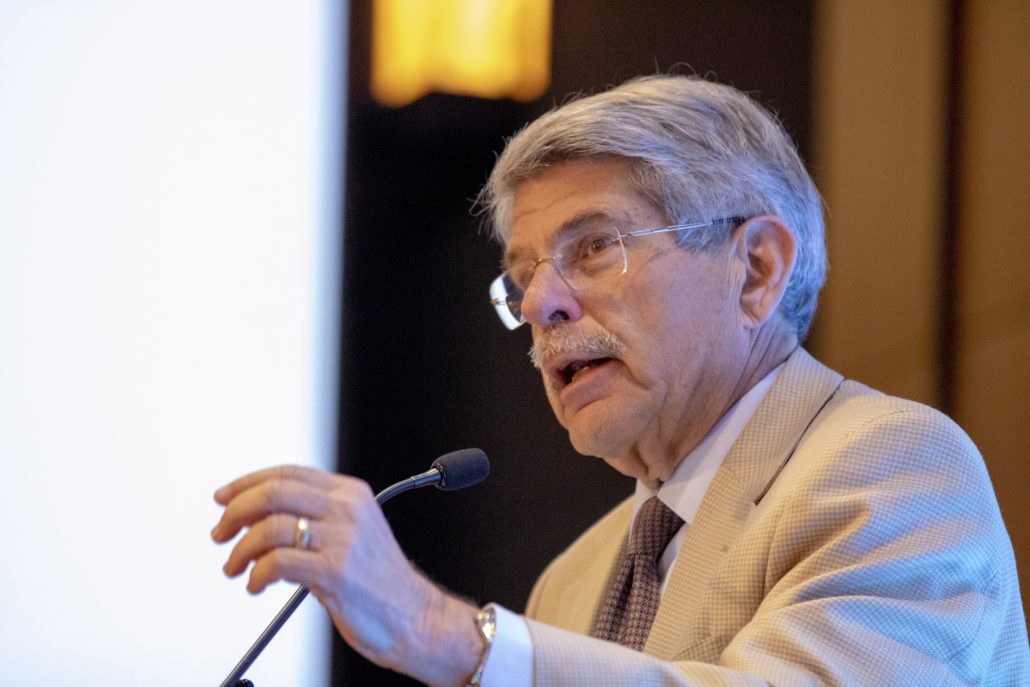
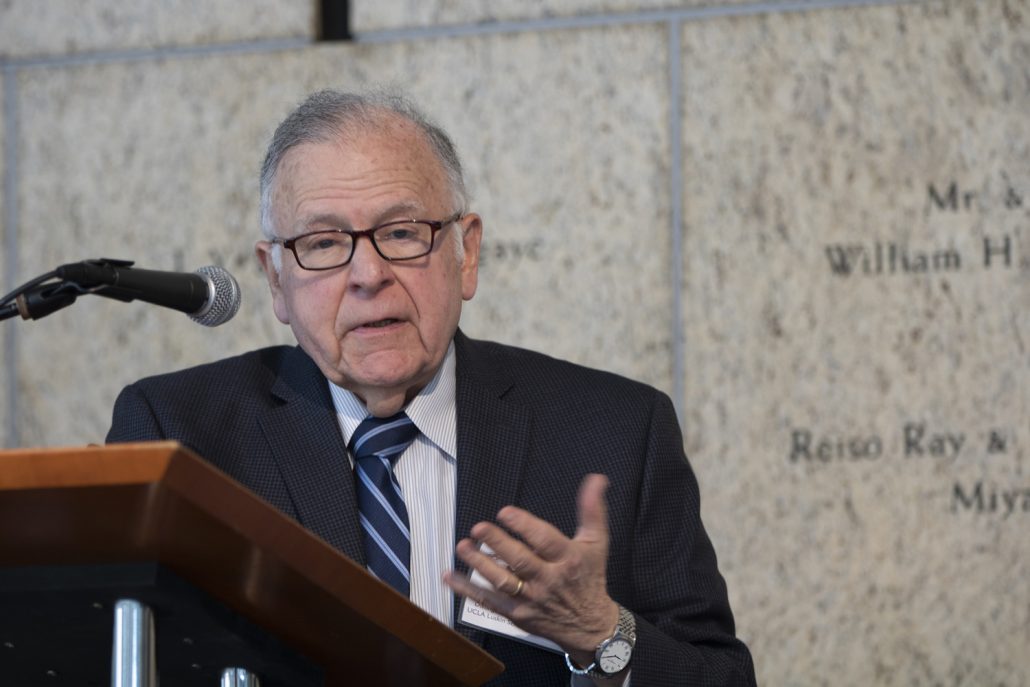
Former Los Angeles City Councilman and County Supervisor Zev Yaroslavsky talks about the Quality of Life Index that he oversees at UCLA Luskin. Photo by Stan Paul

Providing a framework for those discussions was the unveiling of the fourth Quality of Life Index, a project at UCLA Luskin that is supported by The California Endowment under the direction of longtime Los Angeles political stalwart Zev Yaroslavsky, director of the Los Angeles Initiative. The survey asks county residents to rate their quality of life in a range of categories and to answer questions about important issues facing them and the region.

“The cost of living, and particularly the cost of housing, is the single biggest drag on the rating that residents ultimately give to their quality of life in Los Angeles,” Yaroslavsky told Luskin Summit attendees. “The unmistakable takeaway from this project continues to be the crippling impact of the cost of living in Los Angeles County, punctuated by the extraordinary cost of housing.”

The housing affordability crisis was echoed throughout the event and in the days that followed as Yaroslavsky explained details of the survey in coverage by news outlets such as the Los Angeles Times, local radio news programs, and broadcast television reports by the local affiliates for NBC and ABC.

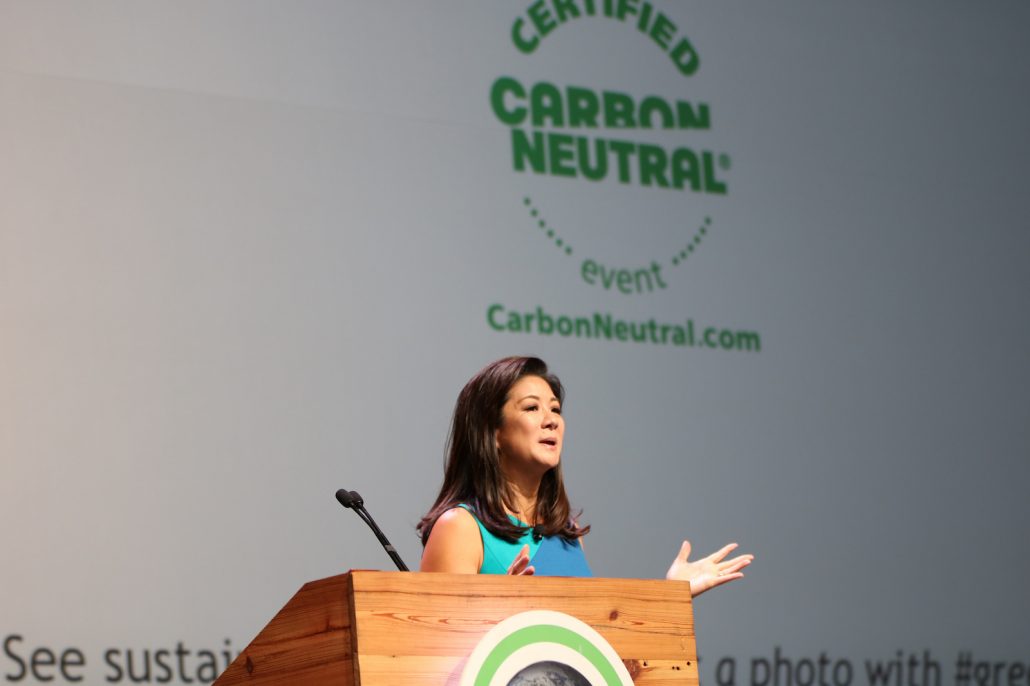
The coverage by KABC (also known as ABC7 Los Angeles) included segments on daily news broadcasts and a follow-up discussion with Yaroslavsky scheduled to air May 26 on the station’s weekly public affairs program, “Eyewitness Newsmakers.” That program is hosted by Adrienne Alpert, a general assignment reporter at ABC7 who served as the moderator for the Luskin Summit.

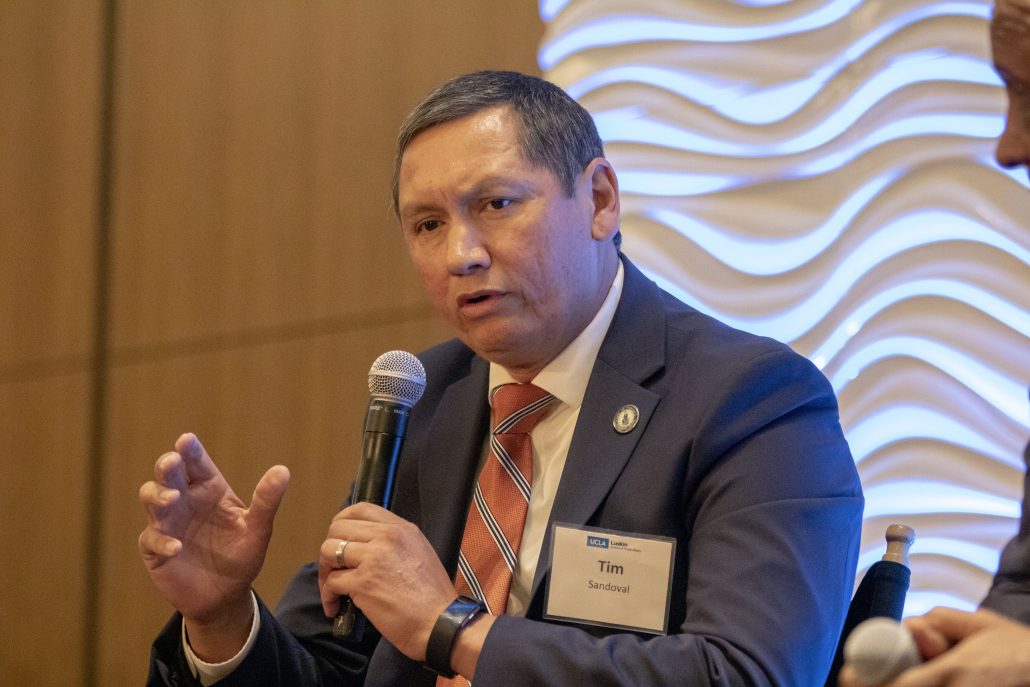
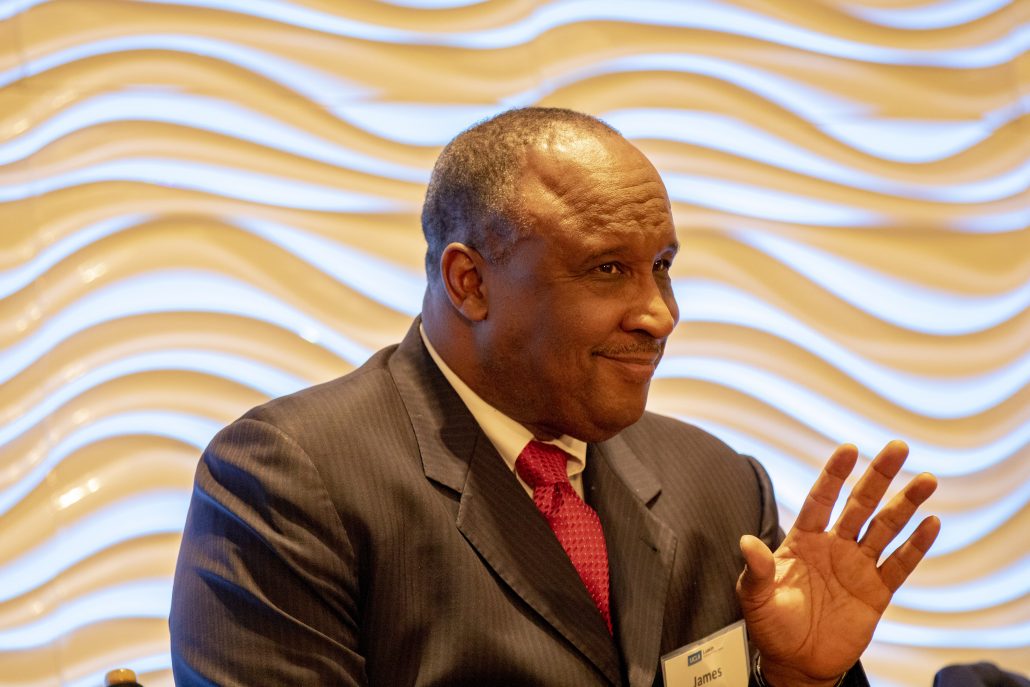
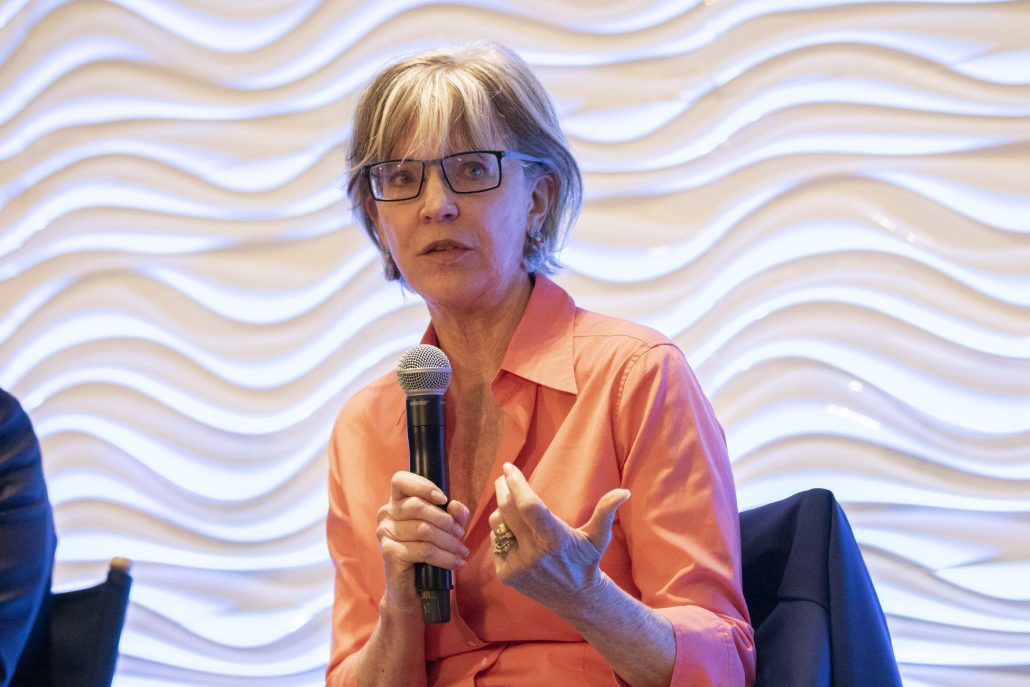
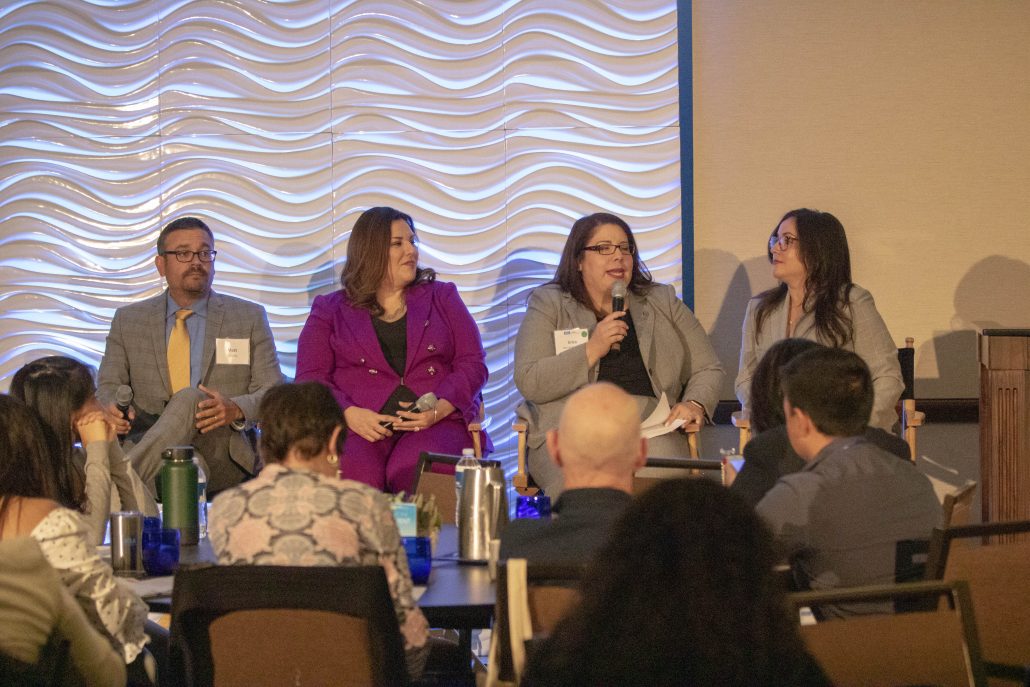
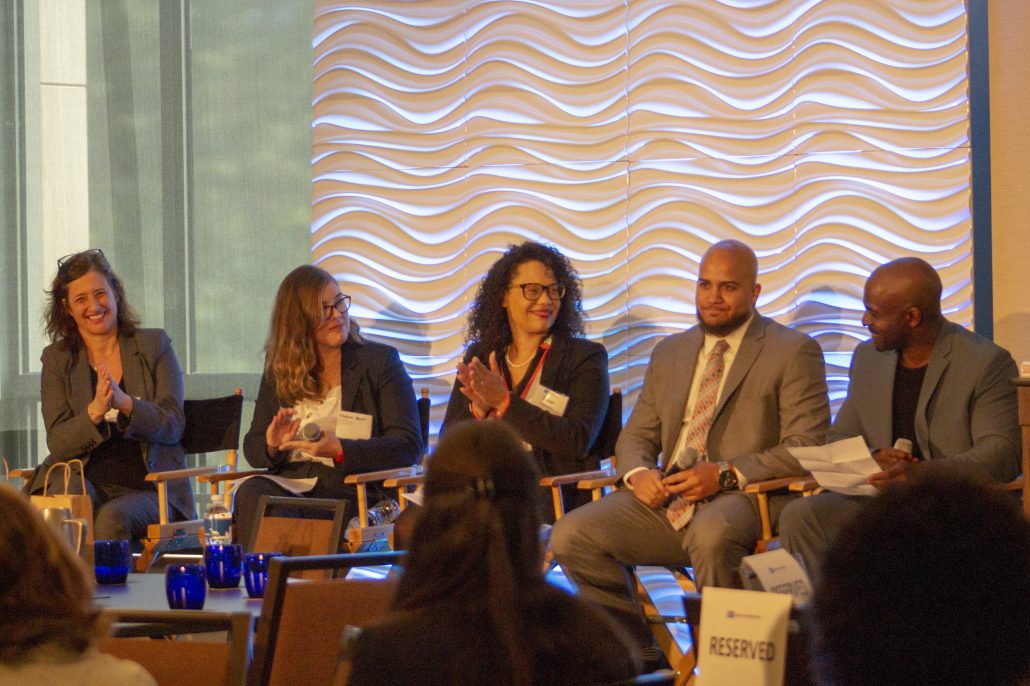
Alpert also hosted a panel discussion that closed the conference, during which mayors of four cities in Los Angeles County — Emily Gabel-Luddy of Burbank, Thomas Small of Culver City, James Butts of Inglewood and Tim Sandoval of Pomona — spoke frankly about the challenges their cities face in dealing with issues such as the rising cost of housing and its potential to lead to displacement of low-income residents.

California Secretary of State Alex Padilla, a former colleague of Yaroslavsky on the Los Angeles City Council, was also in attendance at the conference. Padilla engaged in a lively exchange about election security and voter registration efforts with UCLA Luskin Dean Gary Segura during a lunch meeting of panelists, faculty members and sponsors that took place immediately after the summit.
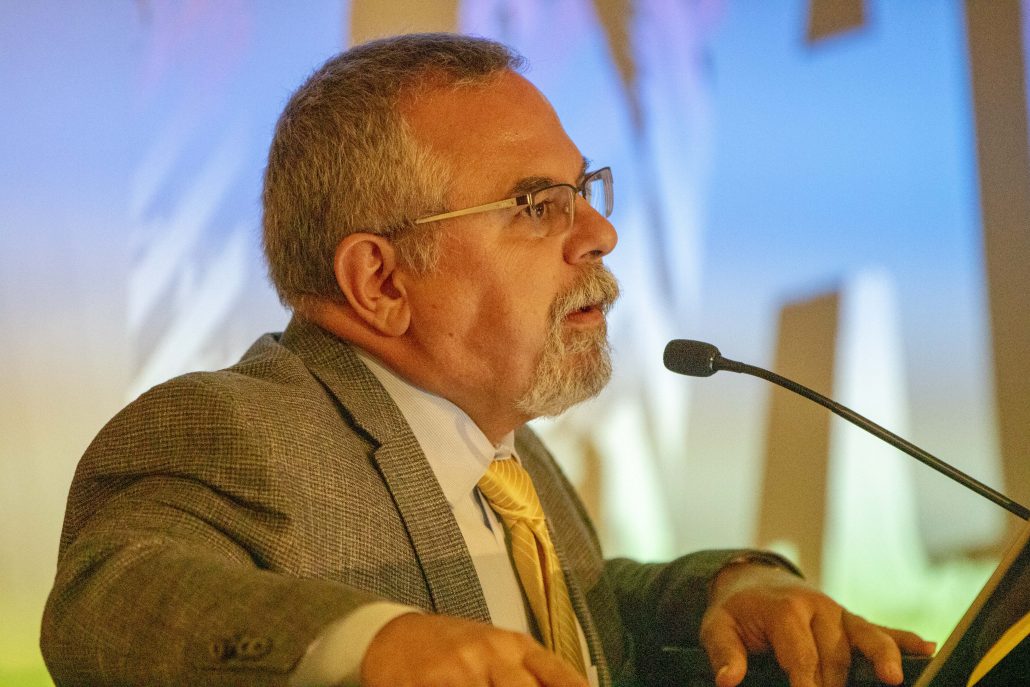
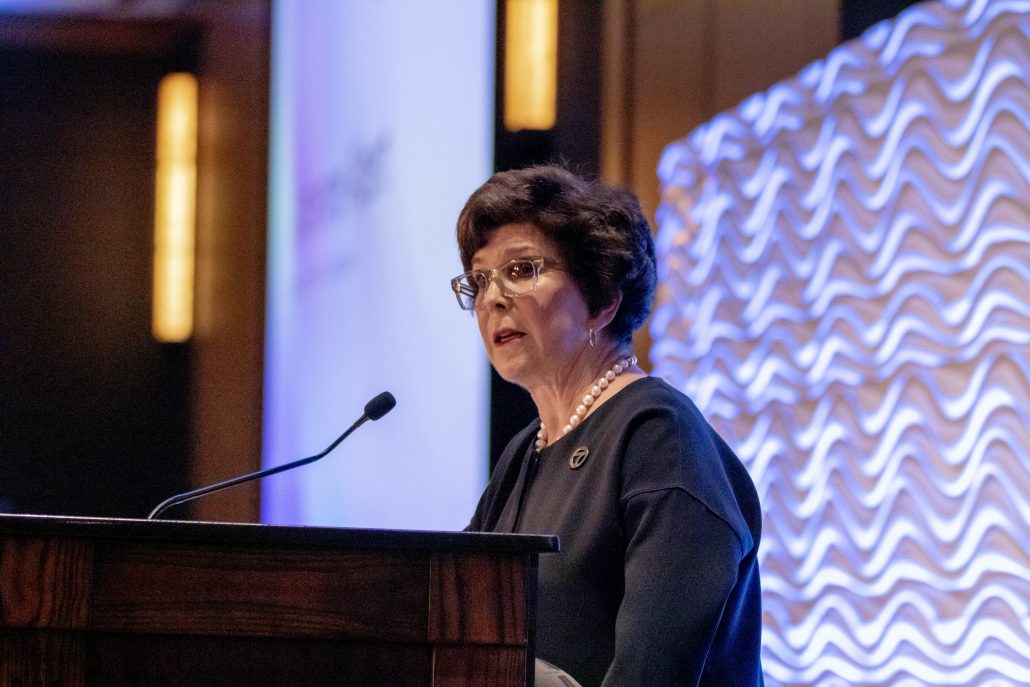
Dean Gary Segura

Segura also provided remarks during the morning session, introducing Bass and giving attendees a preview of the day to follow.

“Today you will hear from a series of dedicated public officials who understand that as great as our nation is, it can be better,” Segura said. “And they are taking action to make our country and our city more effective, more innovative, more fair and more inclusive.”

During her remarks, Bass offered her perspective on the recently released investigation by special counsel Robert Mueller into Russian interference in the 2016 presidential election.

“One thing that is a responsibility by the Constitution for Congress — we are supposed to provide oversight and investigation of the administration,” Bass said. “Most of the time it’s not that controversial, and you don’t really hear about it. But it’s made to be super-controversial now because we are in a hyper-partisan situation.”

The bitter partisanship prevalent in Washington today does have a positive aspect, she said, in that Americans seem to be paying closer attention to government and political issues.

“I am hoping that this trauma that we have collectively gone through will lead to a change in our American culture,” Bass said, “because as a culture we tend not to be involved politically.”

Bass said that more people seem to have a deeper understanding of political actions related to “immigration, the Muslim ban, the environment — all the kind of negative things that this administration has done,” said Bass, a Democrat who has been critical of many Trump administration policies. “I think he has sparked a new level of awareness and involvement, where we are working across our silos. I think, ultimately, we can take advantage of this period and bring about transformative change.”

The idea of initiating transformative change was a popular notion among many attendees at the Luskin Summit, as was the focus on making Los Angeles a more livable place.

“I can’t think of a better topic than how to make our city more livable and touch on all of these different aspects of life and the built environment and our environment in Los Angeles,” said Nurit Katz MPP/MBA ’08, the chief sustainability officer at UCLA.

Wendy Greuel BA ’83 is a former Los Angeles city controller and past president of the Los Angeles City Council. She noted that the research presented during the Luskin Summit was timely and focused “on issues that matter to Los Angeles, but also to this country and this world.”

Greuel served as the chair of the UCLA Luskin Advisory Board committee that helped plan the Luskin Summit. “I think that UCLA Luskin is at the forefront of really focusing on issues that matter and being able to give us real-life solutions and address the challenges,” she said.

Another UCLA Luskin Advisory Board member is Stephen Cheung BA ’00 MSW ’07, who is president of the World Trade Center Los Angeles and executive vice president at the L.A. County Economic Development Corporation.

“I think anything that has to do with sustainability and the growth of Los Angeles as a whole is very important to the economic vitality of this region,” Cheung said as the event got underway. “So this summit and all the information that’s going to be provided will really set a roadmap in terms of what we need to do, addressing public policies in terms of creating new opportunities for our companies here.”
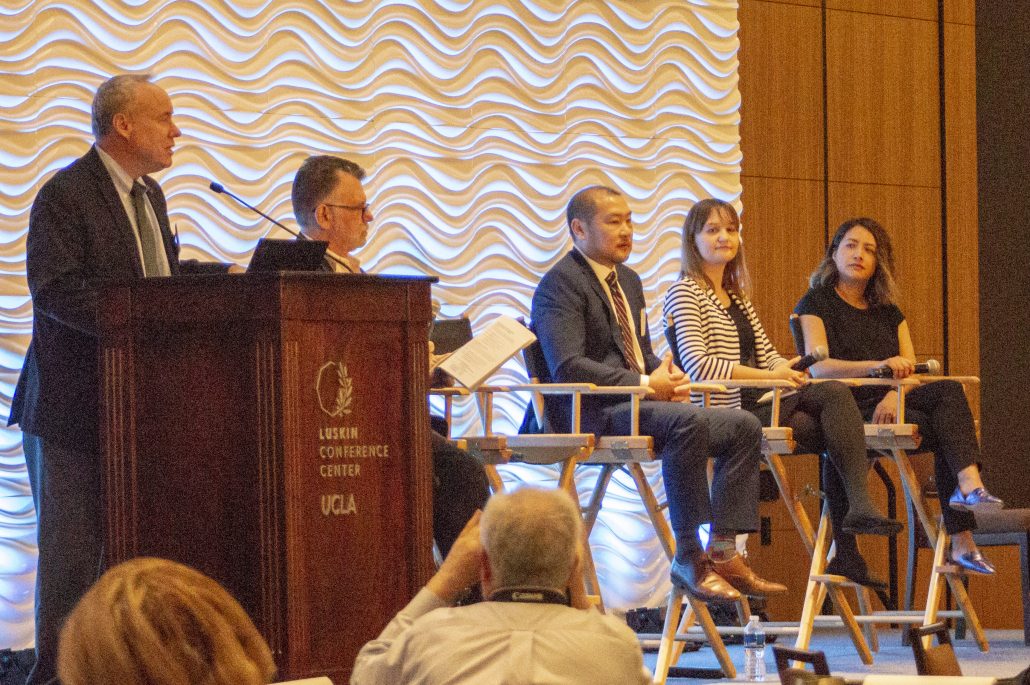
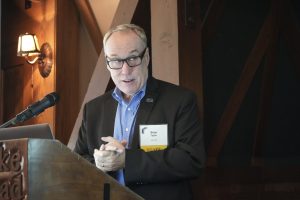
Professor Brian Taylor, at podium, helped lead a breakout session on transit ridership and public mobility. Photo by Mary Braswell

Jackie Guevarra, executive director of the Quality and Productivity Commission of the L.A. County Board of Supervisors, said she attended the Luskin Summit because of her interest in the issues under discussion, including housing affordability.

“Homelessness is a big issue that L.A. County is tackling right now,” Guevarra said. “That is an issue that touches all of us. … The more that we have that conversation, the more people we can get to the same way of thinking about how to address the need — so that maybe we can all say, ‘Yes, we need affordable housing, and it’s OK for it to be here in my community.’”

Misch Anderson is a community activist with the Pasadena Complete Streets Coalition, a volunteer organization created in 2013 after a series of fatal crashes involving cars, pedestrians and cyclists.

“I was feeling like my activism put me in touch with such a small, kind of silo-ized community mindset, and I really want to break out of that and connect with people on a larger level,” said Anderson about her reason for attending the summit. “I just wanted to get some inspiration.”

Her takeaway from the summit?

“The idea that we need cultural change, essentially. I think the realities of globalism should be forcing us as individuals to think more widely, more as a larger group, and not be so xenophobic,” Anderson said. “I keep hearing about cultural change [at the summit] and thinking about what can I do — what can each of us do.”

Among the UCLA students in attendance was Tam Guy, a second-year Urban Planning Ph.D. candidate who is studying equity in the city, which encompasses housing, transportation and environmental design.

“One thing that interested me about this summit in particular is that they’re bringing in people from outside academia to talk about the issues, people who are actually on the ground dealing with policy day-to-day,” Guy noted.

The Luskin Summit drew a large crowd to the UCLA campus, and several hundred people watched a live stream of selected presentations. It drew interest near and far. A prime example was a group seated together near the back of the vast ballroom during the opening session — high school students from New Zealand!

The youths had been traveling up and down the West Coast with Joanna Speed, international coordinator with Crimson Education, a college admissions consulting service that exposes teens to potential careers and educational opportunities abroad. Coincidentally, the group scheduled its campus tour of UCLA for April 24. When they saw that the summit was happening that day, they asked to attend.

“It’s been an incredible experience for them,” Speed said.

Mary Braswell and Stan Paul also contributed to this story. 

—

View additional photos from the UCLA Luskin Summit
UCLA Luskin Summit 2019: Livable L.A.

Watch videos recorded during the event:

  • Opening remarks by U.S. Rep. Karen Bass, plus an overview of the Quality of Life Index by Zev Yaroslavsky and other presentations
  • Breakout session titled “Dealing With Disruption: From Public Transit to Public Mobility”
  • Breakout session titled “A Housing-Oriented Look at Understanding Rising L.A. Inequality”
  • Closing discussion moderated by Adrienne Alpert of ABC7 and featuring Mayor Emily Gabel-Luddy of Burbank, Mayor Thomas Small or Culver City, Mayor James Butts of Inglewood and Mayor Tim Sandoval of Pomona
UCLA Luskin Professor Launches Organization to Fill Research Gap at EPA JR DeShazo co-chairs committee of environmental economists who will advise agency on social costs and benefits of its policies

April 22, 2019/0 Comments/in Business and the Environment, Climate Change, Electric Vehicles and Alternative Fuels, Environment, For Faculty, For Policymakers, For Students, For Undergraduates, Nanotechnology Environmental Health and Safety, Politics, Public Policy, Public Policy News, Research Projects, Resources, School of Public Affairs, Sustainable Energy J.R. DeShazo /by Mary Braswell

Policies on air pollution, climate change and water have far-reaching effects on millions of Americans and businesses. Is the Environmental Protection Agency ─ the federal agency whose mission is to protect public health and the environment ─ using the best available economic science when designing and proposing these policies? The newly created External Environmental Economics Advisory Committee (E-EEAC) will convene nationally recognized environmental economists to ensure that the EPA has access to the most advanced research.

“Our mission is to provide independent, state-of-the-science advice with regard to the benefits, costs and design of the EPA’s environmental programs,” said JR DeShazo, professor in the UCLA Luskin School of Public Affairs, who co-chairs the new research organization.

The E-EEAC formed following the dissolution in 2018 of the original Environmental Economics Advisory Committee, which had operated for more than 25 years within the EPA’s science advisory board structure. Like its predecessor, the E-EEAC consists of economists who apply their expertise to analyze the impact of environmental policies.

“The members believe that, despite the retirement of the internal committee, advances in economic research remain crucial to achieving welfare-enhancing environmental policies,” said Mary Evans, professor at Claremont McKenna College and E-EEAC co-chair. “The E-EEAC is especially needed now given the large number of regulatory modifications that EPA has, and will shortly, propose related to the Clean Air Act, Clean Water Act and the Energy Independence and Security Act.”

These policy changes will impact millions of Americans and firms, along with our ecosystems. The E-EEAC’s intent is to operate until the EPA reconstitutes an internal environmental economics advisory committee composed of independent economists. Many of the members of the original committee are now part of E-EEAC, including the co-chairs.

The EPA must comply with statutes and executive orders that explicitly require the agency to assess the costs, benefits and impacts of regulations. Economic expertise and analysis guide this compliance and enhance the quality of public debate about new regulations.

The E-EEAC is structured to provide independent advice from experts in the field of environmental economics. Functioning as a nonpartisan research organization, the E-EEAC intends to make all of its deliberations and findings easily accessible to the EPA and the public.

The Alfred P. Sloan Foundation and UCLA’s Luskin Center for Innovation have contributed funding to support this endeavor. The Sloan Foundation is a nonprofit philanthropic organization that makes grants primarily to support original research and education related to science, technology, engineering, mathematics and economics. The UCLA Luskin Center for Innovation is a policy-oriented research center uniting UCLA scholars with civic leaders to solve environmental challenges confronting our community, nation and world.

Transit Forum Focuses on Impact of Mobility Innovations UCLA scholars join government, nonprofit and private sector representatives to discuss declining ridership in an era of emerging mobility services

March 12, 2019/0 Comments/in Alumni, Business and the Environment, Complete Streets, Electric Vehicles and Alternative Fuels, Environment, For Faculty, For Policymakers, For Students, Public Policy, School of Public Affairs, Sustainable Energy, Transportation, Urban Planning Martin Wachs, Michael Manville /by Claudia Bustamante

By Claudia Bustamante

Across the country, public transit ridership has been declining.

But that isn’t the story in Seattle. Terry White, deputy general manager at King County Metro Transit, said that can be attributed to the agency’s community efforts.

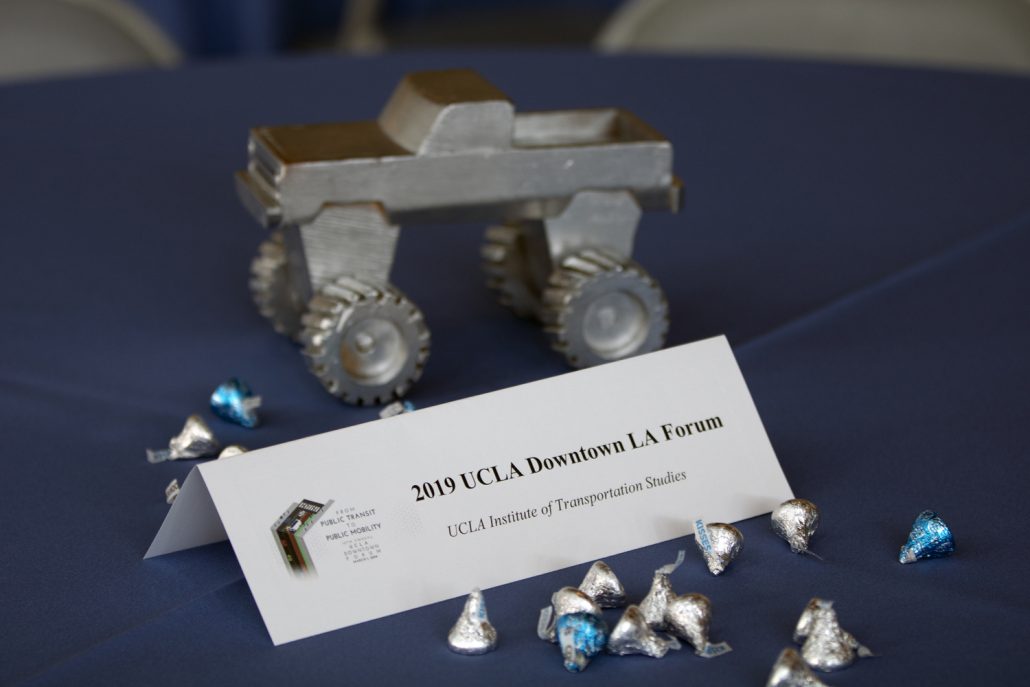
Speaking at the UCLA Institute of Transportation Studies’ 12th annual Downtown Forum on Transportation, Land Use and the Environment held March 1, 2019, at the Japanese American National Museum, White said an organization that doesn’t reflect its community will lose trust.

“We’ve been making a concentrated effort that the folks that make up our outreach and leadership teams reflect the communities we go out and serve,” White said. “I don’t think it’s an accident that we have better relationships since 2014.”

King County Transit, which most recently won the American Public Transportation Association award for outstanding transit system, makes more than 400,000 trips per day and has seen all-time-high ridership as more people move into the Seattle area.

Joining White at the forum were UCLA scholars, and government, nonprofit and private sector representatives who share other real-world examples of how to tackle declining transit ridership, especially in an era of emerging mobility services.

ITS’ 12th annual forum was held at the Japanese American National Museum. Photo by Stan Paul

The forum focused on successful public-private partnerships that could fill gaps in transportation services. Other topics included effective uses of data to manage mobility, practical innovations that can yield great gains for transit ridership, and how new mobility technology and services can enhance equity and quality of life.

Speaking specifically to how a big-city transportation department can put equity first was Ryan Russo, director of Oakland’s Department of Transportation, which was recently formed as a new model of urban mobility centered around progressive policies that aim to recognize and address past injustices.

Russo said the Bay Area city’s legacy of redlining is still seen and felt throughout the area, which means that departmental projects must be considered through an equity lens. Dedicated monthly meetings are held to strategize ways of infusing equity into projects. For example, Paint the Town combined community art and traffic safety through street murals.

For every project approved in less disadvantaged communities, at least two were approved for low-income neighborhoods.

“Transportation and street management isn’t about getting people from A to B,” Russo said. “It’s the way we will serve our community.”

Partnerships and Pilots

In light of the proliferation of private mobility companies, the forum discussed different ways the public sector could partner with these companies to meet transportation needs.

One example came from HopSkipDrive, a ridehailing service for school-aged children, which partnered with Los Angeles County to provide free rides to foster youth. Under the Every Student Succeeds Act, foster youth were provided core protections for school stability, meaning that districts need to provide transportation to keep these students in their schools of origin. Many foster youth bounce from school to school, and they graduate at far lower rates than do their peers.

“We are not meant to replace school bus companies. We are designing our systems to ride alongside school buses and existing transportation systems. That way we can provide mobility opportunities and access for all kids,” said Qiana Patterson, senior director of public partnerships.

In fact, finding innovative ways to partner with the private sector to tackle the biggest transportation issues of the day is something that Metro has been doing through its Office of Extraordinary Innovation.

Its unsolicited proposal process has yielded more than a dozen contract awards and proofs of concept for key projects, including the Sepulveda Transit Corridor, a gondola to Dodger Stadium, mobile tolling and bus electrification.

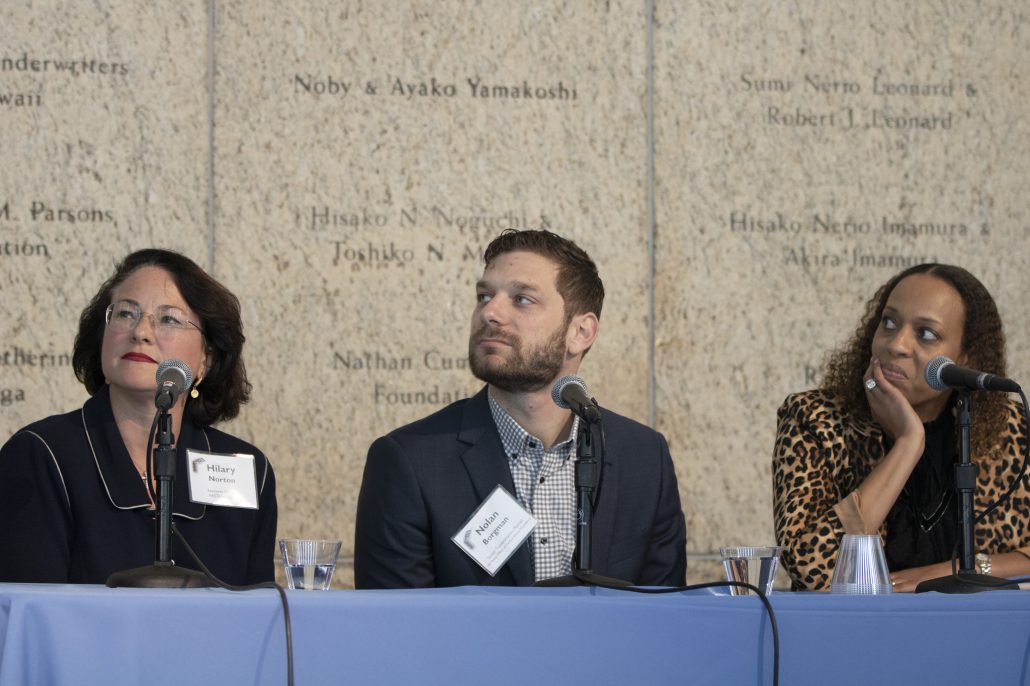
“The public sector is reluctant to admit they have a problem,” said Nolan Borgman, Metro senior transportation planner. “You need to admit that there is a problem that you don’t know how to solve.”

In Santa Monica, the goal of reducing greenhouse gas emissions, along with the rise of electric scooters, drove city officials to authorize a pilot program to offer more mobility choices and gain a better grasp on the use of shared public space.

Declining ridership has also forced many public agencies to adopt innovations to improve transit.

In Everett, Massachusetts, a pop-up bus lane is being utilized to improve mobility and connections to major nearby destinations like Boston. Instead of conducting traditional outreach, City Planner Jay Monty said a pilot project incorporated outreach and gleaned real-time public feedback. The part-time lanes only for buses went quickly from pilot project to a statewide model, and today more than a dozen similar Tactical Transit Lane projects have sprung up across the country as a means of improving mobility.

Disruption

Associate Professor of Urban Planning Michael Manville said that neither new trains or lanes free up space on roads over time. What has worked — where it has been implemented — is congestion pricing.

Speaking to the fairness and equity concerns that come up when congestion pricing is discussed, Manville said that not only was the entire transportation system financed regressively through gas taxes, sales taxes and registration fees, but pricing access to roads could produce revenue to offset the costs for low-income individuals.

“Congestion harms people who live in low-income communities with disproportionate low vehicle ownership,” Manville said. “They have to bear the higher health and pollution burdens of driving, which leads to higher rates of preterm births and other negative health outcomes — and thus inheriting poverty.”

Earlier this year, Metro decided to move forward with a two-year study of congestion pricing, evaluating different pricing methods, including per-mile charges and tolls in specific areas.

Even though all the new mobility options may make it seem otherwise, we are not living through a particularly disruptive period of transportation, said Martin Wachs, emeritus professor of urban planning at UCLA Luskin. People have long been using the same language to describe new mobility — from bicycles and jitneys in the 19th and 20th centuries to today’s ridehailing companies like Lyft and Uber, as well as electric scooters.

Instead of reacting to technology, Wachs said, agencies should create policy that builds upon the capacity of innovation.

View additional photos

Getting a Handle on the Future Transportation experts join with policymakers and entrepreneurs to tackle the impact of disruptive technology on urban mobility

January 4, 2019/0 Comments/in Alumni, Complete Streets, Development and Housing, Digital Technologies, Education, Electric Vehicles and Alternative Fuels, Environment, For Policymakers, The Lewis Center, Transportation, Urban Planning Brian D. Taylor /by webteam

By Will Livesley-O’Neill

Getting around Southern California has never been easy. But the infamously congested region has grown even more complicated with the arrival of new private services — including ridehail companies such as Lyft and Uber and electric scooter operators such as Bird and Lime — looking to disrupt how people travel.

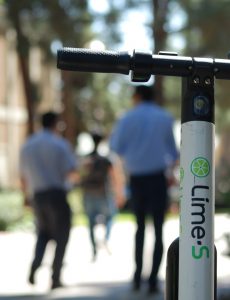
Motorized scooters are often seen at UCLA.

As in any field impacted by technology-fueled disruption, transportation policymakers want to find ways to adapt. And that requires taking stock of what the transportation system is meant to do and, more importantly, whom it is meant to serve.

This was the focus of the 28th annual UCLA Lake Arrowhead Symposium, hosted by the Institute of Transportation Studies (UCLA ITS) and Lewis Center for Regional Policy Studies, in October. At the university’s retreat center in the San Bernardino Mountains, dozens of the nation’s leading experts on transportation and land use policy pondered the symposium’s theme, “From Public Transit to Public Mobility.”

The changing nature of travel means different things for elected officials, planners, academics, advocates and tech leaders. But everyone fundamentally agrees that, as LA Metro chief planning officer and symposium panelist Therese McMillan put it, “there’s a public interest in how private activity happens in a public space.” The modes may change, but the mission of a safe, effective, accessible transportation system remains the same.

John Zimmer, co-founder and president of Lyft, set the tone for a discussion of balance between tradition and innovation. Lyft has been actively expanding beyond ridehailing into other forms of mobility, including e-scooters and automated vehicles. The company’s stated goal of providing more options for consumers and reducing the number of people driving

alone benefits the environment — as well as those profiting from the service.

But the way that some tech companies roll out new products — a “move fast and break things” model — often leads to public backlash.

Southern California has been ground zero for arguments about the traffic tie-ups and sidewalk clutter allegedly caused by ridehailing and scooters. Public officials are being forced to make policy on the fly — although some such as Francie Stefan, chief mobility officer in Santa Monica, describe that as an opportunity. Santa Monica recently partnered with Lyft, Uber, Bird and Lime to introduce new regulations on the number of e-vehicles in the city while funding infrastructure improvements.

“[We] made a conscious choice to embrace new technology and work through some of the kinks that are inherent in change,” Stefan says.

Technology also gives cities the chance to innovate and to fulfill some hard-to-implement planning goals. Willa Ng, an associate director at Google’s Sidewalk Labs, presented an example at her panel on “coding  the curb.”

“If we need to do more stuff at the curb, and we need to have those spaces constantly turning over, we can’t have it managed by a static aluminum sign,” Ng explains, outlining how creating a flexible digital management system could allow the same section of curb to be used for parking, ridehail drop-offs, delivery unloading, or as a bike and scooter lane depending on the time of day. New transportation technology can crowd and complicate the use of public space, but it can also help make sure the space is better used to benefit the most people.

For example, Anastasia Loukaitou-Sideris, a professor of urban planning at UCLA Luskin, recently spoke to the University of California for a story and accompanying video about e-scooters titled, “What the battle over scooters gets wrong.”

Urban planners recently adopted a model known as “complete streets” that involves rethinking how shared space is divided between a street and a sidewalk, Loukaitou-Sideris says. This model abandons the assumption that streets are for cars and sidewalks are for pedestrians.

“The complete street perceives the street as a space where different transportation modes can coexist: not only cars, but also buses, and lanes for trams, bicycles and scooters,” according to Loukaitou-Sideris. “Nobody wants to compromise the safety of anyone by mixing these modes. So that’s where planning and design needs to come in.”

People-centered design — of services, systems and infrastructure — is at center stage in these policy discussions. Technology needs to be a tool to help improve transportation for people, not an end goal in itself.

“A lot of people are really annoyed with private capital coming into the mobility space without understanding people’s travel needs,” says Clarrissa Cabansagan of the Bay Area climate change nonprofit TransForm. But tech disruption will be worthwhile if it provides people with more options to get around besides driving their own car, she says.

Professor Brian Taylor of UCLA Luskin Urban Planning

Urban Planning Professor Brian D. Taylor, director of UCLA ITS, co-authored a groundbreaking 2018 study that found that Southern Californians are buying more cars than ever and turning away from public transit. That’s the exact opposite outcome of what policymakers had sought and shows the need to set new priorities for shared public spaces.

“We have to manage the automobile more intelligently. We can’t just allow people to drive anywhere they want, anytime they want,” Taylor says. “We need to create environments that are more conducive to travel by foot, by bike, by scooter or by public transit.”

New and old mobility services could work hand-in-hand to reduce private car travel. Ideally, technology should improve, not replace or eliminate, traditional transit, according to transportation experts.

“We should really focus on making the core strength of transit something we do incredibly well,” says Houston-based planner and author Christof Spieler, who spoke at the conference. With transit ridership falling across most of the country, new policies need to make riding the bus as easy as hailing a Lyft, he says, noting that public transit can move many more people much more effectively than any ridehail vehicle or scooter.

Bay Area transportation advocate Ratna Amin argues that focusing on riders as people, not cogs in a machine, is key.

“When we think about public transit as a utility, we focus on the bare minimum: We got the service out, it’s clean enough, the doors opened, the bus stop is there and it’s labeled,” Amin says. “We need to actually talk to people and find out what their experience is, and try different possibilities out to see if they improve the experience.”

Seattle is one of just a few American cities to see an increase in transit ridership in recent years. Terry White, the deputy general manager of Seattle’s transit operator, believes one factor has been key to success: an emphasis on making sure service is equitable.

“Transportation is a human right for everyone,” White says. “We’re trying to make sure everyone gets an opportunity to

be mobile.”

That’s ultimately what a better transportation system will mean — mobility for all, regardless of whether they take a bus or ride a scooter. Efficient use of public space lessens the need for gridlocked, polluting private vehicles.

The disruption of old transit methods is still in its early stages, with plenty of blind spots to be navigated. But as Juan Matute, deputy director of UCLA ITS, recently told LA Weekly, it’s important to remember that the disruption from new technology is likely to lessen over time.

“The safety hazards are comparable to those for automobile use,” Matute said of the new innovations, particularly e-scooters. “We’ve had over 100 years to figure out a lot of things.”

Gore, DeShazo Share Insights on California’s Climate Leadership Luskin Center for Innovation director joins environment champion and Nobel laureate at global Climate Reality leadership training

August 30, 2018/0 Comments/in Climate Change, Electric Vehicles and Alternative Fuels, Environment, Luskin Center, Public Policy, School of Public Affairs, Sustainable Energy J.R. DeShazo /by Stan Paul

By Stan Paul

‘We’re going to win this. … Have no doubt about that, we will win this.’
— Al Gore

More than 2,200 people eager to learn how to make a difference in the future of the planet came together at the Los Angeles Convention Center for the largest-ever Climate Reality Leadership Corps training led by former U.S. Vice President Al Gore.

Participants from California, the United States and more than 50 countries took part in the three-day training session that began Aug. 28, 2018, and included working with the best-selling author of An Inconvenient Truth — and subject of the Oscar-winning documentary. They heard from world-renowned scientists, communicators and other experts about how to work together to find solutions to the global climate crisis by influencing public opinion and policy and encouraging action in their own communities.

“In the United States we have a tremendous amount of climate denial. We have a president who is a bitter opponent right now of addressing climate change,” said Ken Berlin, president and CEO of the Washington, D.C.-based Climate Reality Project, in his opening remarks.

The purpose of the ongoing series of trainings, held worldwide starting in 2016, is to develop a critical mass of activists to ensure there is enough support for addressing the climate crisis, Berlin said before introducing Gore, who appeared on stage to a standing ovation.

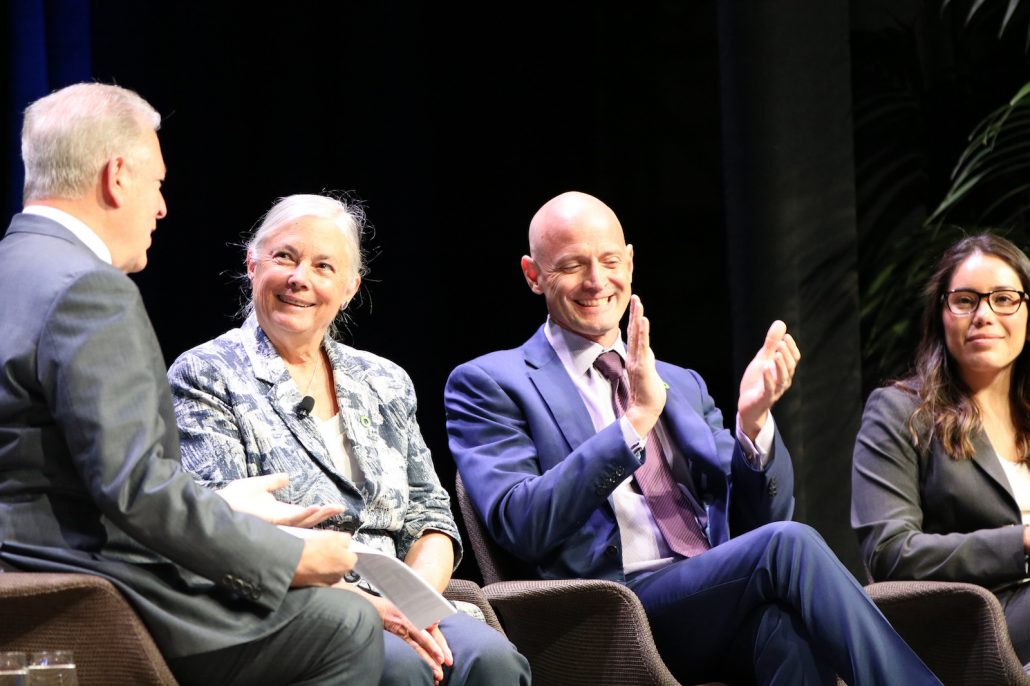
Joining Gore on the first panel of the day, “California’s Roadmap for Climate Change,” was JR DeShazo, director of the UCLA Luskin Center for Innovation, and other experts including Fran Pavley, former member of the California State Senate, and Veronica Garibay, co-founder and co-director of the Leadership Counsel for Justice and Accountability.

“Here we are again at a time when our national government is … disappointing so many of us. Once again California is stepping forward,” Gore said in his opening remarks.

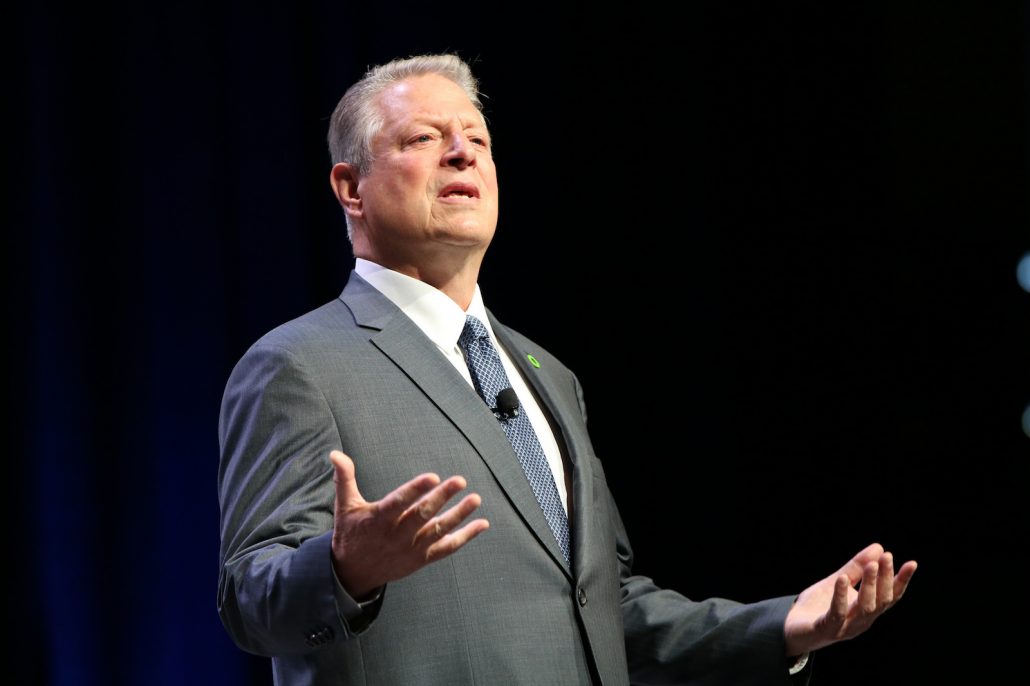
Al Gore opens the three-day Climate Reality Leadership Corps training in Los Angeles. Photo by Stan Paul

Citing California as a national leader and example to other states in addressing the environment and climate change, Gore started the conversation by asking DeShazo, “What is it about California that has led this state to be such a driven leader on climate policies?”

“I think California understands how important historically it was to deal with its air quality challenges,” said DeShazo, Public Policy chair at the UCLA Luskin School of Public Affairs. “And so, in the ’60s and ’70s the state developed this robust set of state agencies to tackle that problem in the energy sector and the transportation sector,” he said.

DeShazo credited state leadership, including Sen. Pavley, with passing legislation that allowed those agencies to shift attention, “with all their expertise and authority, to attack climate change in a very comprehensive way.”

Gore also asked DeShazo to cite examples of the state “breaking up the problem … and addressing those elements in an intelligent way.”

“We decarbonized electricity while making appliances more efficient. We introduced the low-carbon fuel standard in the transportation sector, making transportation fuels lower-carbon while making vehicles more efficient and pushing for electric vehicles. So there was a broad-based scoping plan that really covers all of the relevant carbon-generating sectors of the state,” DeShazo said. He also credited state leadership that was “based upon a California that wanted to take responsibility for its emissions.”

DeShazo, who also holds appointments with UCLA’s Institute of the Environment and Sustainability, UCLA Luskin Urban Planning and UCLA’s civil and environmental engineering departments, recalled that during the nationwide recession California voters rejected a ballot initiative to halt the state’s climate policies.

“We said ‘no,’ ” he said, explaining, “We want to continue with the commitment that the legislature had made on our behalf. … I think that is really evidence of California’s commitment.”

More recently, DeShazo said, a “second generation” of climate policies in California has focused on environmental justice. “There’s a clean vehicles program, and there’s one for low-income consumers, there’s a weatherization program and there’s one for disadvantaged communities,” he said. A significant portion of the $2 billion a year generated by cap and trade is reinvested to benefit disadvantaged communities, he added. This year, the UCLA Luskin Center for Innovation is part of two partnership grants that will benefit disadvantaged communities in particular. The grants ─ awarded by California’s Strategic Growth Council ─ total more than $4 million.

As a result of all of this, the state is making progress. “We’re on track to reach the goal of 50 percent renewable energy in 2020, 10 years ahead of schedule in reaching this goal,” DeShazo said. “And that’s terrific because we need to electrify the transportation sector, and we’re committed to that and that’s where a lot of the heavy lifting still awaits us.”

View more photos from the Climate Reality Leadership Corps training on Flickr.

Who, Exactly, Is Our Transportation System Designed to Serve? Panelists decry transit shortcomings for women and families during second installment of an ongoing discussion series sponsored by the UCLA Institute of Transportation Studies

March 12, 2018/0 Comments/in Alumni, Business and the Environment, Complete Streets, Electric Vehicles and Alternative Fuels, For Faculty, For Policymakers, For Students, Public Policy, School of Public Affairs, Transportation, Urban Planning Evelyn Blumenberg /by webteam

By Will Livesley-O’Neill, UCLA Institute of Transportation Studies

The gender imbalance of transportation planning — a field traditionally dominated by men who designed a system that too often falls short for women and families — was the subject of the second installment of the ongoing Institute of Transportation Studies (ITS) discussion series Transportation is a Women’s Issue on March 7, 2018.

Policymakers, practitioners, scholars and students gathered at the Japanese American Cultural and Community Center in downtown Los Angeles for a panel featuring Seleta Reynolds, Los Angeles Department of Transportation (LADOT) general manager and ITS advisory board member; LA Metro Deputy CEO Stephanie Wiggins; and UCLA Luskin Urban Planning Professor and ITS faculty fellow Evelyn Blumenberg. Moderating was Investing in Place Deputy Director Naomi Iwasaki.

The transportation system is fundamentally designed to accommodate a 9-to-5 work schedule traditionally associated with higher-income men, panelists said. Even as women’s participation in the labor market has surged, that system continues to ignore the needs of travelers at off-peak hours and those with complex trip-making patterns, who are much likelier to be women, especially lower-income women, they said.

Women and men travel similarly in terms of mode, but Blumenberg said that the purposes are often different: Women make more trips that serve their household — a “trip-chaining” form of travel that can include multiple stops on the same tour — in addition to commuting.

“In most households, women work and have a disproportionate responsibility for the unpaid labor in the home,” Blumenberg said. “It’s really hard to carry out those multiple tasks with public transit, or using a bike, or walking.”

Watch the full panel discussion:

In Los Angeles and beyond, work and household trips usually require access to a car. Transit agencies attempt to reduce congestion by focusing on service during traditional peak commute hours, Reynolds argued, ignoring off-peak travel that could benefit women.

“If what you are solving for is the peak, the peak, the peak, then you’re never going to have a system that has reliable, frequent, comfortable service at the times of day when women need it the most,” she said.

Wiggins said that, too often, transit agencies such as LA Metro have adopted supposedly gender-neutral plans that fail to account for the different travel patterns of women.

“They say that what gets measured gets done, and we haven’t been measuring it at all,” she said. “We have to make sure that we don’t use the planning tools of the past to inform planning for the future.”

To that end, LA Metro’s CEO has approved a recommendation from the agency’s women and girls council to gather data about female passengers and hire a consultant to help develop a gender action plan. As LA Metro embarks on a next-generation study to revisit its bus network amid dramatic ridership decline, Wiggins said that women must be at the table for all levels of decision-making — not just in leadership roles but also in conducting the studies or scheduling service changes. Further research into female travel patterns is required to understand what women and families need and to persuade the federal and state agencies that fund transportation projects to emphasize those needs.

Improving transportation safety is critical for women’s travel. A survey of former riders cited safety as their primary reason for leaving the system, and Wiggins said that LA Metro now examines safety concerns through the lenses of sexual harassment and design. New campaigns with Peace Over Violence and local law enforcement agencies aim to crack down on harassment while applying a gender lens to design. Results could include better lighting at bus stops and transit stations, creation of accommodations for strollers, and changes to where passengers sit on buses and trains to minimize unwanted contact.

Blumenberg noted that better off-peak service requires safer conditions getting to and waiting for transit — lower-income workers are more likely to need to travel at night but often feel unsafe using the bus or train at those times.

Reynolds pointed out that too many futurist conversations about the potential benefits of automated buses and rideshare vehicles fail to recognize that many women will not feel comfortable without a driver, who acts as a chaperone.

“That is a really overlooked value and quality that a transit operator brings,” she said, adding that such discussions perpetuate a male way of thinking about mobility. “Most women, we feel like we move through the world always on guard about sexual harassment or assault.”

Reynolds said that her department’s new strategic plan includes a concerted effort to understand what women are looking for from their transportation system.  Then, implementation of pilot programs could lead to larger changes.

LADOT plans to start with after-school transportation, a burden that now largely falls on women to arrange as a result of long-term school budget cuts. A pilot electric car-sharing program in the MacArthur Park neighborhood incorporated local women’s requests for features such as carseats and the ability to add elderly caregivers to family service accounts.

Moving forward, a more comprehensive and inclusive approach to transportation planning is needed, panelists said. That approach should factor in the economic benefits of car access, better off-peak transit service and bike infrastructure catered not just to male preferences, and much more.

Right now, Reynolds said, “we’ve trapped women into finding the one choice that feels safe and comfortable and works for them, because of the design of the system.”

Policymakers, practitioners, scholars and students gathered at the Japanese American Cultural and Community Center in downtown Los Angeles for the panel discussion.


Luskin Forum Online: Who We Are Essays highlight people who make UCLA Luskin a vibrant, thought-provoking and entertaining place to be

January 5, 2018/0 Comments/in Alumni, Business and the Environment, Climate Change, Development and Housing, Diversity, Electric Vehicles and Alternative Fuels, Environment, For Faculty, For Policymakers, For Students, HIV/AIDS, Luskin Center, Public Policy, Public Policy News, Research Projects, Resources, School of Public Affairs, Smart Water Systems, Social Welfare, Social Welfare News, Sustainable Energy, The Lewis Center, Transportation, Urban Planning /by Les Dunseith

[ From the Luskin Forum Online ]

Dean Gary Segura is fond of saying that the UCLA Luskin School of Public Affairs is about human well-being.

“We study ways to make individuals, families, communities and polities function better, for the improvement and quality of lives of all those affected,” Segura told the Class of 2017 at Commencement last June.

Those students, now Luskin alumni, spent 2016-17 working on a variety of projects related to urgent human needs, such as:
  • greenhouse gas reduction
  • interventions with at-risk youth
  • prison population reduction
  • homelessness
  • HIV prevention
  • meningitis epidemic control
  • regulation of new and intrusive technologies
  • safe school environments
  • quality mental health services
  • river restoration
  • access to home ownership
  • responsive governance in the developing world

“I’m reminded every day of how lucky I am and how special it is to be a part of the Luskin School of Public Affairs,” Segura told proud parents and family members at the graduation ceremony.

This issue of Luskin Forum is dedicated to just that: taking pride in how this school makes a difference, and why it’s important to remember the myriad accomplishments of our students, faculty, staff
and alumni.

Our UCLA Luskin mission statement says it perfectly: “At the convergence of the fields of social work, urban planning, and policymaking, the UCLA Luskin School of Public Affairs identifies and develops emerging areas of research and teaching, cultivating leaders and change agents who advance solutions to society’s most pressing problems.”

In the words of Dean Segura: “Do good in the world. Make change.”

— GEORGE FOULSHAM

We Are Connecting

Like their planning and policy peers at UCLA Luskin, the School’s Master of Social Welfare students are connecting with the community throughout their two-year professional program. First-year MSW students have the opportunity to engage in high-impact internships and placements that begin even before fall classes start.

New Luskin MSW students bring with them a wide range of experience in the community and at social work-related agencies, where they have served as students, employees and volunteers. From the get-go, they immerse themselves in the work of organizations that assist and provide programs for the homeless, the elderly, disabled adults, children with emotional and learning disabilities, and foster youth.

The wide array of student placements includes a downtown women’s shelter, a psychiatric care facility, school and community groups, and other sites that provide services such as law advocacy or assistance with transitional housing, according to Michelle Talley MSW ’98, field education faculty member.

First-year MSW students are placed at various field sites throughout Los Angeles County and in surrounding counties, Talley said. Placements are based on previous experience, prior knowledge of the role of a social worker and other factors.

Their extensive field work also involves community outreach and advocacy. They participate in staff meetings and offer consultation. They engage in research activities and participate in development programs that include training on professional responsibility and reporting mandates.

Both years of the MSW program integrate the School, alumni and the community as integral parts of the educational process for this professional practice-oriented degree, assuring that graduates become high-impact practitioners.

“The goal is to place students at sites that will create opportunities to enhance their growth as a professional social worker,” Talley said.

— STAN PAUL

We Are Protectors

From the streets of Los Angeles to innovative research on social media, UCLA Luskin faculty members like Ian Holloway are gathering data to inform programs and policies that improve the health and well-being of vulnerable communities.

In addition to his position as assistant professor of social welfare at UCLA Luskin, Holloway is director of the Southern California HIV/AIDS Policy Research Center. There are approximately 5,000 new HIV cases in California each year. Holloway’s ongoing work focuses on HIV prevention and treatment among sexual and gender minority people. “Young gay and bisexual men, especially those from racial and ethnic minority communities, are disproportionately impacted by HIV, and HIV-related comorbidities,” Holloway said.

In 2016-17, Holloway and a group of Luskin students and recent graduates canvassed more than 500 gay and bisexual men to gauge their awareness of a yearlong outbreak of meningitis in Southern California. Holloway and his research group found that less than a third of those interviewed were vaccinated against meningitis despite extensive outreach efforts by the California Department of Public Health.

Holloway’s findings suggested that better vaccination uptake surveillance, tailored education and more sites for immunization throughout Southern California are needed in order to bolster efforts to track meningitis and encourage vaccination among gay and bisexual men.

Other research conducted by Holloway and student assistants includes the LINX LA project, which uses a mobile phone app to encourage treatment engagement among HIV-positive African American young gay and bisexual men through access to legal and social service resources in Los Angeles.

Next up? Using a new and innovative approach, Holloway and a group of tech-savvy UCLA researchers will use data-mining of social networking sites to learn more about drug use and sexual risk behavior. The project, funded by the National Institutes of Health, aims to use social networking data to inform intervention development. “This would include ‘just-in-time’ technology-delivered interventions aimed at preventing negative health outcomes and promoting healthy behaviors,” Holloway explained.

— STAN PAUL

We Are Innovating

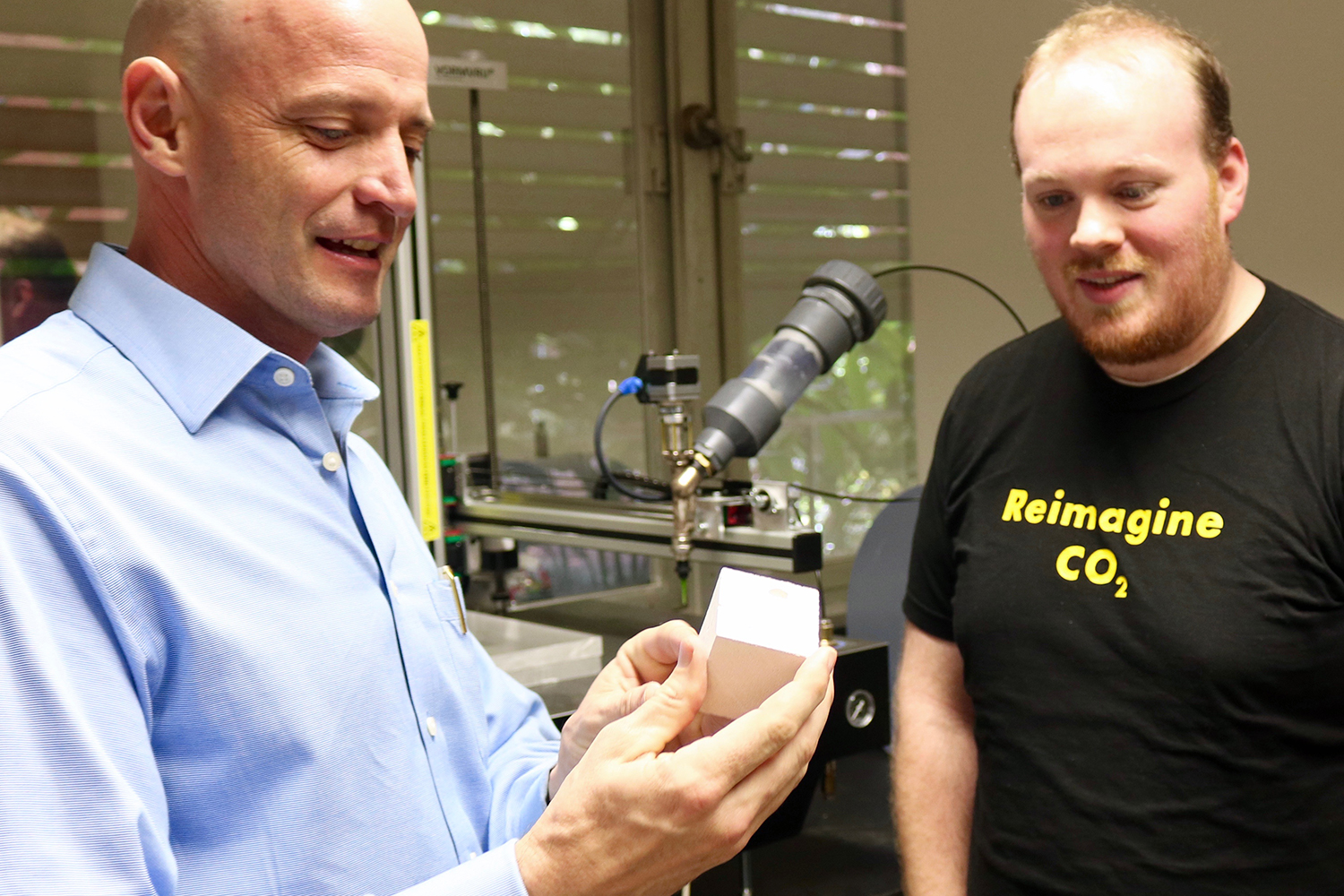
Whether it be guiding equitable revitalization of the L.A. River, helping Californians cut down on their electricity use, or advancing a new way to repurpose carbon dioxide into a greener form of concrete, the Luskin Center for Innovation is a trailblazer among UCLA’s many sustainability leaders.

And that’s just for starters.

Since its inception in 2009, the Luskin Center’s research has influenced local, state and national policy. This includes a new rooftop solar program for Los Angeles, the redesign of California’s clean vehicle rebate program, and current efforts to develop a drinking water low-income assistance program in California. Other research informs the state’s world-renowned actions to combat climate change while maximizing local employment, air quality and health benefits.

A think tank housed within the UCLA Luskin School of Public Affairs, the center is organized around initiatives that translate world-class research into real-world policy solutions. Current initiatives include advanced transportation, clean energy, climate action, digital technologies, sustainable water and urban greening — all linked by the theme of informing effective and equitable policies.

The center brings together faculty and staff from a variety of academic disciplines across campus to conduct research in partnership with civic leaders who use the knowledge to inform policy and organizational innovations. Civic leaders include policymakers, nonprofit organizations, and business associations. Students at UCLA Luskin have the opportunity to work with the Luskin Center to gain hands-on research experience and work closely with these decision-makers.

Meyer Luskin, the visionary and benefactor behind the Luskin Center, says, “Sustaining the environment is the greatest inheritance one can leave to children, and the most enduring gift to the community and nation.”

— KELSEY JESSUP

We Are Inspiring

Each year, UCLA Luskin students are embedded in internships and research projects offered through all three departments. That’s a given. Not as well known is how the school also creates partnerships that benefit students and the communities in which they work.

Take, for example, the Watts Leadership Institute (WLI). The brainchild of Social Welfare adjunct professor Jorja Leap MSW ’80 and her research partner, Karrah Lompa MSW ’13, the WLI is engaged in a 10-year mission to bring about positive change in a community hungry for leadership coaching.

Leap and Lompa are working with the first cohort of community members, providing guidance on everything from learning how to establish successful nonprofits to applying those skills in their community garden. After several years of training and coaching, the cohort will provide guidance for future leaders in Watts.

At the same time, Leap is using the project as a way to provide community-based educational experiences for Luskin’s Social Welfare students.

“This kind of a public-private partnership, along with the research attached to it — and the building of the Watts community — really represent the best of how all of these different factors can come together,” said Leap, who has been working in Watts since conducting research there when she was a Social Welfare graduate student in the 1970s. “It represents part of UCLA’s continuing and growing commitment to communities like Watts that need our involvement, our engagement, our organizing, our research.”

The WLI has received funding from the California Wellness Foundation and from GRoW @ Annenberg, a philanthropic initiative led by Gregory Annenberg Weingarten, as well as office space and in-kind support from Los Angeles City Councilman Joe Buscaino.

“What Watts Leadership did was to help us come together, to put our resources together, and be an example for the rest of the nonprofit and leadership community in Watts,” cohort member Pahola Ybarra said. “It’s been an amazing effort to help us grow, and to help us get out of our own way. It encourages us to reach for as much as we can and do as much as we can in the community.”

— GEORGE FOULSHAM

We Are Woke

On Nov. 9, 2016, after many felt their world spin out of control, the Institute on Inequality and Democracy at UCLA Luskin decided to create a space for students, faculty and staff to critically analyze the forms of exclusion, including white nationalism, so pervasive throughout the election that had just ended.

Post-election, the Institute, whose tagline is “Organizing knowledge to challenge inequality,” expanded its mission to challenge state-sponsored violence against targeted bodies and communities by immediately issuing a call for Jan. 18, 2017: Teach.Organize.Resist.

The campaign, known as #J18, included universities and colleges across the nation and internationally that organized nearly 100 courses, performances, sit-ins, and lectures to demonstrate that places of teaching and learning would not bear silent witness to oppression and hate. After a day of programming at UCLA, #J18 ended with “From the Frontlines of Justice,” a multi-performance event held in Ackerman Grand Ballroom. Highlights are online at teachorganizeresist.luskin.ucla.edu

Ananya Roy, professor of urban planning, social welfare and geography and the director of the Institute, remarked: “I encourage students to think of their role as scholars and to consider the power of research and knowledge.”

To strengthen the link between scholarship and collective action even further, the Institute launched its first Activist-in-Residence program in 2017. In the words of the inaugural fellow, Funmilola Fagbamila, arts and culture director of Black Lives Matter LA and adjunct professor of Pan-African Studies at Cal State LA, the definition of “woke” doesn’t end at knowledge. “To achieve the ‘woke’ label, you must be willing to analyze the conditions in your community. Lastly, you must act.”

Through academic research, and in alliance with social justice movements, the Institute creates scholarship, art and collective action to tackle divides and dispossessions in global Los Angeles and in cities around the world.

“We do so to insist on the academic freedom to examine regimes of power and structures of intolerance,” Roy explained. “We do so to forge imaginations of abolitionism, civil disobedience and human freedom. We do so, as James Baldwin reminded us, to shake the dungeon and leave behind our chains.”

— CRISTINA BARRERA

We Are Global

The impact of the Luskin School resonates far beyond the borders of Los Angeles and California. It’s a brand with international flavor. It’s not unusual to find Luskin students and faculty in Mexico, Uganda, India or Japan.

Luskin’s popular Global Public Affairs program offers students the chance to obtain intellectual and professional preparation to become future experts within the realm of international public affairs.

Each year GPA students travel around the globe, immersing themselves in the culture — and problems — of their host countries, and blogging about it for the GPA website. In the past year, students have lived in Mexico City; Paris; Kampala, Uganda; Bonn, Germany; Santo Domingo, Dominican Republic; and Tokyo, among other locales.

The GPA program is led by two members of the Urban Planning faculty. Michael Storper, distinguished professor of regional and international urban planning, is the director of GPA. He’s also a professor of economic sociology at the Institute of Political Studies in Paris and professor of economic geography at the London School of Economics. Stephen Commins UP PhD ’88, a lecturer in Urban Planning, is a former senior development specialist at the World Bank and director of policy and planning at World Vision International. UCLA Luskin’s international influence also includes:

  • Urban Planning faculty like Paavo Monkkonen MPP ’05, whose students made multiple visits to Tijuana, Mexico, where they provided guidance to city and government officials about the best ways to deal with a housing crisis.
  • Policy professors like Manisha Shah, associate professor of public policy, who has traveled around the world — to India, Mexico, Tanzania and Indonesia — to conduct research into microeconomics, health and development.
  • Faculty leaders like Donald Shoup and Anastasia Loukaitou-Sideris who are among the many UCLA Luskin faculty in great demand as speakers at conferences around the world.
  • Our international students — who add a global perspective to the student body and to Luskin educational efforts.

“A focus on problems that cross borders and involve international interdependence, also identifies where international forces affect domestic policies,” Commins said. “Students can learn from comparing experiences of different countries in how they face planning, policy and social welfare challenges and apply the experiences to their own studies and professional practice.”

— GEORGE FOULSHAM

We Are Problem Solvers

Graduate students at UCLA Luskin don’t wait to step beyond the classroom to address California’s pressing challenges. Master of Public Policy (MPP) and Master of Urban and Regional Planning (MURP) students spend their time on campus deeply immersed in local, state, national and global issues. At the Luskin School, it’s part of the program.

Luskin students log countless hours learning lessons from leading-edge faculty and researchers. Here they seek solutions related to ongoing problems like housing, transportation or sustainability. They look into topics of vital importance to Southern California like electric recharging stations, barriers to bicycling in and around the city, or accessibility to water and food.

“At Luskin, we give students a diverse set of tools (both quantitative and qualitative) that will help guide them through the APP process and ultimately to go out into the real world and conduct policy analysis on issues close to their hearts,” said Manisha Shah, associate professor of public policy and faculty coordinator for the Applied Policy Project program completed by MPP graduates.

Recent work has connected students with county and city offices such as the Mayor of Los Angeles and the Los Angeles Department of Transportation. Regional agencies such as the Southern California Association of Governments (SCAG) frequently serve as clients. Recent APP projects included healthy food choices for elementary school students and employment opportunities for youths. Students also tackle educational issues right here at UCLA or work with the University of California’s Office of the President.

Many student projects benefit local and regional clients and the communities they serve, but they also reach out to communities far way. A recent planning capstone evaluated the short-term rental market in a Northern California city, for example. And a recent policy project analyzed governance at
the local level in the Ukraine.

— STAN PAUL

We Are Trailblazing

There’s no better place to study how people get around than Southern California — and for the past 25 years, UCLA has been home to one of the country’s preeminent transportation research centers.

The UCLA Institute for Transportation Studies (ITS) at UCLA Luskin combines cutting-edge research with meaningful, influential civic engagement to lead to policy results in California and beyond. From the impacts of traffic congestion to fairness around rideshare hailing to the civic consequences of paying for parking, ITS scholars produce work that ties directly to current transportation planning practices and policymaking at the local, state and national levels. ITS is noted for connecting transportation and equity, and for emphasizing the effect of transportation decisions on people’s lives.

“We take our policy mandate seriously,” said Brian Taylor UP PhD ’90, director of ITS and professor of urban planning.

Through close partnership with dozens of outside organizations that include government agencies, private transportation companies, nonprofit foundations and advocacy groups, ITS faculty, staff and students translate the latest knowledge on transportation into proposed real-world policies around movement and growth. ITS’ biannual digital magazine is widely read throughout the transportation community, highlighting important new research in a clear, constructive manner for practitioners.

Luskin students working at ITS collaborate closely with faculty members, receive generous scholarship funding for their own trailblazing projects, and have garnered an inordinate number of prestigious grants and awards over the years. Regular interactive events and publications showcase student findings to the academic community and the public at UCLA and around the country.

The next quarter-century will bring significant changes to how we travel, with daunting societal impacts. As it has since 1992, ITS research and policy action will help guide the way toward solutions.

— WILL LIVESLEY-O’NEILL

We Are Family

Attend any gathering at UCLA Luskin and you may feel like you stumbled into someone’s family reunion.

There will be a toddler or two, chasing a balloon or dancing as a faculty, staff or student parent hovers nearby. You’ll notice plenty of happy young faces — graduate students tend to be in their 20s — but look closer, and you’ll see older folks too. Mid-career professionals returning to add a degree. Staff and faculty, some grayed and others not. Perhaps alumni who earned degrees during the days of typewriters or even pencil and paper, not smartphones.

But family is more than differences in age. It’s continuity. Legacy. Progress over time, as one generation blazes a trail and then passes the torch of knowledge along to another to mark its own, slightly different path. It’s every professor who imparts a tidbit of knowledge only to be surprised, and humbled, when a protégé nurtures that information into something new and wonderful and impactful.

A lifetime of learning walks the Public Affairs Building each day — legends who become mentors, colleagues, even friends. Marty Wachs. Joan Ling. Mark Peterson. Michael Dukakis. Ananya Roy. Gerry Laviña. And so many more. People who have done everything in their careers that students could ever dream of doing themselves and yet still seem to care most about what their students learn now that will improve the world tomorrow.

Family provides inspiration. At Luskin, it’s instructors who know how to say, “You can do better,” in a way that makes students understand that, yes, they really can.

Families help those who need it. It’s every person on the Donor Honor Roll whose name is there not because their wealth exceeds their needs but because money is a way to honor someone who once expanded their worldview. Or lifted their spirits. Or answered a question late one night as a deadline loomed.

After 40 years at UCLA Luskin, Donald Shoup knows all about the Luskin family. In 2017, he won another big award, honoring his contributions as an educator. He put it in perspective: “If we have any influence — if there is going to be anything to remember after we are gone — I think it will be the successful careers of our students who will be changing the world for the better.”

— LES DUNSEITH

UCLA Study Helps Californians Save Electricity — and Money — this Summer Participants in UCLA Luskin research effort receive smartphone notifications that help them make smart decisions about electricity usage and avoid peak pricing

July 25, 2017/2 Comments/in Alumni, Climate Change, Digital Technologies, Electric Vehicles and Alternative Fuels, Environment, For Policymakers, For Students, Luskin Center, Public Policy, Public Policy News, Research Projects, School of Public Affairs, Sustainable Energy J.R. DeShazo /by Les Dunseith

Electricity demand fluctuates each day, and consumers who want to unplug during peak times to save money and help the environment now have a new tool at their disposal. Chai Energy, a partner of the UCLA Luskin Center for Innovation, is making real-time energy information a reality for electricity consumers who want to reduce or shift their electricity usage during peak periods when electricity is the most expensive.

In a pilot study funded by a California Energy Commission grant of more than $2 million, UCLA is seeking to understand and identify the most effective demand response program designs for different types of households across the state, depending on social characteristics.

“We want to provide a comprehensive tool that will help customers save money while improving grid reliability, reducing pollution during peak hours, and maybe even preventing blackouts” said J.R. DeShazo, director of the Luskin Center for Innovation at the UCLA Luskin School of Public Affairs.

How does the study work? 

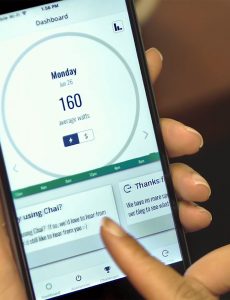
The UCLA researchers have partnered with a clean technology company named Chai Energy. “Chai developed a free smartphone application that displays your home daily electricity consumption and provides you with tips on how to better manage your electricity bill,” DeShazo said. This could include knowing when it makes financial sense to replace an old appliance, or simply what time to use it based on electricity prices. Chai has also developed a gateway device that establishes communication between a participant’s smartphone and the smart-meter already installed in his house, allowing users to see real-time energy consumption by individual household appliances.
The UCLA Luskin Center is delivering and testing messages designed to inform Californians about their electricity consumption and provide tips for reducing it. About 10,000 Californians are expected to download the app and participate in the study.

“This large sample will enable researchers to identify the most effective format, timing and content of messages,” said Julien Gattaciecca, project manager and one of the researchers.

How can Californians participate?

The free Chai Energy application can be found by searching for Chai Energy in android or IOS app stores or by visiting chaienergy.com. Those who install the app are automatically enrolled in the study. A free Chai gateway device with a market value of $75 is being randomly distributed to 5,000 participants.

The study is currently available only for customers of Pacific Gas & Electricity (PG&E), Southern California Edison (SCE), and San Diego Gas & Electricity (SDG&E).


Luskin Center and the Chai Energy App from UCLA Luskin on Vimeo.

The video is also available on YouTube.

A Final Test for Policy Analysis Projects UCLA Luskin public policy master’s degree culminates in a public forum in which students present Applied Policy Projects on issues of regional, global importance

June 23, 2017/0 Comments/in Alumni, Electric Vehicles and Alternative Fuels, For Faculty, For Policymakers, For Students, Public Policy, Public Policy News, School of Public Affairs, Sustainable Energy, Transportation Manisha Shah, Mark A. Peterson, Wesley Yin /by Stan Paul

By Stan Paul

By necessity, the Master of Public Policy (MPP) students at the UCLA Luskin School of Public Affairs quickly begin learning skills and tools to complete the program and prepare for problem-solving careers in the public, private and nonprofit sectors.

The students, working in groups, must clear one final hurdle to graduate: the Applied Policy Project presentation.  Each group has 20 minutes to impress faculty and peers by showcasing what they have learned during two rigorous years of study.

Each year, a diverse group of clients “hire” the students, usually in teams of two or more, to tackle real-world problems and offer actionable recommendations and feasible solutions.

“I think one of the exciting aspects of the APP is the variety of topics covered,” said Manisha Shah, associate professor of public policy and faculty coordinator of the program. “Because our students have a diverse set of interests and because we encourage them to identify their own clients, the result is an interesting variety of APP projects.”

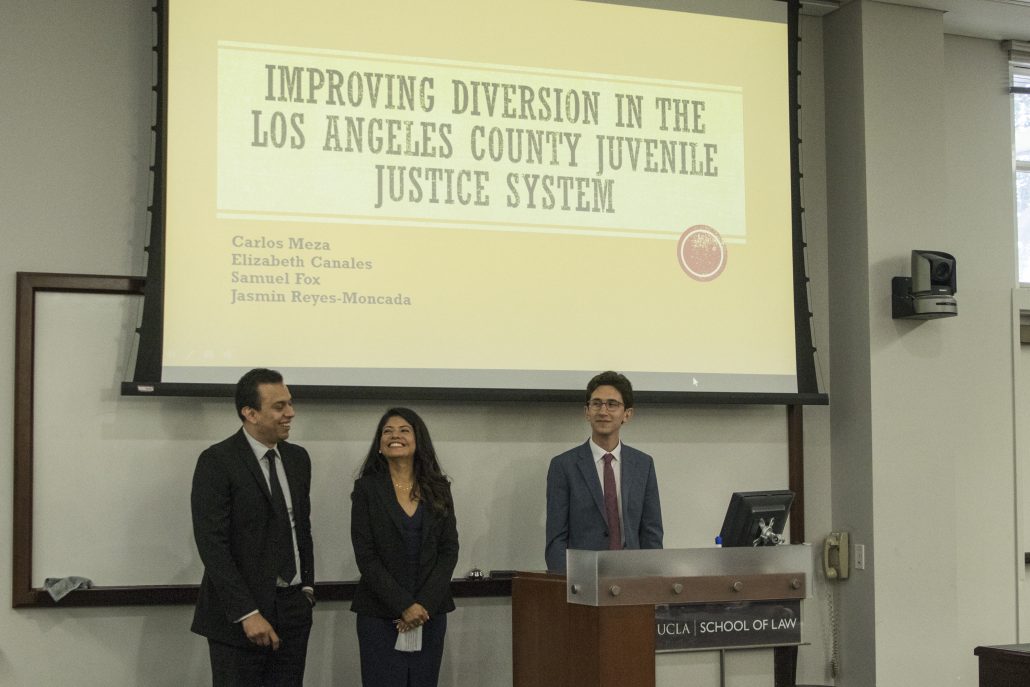
Carlos Meza, Elizabeth Canales and Samuel Fox discuss how to improve juvenile diversion in Los Angeles. Not pictured is Jasmin Reyes-Moncada. Photo by Les Dunseith

Among this year’s clients were the Southern California Association of Governments, Covered California, Peterson Institute for International Economics and a member of the California State Assembly. Internal clients included a research center within the Luskin School, a professional program elsewhere on campus and the University of California’s Office of the President.

“The first-year curriculum of the MPP program is tool-driven,” Shah said. “What I mean by that is we try to give students a diverse set of tools — both quantitative and qualitative — that will help guide them through the APP process and ultimately go out into the real world and conduct policy analysis on issues close to their hearts.”

Shah said she was fortunate to advise a diverse set of APP groups this year. One group of students found that behavioral tools such as reciprocity and commitment devices should be implemented in schools to increase consumption of fruits and vegetables in an attempt to combat obesity. Another group helped improve the service delivery model of an organization in L.A. that tries to get at-risk youth into better employment opportunities. And another group proposed interventions and policies aimed at reducing displacement and gentrification in South L.A.

In all, 18 presentations were made. Luskin faculty watched and then asked questions that tested the students’ depth and breadth of knowledge and the thoroughness of their projects.

The range of projects is broad, including:

  • Local and regional issues such as investments in electric vehicle charging stations in Los Angeles and a rent stabilization ordinance to prevent displacement of low-income minority communities in South Los Angeles.
  • Statewide issues such as bail reform, insuring Californians, health care, access to water and juvenile justice.
  • National and global issues like mitigating the negative impacts of trade on employment in the U.S. auto industry and improving local-level governance amid decentralization reforms in the Ukraine.

A closer look at some of this year’s APPs follows.

Gender Issues in Engineering

Applying qualitative and quantitative methods to their study for the UC’s Office of the President, Traci Kawaguchi, Yuhan Sun and Eri Suzuki focused on the need for connections in their analysis of system-wide retention by gender in engineering at the undergraduate level. They initially determined that the retention rate of female engineering students was significantly lower than for male engineering classmates across the UC system.

Their faculty adviser, Professor of Public Policy John Villasenor, also holds an appointment in electrical engineering at UCLA. He helped connect them with UCLA engineering students, which led to interviews with aspiring female engineers.

Women and men had similar levels of academic performance in the first year, but the qualitative interview uncovered that “affinity groups play a key role in affirming engineering identity and belonging in the field,” according to the UCLA Luskin students’ written summary.

“I think the big thing that came up was just the idea of fitting in,” Kawaguchi said. “When you go into a classroom that is 80 percent male … it may make you feel that you don’t necessarily belong.”

Team members analyzed policy options based on anticipated effectiveness, cost feasibility and institutional feasibility, and they recommended support for female students based on a sense of community and belonging. Adoption of residential living communities and formal peer mentoring programs for female undergraduate students in engineering were also recommended.

 A Program to Help Plug-In Commuters

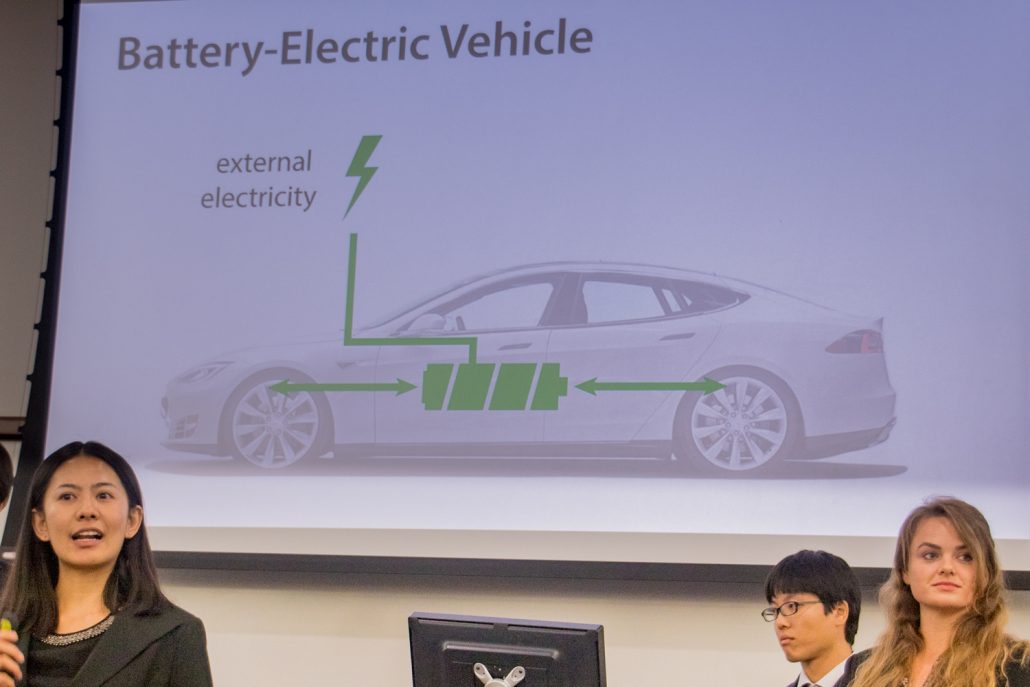
Another APP team focused on plug-in vehicles with a limited range on all-electric power that switch to gasoline-based power after batteries are exhausted. Specifically, the group studied how workplace charging stations in Los Angeles could increase the number of miles that vehicles travel without burning gasoline.

MPP students James Di Filippo, Mahito Moriyama, Toru Terai, Kelly Trumbull and Jiahui Zhang completed their project, “Prioritizing Electric Vehicle Charging Station Investments in Los Angeles County,” for the Southern California Association of Governments (SCAG). Their model combined commuting data from SCAG’s transportation demand study with plug-in electric vehicle registration data, information on vehicle all-electric range, and point data on existing charging infrastructure locations.

The students found that nearly 6,000 plug-in hybrid commuters could benefit from workplace charging but currently do not have access. Full support of those commuters’ vehicles would yield about 76,000 additional miles driven on electric power each day.

The potential increase is concentrated in just a few zones. Di Filippo said that the group used a tool from the Environmental Protection Agency to identify zones that fall within disadvantaged communities that might require additional support, which were more than a third of all zones identified as having potential for investment across Los Angeles County. SCAG should direct additional funding toward those disadvantaged communities to ensure that the benefits are distributed equitably, the students said.

Di Filippo said that the APP process was challenging but rewarding. “I credit my teammates for pulling together quickly, conceptualizing and delivering a strong report that offers actionable information for SCAG’s electric vehicle charging infrastructure siting decisions in only eight weeks,” he said. “My team was fortunate to have the support of faculty and peers who were invaluable in shaping our thinking on key aspects of the report.”

Healthy Food for Children

Sarah White and teammates Sydney Ganon, Hiroto Iwaoka and Jonathan McIlroy examined behavioral economics for tools in nutrition education curricula. Their goal was to promote long-term healthy food choices and habits in third and fourth grade students in light of a growing recognition of negative health outcomes of childhood obesity.

“While the field of behavioral economics is still fairly new, we read a lot of the existing literature and had reason to believe that really low-cost interventions could potentially have large impacts on getting people to make better choices for themselves,” White said.

One challenge that behavioral economics has “rarely, if at all, studied within the realm of children’s nutrition.” That made evaluating different policy options more difficult. “We had to evaluate each policy option on our own,” White said.

The group’s recommendations bundled three potential behavioral tools that are cost-effective. Giving attractive names such as “power peas” to fruits and vegetables in the cafeteria would frame foods in a way that is appealing to children. Giving students something as simple as a sticker and thanking them for choosing the healthy option would promote reciprocity. Having students set goals for eating better would make them more likely to stay committed.

Ayappa Biddanda

Rocking his Comeback

For one student, Ayappa Biddanda, the final APP presentation was a long time in the making. In the early 2000s he left UCLA Luskin to pursue an opportunity that turned into a career in the music industry. He came back this year to do his final presentation — and thus finish his master’s degree.

Biddanda’s project evaluated the impact of an educational enrichment program called Rock the Classroom that paired local musicians with students in the Los Angeles Unified School District. Biddanda’s solo presentation on the final night of the APP program literally rocked the classroom with musical sound bites and his enthusiastic, informative and professionally presented argument that, in education, “art matters.”

A Fond Farewell

Wrapping up two decades of APP presentations, Mark Peterson, chair of the department, thanked the students for their efforts. “I really want you all to applaud yourselves,” he said. “The hard work that went into all of the presentations was obvious to us all, and we really just admire the time you put into all of this and the work that you did to put these presentations on a scale of professionalism that we like to see.”

The 2017 APPs ended on a bittersweet note, with Peterson acknowledging the retirement of a key player. Maciek Kolodziejczak is a longtime UCLA staff member who joined the public policy program when it was founded more than 20 years ago and has long coordinated the APP presentations.

“Sadly, this is the last time that this part of the APP program will be orchestrated, moderated and run by Maciek,” Peterson said.


From the UCLA Luskin Flickr feed:

2017 Applied Policy Project presentations

A Multimillion-Dollar Boost to Tackle Transportation Challenges Grant will support UCLA Luskin’s Institute of Transportation Studies as part of a research collaboration in a new regional center

December 12, 2016/0 Comments/in Electric Vehicles and Alternative Fuels, Environment, For Policymakers, School of Public Affairs, Transportation, Urban Planning Brian D. Taylor /by Les Dunseith

By Stan Paul

Thanks to a multimillion-dollar grant from the U.S. Department of Transportation, faculty, staff researchers, and students affiliated with the UCLA Luskin Institute of Transportation Studies (ITS) will be part of a new regional transportation center that will tackle some of the most important transportation issues facing America.

“Universities are at the forefront of identifying solutions, researching critical emerging issues and ensuring improved access to opportunity for all Americans,” U.S. Secretary of Transportation Anthony Foxx said in announcing more than $300 million in grants to 32 University Transportation Centers (UTCs) nationwide, selected from among 212 proposals submitted. “This competition supports the future transportation workforce by providing students with opportunities to take part in cutting-edge research with leading experts in the field.”

UCLA Luskin’s ITS will collaborate on this new center with USC and universities in four states — California, Nevada, Arizona, and Hawaii — as well as the U.S. Pacific Island territories. The new Pacific Southwest Region University Transportation Center is one of ten new federal regional centers, and will focus on transportation issues facing the southwestern and Pacific regions of the U.S.

“We are thrilled to be a partner in this new university transportation research center, and by the opportunity it presents to our faculty and students to conduct needed research on the many transportation challenges facing our region,” said Brian Taylor UP PhD ’92, director of the UCLA ITS and a professor of Urban Planning at UCLA Luskin. Taylor noted that the new center will address new transportation technologies, improving mobility for vulnerable populations, improving transportation system resilience and protecting the environment, and managing mobility in high-growth urban areas.

“This new center will help the Institute of Transportation Studies continue to recruit the best and the brightest transportation students to UCLA for graduate study, and it will in addition support both faculty and students across the campus in conducting a wide range of research projects — from harnessing the benefits of cleaner technology-driven smart mobility, to better serving the mobility needs of the poor,” explained Taylor, who also leads the Luskin School’s Lewis Center for Regional Policy Studies.

The five-year, $14-million DOT grant will be matched by an additional $14 million from the California Department of Transportation and other sources to support a wide array of research, education and technology transfer programs at the consortium member universities. Taylor said the new center will bring at least $500,000 per year to UCLA, with more than half of that amount funding graduate student fellowships and research projects.

The new Pacific Southwest Region UTC will be directed by USC professor Genevieve Giuliano, who in winter and spring of 2016 was the Harvey Perloff Distinguished Visiting Professor of Urban Planning in the UCLA Luskin School. The other participating institutions in the consortium are Cal State Long Beach, UC Davis, UC Irvine, the University of Hawaii at Manoa, Northern Arizona University and Pima Community College.


Page 2 of 3123

Recent Posts

  • Only Los Angeles could spend $1.5 billion to make airport traffic worse December 18, 2025
  • Golden Bachelder and Prokriti Monolina: Fellows on the First Budget and Finance Advisory Committee December 18, 2025
  • Kaplan on the Social Media Ban for Minors in Florida December 17, 2025
  • How DemocraShe Builds Civic Engagement for All December 17, 2025
  • Yaroslavsky on Rob Reiner’s Legacy of Progressive Advocacy December 17, 2025

Contact

UCLA Luskin School of Public Affairs

3250 Public Affairs Building - Box 951656
Los Angeles, CA 90095-1656

Campus Resources

  • Maps, Directions, Parking
  • Directory
  • Contact
  • Academic Calendar
  • Careers
  • Diversity
  • University of California
  • Terms of Use

Follow

The statements on this page represent the views of people affiliated with the Luskin School of Public Affairs and do not necessarily represent the views of the University of California, or UCLA or its Chancellor.

Posts and comments by individuals at UCLA on social media channels may not reflect the opinions or policies of UCLA, the University of California or the Luskin School, nor its benefactors and academic partners.

Scroll to top