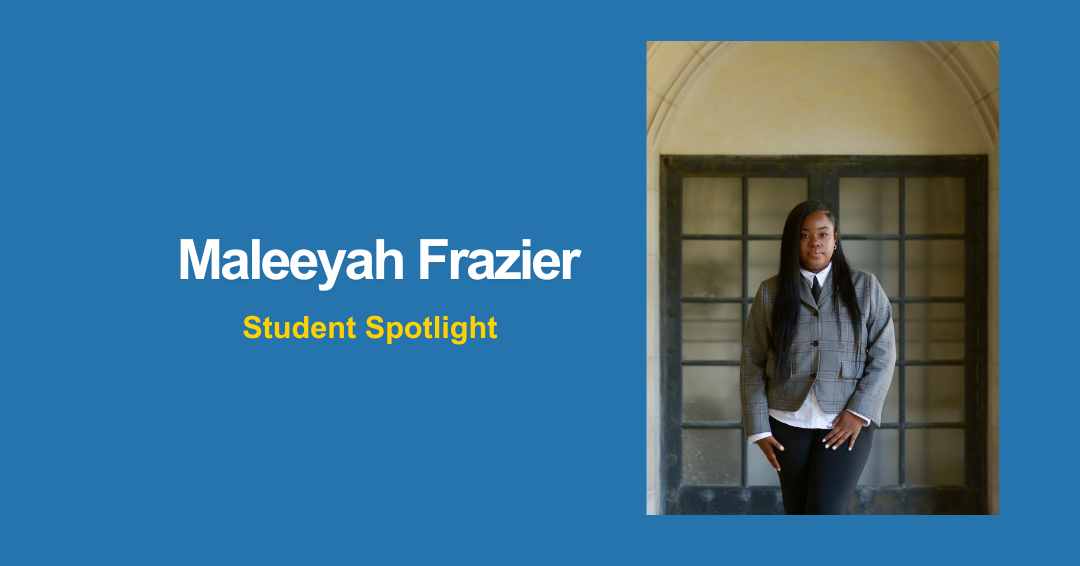
Q&A with Maleeyah Frazier: Youth Activist and a Voice for Black Students Public Affairs major discusses education justice and dismantling the school-to-prison pipeline.
You are passionate about dismantling the school-to-prison pipeline and advocating for youth in marginalized communities. What early experience or moment made you realize this work was important for you?
The moment I realized this work mattered, and that I had a responsibility to step into it, came in the 10th grade, during the George Floyd protests in the middle of COVID. Up until then, I had always been placed in gifted programs and uplifted as the “right kind” of student in my community. I was constantly compared to other students of color who weren’t placed in gifted classes, and teachers often used me as the example of what being a “good student” should look like. That created a harmful dynamic and placed enormous pressure on me, because I knew the system was failing those students, they were being tracked, ignored, and underestimated.
The real turning point happened when I learned that LAUSD was spending over $75 million on school police while investing less than half of that in critical student resources: psychiatric social workers, mental health services, counselors, full-time nurses, and educators. For a district that serves a majority of students of color, including students in areas that were historically redlined, it became clear to me that policing was being prioritized over care.
That’s when I found Students Deserve, a youth-led grassroots organization committed to dismantling the school-to-prison pipeline. I wasn’t just a member, I became deeply involved in organizing actions, speaking at board meetings, and challenging school board members directly. Students Deserve taught me that youth have power, and that our voices, especially Black and brown youth voices, can shift millions of dollars.
Alongside other young leaders, I helped push forward the demand to defund school police and reinvest that money into the Black Student Achievement Plan (BSAP). I spoke out publicly, shared data, uplifted student stories, and organized with peers to make our calls for justice undeniable. That campaign wasn’t theoretical for me, our communities were experiencing the consequences every day. And when LAUSD ultimately redirected funds into BSAP, it showed me what collective youth power could do. That experience solidified my commitment to this work. It was the first time I saw how policy, activism, and community organizing intersect, and the first time I understood that fighting for students wasn’t just important to me, it was part of my purpose.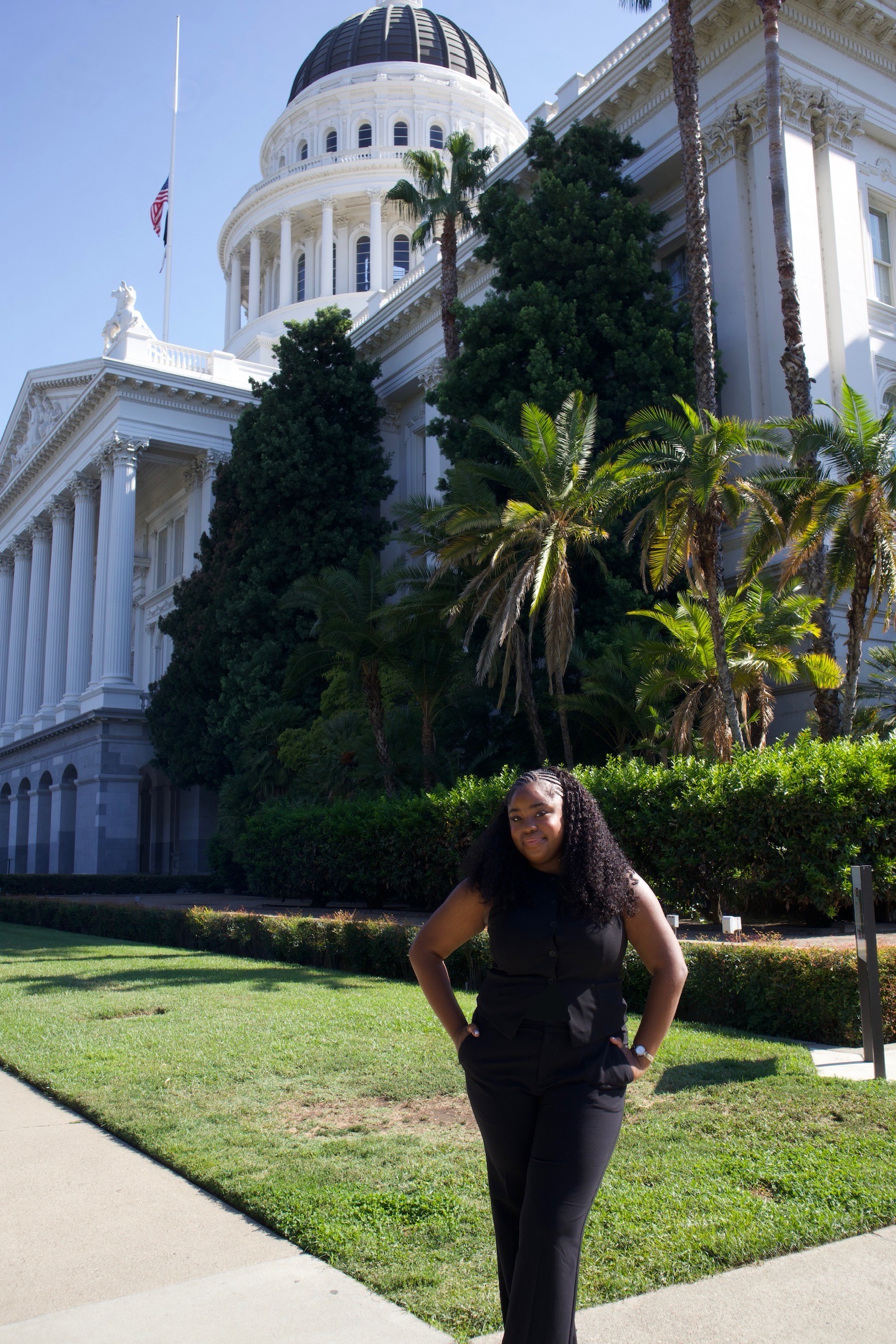
You were present at the Capitol when AB7 passed, a historic moment for Black student representation in higher education. What was going through your mind as you stood at the press conference alongside Assemblymember Isaac Bryan, a UCLA Luskin alum leading this effort?
Being at the Capitol for the passing of AB 7 was a moment I will never forget. Standing at the podium as the Black Student Success Officer for the University of California Student Association, representing tens of thousands of Black students across the UC system, felt like history was unfolding right in front of us, and we were the ones shaping it.
Standing beside Assemblymember Isaac Bryan, a UCLA Luskin alum who has done transformational work for our communities, felt especially powerful. In that moment, I wasn’t just speaking for myself, I was speaking for generations of Black students who have been excluded, overlooked, and systemically disadvantaged in higher education.
Even though Governor Newsom later vetoed AB 7, I felt the magnitude of what we were trying to accomplish. AB 7 would have allowed universities to consider giving preference to students who are descendants of slavery, a policy aimed at addressing centuries of harm embedded in academic institutions. For me, the bill represented hope, recognition, and the possibility of healing long-standing inequities.
As I stood at that press conference, I thought about my younger self, the girl organizing walkouts, challenging school board members, and fighting for resources in LAUSD. I realized that all of that work, all of those moments, had led me to that stage. I felt proud, but more than anything, I felt responsible. That moment strengthened my commitment to continue advocating for Black student success at every level, from K–12 to higher education.
You’ve taken on major leadership roles at UCLA. From Chair of the Afrikan Student Union to Vice President of the Black Pre-Law Association. How have these roles shaped your approach to advocacy and community-centered leadership?
I’ve been rooted in community work since high school, often doing the work long before I ever held a title. But stepping into formal leadership roles at UCLA has deepened my understanding of what it means to lead with intention, accountability, and love for my community. Serving as Chair of the Afrikan Student Union during its 60th anniversary was especially meaningful. ASU has a powerful legacy of Black student activism, cultural resistance, and institutional change. Stepping into that role meant stepping into decades of history. It wasn’t just a position, it was stewardship. It meant honoring the students who fought before me while uplifting the needs of students who are coming after me. Through ASU I learned how to navigate university politics, build coalitions, and advocate for Black students in spaces where we are often underrepresented. More importantly, these roles taught me that leadership isn’t about being at the front, it’s about making sure the community’s needs are at the center. It’s about creating systems, programs, and spaces that will exist long after I graduate. Every role has reminded me that my leadership is rooted in collective power. I carry my community with me in every decision, every meeting, and every piece of advocacy work I do.
You’ve worked across policy, research, and community engagement—from the Department of Youth Development to the UCLA Law Fellows Program. What project or experience has been the most transformative for your future in juvenile justice?
My journey has been shaped by a combination of grassroots organizing and academic enrichment programs, but the most transformative element has been the way these experiences complemented each other. My early grassroots work taught me what justice looks like on the ground. Speaking at protests, showing up for students, and building power through youth-led organizing grounded me in the realities that young people, particularly Black and brown youth, face every day. Those experiences made the systems I want to reform feel personal, not abstract. At the same time, the programs I’ve participated in, like the UCLA Law Fellows Program, Ready to Launch, and the Vice Provost Initiative for Pre-College Scholars (VIPS), helped open doors that previously felt out of reach. VIPS has been pouring into me since high school, shaping my confidence and my academic trajectory. Through Ready to Launch, I had the opportunity to intern with Assemblymember Sade Elhawary, a UCLA alum whose leadership showed me how policy can directly uplift communities when done with intention. UCLA Law Fellows, specifically, gave me the belief that a first-generation, low-income student like me could pursue a legal career and make an impact. These programs showed me that community work and policy work aren’t separate, they strengthen each other. Together, these experiences transformed my perspective on juvenile justice. They taught me that real change requires both lived experience and institutional knowledge, and that I can carry both.
As a third year Public Affairs major, I’d love to hear what stands out most about your experience at UCLA Luskin. Was there a moment, class, project or professor that felt especially transformative or helped shape your path?
My experience at UCLA Luskin has been eye-opening, challenging, and deeply affirming. One of the most impactful classes I’ve taken is Public Affairs 80. That class helped me make sense of the systems that shaped my upbringing and the experiences of the students I advocate for. It gave me the language and tools to understand how policies around housing, education, and criminal justice intersect, and how they disproportionately impact Black and brown communities. But beyond the coursework, the professors made the difference. Professor Smalls and Professor Covington have been transformational figures in my journey. Growing up, I rarely had Black women educators, and stepping into a classroom led by Black women in higher education felt grounding and empowering. They didn’t just teach, they spoke life into me. They modeled excellence, challenged my thinking, and pushed me to see my full potential. Their presence reminded me that representation isn’t just inspirational, it’s necessary. UCLA Luskin helped expand what I thought was possible for my career and my community. It gave me theory, but also the confidence to imagine a bigger future.
As you look ahead to a possible career in juvenile justice law, what legacy do you hope to build for Black youth and future first-gen scholars following in your footsteps?
I hope to build a legacy rooted in transformation, liberation, and possibility. I want to create tangible change in the systems that have harmed our youth for generations. My goal is to dismantle the pathways that push Black and Brown youth into criminalization and instead build pathways toward healing, education, and opportunity. But my legacy isn’t only about the work I do, it’s about the doors I help open. I want first-generation students, low-income students, and Black and Brown youth to see themselves in rooms they were told they didn’t belong in. I want them to know that their voices matter, their stories matter, and their dreams are not too big. If I can show even one young person from my community that they can rewrite their story, then I’ve done my job. I hope to leave behind a legacy of courage, compassion, and faith, a legacy that reminds others that even faith as small as a mustard seed can move mountains.



Leave a Reply
Want to join the discussion?Feel free to contribute!