Skip to content
  • Students & Alumni
    • Career Services
    • Alumni Relations
    • Student Support
    • Graduate Resource Library
    • For Employers
  • News
  • Events
    • Events Calendar
    • Luskin Summit
    • Luskin Lecture Series
    • California Policy Briefing
    • Commencement
  • Students & Alumni
    • Career Services
    • Alumni Relations
    • Student Support
    • Graduate Resource Library
    • For Employers
  • News
  • Events
    • Events Calendar
    • Luskin Summit
    • Luskin Lecture Series
    • California Policy Briefing
    • Commencement
Giving
  • Academics
    Departments & Programs
    • Public Policy
    • Real Estate Development
    • Social Welfare
    • Urban Planning
    • Undergraduate Program
    • Public Policy
    • Real Estate Development
    • Social Welfare
    • Urban Planning
    • Undergraduate Program
    Graduate Degrees
    • Master of Public Policy (MPP)
    • Master of Real Estate Development (MRED)
    • Master of Social Welfare (MSW)
    • Master of Urban and Regional Planning (MURP)
    • PhD in Social Welfare
    • PhD in Urban Planning
    • Master of Public Policy (MPP)
    • Master of Real Estate Development (MRED)
    • Master of Social Welfare (MSW)
    • Master of Urban and Regional Planning (MURP)
    • PhD in Social Welfare
    • PhD in Urban Planning
    Undergraduate Degrees
    • BA in Public Affairs
    • Minor in Urban and Regional Studies
    • Minor in Gerontology
    • Minor in Public Affairs
    • BA in Public Affairs
    • Minor in Urban and Regional Studies
    • Minor in Gerontology
    • Minor in Public Affairs
    Professional Certificates
    • Data Analytics Certificate
    • Data Analytics Certificate
  • Admissions
    Program Specific Admissions
    • Public Policy
    • Real Estate Development
    • Social Welfare
    • Urban Planning
    • Undergraduate Program
    • Public Policy
    • Real Estate Development
    • Social Welfare
    • Urban Planning
    • Undergraduate Program
  • Faculty
    Our Faculty
    • All Faculty
    • Public Policy
    • Real Estate Development
    • Social Welfare
    • Urban Planning
    • All Faculty
    • Public Policy
    • Real Estate Development
    • Social Welfare
    • Urban Planning
    Leadership
    • Our Dean
    • Board of Advisors
    • Faculty Executive Committee
    • Our Dean
    • Board of Advisors
    • Faculty Executive Committee
  • Research Centers
    • Agile Visual Analytics Lab (AVAL)

      Empowers stakeholders with data to make informed decisions for children, families, and communities.

    • Berggruen Governance Index

      Evaluates the quality of political governance and democracy worldwide.

    • Center for Neighborhood Knowledge (CNK)

      Specializes in spatial analysis of socioeconomic disparities in neighborhoods.

    • Center for Policy Research on Aging (CPRA)

      Explores the societal and policy implications of an aging population.

    • Agile Visual Analytics Lab (AVAL)

      Empowers stakeholders with data to make informed decisions for children, families, and communities.

    • Berggruen Governance Index

      Evaluates the quality of political governance and democracy worldwide.

    • Center for Neighborhood Knowledge (CNK)

      Specializes in spatial analysis of socioeconomic disparities in neighborhoods.

    • Center for Policy Research on Aging (CPRA)

      Explores the societal and policy implications of an aging population.

    • Institute of Transportation Studies (ITS)

      Advances research, education, and meaningful civic engagement on transportation issues.

    • Institute on Inequality and Democracy

      Advances scholarship that confronts threats to democracy in America and around the world.

    • Latin American Cities Initiative

      Connects urban planning and policy networks across the Americas.

    • Latino Policy & Politics Institute (LPPI)

      Addresses policy challenges facing Latinos and communities of color.

    • Institute of Transportation Studies (ITS)

      Advances research, education, and meaningful civic engagement on transportation issues.

    • Institute on Inequality and Democracy

      Advances scholarship that confronts threats to democracy in America and around the world.

    • Latin American Cities Initiative

      Connects urban planning and policy networks across the Americas.

    • Latino Policy & Politics Institute (LPPI)

      Addresses policy challenges facing Latinos and communities of color.

    • Lewis Center for Regional Policy Studies

      Studying housing affordability and transportation equity in the L.A. region.

    • Los Angeles Education Research Institute (LAERI)

      Collaborates with schools to improve educational outcomes for L.A. students.

    • Luskin Center for Innovation

      Informing effective and equitable environmental policy that improves lives.

    • UCLA Voting Rights Project

      The flagship project for voting rights litigation and policy research.

    • Lewis Center for Regional Policy Studies

      Studying housing affordability and transportation equity in the L.A. region.

    • Los Angeles Education Research Institute (LAERI)

      Collaborates with schools to improve educational outcomes for L.A. students.

    • Luskin Center for Innovation

      Informing effective and equitable environmental policy that improves lives.

    • UCLA Voting Rights Project

      The flagship project for voting rights litigation and policy research.

    All Research Centers
  • Outcomes
Home / News / Home Sweet Home

Home Sweet Home

During a Lewis Center Book Talk, visiting lecturer Brian McCabe explores the efficiency of U.S. government support for homeownership
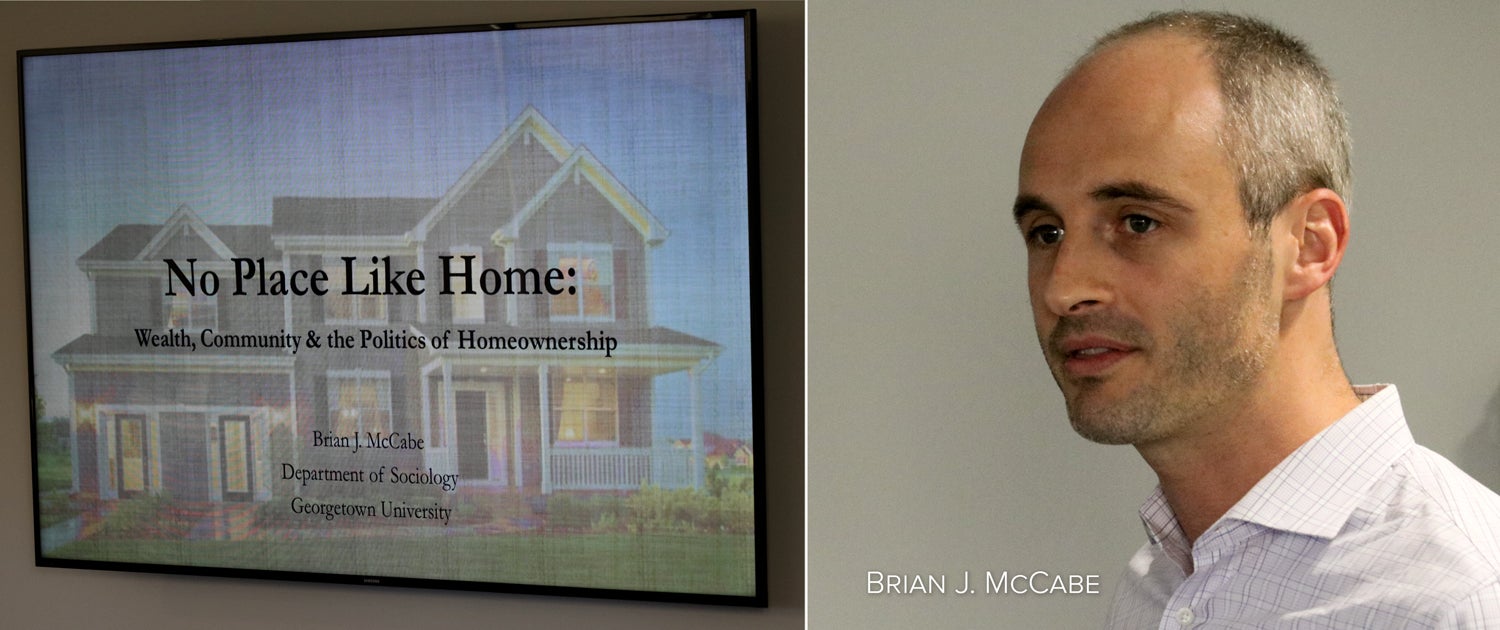
Brian J. McCabe, associate professor of sociology at Georgetown University, delivered a lecture on home ownership at the UCLA Luskin School of Public Affairs. Photos by George Foulsham

Posted in

  • School of Public Affairs, Urban Planning

Published on

  • February 27, 2017
  • finance, homeownership, mortgage, UCLA Luskin School of Public Affairs

Share this Article

By Zev Hurwitz

Brian J. McCabe is a sociologist whose research focuses on the importance, impact and problems associated with homeownership in the U.S. — not exactly common issues for a sociologist.

“Sociologists have largely ceded the study of housing to economists,” McCabe said. “We should be thinking about housing as not only an economic problem but as a social problem, too.”

McCabe, an assistant professor of sociology at Georgetown University, delivered a seminar at the Luskin School of Public Affairs on Feb. 22, 2017, based on his recent book, “No Place Like Home: Wealth, Community & the Politics of Homeownership.” The book explores the American passion for home ownership and its effect on local communities.

At the Book Talk hosted by the UCLA Lewis Center, McCabe walked attendees through the central themes of his book, focusing particularly on methods for evaluating the impact of homeownership on communities.

Michael Lens, assistant professor in UCLA Luskin School of Public Affairs Department of Urban Planning, noted that McCabe’s diverse background yielded a unique approach to his work.

“[McCabe’s] research offers an interdisciplinary approach to the study of cities combining his training in sociology, geography and public policy, primarily on housing issues,” Lens said.

Homeownership did not become the status quo for most Americans until the middle of the 20th century as marketing campaigns and the news media helped establish the notion that owning a home is an American ideal, McCabe said.

“We generally agree that buying a home is a good thing,” he said. “Ninety percent of Americans believe they prefer to live in a home rather than rent one. Most people who own a home are happy with their housing decision, and most renters expect that one day they’re going to be homeowners.”

In addition to being a vehicle for building wealth, home ownership can also be a tool for building citizenship and community. Government programs that create incentives for Americans to purchase a home strive to strengthen citizenry, but McCabe’s book challenges whether owning a home is actually responsible for community and civic engagement.

“This is what I want to challenge in my talk: Does the evidence actually confirm that homeowners are more engaged citizens?” McCabe said. “And, if so, what kinds of civic activities are homeowners engaged in?”

McCabe’s book explores whether the true effects of homeownership have justified government programs designed to promote it, and whether funding for those programs might be better allocated elsewhere.

McCabe cited several pieces of legislation in the 20th century that made it easier for Americans to buy homes, including the National Housing Act of 1934, which established a nationalized mortgage market, and the GI Bill, which made it easier for veterans to pursue homeownership through VA-brokered loans.

“Building a nation where almost 70 percent of Americans own their own home was not natural, nor was it inevitable,” he said. “It’s built on the back of federal interventions and mortgage markets that make the cost of borrowing cheaper. The federal government is deeply involved with all of this.”

In the course of McCabe’s research, he found that homeownership does correspond to higher rates of civic involvement. Homeowners are more likely to vote or sign a petition, McCabe learned.

However, when accounting for “residential stability”— which McCabe defines as living in the same place for five or more years — the data suggest that homeownership has less of an effect on the likeliness to engage in civic ways than does the length of residence.

“The nuance that I want to add to the story that ‘homeowners are better citizens’ is that there are some places where it is not home ownership that causes people to be more engaged, but actually residential stability,” he said.

Putting the roots of civic engagement in the context of modern government programs that make it easier to buy homes, namely the mortgage interest rate deduction, McCabe said that such programs are inefficient and that the payoffs are not substantial.

“Even if the deduction was a way to increase home ownership, the public benefits of promoting homeownership are insufficient to justify those costs,” he said.

McCabe laid out several policy alternatives to current deductions that might be healthier for the country, including capping the size of loans eligible for deduction, eliminating the deduction for a one-time first-home credit or prioritizing programs that promote residential stability, such as home-choice vouchers.

Faculty Mentioned in this Article
|

Michael Lens

Professor of Urban Planning and Public Policy; Chair, Luskin Undergraduate Programs

Michael Lens is Professor of Urban Planning and Public Policy, Chair of the Luskin Undergraduate Programs, and Associate Faculty Director...

Related Articles

foreclosure sign in front of house

Californians Waiting Longer to Enter the Housing Market

September 2, 2026
Luskin in the News
Read More
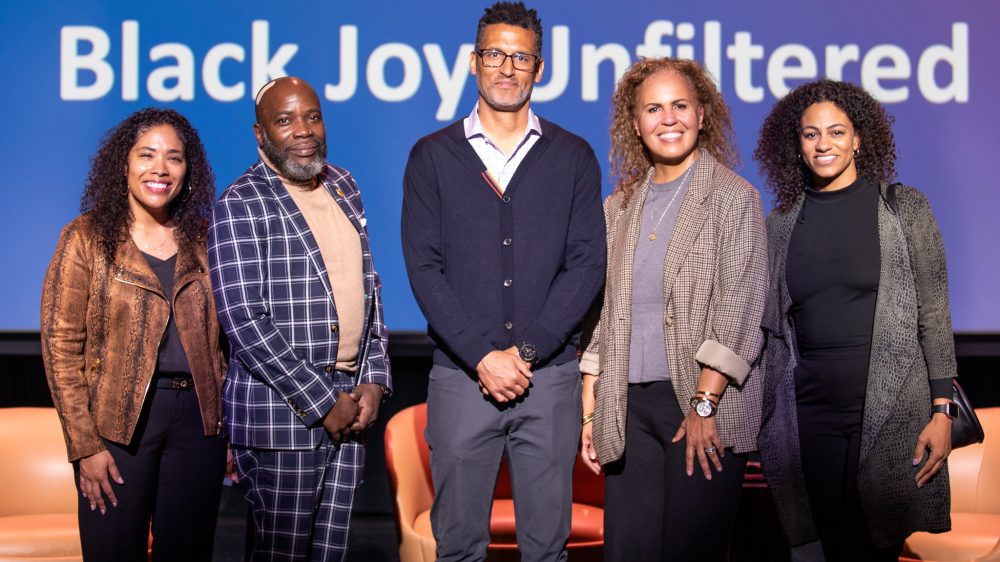
Panelists from the Luskin Lecture on February 25 at the UCLA Nimoy Theater with Michael Harriot, Michael Lens, and Safiya Noble stand on center stage to pose for a group photo.

“Black Joy Unfiltered” Draws Packed House at UCLA Nimoy Theater

March 3, 2026
Luskin's Latest Blog
Michael Harriot and Michael Lens reflect on Black history, neighborhoods and lived experience during a Black...
Read More
For sale home sign in front of a new construction home.

L.A. and Long Beach Among World’s Least Affordable Cities for Homebuyers

February 24, 2026
Luskin in the News
Skyrocketing prices and limited home supplies put homeownership out of reach for many....
Read More
Michael Lens In the News

Lens on the Biggest Fixes Needed in U.S. Housing Policy

November 7, 2025
Luskin in the News
Michael Lens emphasized shifting housing authority to state governments to overcome local barriers and expand affordable...
Read More
infant hand held by adult hand

Repercussions From the U.S.’ Plummeting Birth Rate

October 21, 2025
Luskin in the News
“It’s a really damaging thing if young people who want to have children feel financially unable...
Read More
UCLA Housing Voice Podcast

UCLA Housing Voice Podcast Celebrates 100 Episodes

October 16, 2025
Luskin's Latest Blog
Hosted by Shane Phillips, the podcast continues to bridge the gap between academic research and real-world...
Read More
Learn more about UCLA Luskin

Find contact information and get answers to your questions.

Contact Us

Public Affairs Building
337 Charles E. Young Drive East
Los Angeles, California 90095

Linkedin Youtube Instagram Facebook X-twitter
Campus Resources
  • Map, Directions, Parking
  • Directory
  • Academic Calendar
  • Careers
  • Map, Directions, Parking
  • Directory
  • Academic Calendar
  • Careers
School Resources
  • About
  • Our Dean
  • Administration
  • Board of Advisors
  • Contact Us
  • Visit Us
  • About
  • Our Dean
  • Administration
  • Board of Advisors
  • Contact Us
  • Visit Us
UCLA logo
© 2026 Regents of the University of California
  • Emergency
  • Accessibility
  • Privacy & Terms of Use
  • Emergency
  • Accessibility
  • Privacy & Terms of Use
Facebook Instagram Linkedin X-twitter Youtube Threads
Academics
Departments
  • Public Policy
  • Real Estate Development
  • Social Welfare
  • Urban Planning
  • Undergraduate Program
  • Public Policy
  • Real Estate Development
  • Social Welfare
  • Urban Planning
  • Undergraduate Program
Graduate Programs
  • Master of Public Policy (MPP)
  • Master of Real Estate Development (MRED)
  • Master of Social Welfare (MSW)
  • Master of Urban and Regional Planning (MURP)
  • PhD in Social Welfare
  • PhD in Urban Planning
  • Master of Public Policy (MPP)
  • Master of Real Estate Development (MRED)
  • Master of Social Welfare (MSW)
  • Master of Urban and Regional Planning (MURP)
  • PhD in Social Welfare
  • PhD in Urban Planning
Undergraduate Programs
  • BA in Public Affairs
  • Minor in Urban and Regional Studies
  • Minor in Gerontology
  • Minor in Public Affairs
  • BA in Public Affairs
  • Minor in Urban and Regional Studies
  • Minor in Gerontology
  • Minor in Public Affairs
Professional Certificates
  • Data Analytics Certificate
  • Data Analytics Certificate
Admissions
Program Specific Admissions
  • Public Policy
  • Real Estate Development
  • Social Welfare
  • Urban Planning
  • Undergraduate Program
  • Public Policy
  • Real Estate Development
  • Social Welfare
  • Urban Planning
  • Undergraduate Program
Faculty
Our Faculty
  • All Faculty
  • Public Policy
  • Real Estate Development
  • Social Welfare
  • Urban Planning
  • All Faculty
  • Public Policy
  • Real Estate Development
  • Social Welfare
  • Urban Planning
Leadership
  • Our Dean
  • Board of Advisors
  • Faculty Executive Committee
  • Our Dean
  • Board of Advisors
  • Faculty Executive Committee
Research Centers
  • Agile Visual Analytics Lab (AVAL)

    Empowers stakeholders with data to make informed decisions for children, families, and communities.

  • Berggruen Governance Index

    Evaluates the quality of political governance and democracy worldwide.

  • Center for Neighborhood Knowledge (CNK)

    Specializes in spatial analysis of socioeconomic disparities in neighborhoods.

  • Center for Policy Research on Aging (CPRA)

    Explores the societal and policy implications of an aging population.

  • Agile Visual Analytics Lab (AVAL)

    Empowers stakeholders with data to make informed decisions for children, families, and communities.

  • Berggruen Governance Index

    Evaluates the quality of political governance and democracy worldwide.

  • Center for Neighborhood Knowledge (CNK)

    Specializes in spatial analysis of socioeconomic disparities in neighborhoods.

  • Center for Policy Research on Aging (CPRA)

    Explores the societal and policy implications of an aging population.

  • Institute of Transportation Studies (ITS)

    Advances research, education, and meaningful civic engagement on transportation issues.

  • Institute on Inequality and Democracy

    Advances scholarship that confronts threats to democracy in America and around the world.

  • Latin American Cities Initiative

    Connects urban planning and policy networks across the Americas.

  • Latino Policy & Politics Institute (LPPI)

    Addresses policy challenges facing Latinos and communities of color.

  • Institute of Transportation Studies (ITS)

    Advances research, education, and meaningful civic engagement on transportation issues.

  • Institute on Inequality and Democracy

    Advances scholarship that confronts threats to democracy in America and around the world.

  • Latin American Cities Initiative

    Connects urban planning and policy networks across the Americas.

  • Latino Policy & Politics Institute (LPPI)

    Addresses policy challenges facing Latinos and communities of color.

  • Lewis Center for Regional Policy Studies

    Studying housing affordability and transportation equity in the L.A. region.

  • Los Angeles Education Research Institute (LAERI)

    Collaborates with schools to improve educational outcomes for L.A. students.

  • Luskin Center for Innovation

    Informing effective and equitable environmental policy that improves lives.

  • UCLA Voting Rights Project

    The flagship project for voting rights litigation and policy research.

  • Lewis Center for Regional Policy Studies

    Studying housing affordability and transportation equity in the L.A. region.

  • Los Angeles Education Research Institute (LAERI)

    Collaborates with schools to improve educational outcomes for L.A. students.

  • Luskin Center for Innovation

    Informing effective and equitable environmental policy that improves lives.

  • UCLA Voting Rights Project

    The flagship project for voting rights litigation and policy research.

All Research Centers
Outcomes
Common Search Terms

Results will show as you type.