Skip to content
  • Students & Alumni
    • Career Services
    • Alumni Relations
    • Student Support
    • Graduate Resource Library
    • For Employers
  • News
  • Events
    • Events Calendar
    • Luskin Summit
    • Luskin Lecture Series
    • California Policy Briefing
    • Commencement
  • Students & Alumni
    • Career Services
    • Alumni Relations
    • Student Support
    • Graduate Resource Library
    • For Employers
  • News
  • Events
    • Events Calendar
    • Luskin Summit
    • Luskin Lecture Series
    • California Policy Briefing
    • Commencement
Giving
UCLA Luskin School of Public Affairs Logo
  • Academics
    Departments & Programs
    • Global Public Affairs
    • Public Policy
    • Real Estate Development
    • Social Welfare
    • Urban Planning
    • Undergraduate Program
    • Global Public Affairs
    • Public Policy
    • Real Estate Development
    • Social Welfare
    • Urban Planning
    • Undergraduate Program
    Graduate Degrees
    • Master of Global Public Affairs (MGPA)
    • Master of Public Policy (MPP)
    • Master of Real Estate Development (MRED)
    • Master of Social Welfare (MSW)
    • Master of Urban and Regional Planning (MURP)
    • PhD in Social Welfare
    • PhD in Urban Planning
    • Master of Global Public Affairs (MGPA)
    • Master of Public Policy (MPP)
    • Master of Real Estate Development (MRED)
    • Master of Social Welfare (MSW)
    • Master of Urban and Regional Planning (MURP)
    • PhD in Social Welfare
    • PhD in Urban Planning
    Undergraduate Degrees
    • BA in Public Affairs
    • Minor in Urban and Regional Studies
    • Minor in Gerontology
    • Minor in Public Affairs
    • BA in Public Affairs
    • Minor in Urban and Regional Studies
    • Minor in Gerontology
    • Minor in Public Affairs
    Professional Certificates
    • AI in Public Affairs Certificate
    • AI in Public Affairs Certificate
  • Admissions
    Program Specific Admissions
    • Global Public Affairs
    • Public Policy
    • Real Estate Development
    • Social Welfare
    • Urban Planning
    • Undergraduate Program
    • Global Public Affairs
    • Public Policy
    • Real Estate Development
    • Social Welfare
    • Urban Planning
    • Undergraduate Program
  • Faculty
    Our Faculty
    • All Faculty
    • Public Policy
    • Real Estate Development
    • Social Welfare
    • Urban Planning
    • All Faculty
    • Public Policy
    • Real Estate Development
    • Social Welfare
    • Urban Planning
    Leadership
    • Our Dean
    • Board of Advisors
    • Faculty Executive Committee
    • Our Dean
    • Board of Advisors
    • Faculty Executive Committee
  • Research Centers
    • Agile Visual Analytics Lab (AVAL)

      Empowers stakeholders with data to make informed decisions for children, families, and communities.

    • Berggruen Governance Index

      Evaluates the quality of political governance and democracy worldwide.

    • Center for Neighborhood Knowledge (CNK)

      Specializes in spatial analysis of socioeconomic disparities in neighborhoods.

    • Center for Policy Research on Aging (CPRA)

      Explores the societal and policy implications of an aging population.

    • Institute of Transportation Studies (ITS)

      Advances research, education, and meaningful civic engagement on transportation issues.

    • Institute on Inequality and Democracy

      Advances scholarship that confronts threats to democracy in America and around the world.

    • Latin American Cities Initiative

      Connects urban planning and policy networks across the Americas.

    • Latino Policy & Politics Institute (LPPI)

      Addresses policy challenges facing Latinos and communities of color.

    • Lewis Center for Regional Policy Studies

      Studying housing affordability and transportation equity in the L.A. region.

    • Los Angeles Education Research Institute (LAERI)

      Collaborates with schools to improve educational outcomes for L.A. students.

    • Luskin Center for Innovation

      Informing effective and equitable environmental policy that improves lives.

    • UCLA Voting Rights Project

      The flagship project for voting rights litigation and policy research.

    All Research Centers
  • Outcomes
Home / News / How to Help Queer Kids in Foster Care

How to Help Queer Kids in Foster Care

Author Cris Beam shares insights based on extensive research and personal experience in her Luskin Lecture
Cris Beam, an expert on child welfare and LGBTQ issues, converses with the audience at the UCLA Luskin Lecture on March 5, 2019
Cris Beam, an expert on child welfare and LGBTQ issues, converses with the audience at the UCLA Luskin Lecture on March 5, 2019. Photo by Les Dunseith

Posted in

  • School of Public Affairs, Social Welfare, Undergraduates

Published on

  • March 18, 2019
  • child welfare, foster care, LGBTQ, Luskin Lecture

Share this Article

By Mary Braswell

LGBTQ youth in the foster care system often grapple with rejection, harassment, violence — and their own mistrust of the individuals and institutions charged with protecting them.

Restoring that trust requires taking a hard look at what these youth really need, not just to navigate the child welfare system but to lead rewarding lives.

This was the message shared by Cris Beam — author, educator and herself the foster mom to a transgender young woman — at a UCLA Luskin Lecture on March 5, 2019.

Beam’s talk included many moments of insight and encouragement, even as she described a foster care system that is woefully broken.

“How can we be spending upwards of $22 billion nationally and nobody — not the kids, not the foster parents, not the bio parents, not the administrators, not the policymakers, not the lawyers — nobody thinks this is working?” she asked.

That question sent Beam in pursuit of answers. Her extensive research into the U.S. child welfare system, LGBTQ issues and the power of empathy, as well as her personal experience becoming a foster parent at age 28, led her to a solution that is both simple and daunting.

What kids in foster care need, she said, is what all kids need: lasting human relationships, whether biological, adoptive or built from scratch with “teachers, babysitters, bus drivers” — people who are willing to step up, learn parenting skills and stick around, Beam said.

“The only way a child can succeed is to connect to a family, or even an individual person, for a lifetime. Whether they are gay or straight or bi or trans or otherwise,” she said.

Beam has published several acclaimed fiction and nonfiction books, including “To the End of June: The Intimate Life of American Foster Care” and “I am J,” the first book with a transgender character to make the state of California’s high school reading list. She is also an assistant professor of English at William Paterson University in New Jersey.

Prior to her lecture on “Queer Care: LGBTQ Youth in Child Welfare,” UCLA Luskin Dean Gary Segura noted that Beam’s work is in line with the School’s mission to “provide a voice for the unheard and change society in ways that help those most in need, including and especially families and children.”

Beam’s appearance at the UCLA Faculty Center fittingly coincided with Social Work Month and the National Day of Empathy, said Laura Abrams, chair of Social Welfare, which organized the Luskin Lecture.

More than 50 people came to hear Beam’s insights, including students, faculty, lawyers, child psychologists, and current and aspiring social workers. Their questions for Beam revealed frustration at wanting to serve foster youth within a system that often fails them.

“I feel for you because you’ve got so many people,” Beam said of the heavy caseloads many social workers carry. “But if you can stick by somebody and be constant, sometimes you can be that person that is around for someone for years and years. That’s what they need. It’s that human connection.”

LGBTQ youth are overrepresented in the child welfare and juvenile justice systems. To illustrate the cycle that many of them enter, Beam shared the experiences of her daughter, Christina, who was 16 when they met at a group home where Beam taught. Christina had been in and out of foster care since age 7, was jumped into a gang as a 12-year-old boy, survived on the streets by doing sex work, then entered the criminal justice system — all as she transitioned into a girl.

The probation officer who approached Beam about fostering Christina said, “‘Don’t worry. She’s already 16. She only has another year until she ages out.’” But Beam quickly learned that Christina needed much more, including “time to heal, to be stable and to trust.” No adoption papers were needed to form a lifelong mother-daughter relationship, she said.

Building this kind of support network should be a priority of child welfare agencies, Beam said. Instead, the system often labels children who suffer complex traumas as difficult, equates foster children with juvenile delinquents, and squanders resources training teens to get a job, write a rent check, survive on their own.

“Really what queer kids need are not more resources, more things, but human beings to rock with them all the way,” Beam said.

View more photos from the lecture on Flickr.
Faculty Mentioned in this Article
Gary-Segura-profile-e1515200047412

Gary M. Segura

Professor of Public Policy, Political Science, and Chicano and Chicana Studies

Gary Segura served as the Dean of the Luskin School of Public Affairs at UCLA from January 2017 to December...

Related Articles

A low angle view of a long line of people waitng to vote in the elections.

As Polls Show Latino Disenchantment, True Test Comes on Election Day

October 9, 2026
Luskin in the News
Read More
Photo by Walter Cicchetti / iStock

The Facts on Free and Fair Elections: A Q&A With Gary Segura

May 7, 2026
Public Policy
The UCLA Luskin political scientist weighs in on the changing landscape of voting rights and how...
Read More
Man in orange hat on street with many campaign signs

A Leftward Shift in the Ever-Evolving Latino Vote

April 1, 2026
Luskin in the News
Recent elections suggest an abrupt correction is underway, with some of those who backed Trump now...
Read More
silhouette of voters against stained-glass background

Segura on Bread-and-Butter Issues Driving Latinos to the Polls

November 13, 2025
Luskin in the News
Inflation, jobs, housing, and health care are top priorities, according to a new UnidosUS poll of...
Read More
Downtown LA just after sunset during blue hour, captured from a helicopter point of view with lighted City Hall building.

UCLA Grants Deepen Ties to the L.A. Community

March 17, 2025
Public Policy
Projects by Luskin faculty will build collaboration among scholars, students and local partners....
Read More
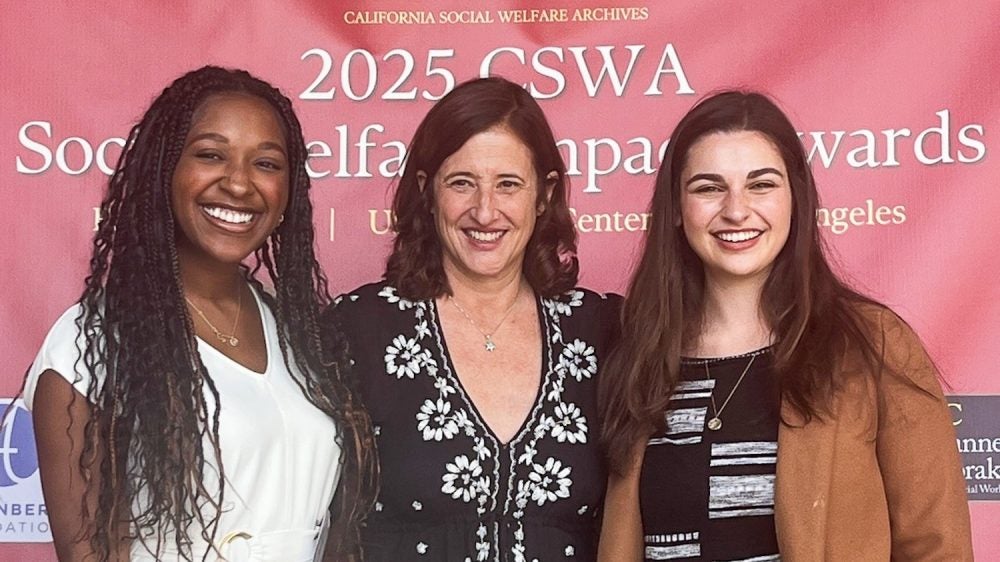
Professor Laura Abrams, center, at the CSWA ceremony with her doctoral students Taylor Reed, left, and Julia Lesnick

Honors for UCLA Luskin Social Welfare Professor and Alumna

March 4, 2025
Luskin's Latest Blog
Professor Laura Abrams and alumna Aurea Montes-Rodriguez are recognized by the California Social Welfare Archives....
Read More
Learn more about UCLA Luskin

Find contact information and get answers to your questions.

Contact Us

Public Affairs Building
337 Charles E. Young Drive East
Los Angeles, California 90095

Linkedin Youtube Instagram Facebook X-twitter
Campus Resources
  • Map, Directions, Parking
  • Directory
  • Academic Calendar
  • Careers
  • Map, Directions, Parking
  • Directory
  • Academic Calendar
  • Careers
School Resources
  • About
  • Our Dean
  • Administration
  • Luskin School Intranet
  • Board of Advisors
  • Contact Us
  • Visit Us
  • About
  • Our Dean
  • Administration
  • Luskin School Intranet
  • Board of Advisors
  • Contact Us
  • Visit Us
UCLA logo
© 2026 Regents of the University of California
  • Emergency
  • Accessibility
  • Privacy & Terms of Use
  • Emergency
  • Accessibility
  • Privacy & Terms of Use
Facebook Instagram Linkedin X-twitter Youtube Threads
UCLA Luskin School of Public Affairs Logo
Academics
Departments
  • Global Public Affairs
  • Public Policy
  • Real Estate Development
  • Social Welfare
  • Urban Planning
  • Undergraduate Program
  • Global Public Affairs
  • Public Policy
  • Real Estate Development
  • Social Welfare
  • Urban Planning
  • Undergraduate Program
Graduate Programs
  • Master of Global Public Affairs (MGPA)
  • Master of Public Policy (MPP)
  • Master of Real Estate Development (MRED)
  • Master of Social Welfare (MSW)
  • Master of Urban and Regional Planning (MURP)
  • PhD in Social Welfare
  • PhD in Urban Planning
  • Master of Global Public Affairs (MGPA)
  • Master of Public Policy (MPP)
  • Master of Real Estate Development (MRED)
  • Master of Social Welfare (MSW)
  • Master of Urban and Regional Planning (MURP)
  • PhD in Social Welfare
  • PhD in Urban Planning
Undergraduate Programs
  • BA in Public Affairs
  • Minor in Urban and Regional Studies
  • Minor in Gerontology
  • Minor in Public Affairs
  • BA in Public Affairs
  • Minor in Urban and Regional Studies
  • Minor in Gerontology
  • Minor in Public Affairs
Professional Certificates
  • AI in Public Affairs Certificate
  • AI in Public Affairs Certificate
Admissions
Program Specific Admissions
  • Global Public Affairs
  • Public Policy
  • Real Estate Development
  • Social Welfare
  • Urban Planning
  • Undergraduate Program
  • Global Public Affairs
  • Public Policy
  • Real Estate Development
  • Social Welfare
  • Urban Planning
  • Undergraduate Program
Faculty
Our Faculty
  • All Faculty
  • Public Policy
  • Real Estate Development
  • Social Welfare
  • Urban Planning
  • All Faculty
  • Public Policy
  • Real Estate Development
  • Social Welfare
  • Urban Planning
Leadership
  • Our Dean
  • Board of Advisors
  • Faculty Executive Committee
  • Our Dean
  • Board of Advisors
  • Faculty Executive Committee
Research Centers
  • Agile Visual Analytics Lab (AVAL)

    Empowers stakeholders with data to make informed decisions for children, families, and communities.

  • Berggruen Governance Index

    Evaluates the quality of political governance and democracy worldwide.

  • Center for Neighborhood Knowledge (CNK)

    Specializes in spatial analysis of socioeconomic disparities in neighborhoods.

  • Center for Policy Research on Aging (CPRA)

    Explores the societal and policy implications of an aging population.

  • Institute of Transportation Studies (ITS)

    Advances research, education, and meaningful civic engagement on transportation issues.

  • Institute on Inequality and Democracy

    Advances scholarship that confronts threats to democracy in America and around the world.

  • Latin American Cities Initiative

    Connects urban planning and policy networks across the Americas.

  • Latino Policy & Politics Institute (LPPI)

    Addresses policy challenges facing Latinos and communities of color.

  • Lewis Center for Regional Policy Studies

    Studying housing affordability and transportation equity in the L.A. region.

  • Los Angeles Education Research Institute (LAERI)

    Collaborates with schools to improve educational outcomes for L.A. students.

  • Luskin Center for Innovation

    Informing effective and equitable environmental policy that improves lives.

  • UCLA Voting Rights Project

    The flagship project for voting rights litigation and policy research.

All Research Centers
Outcomes
Common Search Terms

Results will show as you type.