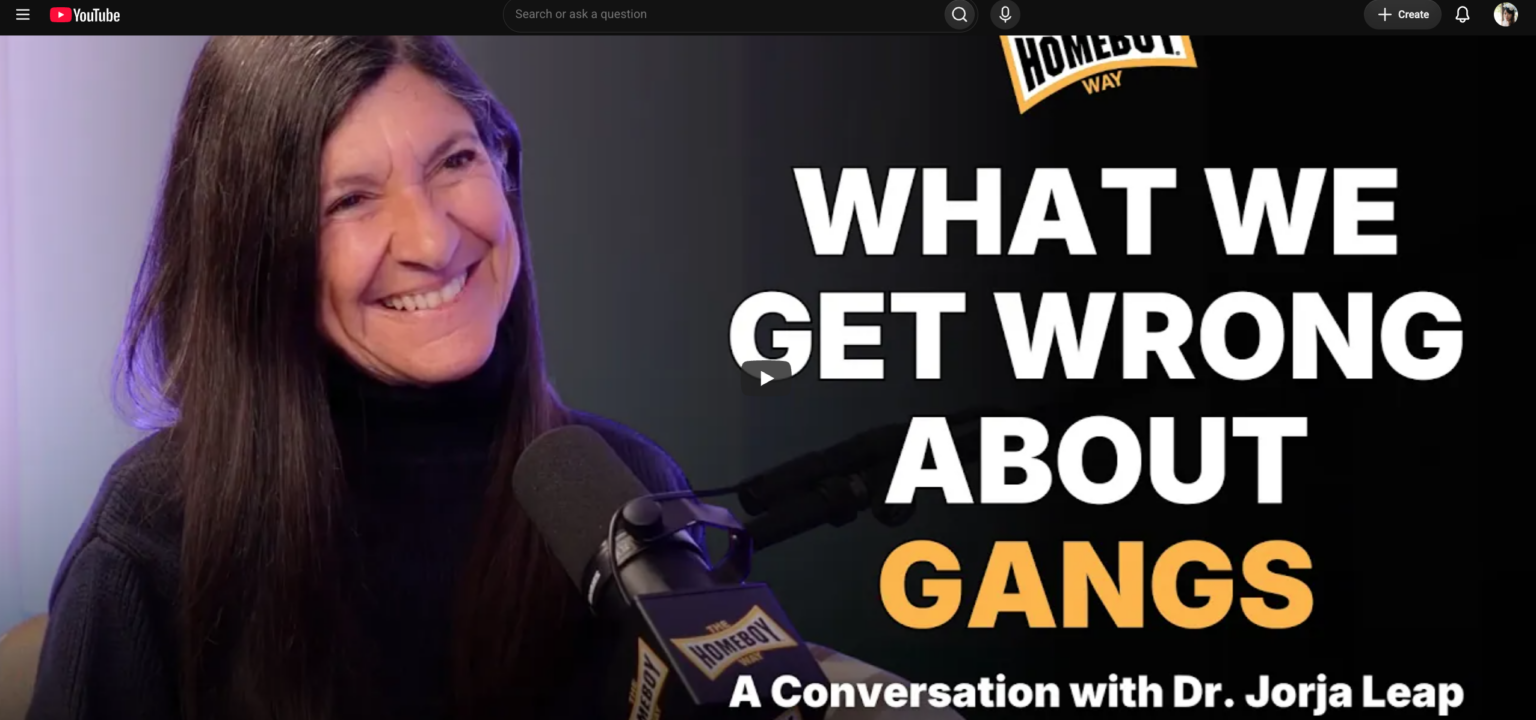
UCLA Luskin Social Welfare Professor Jorja Leap reflected on nearly four decades of research, friendship and learning alongside Homeboy Industries during a recent episode of “The Homeboy Way” podcast.
In conversation with Tom Vozzo, former CEO of Homeboy Industries, Leap recalled first meeting Father Greg Boyle as a young social worker in Watts in the late 1980s, years before Homeboy grew into the gang intervention, rehabilitation and reentry organization it is today.
That relationship would shape both her scholarship and her life.
Leap’s early research with Homeboy sought to understand what helped people leave gang life behind. The answer, she found, was not a single program or intervention.
“The effectiveness was based on relationships,” Leap said.
She also described transformation as a complicated and often nonlinear process, preferring the language of “relapse” rather than “recidivism” and rejecting the idea that setbacks necessarily represent failure.
That philosophy is reflected in Homeboy’s willingness to keep welcoming people back, she said: “Homeboy never gives up on anyone.”
For Leap, however, Homeboy’s influence extends far beyond her research.
“It has taught me the meaning of life, of love,” she said. “I cannot begin to say the ways it has changed me.”
Homeboy, she added, has “utterly changed my perception of people and how they transform themselves” while teaching her about “humility, love, about gangs, gang members and community violence.”
She added, “Greg Boyle has taught me in the purest sense, the meaning of unconditional love,” she said.
The conversation also explored the evolution of gang intervention in Los Angeles, challenges facing community organizations seeking government and philanthropic support, and Leap’s advice to nonprofits on using research to document their impact.