By Stan Paul
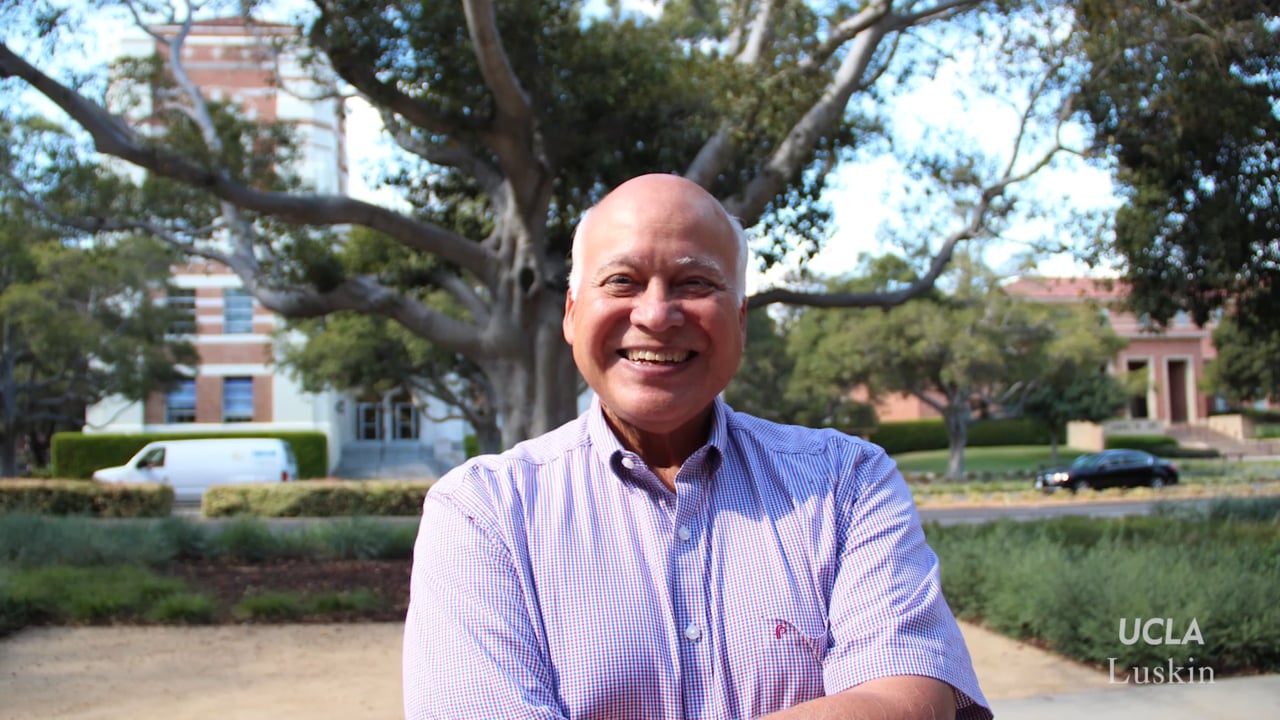
Leo Estrada was a fierce and effective advocate for Latino voting, civil rights and representation prior to his death in November 2018. For 40 years before his retirement in June 2018, Estrada devoted his time and talent to research and teaching new generations of urban planners. But, for the Texas native who first arrived at UCLA in 1977, his career was also marked from the beginning by civic engagement, leadership and giving back.
Estrada was “a giant on many different fronts,” Anastasia Loukaitou-Sideris, a longtime Luskin School colleague and urban planning professor, said prior to his death. “He has been an inspiring teacher and a mentor to an endless number of UCLA students and a role model to many Latino and minority students.”
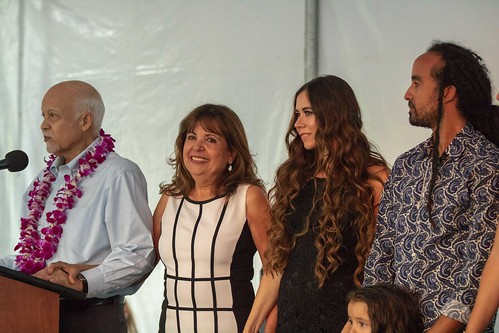
A June 11, 2018, retirement celebration in honor of Estrada recognized his decades of scholarship, service and accomplishments as an associate professor at UCLA and the UCLA Luskin School of Public Affairs.
Estrada was one of the first urban planning scholars to teach and institutionalize courses about diversity and planning, said Loukaitou-Sideris, who is also associate provost for academic planning at UCLA.
“As a brilliant demographer, he was also instrumental in confronting gerrymandering and giving ethnic communities equal representation in California and other states around the country,” she said.
“As if these accomplishments have not been enough, Leo has also served on a number of important university shared-governance posts,” Loukaitou-Sideris said at the time. His most recent leadership post was no small assignment — guiding the direction of UCLA for years to come as chair of the Academic Senate in 2015-16.
UCLA Luskin colleague Fernando Torres-Gil said last spring that Estrada also conducted pioneering work in the fields of gerontology and Latino aging.
“As a young graduate student I came to know about Leo Estrada,” said Torres-Gil, professor of public policy and social welfare. “He was completing his dissertation at Florida State at a time when the field of aging was new and no one had investigated the demographic and social issues of an emerging population — Latinos.”
His former colleague had “the foresight to raise issues of Latino aging, support budding graduate students like myself and become a co-founder of important Hispanic advocacy groups.”
Torres-Gil, director of the UCLA Luskin-based Center for Policy Research on Aging, said of Estrada: “I owe much to his early mentoring, to his friendship and, best of all, to becoming colleagues in the Luskin School.”
According to Torres-Gil, Estrada was among the first and longest-serving Latinos in the Luskin School and its earlier iterations of Social Welfare and Urban Planning at UCLA.
UCLA and Beyond the Gates
Estrada had been at UCLA during its growth into one of the pre-eminent universities in the world.
“When I came here, I would consider UCLA to be one of the better schools in the United States,” Estrada said prior to his retirement ceremony. “As I leave now, in the year 2018, it is one of the best. And so I’m very proud because I participated in some aspects of that all along the way.”
The Leo Estrada fellowship fund at the Luskin School of Public Affairswill support graduate students in the department ofUrban Planning with an unmet financial need who are from cultural,racial, linguistic, geographic and socioeconomic backgrounds that areunderrepresented in graduate education.
Estrada had felt called to engage in the issues, events and protests around him. When he arrived at UCLA, he said last spring, “There was always something happening, and every place I had been to earlier discouraged the faculty from community involvement.”
But Estrada encountered a different attitude in an interview with his first boss at UCLA, the late Harvey Perloff, known as the “dean” of American urban planners and iconic early leader of UCLA’s Graduate School of Architecture and Urban Planning, as it was then known.
“He asked me if I had a question and I said, ‘Yes.’ I said, ‘If I become involved in community issues and spend some of my time not only on campus but off campus, will that be a problem?’ And he said, ‘It’s not a problem at all.’ In fact, he said, ‘I’ll reward you for it.’
“Reward me for it?” repeated Estrada. He recalled Perloff’s response: “ ‘I think our faculty in the field of planning should be in the community, so you do what you have to do. Try not to get arrested.’ ”
Estrada dove into issues in Los Angeles, then the Southwest, then across the country.
“One of the things I had was a skill in mapping, and so I became involved in redistricting issues” in cities including San Diego, Sacramento, Albuquerque, Chicago and New York, he said prior to his retirement.
“The latest thing I did was redistrict the congressional districts in Arizona after the last Census,” said Estrada, who became a go-to expert for government, academics and the media. “I had a talent and I used it.”
The Call
Estrada’s community involvement put him at the forefront of issues in Los Angeles — including the beating of Rodney King in 1991 and the formation of the Christopher Commission to examine use of force by the LAPD.
Estrada recalled answering his home phone one night about 8 o’clock. “It was Tom Bradley. You don’t expect to receive a call from the mayor,” he said. Bradley invited him downtown the next morning to talk about serving on a commission. Estrada didn’t have classes that day, so he agreed.
“When I got downtown, I was introduced as one of Bradley’s group of seven people that had been selected to serve on this commission. When I showed up, I expected to see the mayor and some of his deputy mayors, and there we were in front of the cameras .”
Estrada said the commission worked from early morning into the evening during the 100 days he served. “It was an incredible experience. We worked every day of the week, Saturdays and Sundays near the end as well,” he said. “We argued a lot.”
“As a brilliant demographer, Leo was instrumental in confronting gerrymandering and giving ethnic communities equal representation in California and other states around the country.”
— Anastasia Loukaitou-Sideris, urban planning professor
Relations between police and the public had been deteriorating in Los Angeles for some time. The Christopher Commission concluded that a breakdown in LAPD management created a culture that tolerated the excessive use of force. But the following spring, the acquittal of four officers involved in the beating triggered the Los Angeles riots, which led to scores of deaths.
“It’s one of the most important moments of my history and life here in Los Angeles,” Estrada recalled as he prepared to retire. “That little commission report started a whole movement of community policing that took over in most of the United States.”
On Planning
Estrada’s fascination with the planning profession never waned.
“I think urban planning is … one of the key fields right now in academia. There’s almost nothing that doesn’t touch on planning,” he said last spring. The profession has expanded its horizons, he said, pointing to areas such as food systems and bike path planning as “something we never would have thought of 20 years ago.”
“I’m just pleased by the way we expanded into new fields, never got stuck in a status quo. [We’re] always looking for new ways to make planning relevant to all aspects of urban life,” Estrada said.
In some ways, the field has become more complex, he said, but planners have access to new technology that didn’t exist a generation ago.
“As long as people really believe in trying to make this a better world, we can make things happen,” he said.
Giving Back
“UCLA has been really good to me, and I have been appreciative,” Estrada said as he looked back on his long career prior to retiring. “They provided me with resources, opportunities, just an incredible amount. I can’t even begin to list the amount of things I’ve been able to do, in the department, at the university. And I’ve felt blessed.”
As he approached retirement, Estrada decided he needed to give back. He had previously served on the Undergraduate Council and Academic Senate, and in 2015 he stepped up to chair the Senate, which allows the faculty to participate in governing the university.
But this was no twilight tour for Estrada. “You find yourself in a position of negotiating constantly, and UCLA is such a monster in terms of what’s going on, so many things happening, so many people, and there’s 3,700 members of the Academic Senate and you represent them as the spokesperson.”
“I gave back a lot more than I was expecting,” said Estrada earlier this year. “Some things were controversial.
He added, “Leaders of the Academic Senate … work every day to make the faculty at UCLA the best that it can be.
“It gives you a perspective,” he said of his time on the Academic Senate. “That’s why I can tell you I know for sure that UCLA is one of the best schools in the world because I’ve seen what we do and how it’s done to sustain that kind of quality.”
View photos from the retirement celebration in a Flickr album:
‘Gratitude and Respect’
In preparation for the retirement celebration, students and colleagues from all three UCLA Luskin departments recalled the essential role that Leo Estrada played in their education and careers.
“Leo’s tireless mentorship of our master’s and Ph.D. students is very well-known, and we will honestly struggle mightily to fill that void after he leaves. What might not be as well known is his mentorship of junior faculty. In my case, Leo taught me more than anyone how to work –how to organize your time and ideas, and how to prioritize between the countless opportunities and responsibilities that we face in these great jobs we have. I will continue to pass this advice down to future colleagues and try (and often fail) to fully implement his advice.”
— <a href="https://luskin.ucla.edu/person/michael-lens/">Michael Lens</a>
“When people learn that I was in urban planning at UCLA, their most frequently asked follow up question is “Do you know Leo Estrada? From community spaces to academic conferences to quick conversations with people I’ve just met, Leo is a living legend whose legacy will stretch far beyond his more than four decades at UCLA. Leo was my Ph.D. advisor and dissertation committee chair, and I am endlessly grateful that from day one he modeled for me his incredible dedication to mentoring, to teaching, and to being an active citizen of the university community. Now as a professor at CSULB I often find myself thinking ‘What Would Leo Do?’ when considering how to guide my own students. The answer is easy: I remind myself of the ways in which Leo always sees his students as the whole people that they are, which means it is only natural that he then teaches and mentors them from a place of authentic care. I know I’m not alone in saying that Leo had a significant impact on my trajectory as an educator, and on how I learned to envision a place for myself in academia and the community.”
— Nina Flores, UP Ph.D. ’16
“Professor Estrada always listened first, and then provided his sage and soft prompts that got us back on our feet and headed in the right direction. And he did this for so many students. There was a constant stream of students visiting him in office hours to discuss any number of issues. He has helped thousands of students, and so many of them first generation students of color who, without his guidance, might not have been the first in their families to attain a master’s or doctorate degree. I have also been fortunate to stay connected with Professor Estrada post my UCLA studies, through the enormous work he has led in redistricting, demographics and spatial analysis. Professor Estrada’s work trail blazed equitable representation and full counts of ALL people across Los Angeles, California and beyond. Finally, his wisdom in connecting his students to his applied research work ensured the next generation of demographers, urban planners, and policy leaders follow in his footsteps. To Leo, you have my eternal gratitude, respect, and prayers for good health.”
— Veronica Melvin MPP ’01
“Dr. Estrada represents everything that I hope to be in a Professor. He is brilliant, warm, fair, empowering and extremely skilled in shepherding students through the hurdles of academia. As a woman of color returning for my doctorate in my 40s, Dr. Estrada met my anxious arrival with a calm ‘I know how to get you through, don’t worry.’ My doctoral program was a tough road, as I usually had at least one job (sometimes two) and I was a single parent for much of the time. Dr. Estrada made sure I stayed on track, focused on what was important and made each milestone. Most importantly, he serves as my model for how I interact with students. As a scholar dedicated to social and economic justice, I feel helping students access public education is a vital part of my mission. UCLA, as a great public institution, is only as great as how its faculty provides this access. Dr. Estrada embodies this role – He broke through barriers and widened the pathway for others to follow. Without him, countless students of color would not have achieved their graduate degrees. As a three time Bruin (BA ’91, MA/MSW ’99, PhD ’14), when I define UCLA’s greatness, I describe the faculty that truly believe in the purpose of public education – and Dr. Estrada personifies that purpose.”
— Susan J. Nakaoka, MA ’99, MSW ’99, PhD ’14
“While Leo is a national leader in the field of demographics and was instrumental in developing and teaching the department’s GIS curriculum, I think his most important contribution has been to the hundreds of students he has mentored and supported. For many years Leo and I were the Faculty Counseling Board tasked with helping students who were having academic trouble. Leo had a marvelous way of getting students to focus on why things weren’t going well and to help them create a plan to overcome their difficulties. He was supportive at every step and I can’t remember a student who did not ultimately complete the program successfully – in many cases largely because of Leo’s encouragement. We also both worked on admissions for the department. When tough decisions were required, Leo was always willing to read and discuss files, give valuable input and straightforward opinions. He has been instrumental in helping the department student body become as diverse as it is. Many excellent students applied to our program because of their introduction to Urban Planning in Leo’s undergraduate courses. Whether fellow faculty member, staff or student, Leo would always make time to listen and offer support. I feel very lucky to have worked with him for so many years and to have him as a friend.”
— <a href="https://luskin.ucla.edu/person/robin-liggett/">Robin Liggett</a>