Skip to content
  • Students & Alumni
    • Overview
    • Career Services
    • Alumni Relations
    • Student Support
    • Graduate Resource Library
  • News
  • Events
    • Events Calendar
    • Luskin Summit
    • Luskin Lecture Series
    • California Policy Briefing
    • Commencement
  • Students & Alumni
    • Overview
    • Career Services
    • Alumni Relations
    • Student Support
    • Graduate Resource Library
  • News
  • Events
    • Events Calendar
    • Luskin Summit
    • Luskin Lecture Series
    • California Policy Briefing
    • Commencement
Giving
  • Academics
    Departments
    • Public Policy
    • Real Estate Development
    • Social Welfare
    • Undergraduate Program
    • Urban Planning
    • Public Policy
    • Real Estate Development
    • Social Welfare
    • Undergraduate Program
    • Urban Planning
    Graduate Programs
    • Master of Public Policy (MPP)
    • Master of Real Estate Development (MRED)
    • Master of Social Welfare (MSW)
    • Master of Urban and Regional Planning (MURP)
    • PhD in Social Welfare
    • PhD in Urban Planning
    • Master of Public Policy (MPP)
    • Master of Real Estate Development (MRED)
    • Master of Social Welfare (MSW)
    • Master of Urban and Regional Planning (MURP)
    • PhD in Social Welfare
    • PhD in Urban Planning
    Undergraduate Programs
    • BA in Public Affairs
    • Minor in Urban and Regional Studies
    • Minor in Gerontology
    • Minor in Public Affairs
    • BA in Public Affairs
    • Minor in Urban and Regional Studies
    • Minor in Gerontology
    • Minor in Public Affairs
    Professional Certificates
    • Data Analytics Certificate
    • Data Analytics Certificate
  • Admissions
    Program Specific Admissions
    • Public Policy
    • Real Estate Development
    • Social Welfare
    • Urban Planning
    • Undergraduate Program
    • Public Policy
    • Real Estate Development
    • Social Welfare
    • Urban Planning
    • Undergraduate Program
  • Faculty
    Our Faculty
    • All Faculty
    • Public Policy
    • Real Estate Development
    • Social Welfare
    • Urban Planning
    • All Faculty
    • Public Policy
    • Real Estate Development
    • Social Welfare
    • Urban Planning
    Leadership
    • Our Dean
    • Board of Advisors
    • Faculty Executive Committee
    • Our Dean
    • Board of Advisors
    • Faculty Executive Committee
  • Research Centers
    • Agile Visual Analytics Lab (AVAL):

      Uses data visualization to improve decision-making for family and child services.

    • Berggruen Governance Index

      Evaluates the quality of political governance and democracy worldwide.

    • Center for Neighborhood Knowledge (CNK)

      Specializes in spatial analysis of socioeconomic disparities in neighborhoods.

    • Center for Policy Research on Aging (CPRA)

      Explores the societal and policy implications of an aging population.

    • Agile Visual Analytics Lab (AVAL):

      Uses data visualization to improve decision-making for family and child services.

    • Berggruen Governance Index

      Evaluates the quality of political governance and democracy worldwide.

    • Center for Neighborhood Knowledge (CNK)

      Specializes in spatial analysis of socioeconomic disparities in neighborhoods.

    • Center for Policy Research on Aging (CPRA)

      Explores the societal and policy implications of an aging population.

    • Institute of Transportation Studies (ITS)

      A national leader in transportation policy and mobility research.

    • Institute on Inequality and Democracy

      Advances scholarship addressing displacement and dispossession in Los Angeles and beyond.

    • Latin American Cities Initiative

      Connects urban planning and policy networks across the Americas.

    • Latino Policy & Politics Institute (LPPI)

      Addresses policy challenges facing Latinos and communities of color.

    • Institute of Transportation Studies (ITS)

      A national leader in transportation policy and mobility research.

    • Institute on Inequality and Democracy

      Advances scholarship addressing displacement and dispossession in Los Angeles and beyond.

    • Latin American Cities Initiative

      Connects urban planning and policy networks across the Americas.

    • Latino Policy & Politics Institute (LPPI)

      Addresses policy challenges facing Latinos and communities of color.

    • Lewis Center for Regional Policy Studies

      Researches housing, transportation, and economic development in Southern California.

    • Los Angeles Education Research Institute (LAERI)

      Collaborates with schools to improve educational outcomes for L.A. students.

    • Luskin Center for Innovation (LCI)

      Focuses on environmental policy, clean energy, and climate justice.

    • UCLA Voting Rights Project

      The flagship project for voting rights litigation and policy research.

    • Lewis Center for Regional Policy Studies

      Researches housing, transportation, and economic development in Southern California.

    • Los Angeles Education Research Institute (LAERI)

      Collaborates with schools to improve educational outcomes for L.A. students.

    • Luskin Center for Innovation (LCI)

      Focuses on environmental policy, clean energy, and climate justice.

    • UCLA Voting Rights Project

      The flagship project for voting rights litigation and policy research.

    All Research Centers
  • Outcomes
Home / New Sources, Innovative Applications of Big Data Explored at Conference

New Sources, Innovative Applications of Big Data Explored at Conference

UCLA Luskin Center for Innovation researchers demonstrate how digital technology is transforming humans into sensors that generate behavioral data on an unprecedented scale

Posted in

  • Digital Technologies, For Policymakers, Luskin Center, Public Policy, School of Public Affairs

Published on

  • August 31, 2017
  • Big Data, Facebook, social media, Twitter

Share this Article

By Stan Paul

If your 2016 Thanksgiving dinner was shorter than usual, the turkey on your dining table may not have been to blame.

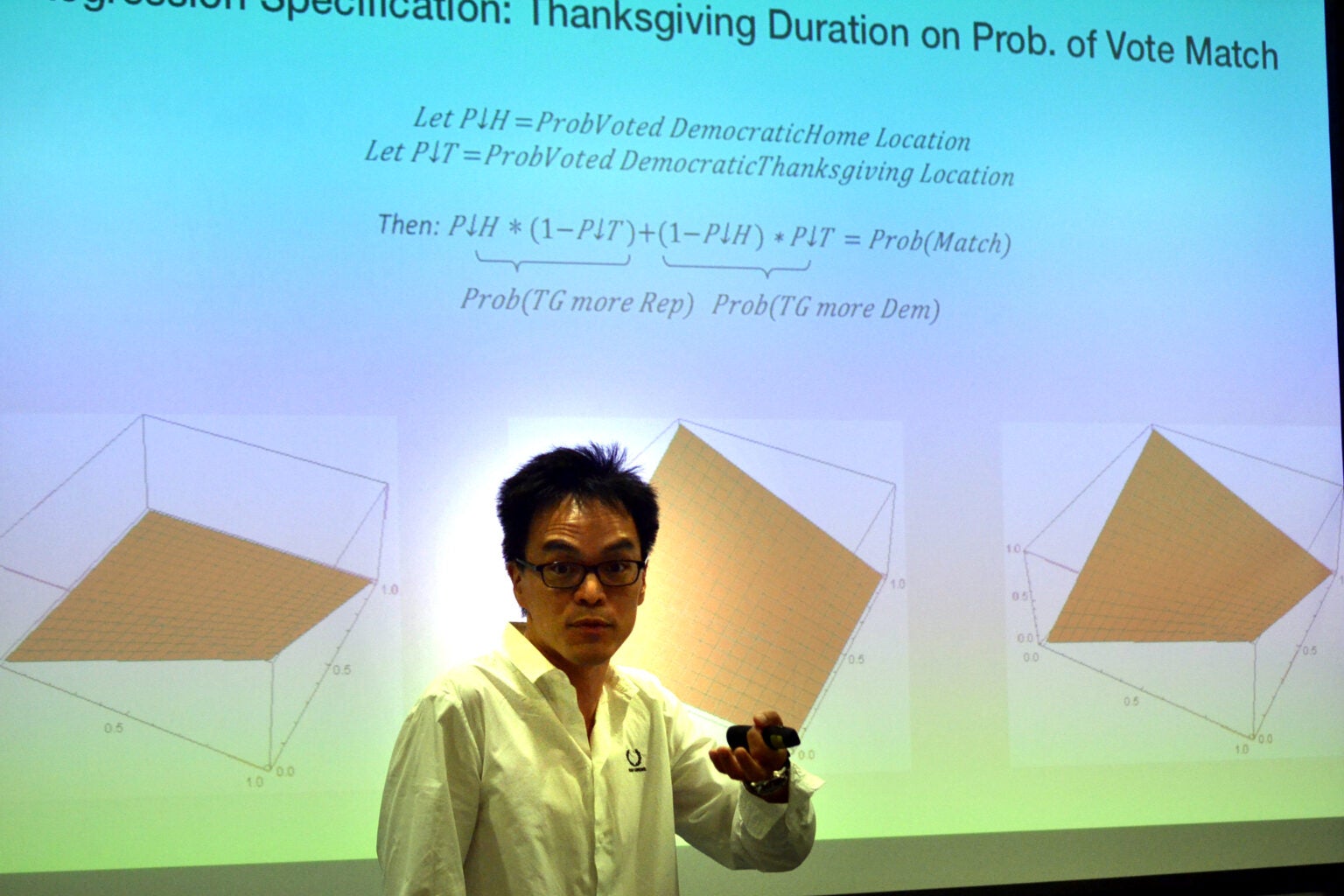
Who you had dinner with and their political affiliations following last year’s divisive election may have shortened the holiday get-together by about 25 minutes — or up to an hour depending on how many campaign/political messages saturated your market area. It’s all in the data.

“It’s not that conservatives and [liberals] don’t like eating Thanksgiving dinner with each other;  they don’t like eating Thanksgiving dinner together after an incredibly polarizing period,” said Keith Chen, associate professor of economics at the UCLA Anderson School of Management. Chen was among a group of scholars and data researchers who presented recent findings on Aug. 25, 2017, at a daylong conference about computational social science and digital technology hosted by the UCLA Luskin Center for Innovation.

Information gleaned from social media and from cellphone tracking data can reveal and confirm political polarization and other topics, such as poverty or protest, said researchers who gathered at the “The Future of Humans as Sensors” conference held at the UCLA Luskin School of Public Affairs.

The event brought together social scientists and data researchers to look for “ways to either extend what we can do with existing data sets or explore new sources of ‘big data,’” said Zachary Steinert-Threlkeld, assistant professor of public policy at UCLA Luskin and the leader of the program.

Steinert-Threlkeld presented his latest research, which was motivated by the Women’s March in the United States, as an example of measuring protest with new data sources that include geo-located Twitter accounts. While conducting research, Steinert-Threlkeld has observed that working with social media data has actually become more difficult of late.

“While Facebook lets you use data from profiles that are public, most people have private profiles,” Steinert-Threlkeld said. Seeing private data requires researchers to work directly with Facebook, which has become more cautious in the wake of a controversial 2014 paper, thus impacting what scholars can publish. In addition, Instagram previously provided much more data, but since 2016 it has followed the Facebook model and that data has been severely restricted despite Instagram’s norm of having public profiles, he said.

“This workshop will discuss how ‘humans as sensors’ can continue to yield productive research agendas,” Steinert-Threlkeld told conference attendees.

Talking about new and innovative ways to do this, Michael Macy, a sociologist and director of the Social Dynamics Laboratory at Cornell, began his presentation by pointing out the innate difficulties of observing human behavior and social interaction, as well as both the potential and the limitations of social media data.

“There are privacy concerns; the interactions are fleeting. You have to be right there at the time when it happens.” He added, “They’re usually behind closed doors, and the number of interactions increases exponentially with the size of the population.”

But, Macy said, new technologies in various scientific fields have opened up research opportunities that were previously inaccessible.

“We can see things that we could never see before. In fact, not only can we see things, the web sees everything and it forgets nothing.”

He tempered the potential of digital data with the fact that for the past several decades the main instrument of social science observation has been the survey, which comes with its own limitations, including unreliability when people recount their own behavior or rely on memories of past events. But, he said, “In some ways I see these social media data as being really nicely complementary with the survey. They have offsetting strengths and weaknesses.”

Macy provided examples of ways that tracking of political polarization can be done, not by looking at extreme positions on a single issue but by inferring positions on one issue by knowing the position that individuals hold on another. This can range from their choices of books on politics and science to their preferences for cars, fast food and music.

“The method seems to recover something real about political alignments … political alignment can be inferred from those purchases, and then we can look to see what else they’re purchasing,” Macy said.

“What I think we’re really looking at is not the era of explanation, at least for now … it’s the era of measurement, and what we are now able to do is to test theories that we could not test before because we can see things that we could not see before.”

The day’s presentations also included the ways in which data can be used to provide rapid policy evaluation with targeted crowds and how demographic sampling weights from Twitter data could be used to improve public opinion estimates. Data could also help fight poverty worldwide.

The world seems awash in information and data, but “most of world doesn’t live in a data-rich environment,” said presenter Joshua Blumemstock, an assistant professor at U.C. Berkeley’s School of Information and director of the school’s Data-Intensive Development Lab.

“You can use Twitter data to measure unemployment in Spain. The problem is that these methods don’t port very well in developing countries,” Blumenstock said. “There’s these big black holes in Africa for Twitter.”

Blumenstock discussed how data from billions of mobile phone calls in countries such as Rwanda could be used in conjunction with survey data to create a composite of where individuals fall on the socioeconomic spectrum. In turn, the information collected could be “aggregated up” to a much larger regional or national level.

“And when you aggregate up, you start to get things that might be conceivably useful to someone doing research or some policymaker,” such as being able to respond instantaneously to economic shocks, Blumenstock said. In addition, instead of costing millions of dollars and taking years, he said this methodology could potentially cost thousands of dollars and be conducted in weeks or months.

“For researchers like me who are interested in understanding the causes and consequences of poverty … just measuring the poverty is the first step. For people designing policy for these countries, their hands are tied if they don’t even know where poverty is,” Blumenstock explained. “It’s hard to think about how to fix it.”



Faculty Mentioned in this Article
Steinert-Threlkeld_2024

Zachary C. Steinert-Threlkeld

Associate Professor of Public Policy and Political Science

Professor Steinert-Threlkeld is an Associate Professor of Public Policy at UCLA’s Luskin School of Public Affairs. His research seeks to...

Related Articles

Photo of a 5 story apartment building recently built in Mar Vista, CA/

Steinert-Threlkeld: Most Angelenos Support New Housing, Survey Shows

September 23, 2025
Luskin in the News
UCLA data reveal broad support for apartment construction, challenging the notion that Los Angeles is dominated...
Read More
Downtown LA just after sunset during blue hour, captured from a helicopter point of view with lighted City Hall building.

UCLA Grants Deepen Ties to the L.A. Community

March 17, 2025
For Faculty
Projects by Luskin faculty will build collaboration among scholars, students and local partners....
Read More
Abstract crowds of people with virtual reality street display.

New UCLA Certificate Program Meets Opportunity and Challenge of Big Data

December 17, 2024
Alumni
UCLA Luskin and University Extension are collaborating on a graduate-level program offering in-demand skills to a...
Read More
Young woman stands in front of the U.S. Capitol.

Learning the Language of Technology

December 21, 2023
Luskin Forum Online
Students like Rocio Perez MPP '23 can now earn a certificate to show they understand the...
Read More
twitter logo illustration

Steinert-Threlkeld on Twitter, Algorithms and Transparency

April 10, 2023
Luskin in the News
The company could be the biggest beneficiary of the decision to publicly share part of its...
Read More
Two people walk side by side dressed in full PPE during the Omicron outbreak in China.

Steinert-Threlkeld on Chinese Censorship of COVID Frustrations

May 5, 2022
Luskin in the News
Many Chinese residents took to social media to express frustrations about extreme COVID lockdown measures, but...
Read More
Russia's President Vladimir Putin appears on a television screen at the stock market in Frankfurt, Germany

Steinert-Threlkeld on Russia’s Disinformation Campaign

April 26, 2022
Luskin in the News
The atmosphere in Russia is "much more similar to Soviet times," when people could not speak...
Read More
stock photo represents China outlined on a globe as seen from space

Circumvention of Censorship in China Has Increased During COVID-19 Pandemic

January 19, 2022
For Faculty
People who broke through firewalls to seek health information also gained access to long-banned political content,...
Read More
trumpy_birdy

Steinert-Threlkeld on Rise of Alt-Right Forums

January 13, 2021
Luskin in the News
As mainstream social media platforms attempt to control false rhetoric and inflammatory content, alt-right forums have...
Read More
40773627633_110a1e516d_b

Steinert-Threlkeld on Social Media Response to Kamala Harris

August 24, 2020
Luskin in the News
Joe Biden’s social media engagement hit a high after naming his running mate....
Read More
IMG_1657III

8th Annual Trivia Night Is a Battle of Bits

June 11, 2020
Luskin's Latest Blog
Trivia contest goes virtual, drawing about 250 competitors, including 119 alumni....
Read More
04-24-Social-Pandemic-609x400

Steinert-Threlkeld on Search for Facts Amid ‘Infodemic’

April 28, 2020
Luskin in the News
In places where information is censored, citizens turn to banned networks for reliable updates on COVID-19....
Read More
Learn more about UCLA Luskin

Find contact information and get answers to your questions.

Contact Us

Public Affairs Building
337 Charles E. Young Drive East
Los Angeles, California 90095

Linkedin Youtube Instagram Facebook X-twitter
Campus Resources
  • Map, Directions, Parking
  • Directory
  • Academic Calendar
  • Careers
  • Map, Directions, Parking
  • Directory
  • Academic Calendar
  • Careers
School Resources
  • About
  • Our Dean
  • Administration
  • Board of Advisors
  • Contact Us
  • Visit Us
  • About
  • Our Dean
  • Administration
  • Board of Advisors
  • Contact Us
  • Visit Us
© 2026 Regents of the University of California
  • Emergency
  • Accessibilty
  • Privacy & Terms of Use
  • Emergency
  • Accessibilty
  • Privacy & Terms of Use
Facebook Instagram Linkedin X-twitter Youtube Threads
Academics
Departments
  • Public Policy
  • Real Estate Development
  • Social Welfare
  • Undergraduate Program
  • Urban Planning
  • Public Policy
  • Real Estate Development
  • Social Welfare
  • Undergraduate Program
  • Urban Planning
Graduate Programs
  • Master of Public Policy (MPP)
  • Master of Real Estate Development (MRED)
  • Master of Social Welfare (MSW)
  • Master of Urban and Regional Planning (MURP)
  • PhD in Social Welfare
  • PhD in Urban Planning
  • Master of Public Policy (MPP)
  • Master of Real Estate Development (MRED)
  • Master of Social Welfare (MSW)
  • Master of Urban and Regional Planning (MURP)
  • PhD in Social Welfare
  • PhD in Urban Planning
Undergraduate Programs
  • BA in Public Affairs
  • Minor in Urban and Regional Studies
  • Minor in Gerontology
  • Minor in Public Affairs
  • BA in Public Affairs
  • Minor in Urban and Regional Studies
  • Minor in Gerontology
  • Minor in Public Affairs
Professional Certificates
  • Data Analytics Certificate
  • Data Analytics Certificate
Admissions
Program Specific Admissions
  • Public Policy
  • Real Estate Development
  • Social Welfare
  • Urban Planning
  • Undergraduate Program
  • Public Policy
  • Real Estate Development
  • Social Welfare
  • Urban Planning
  • Undergraduate Program
Faculty
Our Faculty
  • All Faculty
  • Public Policy
  • Real Estate Development
  • Social Welfare
  • Urban Planning
  • All Faculty
  • Public Policy
  • Real Estate Development
  • Social Welfare
  • Urban Planning
Leadership
  • Our Dean
  • Board of Advisors
  • Faculty Executive Committee
  • Our Dean
  • Board of Advisors
  • Faculty Executive Committee
Research Centers
  • Agile Visual Analytics Lab (AVAL):

    Uses data visualization to improve decision-making for family and child services.

  • Berggruen Governance Index

    Evaluates the quality of political governance and democracy worldwide.

  • Center for Neighborhood Knowledge (CNK)

    Specializes in spatial analysis of socioeconomic disparities in neighborhoods.

  • Center for Policy Research on Aging (CPRA)

    Explores the societal and policy implications of an aging population.

  • Agile Visual Analytics Lab (AVAL):

    Uses data visualization to improve decision-making for family and child services.

  • Berggruen Governance Index

    Evaluates the quality of political governance and democracy worldwide.

  • Center for Neighborhood Knowledge (CNK)

    Specializes in spatial analysis of socioeconomic disparities in neighborhoods.

  • Center for Policy Research on Aging (CPRA)

    Explores the societal and policy implications of an aging population.

  • Institute of Transportation Studies (ITS)

    A national leader in transportation policy and mobility research.

  • Institute on Inequality and Democracy

    Advances scholarship addressing displacement and dispossession in Los Angeles and beyond.

  • Latin American Cities Initiative

    Connects urban planning and policy networks across the Americas.

  • Latino Policy & Politics Institute (LPPI)

    Addresses policy challenges facing Latinos and communities of color.

  • Institute of Transportation Studies (ITS)

    A national leader in transportation policy and mobility research.

  • Institute on Inequality and Democracy

    Advances scholarship addressing displacement and dispossession in Los Angeles and beyond.

  • Latin American Cities Initiative

    Connects urban planning and policy networks across the Americas.

  • Latino Policy & Politics Institute (LPPI)

    Addresses policy challenges facing Latinos and communities of color.

  • Lewis Center for Regional Policy Studies

    Researches housing, transportation, and economic development in Southern California.

  • Los Angeles Education Research Institute (LAERI)

    Collaborates with schools to improve educational outcomes for L.A. students.

  • Luskin Center for Innovation (LCI)

    Focuses on environmental policy, clean energy, and climate justice.

  • UCLA Voting Rights Project

    The flagship project for voting rights litigation and policy research.

  • Lewis Center for Regional Policy Studies

    Researches housing, transportation, and economic development in Southern California.

  • Los Angeles Education Research Institute (LAERI)

    Collaborates with schools to improve educational outcomes for L.A. students.

  • Luskin Center for Innovation (LCI)

    Focuses on environmental policy, clean energy, and climate justice.

  • UCLA Voting Rights Project

    The flagship project for voting rights litigation and policy research.

All Research Centers
Outcomes
Common Search Terms

Results will show as you type.