Skip to content
  • Students & Alumni
    • Career Services
    • Alumni Relations
    • Student Support
    • Graduate Resource Library
    • For Employers
  • News
  • Events
    • Events Calendar
    • Luskin Summit
    • Luskin Lecture Series
    • California Policy Briefing
    • Commencement
  • Students & Alumni
    • Career Services
    • Alumni Relations
    • Student Support
    • Graduate Resource Library
    • For Employers
  • News
  • Events
    • Events Calendar
    • Luskin Summit
    • Luskin Lecture Series
    • California Policy Briefing
    • Commencement
Giving
UCLA Luskin School of Public Affairs Logo
  • Academics
    Departments & Programs
    • Global Public Affairs
    • Public Policy
    • Real Estate Development
    • Social Welfare
    • Urban Planning
    • Undergraduate Program
    • Global Public Affairs
    • Public Policy
    • Real Estate Development
    • Social Welfare
    • Urban Planning
    • Undergraduate Program
    Graduate Degrees
    • Master of Global Public Affairs (MGPA)
    • Master of Public Policy (MPP)
    • Master of Real Estate Development (MRED)
    • Master of Social Welfare (MSW)
    • Master of Urban and Regional Planning (MURP)
    • PhD in Social Welfare
    • PhD in Urban Planning
    • Master of Global Public Affairs (MGPA)
    • Master of Public Policy (MPP)
    • Master of Real Estate Development (MRED)
    • Master of Social Welfare (MSW)
    • Master of Urban and Regional Planning (MURP)
    • PhD in Social Welfare
    • PhD in Urban Planning
    Undergraduate Degrees
    • BA in Public Affairs
    • Minor in Urban and Regional Studies
    • Minor in Gerontology
    • Minor in Public Affairs
    • BA in Public Affairs
    • Minor in Urban and Regional Studies
    • Minor in Gerontology
    • Minor in Public Affairs
    Professional Certificates
    • AI in Public Affairs Certificate
    • AI in Public Affairs Certificate
  • Admissions
    Program Specific Admissions
    • Global Public Affairs
    • Public Policy
    • Real Estate Development
    • Social Welfare
    • Urban Planning
    • Undergraduate Program
    • Global Public Affairs
    • Public Policy
    • Real Estate Development
    • Social Welfare
    • Urban Planning
    • Undergraduate Program
  • Faculty
    Our Faculty
    • All Faculty
    • Public Policy
    • Real Estate Development
    • Social Welfare
    • Urban Planning
    • All Faculty
    • Public Policy
    • Real Estate Development
    • Social Welfare
    • Urban Planning
    Leadership
    • Our Dean
    • Board of Advisors
    • Faculty Executive Committee
    • Our Dean
    • Board of Advisors
    • Faculty Executive Committee
  • Research Centers
    • Agile Visual Analytics Lab (AVAL)

      Empowers stakeholders with data to make informed decisions for children, families, and communities.

    • Berggruen Governance Index

      Evaluates the quality of political governance and democracy worldwide.

    • Center for Neighborhood Knowledge (CNK)

      Specializes in spatial analysis of socioeconomic disparities in neighborhoods.

    • Center for Policy Research on Aging (CPRA)

      Explores the societal and policy implications of an aging population.

    • Institute of Transportation Studies (ITS)

      Advances research, education, and meaningful civic engagement on transportation issues.

    • Institute on Inequality and Democracy

      Advances scholarship that confronts threats to democracy in America and around the world.

    • Latin American Cities Initiative

      Connects urban planning and policy networks across the Americas.

    • Latino Policy & Politics Institute (LPPI)

      Addresses policy challenges facing Latinos and communities of color.

    • Lewis Center for Regional Policy Studies

      Studying housing affordability and transportation equity in the L.A. region.

    • Los Angeles Education Research Institute (LAERI)

      Collaborates with schools to improve educational outcomes for L.A. students.

    • Luskin Center for Innovation

      Informing effective and equitable environmental policy that improves lives.

    • UCLA Voting Rights Project

      The flagship project for voting rights litigation and policy research.

    All Research Centers
  • Outcomes
Home / News / UCLA Study: When Genetics Challenges a Racist’s Identity

UCLA Study: When Genetics Challenges a Racist’s Identity

Researchers analyzed posts on a white nationalist online forum to interpret reactions of subjects whose genetic testing revealed their racial identity wasn’t what they expected
The study found that white nationalists are using DNA results from genetic testing to rethink “the boundaries of whiteness.” Pixabay photo

Posted in

  • Public Policy, School of Public Affairs

Published on

  • August 22, 2017
  • genetics, racism

Share this Article

By Stan Paul

Aaron Panofsky

A new study by UCLA researchers reveals the range of reactions — from rejection to reinterpretation to acceptance — after white nationalists learn that DNA ancestry test results indicate they may not be as white or European as they previously thought.

The study, “When Genetics Challenges a Racist’s Identity: Genetic Ancestry Testing among White Nationalists,” is the work of UCLA researchers Aaron Panofsky and Joan Donovan, who presented their findings at the annual meeting of the American Sociological Association held Aug. 14, 2017, in Montreal, Canada.

Upon receiving genetic evidence of non-white or non-European ancestry, those posting online “expend considerable energy to repair identities by rejecting or reinterpreting GAT results,” said the researchers, who studied discussion threads on the topic posted on the white nationalist online forum Stormfront.

In their qualitative study, Panofsky and Donovan looked at more than 3,000 posts in 70 discussion threads on topics related to “test reveals.” These included posts by individuals who revealed results of non-white/non-European ancestry on Stormfront, a website that requires members to be white or European with non-Jewish ancestry. Responses also included the comments on those test results.

Panofsky, an associate professor with appointments in Public Policy at UCLA Luskin and the Institute for Society and Genetics, and Sociology; and Donovan, a postdoctoral fellow at UCLA’s Institute for Society and Genetics, report that while GATs promote “the capacity to reveal one’s genetic ties to ethnic groups, ancient populations and historical migrations, and even famous historical figures … this opportunity to ‘know thyself’ can come with significant risks.”

Panofsky points out that based on white nationalists’ responses to genetic information, upon learning their test results, there is no reason to believe that they would give up their racial ideology, and, more importantly, that genetic information cannot be relied on to change the views of white nationalists.

In addition, Panofsky said that, as a group, white nationalists appear to have a combination of sophisticated and unsophisticated methods of interpreting the data from statistical and genetic viewpoints, as well as on their own historical reasoning or reinterpretation.

“In this framework, the repair strategy is not to reject scientific or historical knowledge, but to educate oneself to understand the construction of GAT results and to explain those results in alternate terms,” the researchers conclude.

In parsing responses to GAT results posted on Stormfront, Panofsky and Donovan created a “decision tree” consisting of “good news” responses, or confirmation of white identity, or “bad news,” revealing results of non-white or non-European ancestry.

“Good news” served a confirming purpose and was well-received, but “bad news” elicited responses of rejection of the GAT. The alternatives to the rejected responses included championing of traditional methods, citing family history or using a “mirror test,” whereby individuals evaluated their outward appearance as a gauge of racial identity.

When appealing to the online community for more information about confusing results, “Many of the responses to bad news are about how to repair the damage, rather than latching onto the ideology of Stormfront,” Panofsky said. “Even though they have that idea of purity, they help people explain away or dismiss the result.”

The researchers also found that some who reject unfavorable GAT results interpret them as the product of companies with an anti-white bias, or Jewish ownership “invested in sowing racial doubt and confusion among whites.” They also attribute a small percentage of non-white or non-European markers as being “part of a multicultural conspiracy,” according to the study.

Another way the online community dealt with bad news, Panofsky and Edwards reported, was to discount indications of “non-white” ancestry as a statistical error, or “noise” to engage in “scientific reinterpretation of the results.”

The findings also indicate that white nationalists are using GAT results to rethink “the boundaries of whiteness.” Panofsky and Donovan point out that a great deal of discussion on Stormfront focuses on “what are the genetic markers of legitimate whiteness or European-ness,” and how to think about white nationalism in the era of GAT.

“They are doing so based not on wild misinterpretations or anti-scientific conceptualizations, but rather by processing through a racist cognition the materials that geneticists and genetic ancestry companies churn into the public,” Panofsky said.


Faculty Mentioned in this Article
aaron-panofsky_9008006667_o_e

Aaron Panofsky

Professor of Public Policy, Society and Genetics, and Sociology; Director, UCLA Institute for Society & Genetics

Aaron Panofsky is a Professor in Public Policy and the Institute for Society and Genetics. Prior to joining UCLA in...

Related Articles

TmpITN116x9

On the Political Use of Pseudoscience

October 29, 2024
Luskin in the News
Racial genetic theories are on the rise and promoted in Election 2024 campaign rhetoric....
Read More
collage of faces

Panofsky on Distortion of Science to Further a Racist Agenda

January 4, 2023
Luskin in the News
Far-right bloggers, amateur scientists and other fringe figures are wielding the tools and findings of genetics...
Read More
Protesters facing off outdoors

Panofsky on Science, Rhetoric and White Nationalism

November 3, 2022
Luskin in the News
His research as part of UCLA's Initiative to Study Hate will explore how extremists painstakingly attempt...
Read More
collage of people, books, classroom

Luskin Scholars Join UCLA’s New Initiative to Study Hate

October 12, 2022
Luskin's Latest Blog
Researchers from across campus will undertake 23 diverse projects aimed at understanding and ultimately mitigating hate...
Read More
STAT News

Panofsky on Distortion of Science to Justify White Supremacy

May 24, 2022
Luskin in the News
“It’s this language of science and genetics that they find empowering and convincing, and which they...
Read More
Panofsky Carnegie 2

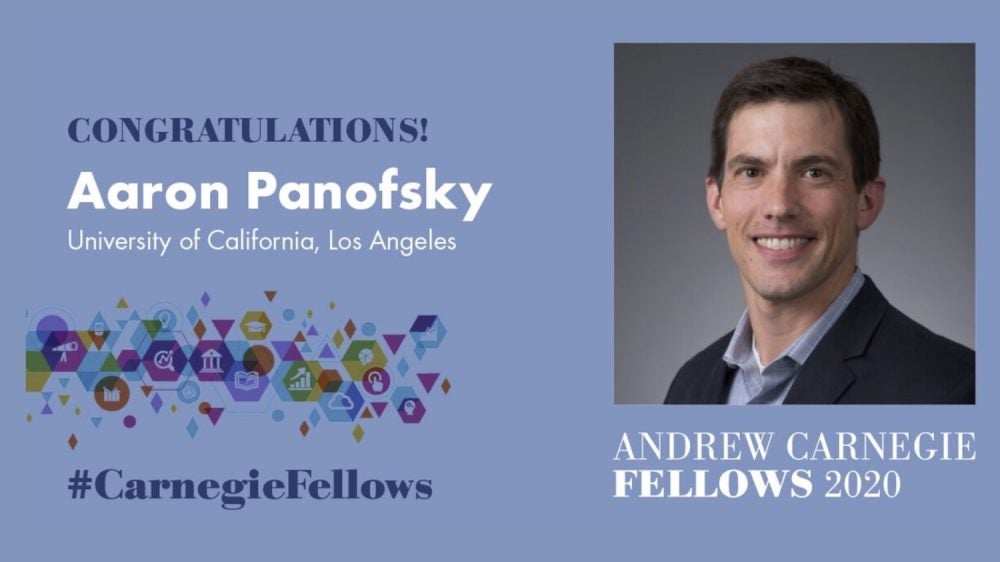
Panofsky Named to Class of 2020 Carnegie Fellows

May 12, 2020
Luskin's Latest Blog
The $200,000 award will support research on how genetics is making the nature of race increasingly...
Read More
Learn more about UCLA Luskin

Find contact information and get answers to your questions.

Contact Us

Public Affairs Building
337 Charles E. Young Drive East
Los Angeles, California 90095

Linkedin Youtube Instagram Facebook X-twitter
Campus Resources
  • Map, Directions, Parking
  • Directory
  • Academic Calendar
  • Careers
  • Map, Directions, Parking
  • Directory
  • Academic Calendar
  • Careers
School Resources
  • About
  • Our Dean
  • Administration
  • Luskin School Intranet
  • Board of Advisors
  • Contact Us
  • Visit Us
  • About
  • Our Dean
  • Administration
  • Luskin School Intranet
  • Board of Advisors
  • Contact Us
  • Visit Us
UCLA logo
© 2026 Regents of the University of California
  • Emergency
  • Accessibility
  • Privacy & Terms of Use
  • Emergency
  • Accessibility
  • Privacy & Terms of Use
Facebook Instagram Linkedin X-twitter Youtube Threads
UCLA Luskin School of Public Affairs Logo
Academics
Departments
  • Global Public Affairs
  • Public Policy
  • Real Estate Development
  • Social Welfare
  • Urban Planning
  • Undergraduate Program
  • Global Public Affairs
  • Public Policy
  • Real Estate Development
  • Social Welfare
  • Urban Planning
  • Undergraduate Program
Graduate Programs
  • Master of Global Public Affairs (MGPA)
  • Master of Public Policy (MPP)
  • Master of Real Estate Development (MRED)
  • Master of Social Welfare (MSW)
  • Master of Urban and Regional Planning (MURP)
  • PhD in Social Welfare
  • PhD in Urban Planning
  • Master of Global Public Affairs (MGPA)
  • Master of Public Policy (MPP)
  • Master of Real Estate Development (MRED)
  • Master of Social Welfare (MSW)
  • Master of Urban and Regional Planning (MURP)
  • PhD in Social Welfare
  • PhD in Urban Planning
Undergraduate Programs
  • BA in Public Affairs
  • Minor in Urban and Regional Studies
  • Minor in Gerontology
  • Minor in Public Affairs
  • BA in Public Affairs
  • Minor in Urban and Regional Studies
  • Minor in Gerontology
  • Minor in Public Affairs
Professional Certificates
  • AI in Public Affairs Certificate
  • AI in Public Affairs Certificate
Admissions
Program Specific Admissions
  • Global Public Affairs
  • Public Policy
  • Real Estate Development
  • Social Welfare
  • Urban Planning
  • Undergraduate Program
  • Global Public Affairs
  • Public Policy
  • Real Estate Development
  • Social Welfare
  • Urban Planning
  • Undergraduate Program
Faculty
Our Faculty
  • All Faculty
  • Public Policy
  • Real Estate Development
  • Social Welfare
  • Urban Planning
  • All Faculty
  • Public Policy
  • Real Estate Development
  • Social Welfare
  • Urban Planning
Leadership
  • Our Dean
  • Board of Advisors
  • Faculty Executive Committee
  • Our Dean
  • Board of Advisors
  • Faculty Executive Committee
Research Centers
  • Agile Visual Analytics Lab (AVAL)

    Empowers stakeholders with data to make informed decisions for children, families, and communities.

  • Berggruen Governance Index

    Evaluates the quality of political governance and democracy worldwide.

  • Center for Neighborhood Knowledge (CNK)

    Specializes in spatial analysis of socioeconomic disparities in neighborhoods.

  • Center for Policy Research on Aging (CPRA)

    Explores the societal and policy implications of an aging population.

  • Institute of Transportation Studies (ITS)

    Advances research, education, and meaningful civic engagement on transportation issues.

  • Institute on Inequality and Democracy

    Advances scholarship that confronts threats to democracy in America and around the world.

  • Latin American Cities Initiative

    Connects urban planning and policy networks across the Americas.

  • Latino Policy & Politics Institute (LPPI)

    Addresses policy challenges facing Latinos and communities of color.

  • Lewis Center for Regional Policy Studies

    Studying housing affordability and transportation equity in the L.A. region.

  • Los Angeles Education Research Institute (LAERI)

    Collaborates with schools to improve educational outcomes for L.A. students.

  • Luskin Center for Innovation

    Informing effective and equitable environmental policy that improves lives.

  • UCLA Voting Rights Project

    The flagship project for voting rights litigation and policy research.

All Research Centers
Outcomes
Common Search Terms

Results will show as you type.