Skip to content
  • Students & Alumni
    • Overview
    • Career Services
    • Alumni Relations
    • Student Support
    • Graduate Resource Library
  • News
  • Events
    • Events Calendar
    • Luskin Summit
    • Luskin Lecture Series
    • California Policy Briefing
    • Commencement
  • Students & Alumni
    • Overview
    • Career Services
    • Alumni Relations
    • Student Support
    • Graduate Resource Library
  • News
  • Events
    • Events Calendar
    • Luskin Summit
    • Luskin Lecture Series
    • California Policy Briefing
    • Commencement
Giving
  • Academics
    Departments
    • Public Policy
    • Real Estate Development
    • Social Welfare
    • Undergraduate Program
    • Urban Planning
    • Public Policy
    • Real Estate Development
    • Social Welfare
    • Undergraduate Program
    • Urban Planning
    Graduate Programs
    • Master of Public Policy (MPP)
    • Master of Real Estate Development (MRED)
    • Master of Social Welfare (MSW)
    • Master of Urban and Regional Planning (MURP)
    • PhD in Social Welfare
    • PhD in Urban Planning
    • Master of Public Policy (MPP)
    • Master of Real Estate Development (MRED)
    • Master of Social Welfare (MSW)
    • Master of Urban and Regional Planning (MURP)
    • PhD in Social Welfare
    • PhD in Urban Planning
    Undergraduate Programs
    • BA in Public Affairs
    • Minor in Urban and Regional Studies
    • Minor in Gerontology
    • Minor in Public Affairs
    • BA in Public Affairs
    • Minor in Urban and Regional Studies
    • Minor in Gerontology
    • Minor in Public Affairs
    Professional Certificates
    • Data Analytics Certificate
    • Data Analytics Certificate
  • Admissions
    Program Specific Admissions
    • Public Policy
    • Real Estate Development
    • Social Welfare
    • Urban Planning
    • Undergraduate Program
    • Public Policy
    • Real Estate Development
    • Social Welfare
    • Urban Planning
    • Undergraduate Program
  • Faculty
    Our Faculty
    • All Faculty
    • Public Policy
    • Real Estate Development
    • Social Welfare
    • Urban Planning
    • All Faculty
    • Public Policy
    • Real Estate Development
    • Social Welfare
    • Urban Planning
    Leadership
    • Our Dean
    • Board of Advisors
    • Faculty Executive Committee
    • Our Dean
    • Board of Advisors
    • Faculty Executive Committee
  • Research Centers
    • Agile Visual Analytics Lab (AVAL):

      Uses data visualization to improve decision-making for family and child services.

    • Berggruen Governance Index

      Evaluates the quality of political governance and democracy worldwide.

    • Center for Neighborhood Knowledge (CNK)

      Specializes in spatial analysis of socioeconomic disparities in neighborhoods.

    • Center for Policy Research on Aging (CPRA)

      Explores the societal and policy implications of an aging population.

    • Agile Visual Analytics Lab (AVAL):

      Uses data visualization to improve decision-making for family and child services.

    • Berggruen Governance Index

      Evaluates the quality of political governance and democracy worldwide.

    • Center for Neighborhood Knowledge (CNK)

      Specializes in spatial analysis of socioeconomic disparities in neighborhoods.

    • Center for Policy Research on Aging (CPRA)

      Explores the societal and policy implications of an aging population.

    • Institute of Transportation Studies (ITS)

      A national leader in transportation policy and mobility research.

    • Institute on Inequality and Democracy

      Advances scholarship addressing displacement and dispossession in Los Angeles and beyond.

    • Latin American Cities Initiative

      Connects urban planning and policy networks across the Americas.

    • Latino Policy & Politics Institute (LPPI)

      Addresses policy challenges facing Latinos and communities of color.

    • Institute of Transportation Studies (ITS)

      A national leader in transportation policy and mobility research.

    • Institute on Inequality and Democracy

      Advances scholarship addressing displacement and dispossession in Los Angeles and beyond.

    • Latin American Cities Initiative

      Connects urban planning and policy networks across the Americas.

    • Latino Policy & Politics Institute (LPPI)

      Addresses policy challenges facing Latinos and communities of color.

    • Lewis Center for Regional Policy Studies

      Researches housing, transportation, and economic development in Southern California.

    • Los Angeles Education Research Institute (LAERI)

      Collaborates with schools to improve educational outcomes for L.A. students.

    • Luskin Center for Innovation (LCI)

      Focuses on environmental policy, clean energy, and climate justice.

    • UCLA Voting Rights Project

      The flagship project for voting rights litigation and policy research.

    • Lewis Center for Regional Policy Studies

      Researches housing, transportation, and economic development in Southern California.

    • Los Angeles Education Research Institute (LAERI)

      Collaborates with schools to improve educational outcomes for L.A. students.

    • Luskin Center for Innovation (LCI)

      Focuses on environmental policy, clean energy, and climate justice.

    • UCLA Voting Rights Project

      The flagship project for voting rights litigation and policy research.

    All Research Centers
  • Outcomes
Home / High Temperatures Increase Workers’ Injury Risk, Whether They’re Outdoors or Inside

High Temperatures Increase Workers’ Injury Risk, Whether They’re Outdoors or Inside

The finding reflects another consequence of climate change, according to new study led by R. Jisung Park of UCLA Luskin Public Policy
|

Posted in

  • Business and the Environment, Climate Change, Environment, For Faculty, For Policymakers, For Students, For Undergraduates, Global Public Affairs, Health Care, Latinos, Luskin Center, Politics, Public Policy, Public Policy News, Research Projects, Resources, School of Public Affairs, Social Welfare, Social Welfare News, Urban Planning

Published on

  • July 16, 2021
  • climate change, global warming, government regulation, health, heat, illness, labor, research, weather, work

Share this Article

A UCLA study published today shows that hot weather significantly increases the risk of accidents and injuries on the job, regardless of whether the work takes place in an indoor or outdoor setting.

The report is based on data from California’s workers’ compensation system, the nation’s largest.

“The incidence of heat illnesses like heat exhaustion and heat stroke definitely go up on hotter days,” said the study’s lead researcher R. Jisung Park, an assistant professor of public policy at UCLA Luskin. “But what we found is that ostensibly unrelated incidents — like falling off a ladder or being hit by a moving truck or getting your hand caught in a machine — tend to occur more frequently on hotter days, too.”

By comparing records from more than 11 million California workers’ compensation claims from 2001 to 2018 to high-frequency local weather data, Park and his co-authors isolated the impact of hotter days on the number of injury claims.

The study shows that on days with high temperature above 90 degrees Fahrenheit, workers have a 6% to 9% higher risk of injuries than they do on days with high temperatures in the 50s or 60s. When the thermometer tops 100, the risk of injuries increases by 10% to 15%.

Those findings are particularly alarming in the context of climate change, which is expected to produce more high-temperature days each year. The researchers estimate that high temperatures already cause about 15,000 injuries per year in California.

“Heat is sometimes described as a silent killer,” said Nora Pankratz, a UCLA postdoctoral scholar. “But if you look into the data and do the statistical analysis, you find that heat has a significant impact on mortality and health outcomes.”
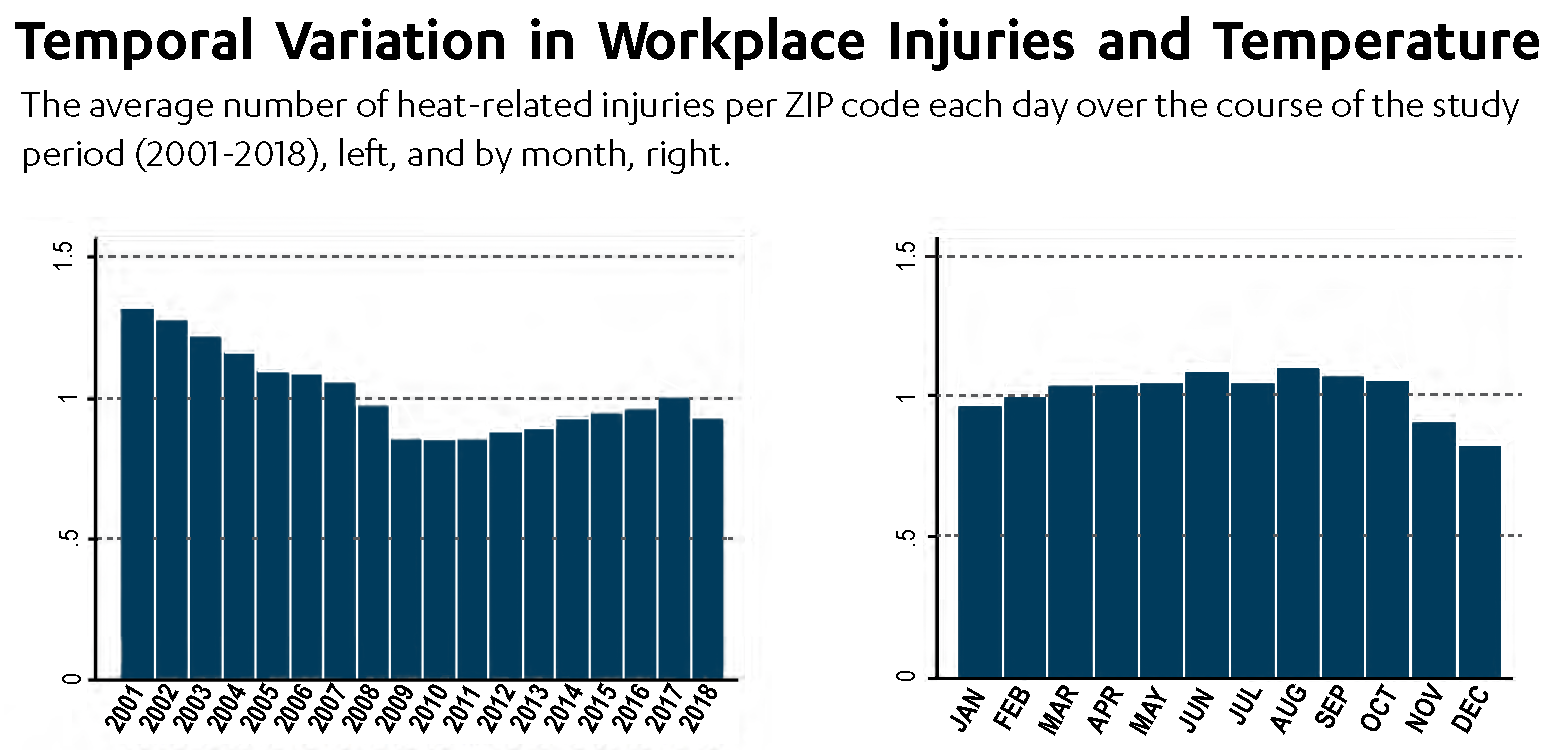
 

It’s not surprising that hot weather would lead to injuries and illness among workers in predominantly outdoor industries such as agriculture, utilities and construction. But the data consistently show that industries in which most people work indoors are affected as well. In manufacturing, for example, days with high temperatures above 95 degrees have an injury risk that is approximately 7% higher than days with high temperatures in the low 60s.

“A lot of manufacturing facilities are not air conditioned,” said Stanford University postdoctoral scholar A. Patrick Behrer, the study’s other co-author. “Because you’re inside, you don’t necessarily think about the temperature as being a major threat.”

The reality is that overheated workers face numerous risks, regardless of where the work occurs.

“Heat affects your physiology,” Park said. “It affects your cognition. It affects your body’s ability to cope. It seems possible that what we’re observing in the data for these workers is that they’re more likely to make mistakes or errors in judgment.”

The researchers found that heat-related workplace injuries are more likely to be suffered by men and lower-income workers. In addition, younger people suffer more heat-related injuries, possibly in part because they’re more likely to hold jobs with greater physical risks on construction sites, in manufacturing plants or at warehouses.

For an office worker at a computer desk, nodding off on a hot summer afternoon is unlikely to cause an injury. “But if you have a huge chainsaw in your hand, you’re not in a great situation,” Park said.

Among the paper’s other conclusions:

  • The number of heat-related injuries actually declined after 2005, when California became the first state to implement mandatory heat illness prevention measures for outdoor workplaces on days when temperatures exceed 95 degrees.
  • The financial costs of heat-related injuries may be between $750 million and $1.25 billion per year in California alone, considering health care expenditures, lost wages and productivity, and disability claims.
  • Inequalities in the labor market are exacerbated in part by the fact that low-income communities tend to be situated in hotter parts of the state. People in the state’s lowest household income tier are approximately five times more likely to be affected by heat-related illness or injury on the job than those in the top income tier, the study found.

The UCLA Luskin Center for Innovation, where Park is associate director of economic research, provided funding for the study. It is available now through the Institute of Labor Economics, which disseminates working versions of potentially influential research prior to publication in academic journals. Park previewed the findings  July 15 during testimony at a Congressional hearing organized by the House Select Committee on the Climate Crisis.

The new study echoes the results of a 2019 study that focused on how extreme temperatures raise injury risk in Texas and in the U.S. mining industry. Park, whose prior research includes a finding that student learning is negatively impacted by warm temperatures, said there has been “an explosion of research just in the last five to 10 years that illustrates, using data, the serious consequences of climate change for health, productivity and economic growth. This likely adds to that urgency of reducing greenhouse gas emissions now.”

Pankratz got involved in the study while working at UCLA Luskin as a postdoctoral scholar, having previously researched the impact of heat on businesses while working toward her Ph.D. in the Netherlands. 

Worldwide, she said, there is growing interest in the concept of adaptation — the pragmatic changes that can be made by governments and businesses to cope with the reality of climate change.

“For a long time, the focus has been on mitigation — what can we do to prevent climate change,” she said. “But as it becomes more and more obvious that there is policy inertia on mitigation, it’s important to think about what we can do to adapt and to work as well as possible in a warmer world.”

The study authors, all of whom have backgrounds in economics, realize that the desire to protect workers from heat may be complicated by economic reality. 

Behrer said policymakers could stipulate that workers not be exposed to the heat on days above 100 degrees, for example, without proscribing a specific strategy to be used by individual business owners.

“Then firms have the option either to use air conditioning or come up with some other method of climate control for their facilities,” he said, noting that some might change work hours or shorten the work day during heat waves. “It allows them to decide the most cost-effective way for them to meet the objective of reducing workplace injuries.”

 

Related Articles

Merchants and vendors at Port Sundan, Sudan, with a man walk across the street

Summer Spotlight: Muram Ibrahim Explores Urban Planning in Post-Conflict Port Sudan

August 11, 2026
Luskin's Latest Blog

This summer, Muram Ibrahim MURP ’27 worked with the Municipal Office of Planning in Port Sudan,...

Read More
Luka Marks stands with Nancy Pelosi and group of women at Feminist Majority Foundation|Luka Marks Stands in front of wall holding up a poster that says Ms. This is what democracy looks like.

Summer Spotlight: Luka Marks Champions Reproductive Justice at the Feminist Majority Foundation

August 7, 2026
Luskin's Latest Blog
UCLA MPP student Luka Marks reflects on her Feminist Majority Foundation internship supporting reproductive justice, research...
Read More
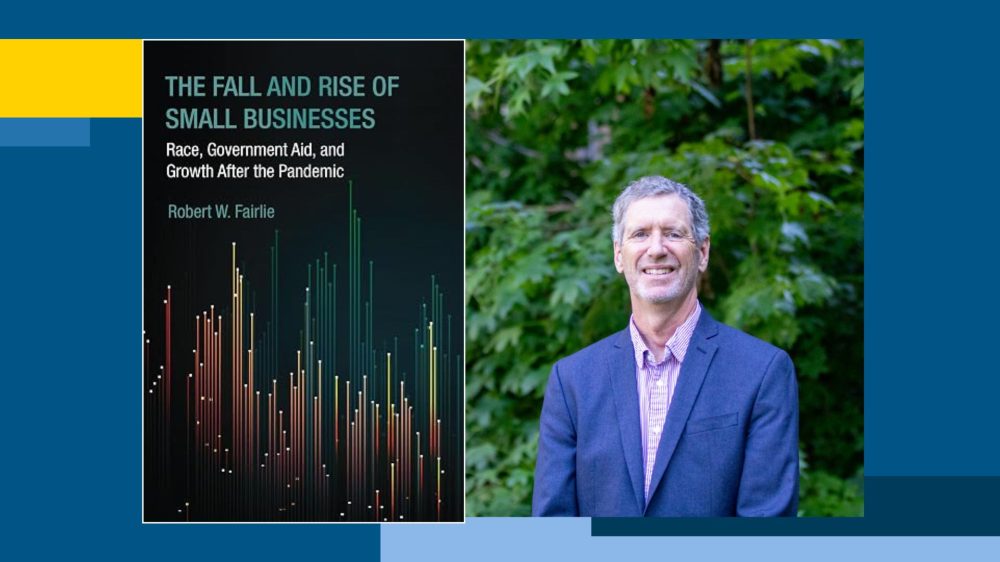
Headshot of Robert Fairlie with cover of his new book the Fall and Rise of Small Businesses.

New Book Examines Small Business Recovery and Racial Equity After the Pandemic

August 7, 2026
Luskin's Latest Blog
UCLA Luskin Professor Robert Fairlie explores how government aid, entrepreneurship and racial inequality shaped small business...
Read More
Photo of Port in South Africa with boats on the harbor and a ferris wheel far away on the right

Summer Spotlight: Cooper Emmott Explores Housing and Spatial Justice in South Africa

August 4, 2026
Luskin's Latest Blog
UCLA MURP student Cooper Emmott reflects on his Cape Town internship advancing housing, land policy and...
Read More
Learn more about UCLA Luskin

Find contact information and get answers to your questions.

Contact Us

Public Affairs Building
337 Charles E. Young Drive East
Los Angeles, California 90095

Linkedin Youtube Instagram Facebook X-twitter
Campus Resources
  • Map, Directions, Parking
  • Directory
  • Academic Calendar
  • Careers
  • Map, Directions, Parking
  • Directory
  • Academic Calendar
  • Careers
School Resources
  • About
  • Our Dean
  • Administration
  • Board of Advisors
  • Contact Us
  • Visit Us
  • About
  • Our Dean
  • Administration
  • Board of Advisors
  • Contact Us
  • Visit Us
© 2026 Regents of the University of California
  • Emergency
  • Accessibilty
  • Privacy & Terms of Use
  • Emergency
  • Accessibilty
  • Privacy & Terms of Use
Facebook Instagram Linkedin X-twitter Youtube Threads
Academics
Departments
  • Public Policy
  • Real Estate Development
  • Social Welfare
  • Undergraduate Program
  • Urban Planning
  • Public Policy
  • Real Estate Development
  • Social Welfare
  • Undergraduate Program
  • Urban Planning
Graduate Programs
  • Master of Public Policy (MPP)
  • Master of Real Estate Development (MRED)
  • Master of Social Welfare (MSW)
  • Master of Urban and Regional Planning (MURP)
  • PhD in Social Welfare
  • PhD in Urban Planning
  • Master of Public Policy (MPP)
  • Master of Real Estate Development (MRED)
  • Master of Social Welfare (MSW)
  • Master of Urban and Regional Planning (MURP)
  • PhD in Social Welfare
  • PhD in Urban Planning
Undergraduate Programs
  • BA in Public Affairs
  • Minor in Urban and Regional Studies
  • Minor in Gerontology
  • Minor in Public Affairs
  • BA in Public Affairs
  • Minor in Urban and Regional Studies
  • Minor in Gerontology
  • Minor in Public Affairs
Professional Certificates
  • Data Analytics Certificate
  • Data Analytics Certificate
Admissions
Program Specific Admissions
  • Public Policy
  • Real Estate Development
  • Social Welfare
  • Urban Planning
  • Undergraduate Program
  • Public Policy
  • Real Estate Development
  • Social Welfare
  • Urban Planning
  • Undergraduate Program
Faculty
Our Faculty
  • All Faculty
  • Public Policy
  • Real Estate Development
  • Social Welfare
  • Urban Planning
  • All Faculty
  • Public Policy
  • Real Estate Development
  • Social Welfare
  • Urban Planning
Leadership
  • Our Dean
  • Board of Advisors
  • Faculty Executive Committee
  • Our Dean
  • Board of Advisors
  • Faculty Executive Committee
Research Centers
  • Agile Visual Analytics Lab (AVAL):

    Uses data visualization to improve decision-making for family and child services.

  • Berggruen Governance Index

    Evaluates the quality of political governance and democracy worldwide.

  • Center for Neighborhood Knowledge (CNK)

    Specializes in spatial analysis of socioeconomic disparities in neighborhoods.

  • Center for Policy Research on Aging (CPRA)

    Explores the societal and policy implications of an aging population.

  • Agile Visual Analytics Lab (AVAL):

    Uses data visualization to improve decision-making for family and child services.

  • Berggruen Governance Index

    Evaluates the quality of political governance and democracy worldwide.

  • Center for Neighborhood Knowledge (CNK)

    Specializes in spatial analysis of socioeconomic disparities in neighborhoods.

  • Center for Policy Research on Aging (CPRA)

    Explores the societal and policy implications of an aging population.

  • Institute of Transportation Studies (ITS)

    A national leader in transportation policy and mobility research.

  • Institute on Inequality and Democracy

    Advances scholarship addressing displacement and dispossession in Los Angeles and beyond.

  • Latin American Cities Initiative

    Connects urban planning and policy networks across the Americas.

  • Latino Policy & Politics Institute (LPPI)

    Addresses policy challenges facing Latinos and communities of color.

  • Institute of Transportation Studies (ITS)

    A national leader in transportation policy and mobility research.

  • Institute on Inequality and Democracy

    Advances scholarship addressing displacement and dispossession in Los Angeles and beyond.

  • Latin American Cities Initiative

    Connects urban planning and policy networks across the Americas.

  • Latino Policy & Politics Institute (LPPI)

    Addresses policy challenges facing Latinos and communities of color.

  • Lewis Center for Regional Policy Studies

    Researches housing, transportation, and economic development in Southern California.

  • Los Angeles Education Research Institute (LAERI)

    Collaborates with schools to improve educational outcomes for L.A. students.

  • Luskin Center for Innovation (LCI)

    Focuses on environmental policy, clean energy, and climate justice.

  • UCLA Voting Rights Project

    The flagship project for voting rights litigation and policy research.

  • Lewis Center for Regional Policy Studies

    Researches housing, transportation, and economic development in Southern California.

  • Los Angeles Education Research Institute (LAERI)

    Collaborates with schools to improve educational outcomes for L.A. students.

  • Luskin Center for Innovation (LCI)

    Focuses on environmental policy, clean energy, and climate justice.

  • UCLA Voting Rights Project

    The flagship project for voting rights litigation and policy research.

All Research Centers
Outcomes
Common Search Terms

Results will show as you type.