Skip to content
  • Students & Alumni
    • Career Services
    • Alumni Relations
    • Student Support
    • Graduate Resource Library
    • For Employers
  • News
  • Events
    • Events Calendar
    • Luskin Summit
    • Luskin Lecture Series
    • California Policy Briefing
    • Commencement
  • Students & Alumni
    • Career Services
    • Alumni Relations
    • Student Support
    • Graduate Resource Library
    • For Employers
  • News
  • Events
    • Events Calendar
    • Luskin Summit
    • Luskin Lecture Series
    • California Policy Briefing
    • Commencement
Giving
UCLA Luskin School of Public Affairs Logo
  • Academics
    Departments & Programs
    • Global Public Affairs
    • Public Policy
    • Real Estate Development
    • Social Welfare
    • Urban Planning
    • Undergraduate Program
    • Global Public Affairs
    • Public Policy
    • Real Estate Development
    • Social Welfare
    • Urban Planning
    • Undergraduate Program
    Graduate Degrees
    • Master of Global Public Affairs (MGPA)
    • Master of Public Policy (MPP)
    • Master of Real Estate Development (MRED)
    • Master of Social Welfare (MSW)
    • Master of Urban and Regional Planning (MURP)
    • PhD in Social Welfare
    • PhD in Urban Planning
    • Master of Global Public Affairs (MGPA)
    • Master of Public Policy (MPP)
    • Master of Real Estate Development (MRED)
    • Master of Social Welfare (MSW)
    • Master of Urban and Regional Planning (MURP)
    • PhD in Social Welfare
    • PhD in Urban Planning
    Undergraduate Degrees
    • BA in Public Affairs
    • Minor in Urban and Regional Studies
    • Minor in Gerontology
    • Minor in Public Affairs
    • BA in Public Affairs
    • Minor in Urban and Regional Studies
    • Minor in Gerontology
    • Minor in Public Affairs
    Professional Certificates
    • AI in Public Affairs Certificate
    • AI in Public Affairs Certificate
  • Admissions
    Program Specific Admissions
    • Global Public Affairs
    • Public Policy
    • Real Estate Development
    • Social Welfare
    • Urban Planning
    • Undergraduate Program
    • Global Public Affairs
    • Public Policy
    • Real Estate Development
    • Social Welfare
    • Urban Planning
    • Undergraduate Program
  • Faculty
    Our Faculty
    • All Faculty
    • Public Policy
    • Real Estate Development
    • Social Welfare
    • Urban Planning
    • All Faculty
    • Public Policy
    • Real Estate Development
    • Social Welfare
    • Urban Planning
    Leadership
    • Our Dean
    • Board of Advisors
    • Faculty Executive Committee
    • Our Dean
    • Board of Advisors
    • Faculty Executive Committee
  • Research Centers
    • Agile Visual Analytics Lab (AVAL)

      Empowers stakeholders with data to make informed decisions for children, families, and communities.

    • Berggruen Governance Index

      Evaluates the quality of political governance and democracy worldwide.

    • Center for Neighborhood Knowledge (CNK)

      Specializes in spatial analysis of socioeconomic disparities in neighborhoods.

    • Center for Policy Research on Aging (CPRA)

      Explores the societal and policy implications of an aging population.

    • Institute of Transportation Studies (ITS)

      Advances research, education, and meaningful civic engagement on transportation issues.

    • Institute on Inequality and Democracy

      Advances scholarship that confronts threats to democracy in America and around the world.

    • Latin American Cities Initiative

      Connects urban planning and policy networks across the Americas.

    • Latino Policy & Politics Institute (LPPI)

      Addresses policy challenges facing Latinos and communities of color.

    • Lewis Center for Regional Policy Studies

      Studying housing affordability and transportation equity in the L.A. region.

    • Los Angeles Education Research Institute (LAERI)

      Collaborates with schools to improve educational outcomes for L.A. students.

    • Luskin Center for Innovation

      Informing effective and equitable environmental policy that improves lives.

    • UCLA Voting Rights Project

      The flagship project for voting rights litigation and policy research.

    All Research Centers
  • Outcomes
Home / News / How DemocraShe Builds Civic Engagement for All

How DemocraShe Builds Civic Engagement for All

How UCLA Luskin alumna Sarah Jakle combines trauma-informed practice, public policy, and mentorship to prepare young women for civic leadership.

Posted in

  • Alumni, Luskin's Latest Blog, Public Policy

Published on

  • December 17, 2025

Share this Article

Sarah Jakle M.P.P. ’04 (she/her) has always believed that leadership must support the whole human being. Her commitment to women’s civic empowerment began long before she founded her organization DemocraShe, but the seeds were planted in the classrooms and mentorship circles she experienced as a graduate student at UCLA.

Jakle studied literature as an undergraduate before beginning her early career working with unhoused communities and individuals living with mental illness. This included an internship at U.S. VETS in Long Beach, where she worked directly with veterans experiencing homelessness, trauma and complex behavioral health needs. The work highlighted the barriers that individuals face when navigating unstable housing, mental health challenges and limited resources.

“I was working with unhoused veterans who had survived extraordinary adversity,” Jakle said. “Trauma was everywhere. It became clear that understanding trauma was essential to understanding how to really help people.”

Although she was making an impact one person at a time, Jakle saw how structural policies often determined whether meaningful change was possible. That realization brought her to graduate school, where she sought to understand the systems that shape people’s lives.

She earned a master’s in public policy from the UCLA Luskin School of Public Affairs and later completed a master’s in social work at USC with a concentration in military social work. The dual training created what she describes as a “Venn diagram” of her interests. The public policy curriculum equipped her with analytical and quantitative tools, while her social work training gave her trauma-informed frameworks for understanding the emotional experiences of people navigating public systems.

At UCLA, Jakle took several courses that fundamentally shifted her perspective, including the statistics and evaluation courses that she initially found intimidating as a non-STEM student.

“I was a literature major, so taking calculus-based economics and statistics was a shock,” she said. “But those classes transformed me. They taught me that you cannot assume you have impact. You have to measure it.”

Another defining experience came from her mentorship with former Massachusetts Governor Michael Dukakis, one of her professors at UCLA Luskin. Dukakis invited her to his home, where she met his wife, Kitty Dukakis. Learning about Kitty’s treatment in the press during the 1988 presidential election had a lasting influence on Jakle.

“Kitty was brilliant and compassionate, but she had been deeply mistreated during the campaign,” Jakle said. “It was the first time I truly understood that the emotional experience of being in politics could be as consequential as any policy outcome.”

The experience opened Jakle’s eyes to how women experience public scrutiny, and how often their emotional well-being is overlooked in discussions about civic leadership. This realization stayed with her as she continued her work after graduate school.

From Theory to Practice

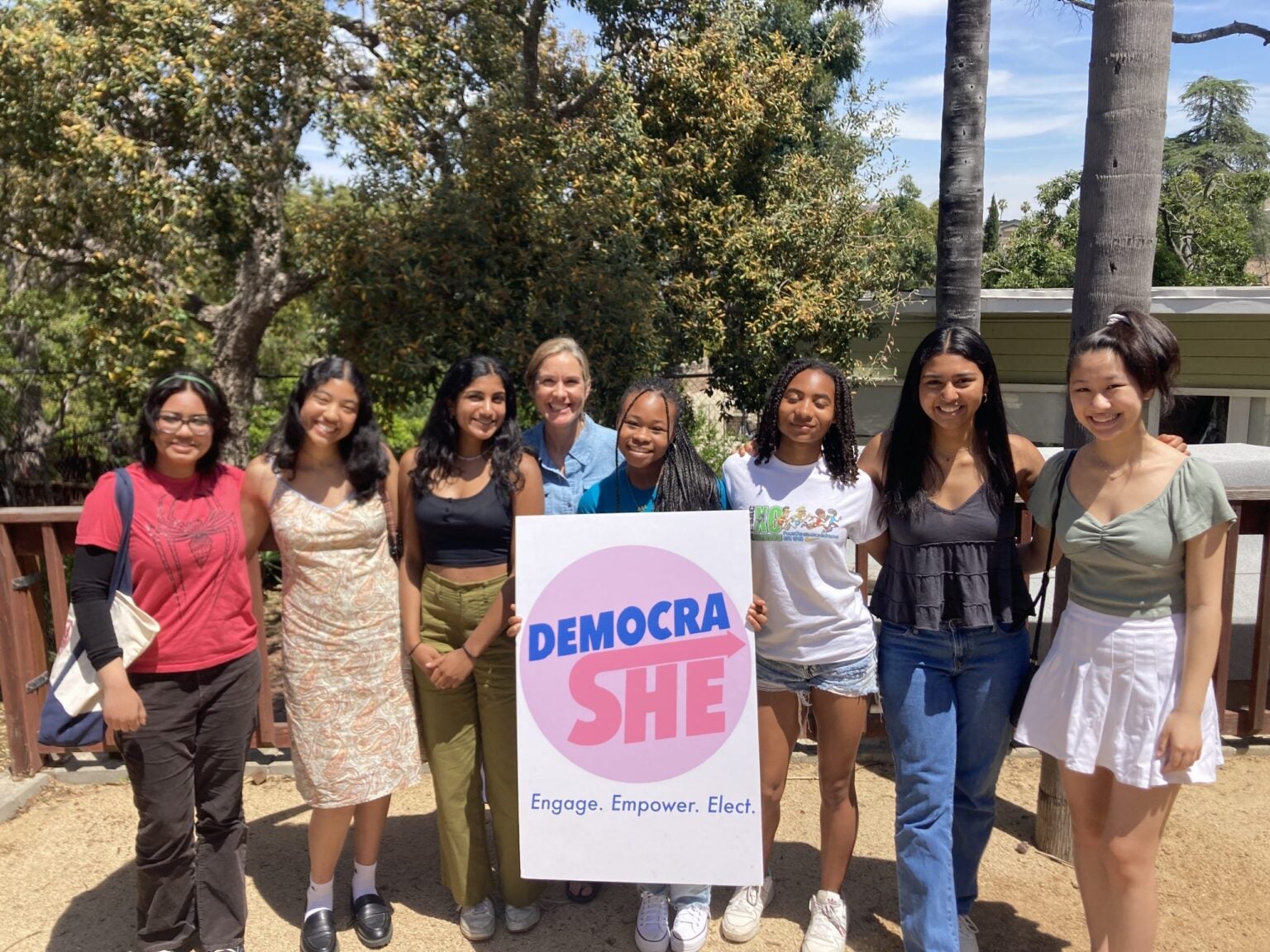
Jakle’s graduate training and early career experiences directly shaped the creation of DemocraShe, a nonpartisan leadership program for young women. The organization serves a diverse group of students, with the majority identifying as girls of color and many as first-generation Americans.

DemocraShe teaches students foundational civic knowledge, leadership skills and what Jakle calls “amygdala skills,” which are basic neuroscience tools that help young women regulate fear, discomfort and internalized barriers when stepping into unfamiliar or high-pressure spaces.

“Women are socialized to be perfect, and stepping out of your comfort zone can trigger the amygdala,” Jakle said. “That discomfort often shows up as hesitation or self-doubt, which people call imposter syndrome. We teach girls how to regulate those feelings so they can pursue opportunities that match their ambition.”
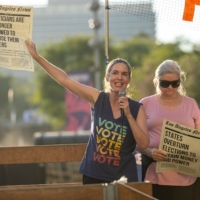
Sarah Jakle Speaking on a microphone at a political rally with a flyer that reads "politicians are no longer allowed to choose their voters"

Grounding and resourcing are two of the trauma-informed techniques that students learn. Grounding involves returning to the present moment through sensory awareness. Resourcing involves cultivating an inner supportive voice to counteract internalized criticism. Both practices are drawn from trauma research and help to calm the amygdala, allowing the prefrontal cortex to re-engage.

“We teach girls that the brain is constantly scanning for threat and safety,” she said. “If they can regulate the amygdala, they can make choices from a place of confidence and clarity.”

DemocraShe integrates rigorous evaluation into its programming, a discipline Jakle attributes to her training at UCLA Luskin. Students complete anonymous pre-program and post-program surveys so the team can track changes over time. For the full 2025 cohort, 37% of students reported understanding how to move forward as active participants in American democracy before the 10-week flagship program. After completing the program, that figure rose to 99%.

Another key metric asks whether DemocraShe helped students do something they were previously afraid to try; 92% say yes. Examples range from delivering public remarks in religious spaces, to running for school leadership positions, to asserting themselves in instances of workplace conflict.

“These findings tell us that our work is shifting both leadership skills and resilience skills,” Jakle said. “We are helping young women navigate adversity while stepping into the roles they deserve.”

Mentorship and Civic Leadership

Although UCLA shaped her academic foundation, one of Jakle’s most influential mentors came through her political organizing work. She credits Ada Briceño, labor leader and former chair of the Democratic Party of Orange County, as someone who demonstrated what courageous leadership looks like.
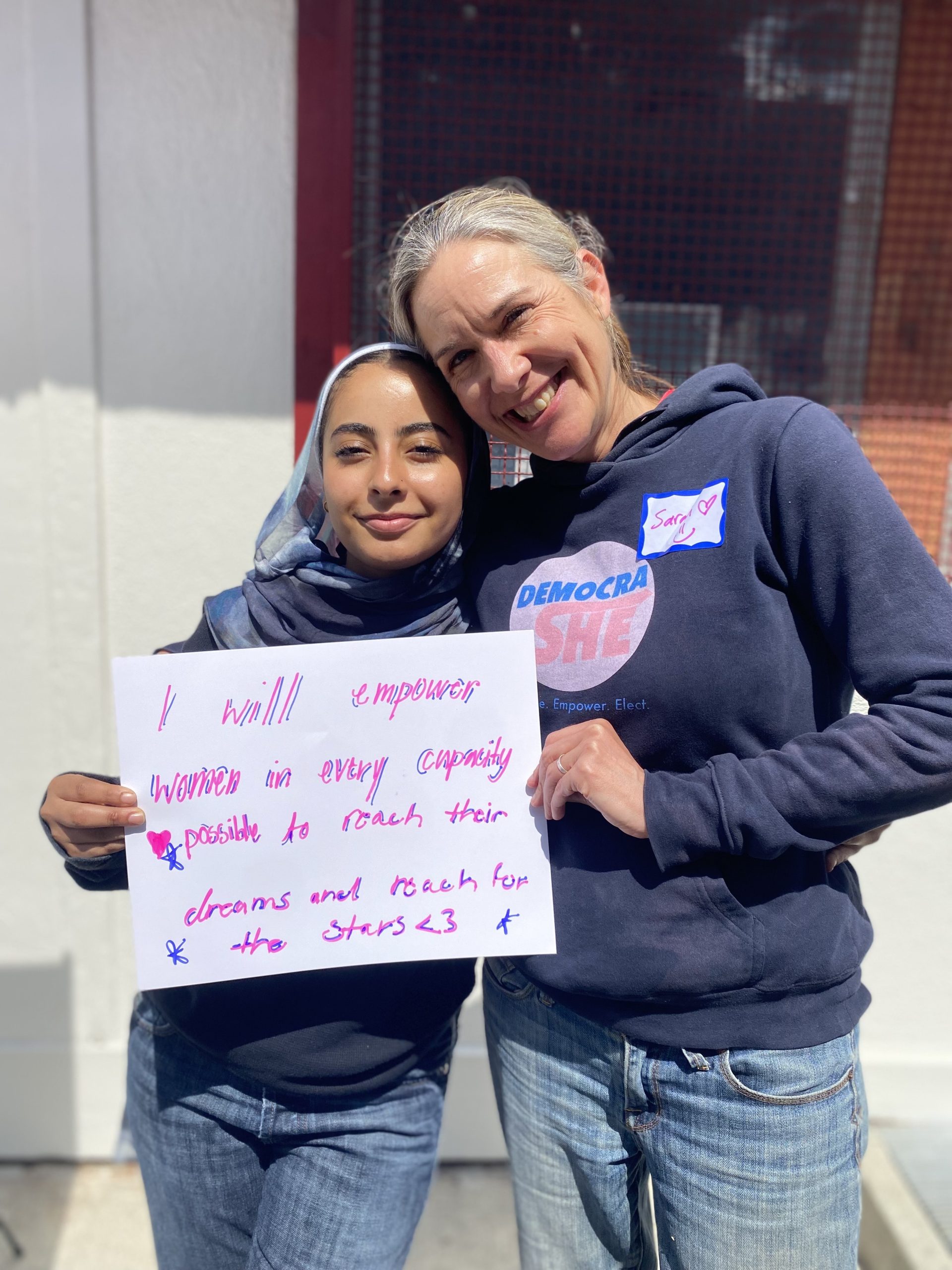
“Watching Ada, I saw firsthand how women, especially women of color, experience systemic pushback in civic spaces,” Jakle said. “It made me passionate not only about strengthening our democracy but also about protecting the emotional lives of the women who lead.”

Jakle has also worked as the Get Out the Vote director for the California National Organization for Women. During that time, she heard many women receive vague warnings that political life would be difficult, without being offered any tangible tools to manage the challenges ahead.

“For me, that felt like a missed opportunity,” she said. “We have decades of research on how people can self-regulate during stress. We should not send women into public life without these tools.”

Navigating the Present and Looking Ahead

Jakle believes that civic engagement extends far beyond voting. She encourages students from all academic backgrounds to understand how policy affects their educational pathways, professional fields and daily lives. She also believes that higher education institutions can play a significant role in preparing the next generation of civic leaders.

One of her priorities is advocating for paid opportunities for students to participate in policy work. She notes that many early political pipeline programs are unpaid, which often prevents students who need to work from participating.

“There are meetings happening right now about the future of the UC system,” she said. “Students should be in those rooms, and they should be paid for their time. Otherwise, only students with financial flexibility will get access to those spaces.”

As part of that commitment, DemocraShe pays all participants who take part in its 10-week program or its one-day summer intensives held live on Zoom.

Jakle also recognizes that many young people feel overwhelmed by political uncertainty and social change. She emphasizes the importance of joy as a protective factor for the brain. She teaches a practice called “savoring,” in which individuals spend a few moments each morning noticing two joyful or beautiful things to counter the brain’s negativity bias.

“When there is so much suffering, it can feel like experiencing joy is a betrayal,” she said. “But joy protects the brain. It helps people stay engaged instead of burning out.”

Her advice for those seeking to remain informed and active is simple. She encourages people to find community, participate in local action, and take small, consistent steps that contribute to positive change. She also recommends looking at diverse sources of information and listening to students and young organizers who are at the center of campus activism.

“Democracy is woven through everyday life,” she said. “Small actions matter. Community matters. And every person has a role in shaping the world around them.”

Jakle’s journey from social work to public policy and civic empowerment illustrates how trauma-informed leadership can strengthen democracy. Through DemocraShe, she continues to uplift young women and equip them with tools that support both their public leadership and their inner resilience.

This article was originally published by UCLA Alumni. Read the full article here.
Related Articles

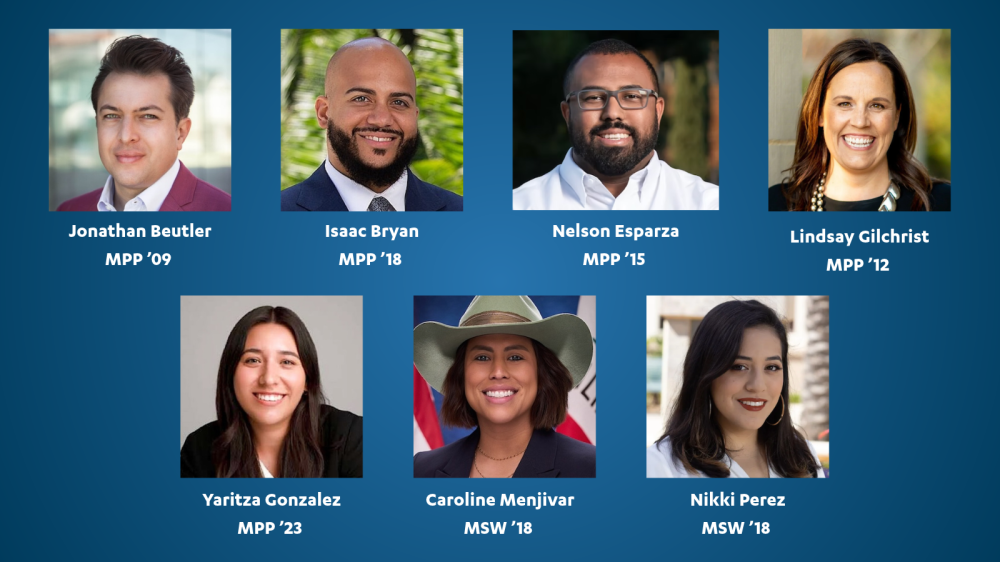
headshots of three men and four women

UCLA Luskin Alumni Elected to Office

November 18, 2026
School of Public Affairs

Seven UCLA Luskin alumni have turned their records of civic engagement into successful bids for public...

Read More
nmUYzerLsDF-vxznBj2iXWQ0Suy8NJ4vzW2r74pRkPkEOv61Xwd2U4CM47cJ9HhH1IlDmaPSWHxNactfpEPdBMDHq2QaixcBSrPsq8ORpez8sfBiLYhJGpJpVqLXEFc847Icua7x-AHfxx0Si1g1-GTVk1pddSOWlGV9TQStUDoT7Ih2Su_Xgd6DkmDkZZDd (1)

Nithya Raman Defeats Karen Bass to Become Los Angeles Mayor

November 16, 2026
Luskin in the News
Read More
small black camera and black solar panel set against blue sky with treeline in background

What’s Next for Flock Cameras: A Q&A With Zachary Steinert-Threlkeld

November 12, 2026
Public Policy

With the proliferation of security cameras, smart doorbells, facial recognition, location sharing and social media tracking,...

Read More
Professor Megan Mullin joins CNN Newsroom With Fredricka Whitfield

Mullin Discusses Growing Opposition to AI Data Centers After Midterm Elections

November 10, 2026
Public Policy
Read More
Learn more about UCLA Luskin

Find contact information and get answers to your questions.

Contact Us
UCLA Luskin School of Public Affairs

Public Affairs Building
337 Charles E. Young Drive East
Los Angeles, California 90095

Linkedin Youtube Instagram Facebook X-twitter
Campus Resources
  • Map, Directions, Parking
  • Directory
  • Academic Calendar
  • Careers
  • Map, Directions, Parking
  • Directory
  • Academic Calendar
  • Careers
School Resources
  • About
  • Our Dean
  • Administration
  • Luskin School Intranet
  • Board of Advisors
  • Contact Us
  • Visit Us
  • About
  • Our Dean
  • Administration
  • Luskin School Intranet
  • Board of Advisors
  • Contact Us
  • Visit Us
UCLA logo
© 2026 Regents of the University of California
  • Emergency
  • Accessibility
  • Privacy & Terms of Use
  • Emergency
  • Accessibility
  • Privacy & Terms of Use
Facebook Instagram Linkedin X-twitter Youtube Threads
UCLA Luskin School of Public Affairs Logo
Academics
Departments
  • Global Public Affairs
  • Public Policy
  • Real Estate Development
  • Social Welfare
  • Urban Planning
  • Undergraduate Program
  • Global Public Affairs
  • Public Policy
  • Real Estate Development
  • Social Welfare
  • Urban Planning
  • Undergraduate Program
Graduate Programs
  • Master of Global Public Affairs (MGPA)
  • Master of Public Policy (MPP)
  • Master of Real Estate Development (MRED)
  • Master of Social Welfare (MSW)
  • Master of Urban and Regional Planning (MURP)
  • PhD in Social Welfare
  • PhD in Urban Planning
  • Master of Global Public Affairs (MGPA)
  • Master of Public Policy (MPP)
  • Master of Real Estate Development (MRED)
  • Master of Social Welfare (MSW)
  • Master of Urban and Regional Planning (MURP)
  • PhD in Social Welfare
  • PhD in Urban Planning
Undergraduate Programs
  • BA in Public Affairs
  • Minor in Urban and Regional Studies
  • Minor in Gerontology
  • Minor in Public Affairs
  • BA in Public Affairs
  • Minor in Urban and Regional Studies
  • Minor in Gerontology
  • Minor in Public Affairs
Professional Certificates
  • AI in Public Affairs Certificate
  • AI in Public Affairs Certificate
Admissions
Program Specific Admissions
  • Global Public Affairs
  • Public Policy
  • Real Estate Development
  • Social Welfare
  • Urban Planning
  • Undergraduate Program
  • Global Public Affairs
  • Public Policy
  • Real Estate Development
  • Social Welfare
  • Urban Planning
  • Undergraduate Program
Faculty
Our Faculty
  • All Faculty
  • Public Policy
  • Real Estate Development
  • Social Welfare
  • Urban Planning
  • All Faculty
  • Public Policy
  • Real Estate Development
  • Social Welfare
  • Urban Planning
Leadership
  • Our Dean
  • Board of Advisors
  • Faculty Executive Committee
  • Our Dean
  • Board of Advisors
  • Faculty Executive Committee
Research Centers
  • Agile Visual Analytics Lab (AVAL)

    Empowers stakeholders with data to make informed decisions for children, families, and communities.

  • Berggruen Governance Index

    Evaluates the quality of political governance and democracy worldwide.

  • Center for Neighborhood Knowledge (CNK)

    Specializes in spatial analysis of socioeconomic disparities in neighborhoods.

  • Center for Policy Research on Aging (CPRA)

    Explores the societal and policy implications of an aging population.

  • Institute of Transportation Studies (ITS)

    Advances research, education, and meaningful civic engagement on transportation issues.

  • Institute on Inequality and Democracy

    Advances scholarship that confronts threats to democracy in America and around the world.

  • Latin American Cities Initiative

    Connects urban planning and policy networks across the Americas.

  • Latino Policy & Politics Institute (LPPI)

    Addresses policy challenges facing Latinos and communities of color.

  • Lewis Center for Regional Policy Studies

    Studying housing affordability and transportation equity in the L.A. region.

  • Los Angeles Education Research Institute (LAERI)

    Collaborates with schools to improve educational outcomes for L.A. students.

  • Luskin Center for Innovation

    Informing effective and equitable environmental policy that improves lives.

  • UCLA Voting Rights Project

    The flagship project for voting rights litigation and policy research.

All Research Centers
Outcomes
Common Search Terms

Results will show as you type.