Skip to content
  • Students & Alumni
    • Career Services
    • Alumni Relations
    • Student Support
    • Graduate Resource Library
    • For Employers
  • News
  • Events
    • Events Calendar
    • Luskin Summit
    • Luskin Lecture Series
    • California Policy Briefing
    • Commencement
  • Students & Alumni
    • Career Services
    • Alumni Relations
    • Student Support
    • Graduate Resource Library
    • For Employers
  • News
  • Events
    • Events Calendar
    • Luskin Summit
    • Luskin Lecture Series
    • California Policy Briefing
    • Commencement
Giving
UCLA Luskin School of Public Affairs Logo
  • Academics
    Departments & Programs
    • Global Public Affairs
    • Public Policy
    • Real Estate Development
    • Social Welfare
    • Urban Planning
    • Undergraduate Program
    • Global Public Affairs
    • Public Policy
    • Real Estate Development
    • Social Welfare
    • Urban Planning
    • Undergraduate Program
    Graduate Degrees
    • Master of Global Public Affairs (MGPA)
    • Master of Public Policy (MPP)
    • Master of Real Estate Development (MRED)
    • Master of Social Welfare (MSW)
    • Master of Urban and Regional Planning (MURP)
    • PhD in Social Welfare
    • PhD in Urban Planning
    • Master of Global Public Affairs (MGPA)
    • Master of Public Policy (MPP)
    • Master of Real Estate Development (MRED)
    • Master of Social Welfare (MSW)
    • Master of Urban and Regional Planning (MURP)
    • PhD in Social Welfare
    • PhD in Urban Planning
    Undergraduate Degrees
    • BA in Public Affairs
    • Minor in Urban and Regional Studies
    • Minor in Gerontology
    • Minor in Public Affairs
    • BA in Public Affairs
    • Minor in Urban and Regional Studies
    • Minor in Gerontology
    • Minor in Public Affairs
    Professional Certificates
    • AI in Public Affairs Certificate
    • AI in Public Affairs Certificate
  • Admissions
    Program Specific Admissions
    • Global Public Affairs
    • Public Policy
    • Real Estate Development
    • Social Welfare
    • Urban Planning
    • Undergraduate Program
    • Global Public Affairs
    • Public Policy
    • Real Estate Development
    • Social Welfare
    • Urban Planning
    • Undergraduate Program
  • Faculty
    Our Faculty
    • All Faculty
    • Public Policy
    • Real Estate Development
    • Social Welfare
    • Urban Planning
    • All Faculty
    • Public Policy
    • Real Estate Development
    • Social Welfare
    • Urban Planning
    Leadership
    • Our Dean
    • Board of Advisors
    • Faculty Executive Committee
    • Our Dean
    • Board of Advisors
    • Faculty Executive Committee
  • Research Centers
    • Agile Visual Analytics Lab (AVAL)

      Empowers stakeholders with data to make informed decisions for children, families, and communities.

    • Berggruen Governance Index

      Evaluates the quality of political governance and democracy worldwide.

    • Center for Neighborhood Knowledge (CNK)

      Specializes in spatial analysis of socioeconomic disparities in neighborhoods.

    • Center for Policy Research on Aging (CPRA)

      Explores the societal and policy implications of an aging population.

    • Institute of Transportation Studies (ITS)

      Advances research, education, and meaningful civic engagement on transportation issues.

    • Institute on Inequality and Democracy

      Advances scholarship that confronts threats to democracy in America and around the world.

    • Latin American Cities Initiative

      Connects urban planning and policy networks across the Americas.

    • Latino Policy & Politics Institute (LPPI)

      Addresses policy challenges facing Latinos and communities of color.

    • Lewis Center for Regional Policy Studies

      Studying housing affordability and transportation equity in the L.A. region.

    • Los Angeles Education Research Institute (LAERI)

      Collaborates with schools to improve educational outcomes for L.A. students.

    • Luskin Center for Innovation

      Informing effective and equitable environmental policy that improves lives.

    • UCLA Voting Rights Project

      The flagship project for voting rights litigation and policy research.

    All Research Centers
  • Outcomes
Home / News / Losing faith: Democracies struggle for support

Losing faith: Democracies struggle for support

Democracies deliver, but some grow impatient and lose confidence.

Posted in

  • Luskin's Latest Blog, School of Public Affairs

Published on

  • October 21, 2026
  • Berggruen Governance Index, democracy

Share this Article

This article originally appeared in the Fall 2026 issue of UCLA Blueprint. View the original story.

There’s good news for those concerned about the state of democracy.

The Berggruen Governance Index (BGI) report, released in May, analyzed data from 145 countries falling into one of four forms of governance and concluded that democratic states led their counterparts in all three areas that matter most: democratic accountability, state capacity and public goods provision. The democracies also were best equipped to face future challenges and maintain improvements in the quality of life.

Democracies have “higher fiscal capacity, stronger rule of law, more resilient health and educational infrastructure and the least climate vulnerability,” the report found.

But there’s bad news, too. Despite the functional superiority of democracies, many “face risks from institutional drift and complacency,” which threaten their ability to continue to provide a good quality of life for their people.

Those are among the latest findings from a periodic look at the political world that has become a staple of the international assessment of the state of democracy. The report is a joint project of the Berggruen Institute and the UCLA Luskin School of Public Affairs.

While the world has not become more democratic in the first quarter of this century and “the quality of government has shown no consistent improvement, the quality of life has generally risen” across all forms of government, the report found.

Can improvements in the quality of life be sustained in the face of future challenges? And which governments are most likely able to do so? Again, there’s something to be said for democratic rule: Democracies “lead on virtually every measure of preparedness, just as they do on governance performance.”

Helmut K. Anheier, creator and principal investigator of the BGI and an adjunct professor in the Luskin School of Public Affairs, noted that the latest look at governance around the world contains some sobering facts for the leaders of democracies. Effective as it is as a form of government, it is nevertheless a hard system to maintain, he said.

“Having a democratic system is not enough to make democracy survive in the intermediate or long term,” Anheier said in an interview from Berlin, Germany, where he is also a part-time professor at the Hertie School. The BGI originated there.

For democracies, he stressed, the test often comes down to whether people are confident that their government is genuinely serving their interests. “When you have a democratically elected government,” he said, “that government has to deliver and the people have to feel that democracy works for them and not against them.

“That’s a very, very difficult task to master for most countries,” as it can fall prey to a lack of resources, or slide into corruption or meet other obstacles that cause their citizens to feel that democracy doesn’t work. That’s one of the main messages of the report and helps explain why the so-called “golden age of democracy,” which arose in the late 1980s and early 1990s, around the time of the dissolution of the Soviet Union, fell short of expectations, he said.

Creating a network

Investor/philanthropist Nicolas Berggruen and journalist Nathan Gardels founded the Berggruen Institute in 2010, forming a global network of thinkers to devise solutions to the challenges of a rapidly changing world. Based in downtown Los Angeles’ Bradbury Building, the institute has offices in Beijing, China, and Venice, Italy. It is developing an approximately 450-acre campus, dubbed Monteverdi, in the Santa Monica Mountains near the 405 freeway.

The institute launched the governance index with Anheier soon after its founding, and the institute and the Hertie School published its first report in 2019.

Gary M. Segura, a UCLA professor of public policy, was dean of the Luskin School in 2020, when the Berggruen Institute awarded Luskin a grant to produce and disseminate the BGI. He oversaw the transition from Hertie and helped bring Anheier back to UCLA.

Segura, a member of the BGI advisory board, sees several important roles for the governance index, including evaluating the effectiveness of governments in meeting the needs of their people and providing solid data to guide leaders in improving how well a government carries out its given tasks. That’s especially important if a government is transitioning from authoritarian to democratic.

“There needs to be scientific information on what to emulate and what not to,” Segura said, noting that political scientists and public policy shapers are especially interested in the BGI.

He also sees the index as a way of “calling balls and strikes” on governments, which are not in a position to objectively evaluate their own performances.

“Governments are not ever to be trusted as their own judges or referees,” Segura said. “And so what I think political scientists and public policy folks do that’s different is that we bring measurement and data to issues where many people bring ideology and emotions.”

Democratic durability — usually

Countries that form democracies tend to stay that way — but not always.

The BGI’s report found little movement from one form of governance to another during the first quarter of the century. Only Jamaica moved into the consolidated democratic states cluster of 39 countries, which includes the United States and Canada, most of Western Europe, South Korea, Costa Rica and Uruguay.

But five countries — Argentina, Botswana, Hungary, Poland and Hong Kong — left the democratic cluster, four falling into the category of “capacity constrained” states while Hong Kong, which passed from British to Chinese rule, moved into the authoritarian category as China tightened its control over the peninsula and island.

The report described capacity-constrained states as those with “reasonably strong democratic accountability but with governments that struggle to deliver.” They include 45 nations, including India, Indonesia, much of Latin America and Croatia, and the recent entries of Hungary and Poland, whose democracies have faltered in recent years and have dropped into this group.

Authoritarian and hybrid states include 29 countries, among them China, Russia and Vietnam. “With few exceptions,” the report found, “their quality of government remains held down by high levels of corruption, casting doubt on how sustainable gains in quality of life will be in the long run.

The 32 countries dubbed low-capacity developing states — including Haiti, Pakistan and much of sub-Saharan Africa — were found to have “the steepest hill to climb on every governance dimension. They are not only the most exposed to future crises and challenges, but they are also the least prepared and lack institutional resilience.”

Anheier said he was struck by “how rarely countries improve their governance performance in significant and sustainable ways.”

Despite their comparatively high rankings, democracies “face many pitfalls,” Anheier said, a major one being that, “because of the political calculus that you have in a democracy, politicians have a tendency to attack shorter-term issues and not think longer than that.”

What democracy does better than other forms of governance is “allow the government to set priorities. Elections are a priority-setting exercise,” Anheier said. “But democracy is not only elections, it’s also important having a rule of law, and having stable institutions like the judiciary and a separation of powers.

“Think of democracy as a package deal,” he added, “that in the medium to long term is better able to deliver a higher quality of life than any other form of governance.”

That’s a principle that is being tested in America today, he noted, as the “Trump administration is creating a lot of damage to the checks and balances in the U.S.”

As with democracy itself, there is reason for both hope and worry: The damage, he said, “can be undone … but unfortunately, it takes longer to fix it than to destroy it.”

Related Articles

Royce hall on the left with the california flag on the right with the headshot of Avygail Sanchez in the center, background is very blurred black.

UCLA Luskin Alumna Avygail Sanchez Appointed to California State Board of Pharmacy

November 10, 2026
Luskin's Latest Blog

Avygail Sanchez MA UP ’04, a UCLA Luskin alumna and longtime leader in government relations and...

Read More
Dance performance from three Bruinettes in yellow and blue outfits

David C. Turner III Honored at UCLA’s Black Convocation

November 5, 2026
Luskin's Latest Blog

David C. Turner III, assistant professor of Black Life and Racial Justice at UCLA Luskin, received...

Read More
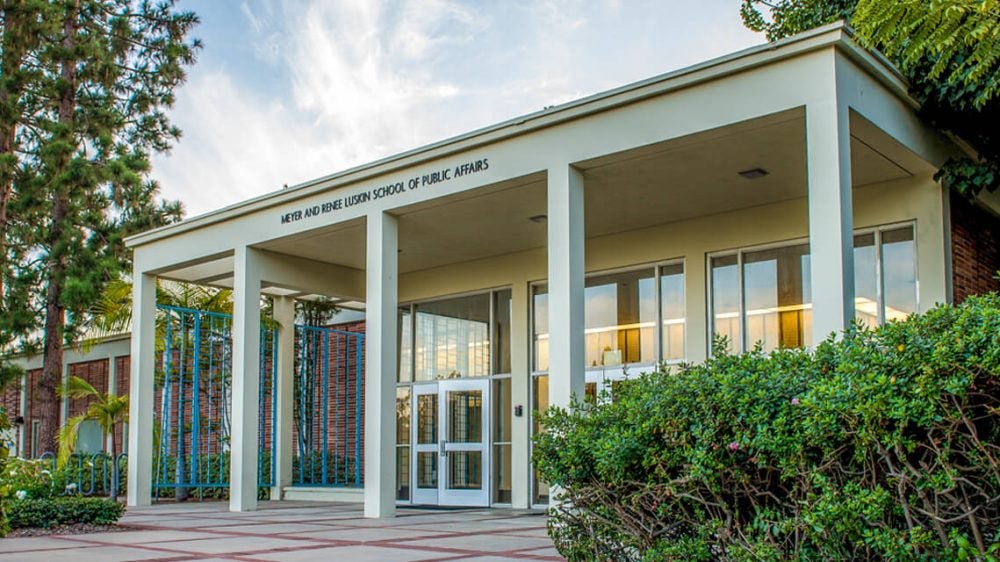
Front entrance of Luskin School of Public Affairs

Luskin Faculty Recognized Among World’s Top 2% of Scientists

November 2, 2026
Luskin's Latest Blog

UCLA Luskin School of Public Affairs faculty members have been recognized in the 2026 Stanford-Elsevier Top...

Read More
Headshot of Kamal Cheema MPP 23 on the left and a group photo on the right. He worked with Laura Edwards, Thomas Hernandez, Mei Naito and Ibuki Yamada on One Dollar a Day: Labor Conditions Within California Immigrant Detention Centers

Three Years After Graduation, UCLA Luskin Alumni See Their Research Help Shape California Law

October 30, 2026
Public Policy

Research conducted by UCLA Luskin Master of Public Policy students in 2023 has helped inform new...

Read More
Learn more about UCLA Luskin

Find contact information and get answers to your questions.

Contact Us

Public Affairs Building
337 Charles E. Young Drive East
Los Angeles, California 90095

Linkedin Youtube Instagram Facebook X-twitter
Campus Resources
  • Map, Directions, Parking
  • Directory
  • Academic Calendar
  • Careers
  • Map, Directions, Parking
  • Directory
  • Academic Calendar
  • Careers
School Resources
  • About
  • Our Dean
  • Administration
  • Luskin School Intranet
  • Board of Advisors
  • Contact Us
  • Visit Us
  • About
  • Our Dean
  • Administration
  • Luskin School Intranet
  • Board of Advisors
  • Contact Us
  • Visit Us
UCLA logo
© 2026 Regents of the University of California
  • Emergency
  • Accessibility
  • Privacy & Terms of Use
  • Emergency
  • Accessibility
  • Privacy & Terms of Use
Facebook Instagram Linkedin X-twitter Youtube Threads
UCLA Luskin School of Public Affairs Logo
Academics
Departments
  • Global Public Affairs
  • Public Policy
  • Real Estate Development
  • Social Welfare
  • Urban Planning
  • Undergraduate Program
  • Global Public Affairs
  • Public Policy
  • Real Estate Development
  • Social Welfare
  • Urban Planning
  • Undergraduate Program
Graduate Programs
  • Master of Global Public Affairs (MGPA)
  • Master of Public Policy (MPP)
  • Master of Real Estate Development (MRED)
  • Master of Social Welfare (MSW)
  • Master of Urban and Regional Planning (MURP)
  • PhD in Social Welfare
  • PhD in Urban Planning
  • Master of Global Public Affairs (MGPA)
  • Master of Public Policy (MPP)
  • Master of Real Estate Development (MRED)
  • Master of Social Welfare (MSW)
  • Master of Urban and Regional Planning (MURP)
  • PhD in Social Welfare
  • PhD in Urban Planning
Undergraduate Programs
  • BA in Public Affairs
  • Minor in Urban and Regional Studies
  • Minor in Gerontology
  • Minor in Public Affairs
  • BA in Public Affairs
  • Minor in Urban and Regional Studies
  • Minor in Gerontology
  • Minor in Public Affairs
Professional Certificates
  • AI in Public Affairs Certificate
  • AI in Public Affairs Certificate
Admissions
Program Specific Admissions
  • Global Public Affairs
  • Public Policy
  • Real Estate Development
  • Social Welfare
  • Urban Planning
  • Undergraduate Program
  • Global Public Affairs
  • Public Policy
  • Real Estate Development
  • Social Welfare
  • Urban Planning
  • Undergraduate Program
Faculty
Our Faculty
  • All Faculty
  • Public Policy
  • Real Estate Development
  • Social Welfare
  • Urban Planning
  • All Faculty
  • Public Policy
  • Real Estate Development
  • Social Welfare
  • Urban Planning
Leadership
  • Our Dean
  • Board of Advisors
  • Faculty Executive Committee
  • Our Dean
  • Board of Advisors
  • Faculty Executive Committee
Research Centers
  • Agile Visual Analytics Lab (AVAL)

    Empowers stakeholders with data to make informed decisions for children, families, and communities.

  • Berggruen Governance Index

    Evaluates the quality of political governance and democracy worldwide.

  • Center for Neighborhood Knowledge (CNK)

    Specializes in spatial analysis of socioeconomic disparities in neighborhoods.

  • Center for Policy Research on Aging (CPRA)

    Explores the societal and policy implications of an aging population.

  • Institute of Transportation Studies (ITS)

    Advances research, education, and meaningful civic engagement on transportation issues.

  • Institute on Inequality and Democracy

    Advances scholarship that confronts threats to democracy in America and around the world.

  • Latin American Cities Initiative

    Connects urban planning and policy networks across the Americas.

  • Latino Policy & Politics Institute (LPPI)

    Addresses policy challenges facing Latinos and communities of color.

  • Lewis Center for Regional Policy Studies

    Studying housing affordability and transportation equity in the L.A. region.

  • Los Angeles Education Research Institute (LAERI)

    Collaborates with schools to improve educational outcomes for L.A. students.

  • Luskin Center for Innovation

    Informing effective and equitable environmental policy that improves lives.

  • UCLA Voting Rights Project

    The flagship project for voting rights litigation and policy research.

All Research Centers
Outcomes
Common Search Terms

Results will show as you type.