
Overview
Applied and community engaged research is a defining part of the educational experience in UCLA’s Department of Urban Planning. In masters capstones and through additional research opportunities, students examine pressing challenges facing cities and regions and develop evidence-based approaches to addressing them.
These projects allow students to bring together the knowledge and skills developed throughout their studies, including research, data analysis, community engagement, policy evaluation and planning practice. Working independently or in interdisciplinary teams, students explore issues such as housing affordability, transportation, climate resilience, economic development, social equity and the design of more inclusive communities.
The work reflects both the breadth of the urban planning field and UCLA Luskin’s commitment to connecting rigorous scholarship with real-world impact.
Masters Capstones
Applied Planning Research Capstones
The Client Project is applied planning research on a real-world problem conducted by MURP students in their 2nd year in order to satisfy the capstone requirement for the degree. Students present visual representations of their research at Careers, Capstones, and Conversation: A Networking Event (CCC) in the Spring. Each year at CCC three students are awarded for outstanding posters. The 2026 poster winners are below. All projects can be viewed in the Capstone Project Database.
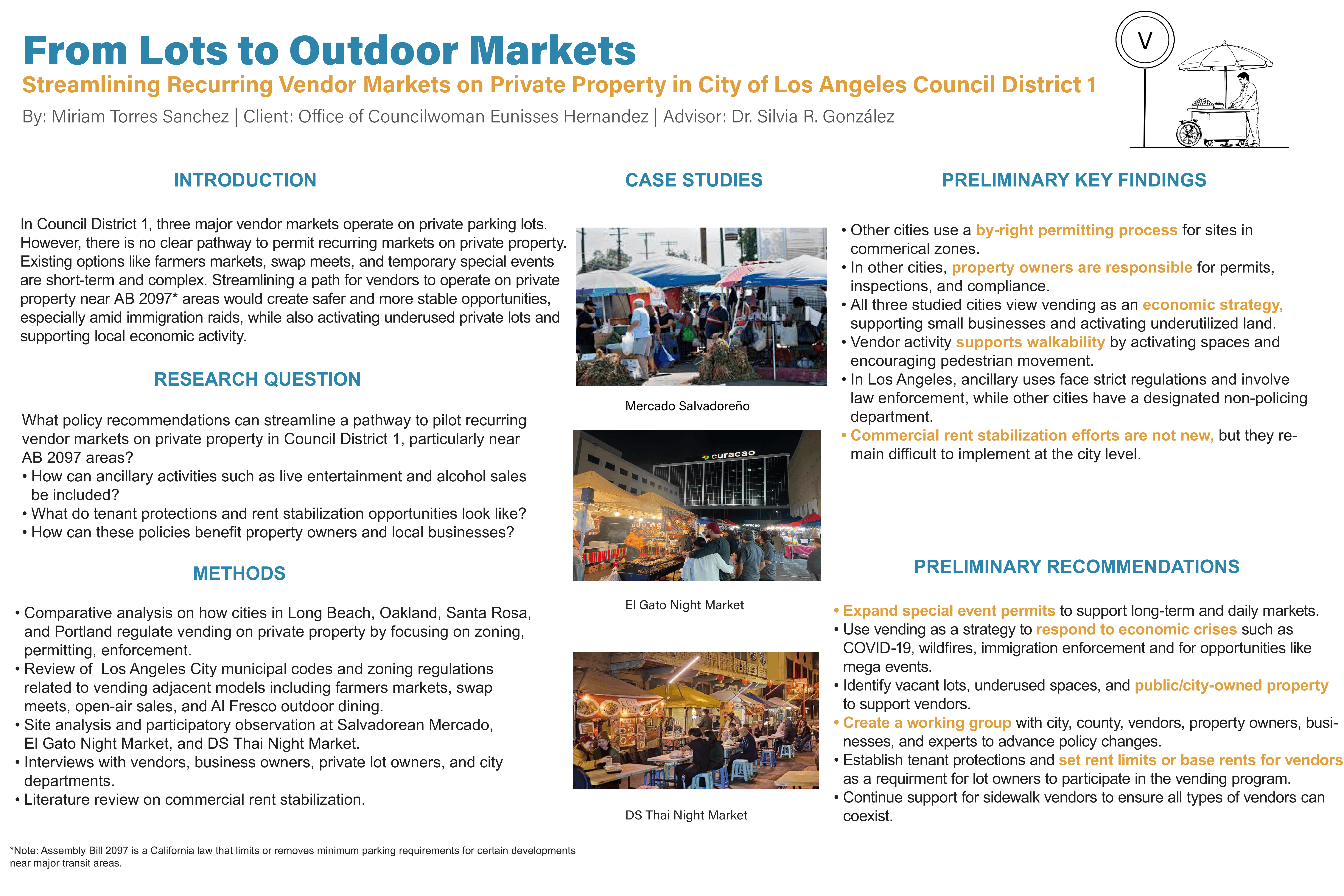
Miriam Torres Sanchez
From Lots to Outdoor Markets:
Streamlining recurring vendor markets on private property in City of Los Angeles Council District 1
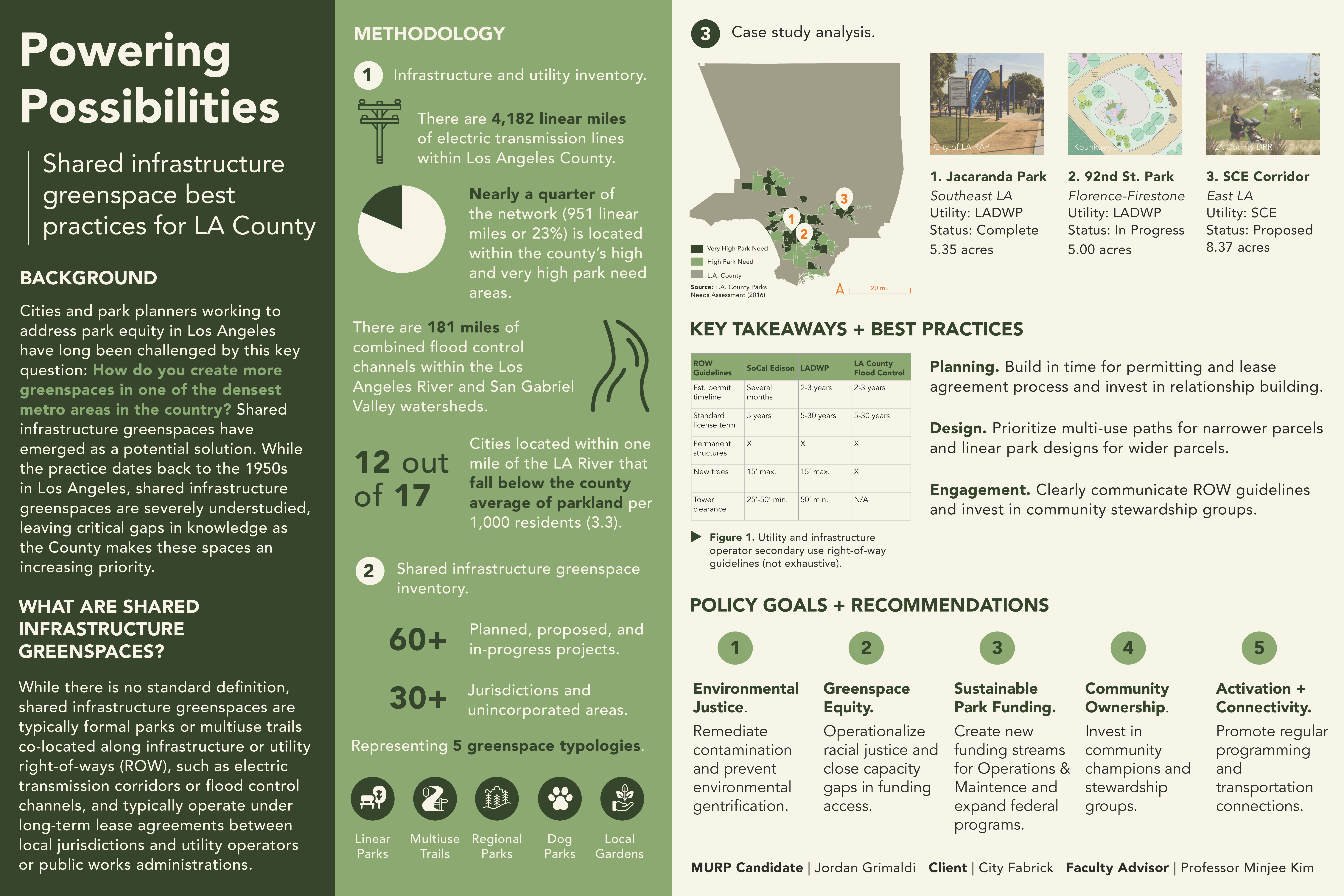
Jordan Grimaldi
Powering Possibilities: Shared infrastructure greenspace best practices for LA County
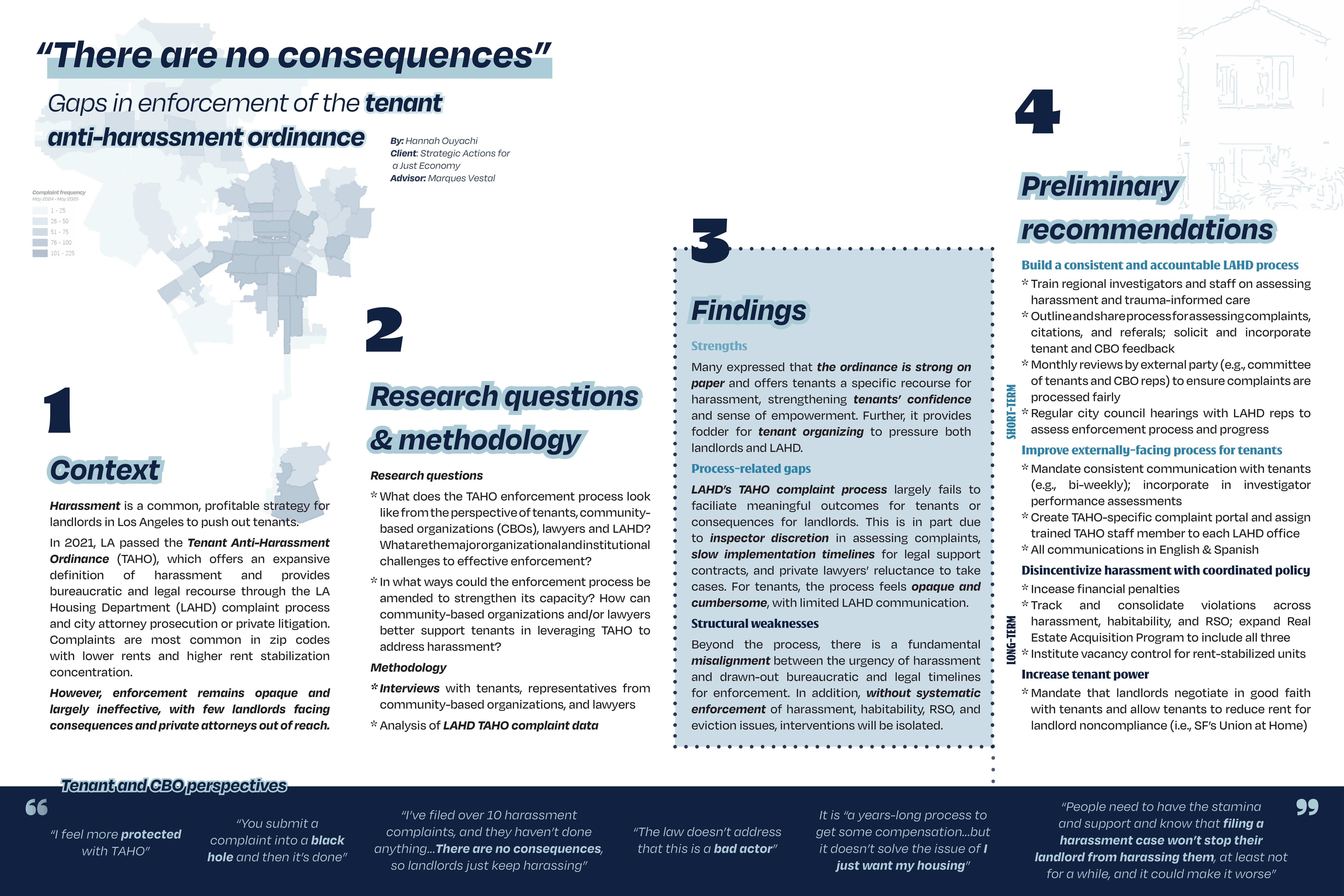
Hannah Ouyachi
“There are no consequences”: Gaps in enforcement of the tenant anti-harassment ordinance
Community Collaborative & Comprehensive Projects
Community Collaborative & the Comprehensive Projects are similar, in many respects, to the client project, but larger in scope and scale. These projects simulate real world planning practice in that they incorporate students from various areas of concentration working together to research a problem from multiple planning angles.
The Community Collaborative, launched in 2020, grew out of the Community Scholars Program, which was created in 1991 as a joint initiative of UCLA’s Department of Urban Planning and the Center for Labor Research and Education in recognition of the important role that grassroots community and labor leaders, organizers, and artists play in shaping community development policy in Los Angeles. The Community Collaborative program continues to work in this spirit and provides an opportunity for these key grassroots players, regardless of their formal education background, to participate in this special applied research seminar along with graduate students. All work together on research and strategy-building on an issue of pressing concern to Los Angeles communities.
2026 Projects
The 2026 Community Scholars and Comprehensive Project reports are listed below. All capstone projects can be viewed in the Capstone Project Database.
Drought & Climate Resiliency Solutions for Small Water Systems in Los Angeles County
Creating a Shade Equity Plan for
Unincorporated East Coachella
Valley
Masters Thesis
The thesis focuses on posing and answering a research question in planning that has not previously been answered. Research is conducted by a MURP student in conjunction with a faculty committee. Students present visual representations of their research at Careers, Capstones, and Conversation: A Networking Event (CCC) in the Spring.
PhD Dissertations
After successful completion of all requirements in planning theory and history, the major field, research methods, and outside coursework, students petition for appointment of a doctoral committee. The doctoral committee guides the student in preparing the dissertation, which is to be a monograph representing an original contribution to planning knowledge. The Class of 2026 is listed below. To view all doctoral dissertations, visit the UCLA Library.
Dr. Claire Nelischer
Professor Anastasia Loukaitou-Sideris
“Natural alliances: Greening, growth, and
the private production of the public realm”
Dr. Ana María Durán Calisto
Professor Susanna B. Hecht
“Exogenous and Endogenous Systems of Planning in Upper Amazonia: Possible Futures”
Dr. Madeline Wander
Professor Evelyn Blumenberg
“Mobility and Racial-Spatial Isolation in Suburbs”
Dr. Gus Wendel
Professor Dana Cuff
“Planning the Gay City: Incorporation, Redevelopment, and the Formation
of West Hollywood”
Dr. Chendi Zhang
Professor Anastasia Loukaitou-Sideris
“Aging with Autonomy: Global, Regional, and Local Planning and Design for Aging in Place”
Additional Research Opportunities
Research with Luskin Research Centers
Urban Planning students have access to UCLA Luskin’s interdisciplinary research centers, where they partner with faculty and community organizations to advance innovative research that informs policy and improves cities and communities around the world. Explore the full range of UCLA Luskin research centers and affiliated institutes to learn more about the opportunities available to Urban Planning students.
Awards & Competitions
Every year MURP and PhD students participate in/apply for various awards and competitions as well as create their own educational trips and independent studies. These extracurricular activities take learning beyond the classroom and allow students to share their work to with a larger community. These opportunities are invaluable to the learning process and professional development of our students. If you are interesting in supporting these educational opportunities click here for more details.
Critical Planning Journal
Critical Planning is the graduate-student-run journal of the UCLA Urban Planning Department. CPJ began in 1993 as a forum for the urban studies and planning communities to debate current issues, showcase emerging research, and propose new ideas concerning cities and regions. The core mission of Critical Planning is to promote criticality and social justice. In pursuit of these ends, Critical Planning seeks out new forms of knowledge and modes of representation. The journal is thus not only a space for planning scholars and practitioners, but also activists, artists, organizers and others who take “the city,” however defined, as their object of inquiry.
Critical Planning Journal (CPJ) is a double-blind peer-reviewed publication. Submissions should be original (not published elsewhere). CPJ accepts various submission formats including, but not limited to, academic articles, fiction, poetry, manifestos, and personal essays.
For more information, including how to submit original work, visit the Critical Planning Journal Website.
Past volumes can be viewed on CPJs eScholarship page.