Skip to content
  • Students & Alumni
    • Overview
    • Career Services
    • Alumni Relations
    • Student Support
    • Graduate Resource Library
  • News
  • Events
    • Events Calendar
    • Luskin Summit
    • Luskin Lecture Series
    • California Policy Briefing
    • Commencement
  • Students & Alumni
    • Overview
    • Career Services
    • Alumni Relations
    • Student Support
    • Graduate Resource Library
  • News
  • Events
    • Events Calendar
    • Luskin Summit
    • Luskin Lecture Series
    • California Policy Briefing
    • Commencement
Giving
  • Academics
    Departments
    • Public Policy
    • Real Estate Development
    • Social Welfare
    • Undergraduate Program
    • Urban Planning
    • Public Policy
    • Real Estate Development
    • Social Welfare
    • Undergraduate Program
    • Urban Planning
    Graduate Programs
    • Master of Public Policy (MPP)
    • Master of Real Estate Development (MRED)
    • Master of Social Welfare (MSW)
    • Master of Urban and Regional Planning (MURP)
    • PhD in Social Welfare
    • PhD in Urban Planning
    • Master of Public Policy (MPP)
    • Master of Real Estate Development (MRED)
    • Master of Social Welfare (MSW)
    • Master of Urban and Regional Planning (MURP)
    • PhD in Social Welfare
    • PhD in Urban Planning
    Undergraduate Programs
    • BA in Public Affairs
    • Minor in Urban and Regional Studies
    • Minor in Gerontology
    • Minor in Public Affairs
    • BA in Public Affairs
    • Minor in Urban and Regional Studies
    • Minor in Gerontology
    • Minor in Public Affairs
    Professional Certificates
    • Data Analytics Certificate
    • Data Analytics Certificate
  • Admissions
    Program Specific Admissions
    • Public Policy
    • Real Estate Development
    • Social Welfare
    • Urban Planning
    • Undergraduate Program
    • Public Policy
    • Real Estate Development
    • Social Welfare
    • Urban Planning
    • Undergraduate Program
  • Faculty
    Our Faculty
    • All Faculty
    • Public Policy
    • Real Estate Development
    • Social Welfare
    • Urban Planning
    • All Faculty
    • Public Policy
    • Real Estate Development
    • Social Welfare
    • Urban Planning
    Leadership
    • Our Dean
    • Board of Advisors
    • Faculty Executive Committee
    • Our Dean
    • Board of Advisors
    • Faculty Executive Committee
  • Research Centers
    • Agile Visual Analytics Lab (AVAL):

      Uses data visualization to improve decision-making for family and child services.

    • Berggruen Governance Index

      Evaluates the quality of political governance and democracy worldwide.

    • Center for Neighborhood Knowledge (CNK)

      Specializes in spatial analysis of socioeconomic disparities in neighborhoods.

    • Center for Policy Research on Aging (CPRA)

      Explores the societal and policy implications of an aging population.

    • Agile Visual Analytics Lab (AVAL):

      Uses data visualization to improve decision-making for family and child services.

    • Berggruen Governance Index

      Evaluates the quality of political governance and democracy worldwide.

    • Center for Neighborhood Knowledge (CNK)

      Specializes in spatial analysis of socioeconomic disparities in neighborhoods.

    • Center for Policy Research on Aging (CPRA)

      Explores the societal and policy implications of an aging population.

    • Institute of Transportation Studies (ITS)

      A national leader in transportation policy and mobility research.

    • Institute on Inequality and Democracy

      Advances scholarship addressing displacement and dispossession in Los Angeles and beyond.

    • Latin American Cities Initiative

      Connects urban planning and policy networks across the Americas.

    • Latino Policy & Politics Institute (LPPI)

      Addresses policy challenges facing Latinos and communities of color.

    • Institute of Transportation Studies (ITS)

      A national leader in transportation policy and mobility research.

    • Institute on Inequality and Democracy

      Advances scholarship addressing displacement and dispossession in Los Angeles and beyond.

    • Latin American Cities Initiative

      Connects urban planning and policy networks across the Americas.

    • Latino Policy & Politics Institute (LPPI)

      Addresses policy challenges facing Latinos and communities of color.

    • Lewis Center for Regional Policy Studies

      Researches housing, transportation, and economic development in Southern California.

    • Los Angeles Education Research Institute (LAERI)

      Collaborates with schools to improve educational outcomes for L.A. students.

    • Luskin Center for Innovation (LCI)

      Focuses on environmental policy, clean energy, and climate justice.

    • UCLA Voting Rights Project

      The flagship project for voting rights litigation and policy research.

    • Lewis Center for Regional Policy Studies

      Researches housing, transportation, and economic development in Southern California.

    • Los Angeles Education Research Institute (LAERI)

      Collaborates with schools to improve educational outcomes for L.A. students.

    • Luskin Center for Innovation (LCI)

      Focuses on environmental policy, clean energy, and climate justice.

    • UCLA Voting Rights Project

      The flagship project for voting rights litigation and policy research.

    All Research Centers
  • Outcomes
Home / Former Governors Wilson, Davis Discuss Housing, Crime and More at Luskin Summit

Former Governors Wilson, Davis Discuss Housing, Crime and More at Luskin Summit

The two leaders, a Republican and a Democrat, express their differing perspectives on 'The State of California'
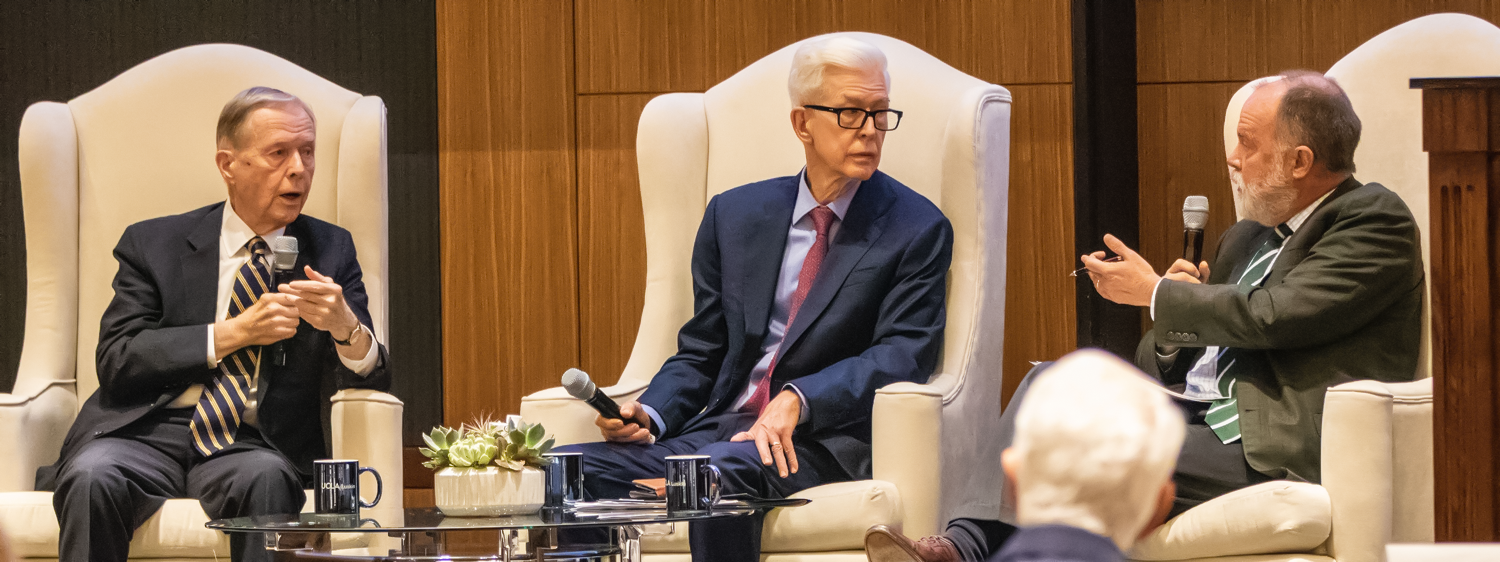
From left in large chairs on a stage during discussion at UCLA are Pete Wilson, Gray Davis and Jim Newton

Posted in

  • Alumni, Business and the Environment, Climate Change, Development and Housing, Education, Environment, For Faculty, For Policymakers, For Students, For Undergraduates, Politics, Public Policy, Public Policy News, School of Public Affairs, Social Welfare News, Urban Planning

Published on

  • April 27, 2022
  • California, crime, Democrats, education, government, housing, politics, poverty, Republicans, research, Sacramento, universities

Share this Article

By Les Dunseith

Former California governors Pete Wilson and Gray Davis headlined the closing session of Luskin Summit 2022: Research in Action on April 22, often tackling political issues from starkly different perspectives.

In a session moderated by UCLA Blueprint Editor-in-Chief Jim Newton and titled “The State of California,” the former governors explored topics such as the economy and inflation, housing, environmental issues and rising crime during a discussion that mostly reflected a tone of respectful disagreement.

The governors spoke during a half-day event at the Luskin Conference Center at UCLA to close out this year’s Luskin Summit, which is a series of research-informed, cross-sector explorations of the major issues facing Los Angeles and California. The day’s agenda also included the unveiling of the annual Quality of Life Index led by Zev Yaroslavsky, a well-known former elected official in Los Angeles who, like Newton, is now a faculty member associated with the UCLA Luskin School of Public Affairs.

Yaroslavsky’s session, which was moderated by news anchor Phillip Palmer of ABC7, explained why the rating in his survey of Los Angeles County residents fell to its lowest point in seven years of existence. A majority of respondents said they are dissatisfied with the overall quality of their lives as reflected in nine categories, including cost of living, education, the environment and public safety. And those topics were also front of mind during the governors’ discussion.

Wilson, a Republican who was California governor from 1991 to 1999, took note of the current $80 billion revenue surplus in California, saying that if current lawmakers can’t solve the state’s shortcomings, it won’t be for lack of funds.

“The state is rolling in money. That’s not the problem,” he said when asked by Newton to speculate on the public’s downbeat mood. “The way it is spent is what’s causing a lot of the dissatisfaction. There are people who are very much concerned about crime because they’ve seen a dramatic shift, a really discernible shift. And they’re concerned about their children’s education, and they should be.”

Davis, a Democrat who was governor of California from 1999 to 2003, took a different tack on Californians’ current mood in the wake of the COVID-19 pandemic.

“There’s a lot of good news globally, nationally and in California as it relates to people working again, and lower unemployment rates,” he said. “The bad news is that people have been through a very tough time. This has been two-and-a-half years where we’ve been told we can’t do this, we can’t do that. … People don’t like to be told what they can’t do.”

Solving society’s problems will require innovation, Davis said, and California is the right place. The number of U.S. patents that originated in California in recent years, he said, is roughly four times the number originating in the state that comes in second, Texas.

“If you want to invent something, this is the place to do it, in California,” he said. “We invent, we design, we create.”

Davis took note of the setting, a public research university in a state that is widely respected for its institutions of higher education. Mentioning that UCLA Chancellor Gene Block was in attendance, Davis continued, “There is nothing better about California than its 10 UC campuses. Nobody in the country has anything close to this.”

Block provided the introduction for the session, noting that Los Angeles faces substantial challenges relating to public safety, the ongoing pandemic and a shortage of affordable housing.

“These issues are bearing down on people all across the state. We’re not alone,” Block said. “Addressing them is going to require scholars, businesspeople, community leaders to really work together and devise and enact solutions.”

Noting the presence of the two former governors, Block continued. “Wisdom is gained by experience, and we have a vast amount of that here.”

Newton, a former reporter and editor at the Los Angeles Times whose books include a recent biography of two-time governor Jerry Brown, asked Wilson and Davis to talk about their approaches to public safety.

Davis acknowledged crime rates are on the rise, although not to “where they were in the ’90s when Pete Wilson and I were a governor.”

One solution, he said, lies in effective law enforcement.

“Police have to be part of the equation,” said Davis, acknowledging past abuses by some officers. “Anyone who saw the video of the George Floyd murder knows it was appalling, not acceptable, and should never happen again. But there are some common-sense reforms that I think most law enforcement agree with.”

He called for a balanced approach. “The police have to behave in a respectful way, treat people with dignity, in a way that commands respect.”

Wilson echoed the sentiment. “It’s called community policing. And it makes great sense, as does treating people respectfully when you stop them as a police officer.”

In his view, however, effective law enforcement is too often undermined by a lenient criminal justice system, especially regarding violent crime.

“I think I was the first governor in the country to sign — what was also subsequently in the same year, an initiative measure — that was called three strikes. And what it did was to focus on recidivism, on the people who were career violent criminals. … It’s not fair to play with people’s lives by letting people out on the street who are known violent criminals.”

Davis countered by pointing to a shortcoming of taking a hard-line approach to crime — overcrowded prisons that tend to perpetuate societal and racial inequities. Incarceration without rehabilitation doesn’t work either.

“Getting people to transition from prison back to productive life requires an extraordinary amount of help,” he said.

Perhaps no public policy issue better represents the divide between the haves and have-nots in California than the housing crisis. At a time when many homeowners are sitting on a fortune in housing equity, millions of people in the state struggle to pay rent. Some end up homeless.

“The California legislature has to get serious about making housing more affordable,” Davis said.

He pointed to legislation pending in Sacramento that would allocate $25 billion to an agency that could help potential homebuyers with a down payment and closing costs. Another effort in the private sector is offering 10% of a home’s down payment in exchange for 25% of the homeowner’s future equity.

“I’m not saying it’s perfect, but that’s on the right track,” Davis said.

Wilson pointed to the California Environmental Quality Act, known as CEQA, passed in 1970 and signed by then-governor Ronald Reagan, as a major hurdle to building more affordable housing in the state.

“The best single thing that could happen is for CEQA to be reformed because that has held up the construction of homes,” said Wilson, who decried the long wait that developers often face to clear the environmental protection review process. “It has hugely added to the delay in providing housing. And that has cost a fortune in terms of the ultimate buyer.”

But the legislation still has value, Newton said. “It is protective of the environment. No?”

Davis jumped into the discussion.

“Look, the original idea was: If Caltrans was building a freeway, the public should comment on it, and it should be thoroughly debated before it occurs,” he said.

Today, circumstances have changed, and the focus has turned to building homes for the state’s large population. Environmental reviews and public hearings about land use take time, but there are ways to shorten the process.

“The good news is we are making some progress,” Davis said. “When it comes to the homeless — anything for the building of shelter for the homeless and for all the services attended to in mental health and social services — all those buildings should be exempt [from CEQA].”

Newton also asked the governors to weigh in on another hot button topic, giving some of the state’s budget surplus back to Californians.

“Absolutely. I mean, gas prices are near a record high,” Davis said.

“Well, I think that it’s not bad, but it’s like dipping into [the country’s] petroleum reserve, it’s not the answer,” Wilson said.

Newton pressed forward, seeking to clarify that both former governors think the current governor, Gavin Newsom, should send a portion of the California surplus back to the state’s residents.

“We have a big surplus. It should be used for one-time expenditures like this,” Davis said.

“If it’s a one-time, modest solution, that will help,” Wilson said.

“You do agree,” Newton said, smiling. “I was surprised.”

Soon after, Newton thanked the former elected officials for their years of government service and their willingness to participate in a public discussion of political issues seen from their different vantage points.

“We all will disagree on things,” Newton said to the in-person audience and those watching online. “I think it’s too commonplace these days to assume that disagreement is [just cause] to be enemies. And it’s heartening to have the both of you here to show otherwise.”

Watch a recording of the session:

See additional photos from both April 22 sessions on Flickr:

Luskin Summit 2022 Closing Sessions

Faculty Mentioned in this Article
Newton+Jim

Jim Newton

Lecturer of Public Policy

Jim Newton is a veteran journalist, author and teacher. In 25 years at the Los Angeles Times, Newton worked as...

|

Zev Yaroslavsky

Director, Los Angeles Initiative

During a career in public life spanning nearly four decades, Zev Yaroslavsky has been at the forefront of Los Angeles...

Related Articles

a complex of buildines in process of getting built, framing is done and some sheathing sitting on a muddy construction site.

Zev Yaroslavsky Discusses L.A. County’s Growth and Housing Challenges

July 10, 2026
Luskin in the News
Zev Yaroslavsky analyzed L.A. County’s booming communities, explaining housing growth opportunities and affordability challenges in the...
Read More
Two women on stage|three men in suits sitting on stage

Hope Is Hard Work: Laphonza Butler Delivered Call to Action on Building Power From the Ground Up

April 20, 2026
Alumni
At the annual Luskin Summit, the former U.S. senator joined 400 scholars, students, and leaders in...
Read More
Los Angeles Times

Zev Yaroslavsky Reflects on Declining Quality of Life in Los Angeles Times Report

April 17, 2026
Luskin in the News
The index score dropped to 52, driven by widespread declines in satisfaction across nearly all major...
Read More
collage of three women and one man

A Toss-Up in the LA Mayor’s Race

April 16, 2026
Luskin in the News
UCLA Luskin poll finding 40% undecided draws local, national and international coverage....
Read More
A northbound view of the 405 freeway during Friday afternoon traffic with Getty Museum, Westwood and Santa Monica mountains in the background.

Los Angeles County residents’ satisfaction with quality of life at all-time low in year 11 of UCLA survey

April 15, 2026
School of Public Affairs
L.A. County residents are less satisfied with their quality of life than at any time in...
Read More
Zev QLI ABC News

Zev Yaroslavsky Discusses Los Angeles Quality of Life Survey Ahead of Luskin Summit

April 13, 2026
Luskin in the News
Luskin’s Quality of Life Index is an annual survey conducted since 2016....
Read More
Zev Yaroslavsky apearing on “Inside the Issues“ news segment with Amrit Singh on Spectrum News 1. They sit across from each other on the tv news set.

Zev Yaroslavsky Reflects on 1984 Olympics and Weighs in on LA28

April 9, 2026
Luskin in the News
Zev Yaroslavsky discusses lessons from the 1984 Olympics and calls for transparency as Los Angeles prepares...
Read More
I Voted stickers||

Volatility Ahead in LA Mayor’s Race; UCLA Luskin Poll Finds 40% of Voters Undecided

April 3, 2026
For Policymakers

With just two months to go before a primary election for Los Angeles’ next mayor, 40%...

Read More
Yaroslavsky In the News

Yaroslavsky on the Response to the Lachman Fire

November 21, 2025
Luskin in the News
Zev Yaroslavsky spoke with the Guardian about the response to the Lachman fire, which resulted in...
Read More
Man in suit and glasses seated at meeting

Failure to Vote on a Key Los Angeles Appointment

October 3, 2025
Luskin in the News
"It's almost unheard of," Zev Yaroslavsky says after City Council fails to act to confirm or...
Read More
Zev Yaroslavsky, a former member of the Los Angeles County Board of Supervisors, in his then-office in 2014. (Los Angeles Times)

Zev Yaroslavsky, UCLA’s Jewish community unite against Trump’s $1B demand

August 19, 2025
Luskin in the News
Jewish faculty at UCLA, joined by former L.A. County supervisor Zev Yaroslavsky, rally against the Trump...
Read More
Photo of speakers on a stage|||||||||||||

UCLA Luskin Summit Focused on Rebuilding and Recovery from the Wildfires

May 16, 2025
School of Public Affairs
L.A. Mayor Karen Bass and other community leaders joined nearly 400 attendees for the 2025 Luskin...
Read More
Learn more about UCLA Luskin

Find contact information and get answers to your questions.

Contact Us

Public Affairs Building
337 Charles E. Young Drive East
Los Angeles, California 90095

Linkedin Youtube Instagram Facebook X-twitter
Campus Resources
  • Map, Directions, Parking
  • Directory
  • Academic Calendar
  • Careers
  • Map, Directions, Parking
  • Directory
  • Academic Calendar
  • Careers
School Resources
  • About
  • Our Dean
  • Administration
  • Board of Advisors
  • Contact Us
  • Visit Us
  • About
  • Our Dean
  • Administration
  • Board of Advisors
  • Contact Us
  • Visit Us
© 2026 Regents of the University of California
  • Emergency
  • Accessibilty
  • Privacy & Terms of Use
  • Emergency
  • Accessibilty
  • Privacy & Terms of Use
Facebook Instagram Linkedin X-twitter Youtube Threads
Academics
Departments
  • Public Policy
  • Real Estate Development
  • Social Welfare
  • Undergraduate Program
  • Urban Planning
  • Public Policy
  • Real Estate Development
  • Social Welfare
  • Undergraduate Program
  • Urban Planning
Graduate Programs
  • Master of Public Policy (MPP)
  • Master of Real Estate Development (MRED)
  • Master of Social Welfare (MSW)
  • Master of Urban and Regional Planning (MURP)
  • PhD in Social Welfare
  • PhD in Urban Planning
  • Master of Public Policy (MPP)
  • Master of Real Estate Development (MRED)
  • Master of Social Welfare (MSW)
  • Master of Urban and Regional Planning (MURP)
  • PhD in Social Welfare
  • PhD in Urban Planning
Undergraduate Programs
  • BA in Public Affairs
  • Minor in Urban and Regional Studies
  • Minor in Gerontology
  • Minor in Public Affairs
  • BA in Public Affairs
  • Minor in Urban and Regional Studies
  • Minor in Gerontology
  • Minor in Public Affairs
Professional Certificates
  • Data Analytics Certificate
  • Data Analytics Certificate
Admissions
Program Specific Admissions
  • Public Policy
  • Real Estate Development
  • Social Welfare
  • Urban Planning
  • Undergraduate Program
  • Public Policy
  • Real Estate Development
  • Social Welfare
  • Urban Planning
  • Undergraduate Program
Faculty
Our Faculty
  • All Faculty
  • Public Policy
  • Real Estate Development
  • Social Welfare
  • Urban Planning
  • All Faculty
  • Public Policy
  • Real Estate Development
  • Social Welfare
  • Urban Planning
Leadership
  • Our Dean
  • Board of Advisors
  • Faculty Executive Committee
  • Our Dean
  • Board of Advisors
  • Faculty Executive Committee
Research Centers
  • Agile Visual Analytics Lab (AVAL):

    Uses data visualization to improve decision-making for family and child services.

  • Berggruen Governance Index

    Evaluates the quality of political governance and democracy worldwide.

  • Center for Neighborhood Knowledge (CNK)

    Specializes in spatial analysis of socioeconomic disparities in neighborhoods.

  • Center for Policy Research on Aging (CPRA)

    Explores the societal and policy implications of an aging population.

  • Agile Visual Analytics Lab (AVAL):

    Uses data visualization to improve decision-making for family and child services.

  • Berggruen Governance Index

    Evaluates the quality of political governance and democracy worldwide.

  • Center for Neighborhood Knowledge (CNK)

    Specializes in spatial analysis of socioeconomic disparities in neighborhoods.

  • Center for Policy Research on Aging (CPRA)

    Explores the societal and policy implications of an aging population.

  • Institute of Transportation Studies (ITS)

    A national leader in transportation policy and mobility research.

  • Institute on Inequality and Democracy

    Advances scholarship addressing displacement and dispossession in Los Angeles and beyond.

  • Latin American Cities Initiative

    Connects urban planning and policy networks across the Americas.

  • Latino Policy & Politics Institute (LPPI)

    Addresses policy challenges facing Latinos and communities of color.

  • Institute of Transportation Studies (ITS)

    A national leader in transportation policy and mobility research.

  • Institute on Inequality and Democracy

    Advances scholarship addressing displacement and dispossession in Los Angeles and beyond.

  • Latin American Cities Initiative

    Connects urban planning and policy networks across the Americas.

  • Latino Policy & Politics Institute (LPPI)

    Addresses policy challenges facing Latinos and communities of color.

  • Lewis Center for Regional Policy Studies

    Researches housing, transportation, and economic development in Southern California.

  • Los Angeles Education Research Institute (LAERI)

    Collaborates with schools to improve educational outcomes for L.A. students.

  • Luskin Center for Innovation (LCI)

    Focuses on environmental policy, clean energy, and climate justice.

  • UCLA Voting Rights Project

    The flagship project for voting rights litigation and policy research.

  • Lewis Center for Regional Policy Studies

    Researches housing, transportation, and economic development in Southern California.

  • Los Angeles Education Research Institute (LAERI)

    Collaborates with schools to improve educational outcomes for L.A. students.

  • Luskin Center for Innovation (LCI)

    Focuses on environmental policy, clean energy, and climate justice.

  • UCLA Voting Rights Project

    The flagship project for voting rights litigation and policy research.

All Research Centers
Outcomes
Common Search Terms

Results will show as you type.