
Is Bipartisanship Worth It? The Challenge of Working Through Deep Political Divides At a UCLA appearance, former Congress members Jane Harman and David Dreier share insights on overcoming polarization
On Oct. 14, the UCLA Luskin School of Public Affairs, in partnership with the Los Angeles World Affairs Council, hosted a compelling panel discussion titled “Is Bipartisanship Dead?” The event brought together some of the nation’s top policymakers to explore the challenges — and opportunities — of working across party lines in today’s deeply polarized political landscape.
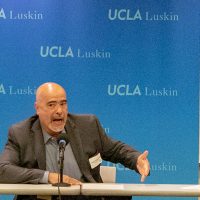
The discussion featured speakers with decades of experience in public office. Former Congresswoman Jane Harman (D-CA) shared insights from her time as ranking member of the House Intelligence Committee and chair of the Homeland Security Committee’s Intelligence Subcommittee. Former Congressman David Dreier (R-CA), who served in the U.S. House of Representatives for over three decades, offered reflections from his years navigating both domestic and international policy challenges.
The event was moderated by Jim Newton, UCLA Luskin faculty member and long-time journalist, who is now editor of UCLA’s Blueprint Magazine. He kicked off the panel by offering what he described as a heretical question – is bipartisanship worth it?
Harman immediately dove into the importance of reaching across the aisle drawing from her time as a U.S. representative, saying, “If you are lucky enough to be elected to [political office], what you want to do there is add value, and you do that by working with other people to solve hard problems for the country. And some of those people may not be in your political party. … It is a tragedy right now that Congress is closed for business.”
In discussing the importance of bipartisanship in a democratic system that encourages and allows for different viewpoints, Dreier championed a political concept outlined in James Madison’s essay, Federalist No. 10. “Madison envisaged a ‘clash of ideas.’ But at the end of the day, a resolution.”
It was clear from the event that Harman and Dreier, despite finding themselves with opposing viewpoints on many issues while serving together in political office, were close and had enjoyed a collegial relationship despite their clear philosophical differences on many issues.
The conversation turned toward the inflection point that started the United States down a path of declining civility in politics. Harman decried the proliferation of negative political ads as a key cause of polarization in this country. “Pollsters tell you that saying something negative penetrates twice as fast as saying something positive about somebody. So, if you want to save your campaign money, you go negative.”
Both panelists offered sage advice for young people just leaving college and hoping to go into public service careers to be problem solvers and bridge builders. They both emphasized the importance of the next generation getting involved in politics to help inform lawmakers with the views and challenges of their generation.
“This is something I think about every day. My purpose is to encourage smart, honest, hardworking, well-educated, ethical people into public service, because I think it’s absolutely essential,” said Dreier, who ran for Congress when he was 25 years old.
“There are some very responsible people in both parties in elected office at various levels,” said Harman in response to a question from a young audience member. “Go find one and sign up as an intern, and go and learn. When I was in high school, I volunteered in a campaign for Congress in my area. … I learned so much, and it set me up for the next job and the next job. Bring your own skills and your hopefulness.”
View photos from the event on Flickr.









Leave a Reply
Want to join the discussion?Feel free to contribute!