• Public Policy
  • Social Welfare
  • Real Estate Development
  • Urban Planning
  • Undergraduate Program
  • Stay in Touch
  • Events Calendar
  • Give Now
  • About
    • Our Dean
    • Board of Advisors
    • Contact Us
    • Visit Us
    • Diversity, Disparities and Difference
    • Communications
      • UCLA Luskin in the News
      • Luskin Forum Online
  • Departments
    • Public Policy
    • Real Estate Development
    • Social Welfare
    • Undergraduate Program
    • Urban Planning
  • Apply
    • Master of Public Policy
    • Master of Real Estate Development
    • Master of Social Welfare
    • Master of Urban and Regional Planning
      • Double Degree With Sciences Po
    • PhD in Social Welfare
    • PhD in Urban Planning
    • Undergraduate Programs
  • Faculty
    • All
    • Public Policy
    • Social Welfare
    • Urban Planning
    • Real Estate Development
    • Faculty Executive Committee
    • Open Positions
  • Student Affairs & Alumni
    • Career Services
      • Employers
      • Fellowships
    • Student Support
    • Graduate Resource Library
    • Alumni Relations
  • Support
  • Programs
    • Research Centers & Affiliated Research
    • CA Title IV-E Education Program
    • Global Public Affairs (GPA)
    • Data Analytics Certificate
    • Luskin Lecture Series
    • Luskin Summit
    • UCLA Luskin California Policy Briefing
    • Public Service Weekend
    • Commencement
  • Administration
    • Financial Services
    • Events Office
    • Information Technology
  • Search
  • Menu Menu

Archive for category: School of Public Affairs

Counteracting the Market Dominance That Keeps Health Care So Expensive Research by UCLA Luskin's Wesley Yin is one of several projects made possible by nearly $55 million in awards to the school

December 3, 2025/0 Comments/in Public Policy, Public Policy News, School of Public Affairs Wesley Yin /by Mary Braswell

Americans are facing rising health expenses year after year, with many compelled to skip or delay the care their families need. To investigate the root causes of this barrier to affordability, UCLA Luskin’s Wesley Yin has embarked on a pair of ambitious studies of market power in the health care industry — and how it might be checked.

Yin’s research, funded by the nonprofit Arnold Ventures, will seek to answer several questions:

How has consolidation in the industry — mergers among hospitals, physician practices, insurers, and pharmaceutical managers, for example —  eroded competition?

How has the market dominance of hospitals and other medical care providers suppressed wages in the health sector — an industry that accounts for 18% of the U.S. economy?

Can “public option” health insurance plans, with cost structures set by government statute, exert enough pressure to counteract the price-negotiating power of dominant providers, leading to lower health care bills?

Headshot of man in suit, white shirt, tie

Professor Yin will tap into powerful research tools to explore market forces in the health sector.

“There are a lot of markets in the U.S. economy that are no longer competitive. This can generate some benefits at times. But the broad concern is that this can create a lot of distortions in the markets, which ultimately bear down on consumers and on workers through higher prices, fewer options, and lower wages,” said Yin, a UCLA Luskin professor of public policy with a joint appointment at the UCLA Anderson School of Management.

“Health care is an industry where this concentration has been rising for decades.”

Yin’s two-year study was made possible by a $466,000 grant from Arnold Ventures, which funds research into policy solutions that address inequity and injustice. It is one of several grants and contracts that have brought nearly $55 million to the UCLA Luskin School of Public Affairs from April to October 2025.

By far the largest component of that funding — more than $47 million — is from federal, state, and county agencies that contract with UCLA Luskin Social Welfare to administer social services and training programs.

Philanthropic groups, nonprofits, community organizations, and public agencies have also stepped up to support UCLA Luskin research spanning the school’s broad portfolio: fair housing, water quality, voting rights, K-12 education, parking reform, and more.

The common thread is a desire to find policy solutions to the most pressing issues of our time, with donors turning to UCLA for its extensive faculty expertise and deep resources as a top-tier research university.

Yin’s work draws on his experience as a scholar, economist and public servant. Motivated by a desire to understand the causes and consequences of excessive market power, he recently co-authored a high-impact study of the crippling impact of medical debt in America.

In the Biden Administration, Yin served as Chief Economist of the White House Office of Management and Budget, where he helped advance policies surrounding affordability and competition. In the Obama Administration a decade earlier, he helped implement the Affordable Care Act during his service in the Department of Treasury and Council of Economic Advisors.

For his current project on the health care industry’s market power, Yin and his research team will tap into powerful resources, including the Federal Statistical Research Data Center, housed in the UCLA Luskin Public Affairs building. Access is highly selective, requiring security clearances and confidentiality agreements — but the massive trove of data opens up vast opportunities for novel research.

Yin has secured permission to analyze anonymized U.S. Census Bureau and Internal Revenue Service files to assess the impact of consolidation in the health care industry on workers’ earnings and job stability — including the potential for lopsided bargaining power and wage inequality.

For a second investigation funded by the grant, Yin and his team will review records from Washington state’s public option health care program, the first in the nation. They hope to identify how such public-private partnerships in procurement can best be structured to act as a brake on soaring health care costs.

“In theory, a public option, if it’s structured well, could try to achieve the prices of what a competitive market would have achieved,” said Yin. “The big question is how to design a public option program with teeth that also supports a healthy hospital market. This project essentially is to understand this.”

Is Bipartisanship Worth It? The Challenge of Working Through Deep Political Divides At a UCLA appearance, former Congress members Jane Harman and David Dreier share insights on overcoming polarization

October 20, 2025/0 Comments/in School of Public Affairs /by Mary Braswell

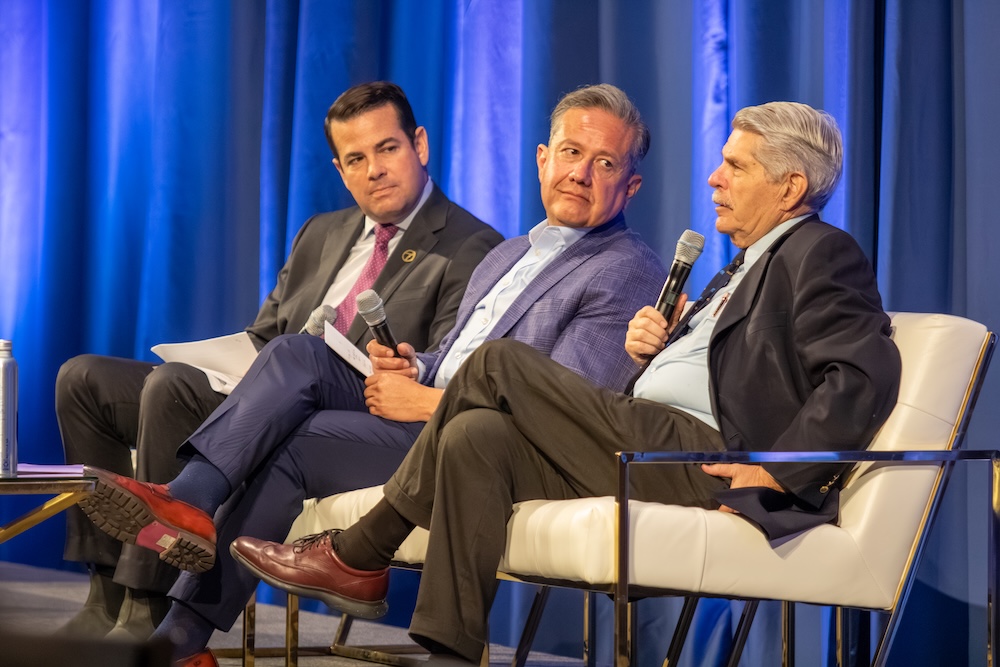
On Oct. 14, the UCLA Luskin School of Public Affairs, in partnership with the Los Angeles World Affairs Council, hosted a compelling panel discussion titled “Is Bipartisanship Dead?” The event brought together some of the nation’s top policymakers to explore the challenges — and opportunities — of working across party lines in today’s deeply polarized political landscape.

The discussion featured speakers with decades of experience in public office. Former Congresswoman Jane Harman (D-CA) shared insights from her time as ranking member of the House Intelligence Committee and chair of the Homeland Security Committee’s Intelligence Subcommittee. Former Congressman David Dreier (R-CA), who served in the U.S. House of Representatives for over three decades, offered reflections from his years navigating both domestic and international policy challenges.

The event was moderated by Jim Newton, UCLA Luskin faculty member and long-time journalist, who is now editor of UCLA’s Blueprint Magazine. He kicked off the panel by offering what he described as a heretical question – is bipartisanship worth it?

Harman immediately dove into the importance of reaching across the aisle drawing from her time as a U.S. representative, saying, “If you are lucky enough to be elected to [political office], what you want to do there is add value, and you do that by working with other people to solve hard problems for the country. And some of those people may not be in your political party. … It is a tragedy right now that Congress is closed for business.”

In discussing the importance of bipartisanship in a democratic system that encourages and allows for different viewpoints, Dreier championed a political concept outlined in James Madison’s essay, Federalist No. 10. “Madison envisaged a ‘clash of ideas.’ But at the end of the day, a resolution.”

It was clear from the event that Harman and Dreier, despite finding themselves with opposing viewpoints on many issues while serving together in political office, were close and had enjoyed a collegial relationship despite their clear philosophical differences on many issues.

The conversation turned toward the inflection point that started the United States down a path of declining civility in politics. Harman decried the proliferation of negative political ads as a key cause of polarization in this country. “Pollsters tell you that saying something negative penetrates twice as fast as saying something positive about somebody. So, if you want to save your campaign money, you go negative.”

Both panelists offered sage advice for young people just leaving college and hoping to go into public service careers to be problem solvers and bridge builders. They both emphasized the importance of the next generation getting involved in politics to help inform lawmakers with the views and challenges of their generation.

“This is something I think about every day. My purpose is to encourage smart, honest, hardworking, well-educated, ethical people into public service, because I think it’s absolutely essential,” said Dreier, who ran for Congress when he was 25 years old.

“There are some very responsible people in both parties in elected office at various levels,” said Harman in response to a question from a young audience member. “Go find one and sign up as an intern, and go and learn. When I was in high school, I volunteered in a campaign for Congress in my area. … I learned so much, and it set me up for the next job and the next job. Bring your own skills and your hopefulness.”

View photos from the event on Flickr.

Is Bipartisanship Dead? A Panel Discussion

LPPI Faculty Director Amada Armenta’s Personal History Influences Her Policy Efforts Her research pushes back on the narrative that Latino communities don’t matter

October 16, 2025/0 Comments/in Alumni, Featured, School of Public Affairs, Urban Planning Amada Armenta /by Mary Braswell
By Sophia Pu
Amada Armenta, a UCLA alumna and associate professor of urban planning, is never far from her roots. While Oct. 15 marks the end of Hispanic Heritage Month, Armenta’s pride in her heritage inspires her to empower Latino communities every day through her work.

Armenta, faculty director of the UCLA Latino Policy and Politics Institute (LPPI) since May 2024, is the first Latina to hold the position. But her journey began 200 miles away, in El Centro, California, at the heart of the Imperial Valley.

Imperial County, which borders Mexico and Arizona, is 85% Hispanic and is California’s top producer of alfalfa and carrots. Yet the unemployment rate in the county continues to rank among the highest in the state. Growing up there taught Armenta the strength of community in the face of economic and social inequalities.

Like many other families in the area, Armenta’s great-grandmother and grandmother crossed the border from Jalisco, Mexico, without authorization to work in the fields. Immigration enforcement checkpoints, vehicles, and increasing surveillance shaped her everyday life.

“Attacks on undocumented immigrants have always felt personal to me,” Armenta said. “For many years, my family was undocumented, so these attacks make me feel like there are people in this country who wish we weren’t here. As a kid, I found that deeply painful.”

Despite Imperial County’s limited resources, Armenta’s family always reminded her to be proud of where she came from.

She recalls: “My dad used to tell me, ‘Brown, it’s beautiful!’ As a kid, I thought he was kind of insane. But now, I’m grateful he said it so often, because it stuck.”

Armenta’s family history and life experiences led her to UCLA’s sociology program for graduate school, where she found “the only institution that has truly felt like home.” Her personal research examines how and why immigration enforcement operates — and its consequences for families and communities.

Armenta’s leadership at LPPI embodies the phrase “knowledge is power.” The research and data-based recommendations provided by the institute to policymakers and advocates, she says, push back on the narrative that Latino communities don’t matter.

LPPI’s policy fellows program also advances one of the key recommendations to becoming a Hispanic-Serving Institution by improving access to graduate and professional programs, extending opportunities for engagement in research, and ensuring mentorship support.

Students have the opportunity to work hands-on alongside professional staff and researchers to gain paid experience shaping academia, policy, and media. This experience provides pathways to careers in legislative offices, government agencies, and research institutions.

“Their opportunities — and mine — exist because of the trailblazers whose work and sacrifice opened doors for us,” Armenta said. “We’re building on their legacies every day.”

UCLA’s Master of Real Estate Development Program to Receive $2.5 Million Gift The pledge from Standard Communities’ Jeffrey Jaeger and Scott Alter will support innovative approaches to affordable housing

October 15, 2025/0 Comments/in School of Public Affairs, Urban Planning /by Mary Braswell

By Kate Shirley

The new Master of Real Estate Development Program (MRED) at the UCLA Luskin School of Public Affairs has received a $2.5 million commitment to support its affordable housing program. The pledge comes from Jeffrey Jaeger and Scott Alter, co-founders and principals of Standard Communities, a Los Angeles–based real estate company dedicated to building and preserving affordable and workforce housing nationwide. In recognition of the gift, the program will be known as the UCLA Jaeger Alter Standard Communities (JASC) Affordable Housing Program. Participating students would earn a Certificate in Affordable Housing.

Launched in fall 2025, the UCLA MRED is a one-year graduate program designed in collaboration with industry leaders. Students gain hands-on experience through case studies, site visits and competitions, preparing them to address pressing housing, environmental and equity challenges. The JASC Affordable Housing Program will ensure UCLA MRED graduates enter the real estate field with the skills, networks and vision to create lasting social impact.

headshots of two men in dark suits

Scott Alter, left, and Jeffrey Jaeger

“This enduring gift enables us to develop new coursework focused on innovative approaches to building affordable housing — drawing on emerging capital market solutions that can scale production far beyond what traditional public subsidies can support,” said Greg Morrow, executive director of the UCLA MRED program. “Through this effort, UCLA MRED is helping to pioneer new ways of addressing the affordable housing crisis.”

Standard Communities has built a reputation as a national leader, delivering innovative, high-impact housing solutions that expand access to safe, dignified and affordable homes. By leveraging creative financial structuring and public-private partnerships, Standard Communities preserves and develops communities that uplift residents, strengthen neighborhoods and help address the country’s urgent affordability crisis.

As part of the UCLA MRED focus on industry partnerships and collaboration, Jaeger and Alter plan to provide guest lectures, mentorships and internships with the goal of strengthening the pipeline of talent committed to addressing housing affordability.

“We’ve seen firsthand how access to safe, stable, dignified, affordable housing can transform lives,” said Alter. “This gift is an investment in the leaders who will emerge from the UCLA MRED program and will carry that mission forward — building stronger, more resilient communities for generations to come.”

Standard Communities was founded during the 2008 housing crisis, and this gift aligns with the company’s mission, which reflects a belief that affordable housing is not only central to thriving communities but also a meaningful and rewarding career path for young professionals.

“What makes the affordable housing industry so powerful is that it allows us to have a profound impact in our communities and in the world at large, while offering meaningful and financially rewarding careers,” said Jaeger. “By supporting the program, we hope to expand the pipeline of talented professionals who will bring fresh ideas, energy and commitment to this space, ultimately helping to deliver housing solutions that are sustainable, equitable and capable of transforming lives.”

The JASC program underscores UCLA MRED’s dedication to offering specialized skills through several certificate programs, including sustainable development, property technology and asset management, as well as affordable housing.

“Affordable housing is among the most urgent needs in our region and beyond,” said Anastasia Loukaitou-Sideris, interim dean of UCLA Luskin. “This gift enables us to train a new generation of real estate leaders who can design, develop and manage housing that is both affordable and sustainable. We are deeply grateful to Jeffrey Jaeger and Scott Alter for their foresight and generosity.”

5 UCLA Luskin Alumni Honored for Civic Leadership

October 6, 2025/0 Comments/in Luskin's Latest Blog, School of Public Affairs /by Mary Braswell

Five alumni of the UCLA Luskin School of Public Affairs received the 2025 Bruin Excellence in Civic Engagement distinction, recognizing their work to improve the quality of life in their communities.

Cameron Carrasquillo MURP ’18, Alex Fung MPP ’18, Edgar Garcia MA UP ’06, Álvaro M. Huerta MA UP ’03 and Sarah Letts MA UP ’91 are among 40 Bruin public servants who were honored by UCLA Alumni Affairs this year for their impact as visionaries, volunteers and leaders seeking solutions to today’s civic issues.

Here is a closer look at the UCLA Luskin alumni’s contributions:

Cameron Carrasquillo is an urban planner whose career has focused on centering the perspectives of communities who have been harmed and underserved by traditional planning processes.

In her position at Los Angeles City Planning, Carrasquillo supports the restructuring of the department to improve development services. She has also helped institute the Office of Racial Justice, Equity and Transformative Planning, with the goal of addressing the legacy of racial inequity in planning and reimagining land use practices.

In addition to her MURP from UCLA Luskin, she has a certificate in urban humanities.

Alexander Fung is part of the City of Eastvale’s Executive Team, where he oversees economic development, workforce development, government relations and community growth projects, including regional preparations for the 2028 Los Angeles Olympics.

Previously, Fung advanced major regional initiatives in transportation, sustainability and public outreach at the San Gabriel Valley Council of Governments.

Beyond his local government role, Fung serves as the vice chair/commissioner for the City of Cupertino’s Sustainability Commission and board member for the California Chapter of International City/County Management Association.

He gives lectures at UCLA and USC on local government leadership topics.

Edgar García is interim general manager for El Pueblo de Los Angeles Historical Monument and has over 25 years’ experience in cultural policy, arts administration, historic preservation and urban planning.

Born in Los Angeles to Mexican immigrants, he was raised in the communities of Lincoln Heights and Chinatown.

García began his public service with the City of Los Angeles as preservation planner for the Office of Historic Resources, overseeing thousands of L.A.’s most cherished historic buildings and cultural sites. He went on to serve as arts and culture deputy for the administration of former Mayor Eric Garcetti.

Álvaro Huerta came to UCLA as a freshman mathematics major in 1985. His involvement in student activism compelled him to a life of civic engagement in Los Angeles and beyond, advocating for marginalized Latina/o communities.

Huerta took a break from (and later returned to) his undergraduate studies to take leadership roles in campaigns to protect Latino gardeners targeted by the city of Los Angeles and to advocate for environmental justice at a power plant in Southeast Los Angeles, among others.

After completing his bachelor’s and master’s at UCLA, Huerta went on to earn a PhD in city and regional planning from UC Berkeley. The scholar-activist is now a professor of urban and regional planning and ethnic and women’s studies at Cal Poly Pomona.

Sarah Letts has 35 years of experience in the development and operation of affordable rental housing and the delivery of critically needed services.

Since joining Hollywood Community Housing Corporation (HCHC) in 2016, Sarah has directed the organization toward significant growth. HCHC is building affordable and permanent supportive housing at the fastest rate in the organization’s history to help address the housing and homelessness crisis throughout Los Angeles County.

She has also brought property management in-house to reinforce HCHC’s commitment to the principles of trauma-informed care and to better serve the thousands of residents living in HCHC properties.

Read more about the 2025 Bruin Excellence in Civic Engagement award.

After January wildfires, Luskin students help one vulnerable community build resilience

September 15, 2025/0 Comments/in For Students, Luskin's Latest Blog, School of Public Affairs, Urban Planning Minjee Kim /by Peaches Chung

by Joey Waldinger

This spring, as Los Angeles recovered from wildfires that devastated Altadena and Pacific Palisades, a class of UCLA urban planning graduate students was learning how to help vulnerable neighborhoods prepare for the next one.

In assistant professor Minjee Kim’s Site Planning Studio, students spent the quarter immersed in Solano Canyon, repeatedly visiting the hillside community neighboring Dodger Stadium and meeting with residents to develop practical strategies for wildfire resilience.

The class was a crash-course in the realities of urban planning — unexpected challenges, stakeholder relationships and tight deadlines. But these challenges, Kim said, pushed everyone to grow, creating a deeply fulfilling educational experience and laying the foundation for further research on regional wildfire resilience.

“Working with actual stakeholders who had land ownership, resources or authority over the areas we were proposing ideas for — that level of real-worldness wasn’t something I envisioned,” Kim said. “It made the class really challenging but at the same time really rewarding. I’m so grateful to the entire class for being extremely passionate and dedicated about the project, and to the people of Solano Canyon.”

A service to Los Angeles

Kim was still planning her studio curriculum when the fires broke out in January.

“It seemed like a disservice to the community and the broader L.A. region if I didn’t address the wildfires in some way,” she said.

Not wanting to burden recently affected communities, Kim began researching other communities vulnerable to potential fire events. Through the city of L.A.’s Urban Design Studio, she connected with community organizers in Solano Canyon who were already working to reduce wildfire risks.

Sara Harris Ben-Ari, a co-founder of community group 1866 in Historic Solano Canyon, has lived in Solano Canyon since 2000. Fires have sparked in the neighborhood almost monthly for at least a decade, and Harris Ben-Ari and her neighbors have been working to reduce fire risks for nearly as long. But after the Eaton Fire — when burning embers flew into her yard— she pursued solutions with more urgency.

When Kim reached out to discuss a collaboration, Harris Ben-Ari said it felt like a perfect match.

“It was a godsend to have a group of really smart young students who are working at that level and have that level of training, attention … who really want to learn about landscape design and resiliency and geography as it applies to public planning and policy,” she said.

Planning for equitable fire resilience

Nestled within Elysian Park, vibrant Solano Canyon is the last remaining part of Chavez Ravine, a historic neighborhood razed in 1959 to clear space for a massive public housing project known as Elysian Park Heights, which never materialized, and later Dodger Stadium. Solano Canyon is located in one of the state’s highest fire severity zones, though its density and relative affordability are unique among most communities included in fire resilience discourse.

“I thought this would be a great opportunity for the students to work in a diverse and urban environment that is very different from affluent neighborhoods that already have resources to make their communities more fire resilient,” Kim said.

Students took this opportunity head on. During the first Saturday of the quarter, Harris Ben-Ari and fellow 1866 co-founder Lydia Moreno led the class on a neighborhood tour, pointing out fire hazards such as wooden infrastructure, overgrown grasses and invasive eucalyptus trees. Kim urged the students to revisit the area individually throughout the quarter.

Micah Wilcox, a second-year master’s student, said that as the quarter progressed, the class increasingly resembled a project that professional urban planners would encounter in the field. Working in teams, students presented weekly updates on their projects, honed visual and public-speaking skills, and learned to work as a team under tight deadlines.

“To just get dropped into a group and say, ‘Hey, you have a deadline, you guys need to put this together’ — that’s a foundational skill,” Wilcox said. “That’s what we do in the real world.”

Building community ties

UCLA students present maps and findings at various stations in a room. Credit: Minjee Kim

Community engagement is another foundation of urban planning that was baked into the class. And in the real world, as Kim’s class learned, community engagement is not always easy.

For the midterm, students invited residents to a presentation analyzing the neighborhood’s wildfire risks and vulnerabilities. Presenting to community members instead of engaging with them sparked tension, while concerns about fires started by the neighborhood’s unhoused population complicated things further.

“We did not realize that [the living quarters of unhoused people] was a major source of fire events in Solano Canyon, and when the community members started bringing up this issue, we didn’t have a good answer,” Kim said.

Kim describes the midterm as a turning point in the class. By the final, the class shifted to a design charette format, where the students created interactive stations that invited participation and input from the residents. She added that students steadfastly advocated for community members to work with their unhoused neighbors in reducing fire ignitions, instead of trying to “sweep away the issue.”

“It wasn’t us presenting information to them. It was more like we are learning from you, and here are some of the ideas and thoughts we can share with you,” Kim said. “So it was very much a cooperative, positive conversation.”

Overall, though, Harris Ben-Ari said the community was impressed by the students’ professionalism and thoughtfulness. The students’ work, she said, stood in stark contrast to what Solano Canyon residents often experience from officials — just holding obligatory meetings without really considering community needs.

“Everybody really felt like they were heard,” she said. “And if they didn’t, they felt like they could explain how they would be better heard and understood.”

What’s next?

Most of Kim’s research focuses on zoning and land use, but her studio class touched off an ongoing project on wildfire resilience. Over the summer, Kim has been working with two graduate students on a report summarizing the class’s recommendations and proposals, and illustrating how Solano Canyon can serve as a model for similarly positioned communities.

“It’s going to be a case study of Solano Canyon, but framed in a way that is helpful for the broader L.A. region in making hillside communities more fire resilient,” she said.

For Harris Ben-Ari and her neighbors, the students’ maps, research and other resources will help them apply for grant funding and push for more support from the city.

“It’s one more very solid tool in the toolbox.”

Summer Job Diaries: Margaret Saunders MPP ’26 From the Classroom to NASA: A Summer at the Intersection of Data, Policy, and the Planet

August 11, 2025/0 Comments/in Environment, For Students, Public Policy, Public Policy News, School of Public Affairs /by Peaches Chung

Margaret Saunders, a Master of Public Policy student at UCLA Luskin, spent her summer with NASA’s DEVELOP program researching how California’s redwood forests are impacted by and recover from wildfires, using Earth observation data to inform environmental understanding and policy.

What organization or agency are you working with this summer, and what are your primary responsibilities day‑to‑day?  

This summer, I participated in the NASA DEVELOP program. DEVELOP is part of NASA’s Earth Sciences Division’s Earth Action program and works with participants and partner organizations to address important environmental issues using NASA Earth Observations. Throughout the course of 10 weeks, our team has been working remotely to conduct a research project which assesses how redwood forests are impacted by wildfires in Santa Cruz, California and investigate how they recover after fires. Day to day, myself and my team are using Earth observations to investigate this issue and creating science communications to explain our findings!

Which Luskin course, concept, or skill have you found yourself using the most so far—or what public policy concepts and theories have you seen up close and personal?  

During my first year in the Luskin Public Policy program, I learned how to use RStudio for policy-related work. Seeing how this is used for Earth Observations has reinforced how vital this tool is for addressing a range of environmental concerns. Working with partner organizations has been particularly valuable, as it has given me in-depth insight into the impact of fires on redwood forests, people, and the economy—crucial issues for policy.

How has this experience shaped your career goals or next steps at Luskin? Any advice for peers seeking similar internships or research opportunities?  

This experience has had a huge impact on my career goals. It has always been important to me to pursue work that makes a difference to people and the planet, and seeing the impact DEVELOP projects can have on real organizations and communities has reinforced that goal. From a skills perspective, experiencing the technical side of this work has shown me a new way to achieve this goal and the program has built my skillset massively. For anyone who is passionate about environmental change and wants to expand their skillset my advice is to seek and say yes to opportunities that challenge you and expose you to new environmental concerns because that is where the most growth happens. Every new experience expands both your skills and your network which helps you to develop personally and professionally!

How has working on Earth science and geospatial projects with NASA DEVELOP shaped your perspective on the role of data in driving policy decisions, and has it influenced your future career goals?

Data is vital for policy decisions. While NASA DEVELOP doesn’t prescribe policy, working on this project has shown me how using data to highlight issues can provide important guidance for decision-making. In particular, data and maps are a great tool for visualizing a problem or providing a holistic yet detailed view of a situation. In a policy context, data makes the background for policy issues accessible for a range of people across different fields and areas of expertise which is important for making decisions that support all relevant stakeholders!

Vote16USA National Convening Unites Youth Organizers, Advocates at UCLA Luskin Youth from across the country gathered at UCLA to strategize, mobilize, and build momentum for the national movement to lower the voting age to 16.

August 7, 2025/0 Comments/in For Faculty, For Policymakers, For Students, For Undergraduates, Luskin's Latest Blog, Politics, Public Policy, School of Public Affairs, Social Welfare /by Peaches Chung

Vote16USA—a leading national organization working to extend voting rights to 16- and 17-year-olds—hosted its largest-ever National Convening in partnership with the UCLA Luskin School of Public Affairs on August 5-6. The two-day event brought together youth organizers, educators, policymakers, researchers and community leaders from across the nation to reflect, strategize and mobilize around the movement to lower the voting age in local, state and federal elections.

The convening focused on strategic collaboration, hands-on workshops, and discussions about youth civic engagement and the future of American democracy. Panels featured youth organizers from Albany, San Francisco, and Oakland who shared insights into their successful local campaigns. Linh Le, an Oakland youth organizer, recounted the journey of Measure QQ—a 2020 ballot initiative that successfully lowered the voting age for Oakland school board elections to 16.

“This convening is really about bringing together all our youth organizers to reflect, learn best practices, and develop strategies for a strong 2026 campaign,” said LaJuan Allen, Executive Director of Vote16USA. “We’re laying the groundwork for ballot questions up and down the state of California and beyond. Young people want to be engaged. When you think about climate justice reform, common sense gun legislation, education policy, it is the young people at the forefront of these movements.”

Throughout the convening, small group sessions and breakout workshops offered participants practical tools for grassroots organizing, media engagement, and public policy advocacy. From mastering persuasive op-ed writing to crafting effective digital mobilization strategies, attendees honed their skills to strengthen local campaigns. Roundtable discussions fostered regional collaboration and action planning, ensuring that momentum from the convening would translate into real progress.

“The movement to lower the voting age is building across the U.S. and internationally, and this convening is happening at a pivotal moment, when more teenagers across the US and elsewhere are gaining rights to vote,” said Laura Wray-Lake, Professor of Social Welfare at UCLA Luskin. “The Vote16USA national convening will offer inspiration and tangible next steps for how to strengthen democracy by bringing more young people into the process.”

“The Vote16USA National Convening is a powerful testament to the innovation and resilience that youth bring to our democracy,” said Allen. “We are deeply grateful to the UCLA Luskin School of Public Affairs for hosting us and creating space for this movement to grow.”

Underpaying and Overusing Our Roads: The True Cost of Driving UCLA Luskin’s Mike Manville is challenging how we think about traffic, housing, and fairness.

July 25, 2025/0 Comments/in Development and Housing, Environment, For Faculty, For Policymakers, For Students, For Undergraduates, Luskin's Latest Blog, Politics, Public Policy, School of Public Affairs, Transportation, Urban Planning Michael Manville /by Peaches Chung

If you’ve ever been stuck in gridlock traffic on the 405 or circled the block looking for parking in L.A., you’ve experienced the kinds of problems Michael Manville has spent years researching and trying to solve. As professor and chair of urban planning at the UCLA Luskin School of Public Affairs, Manville is reshaping how we think about transportation and housing in a sprawling city like Los Angeles and turning his research into real-world impact.

At the center of Manville’s transportation research is a deceptively simple idea: the way we price things matters and how we price things shapes how we use them.

” Driving costs less than it should, because the full social costs of driving, like congestion, pollution, infrastructure wear, aren’t reflected in what we pay to use our roads.”

“Driving is too cheap, and housing is too expensive,” he says. “Driving isn’t cheap in the absolute sense of the word ‘cheap’ because cars aren’t cheap and gas isn’t free, but in the sense that it costs less than it should, because the full social costs of driving, like congestion, pollution, infrastructure wear, aren’t reflected in what we pay to use our roads.” The price of housing, meanwhile, is driven up by restrictive land-use policies that limit supply.

Manville’s first introduction into urban planning began in a newsroom while covering transportation and housing topics as a local reporter. When the newspaper he worked for went bankrupt, he joined the local planning commission. Eager to turn his newfound passion into a career, he enrolled in the urban planning master’s degree program at UCLA and after a summer as a research assistant, decided to pursue a Ph.D. Today, he leads the department that jumpstarted his second career.

Building on the groundbreaking work of his mentor Donald Shoup, former UCLA urban planning professor and pioneer in parking reform who famously argued that free or underpriced parking distorts urban development, Manville and many other experts in the field have expanded this logic more broadly, emphasizing that it’s not just parking that’s mispriced, it’s also the roads themselves.

One proven strategy to address this is congestion pricing, a transportation policy that charges drivers a fee to use certain roads during peak traffic times. A controversial idea that has gained some traction in recent years, the goal primarily is to improve traffic flow and lower pollution, although it can also generate revenue for public transit and infrastructure.

It’s the idea that using roads during peak times should come with a price, just like electricity or water. “We meter every other government-owned utility,” Manville explains, “but not roads.” “It’s the only system that we don’t charge prices for, and it’s not a coincidence that it’s the only system that colossally breaks down about two times a day.” Manville argues that the same basic principle we apply to everything else in our economy, pricing goods and services based on demand, should also apply to road usage.

“We meter every other government-owned utility, but not our roads. It’s the only system that we don’t charge prices for, and it’s not a coincidence that it’s the only system that colossally breaks down about two times a day.”

Cities like Singapore prove it can work. In Singapore, dynamic tolling keeps traffic flowing at 45–55 mph even in a city as densely populated as San Francisco. Manville argues that Los Angeles could reap similar benefits if it embraced the idea. “We’ve normalized the dysfunction of our transportation system,” he says. “But there’s nothing inherently fair about free roads, or unfair about charging for their use.”

For Manville, reimagining cities isn’t just about policy; it’s about turning research into practical, real-world implementation. At UCLA Luskin, he says, that happens through teaching the next generation of planners, working directly with policymakers, and ensuring research is more accessible to community members. “The biggest impact we can have,” he explains, “is making sure our students leave with the ability to weigh tradeoffs—not chase perfect solutions.”

When asked what he hopes for the next generation of urban planners who will be tasked to solve some of the most complicated issues our cities face today, Manville had some wisdom from his own experience as a young planner.

“I came to UCLA convinced there were a bunch of right answers,” he reflects. “But the biggest lesson I’ve learned, and hope to pass on, is that progress comes from understanding the nuance and complexity of the issues we hope to solve. In a city as vast and diverse as L.A., differing perspectives are inevitable and real change begins with listening, especially to those you may not agree with.”

Luskin Alum Edgar Garcia MURP ’06 Welcomes Mayor Bass at Executive Directive Signing Edgar Garcia stands alongside Mayor Karen Bass as city advances protections for immigrants at historic Los Angeles landmark.

July 11, 2025/0 Comments/in Alumni, For Policymakers, For Students, For Undergraduates, Latinos, Luskin's Latest Blog, Politics, Public Policy, Public Policy News, School of Public Affairs, Uncategorized, Urban Planning los angeles history /by Peaches Chung

UCLA Luskin alum Edgar Garcia MURP ’06 helped mark a significant moment in Los Angeles history as he welcomed Mayor Karen Bass to El Pueblo de Los Ángeles Historical Monument on July 11, where she signed a new executive directive to strengthen city protections for immigrant communities.

“In 1931, our plaza here, was the site of the forced repatriation of U.S. citizens of Mexican heritage, where raids occurred on unsuspecting visitors…It’s a sad history but a powerful reminder of what we are facing today,” said Garcia. “The fear and trauma of so many back then, has once again been awakened across our city. But there’s also another history — one rooted in hope, unity and solidarity.”

From the painful legacy of forced repatriations in the 1930s to the sanctuary movement sparked at La Placita Church in the 1980s by Father Olivares, Edgar reminded us our city’s history holds both trauma and hope — and a responsibility to protect our most vulnerable.

Mayor Bass’ directive comes in response to a wave of recent ICE raids in Los Angeles. The directive requires all city departments to comply with L.A.’s sanctuary ordinance, submit preparedness plans, and expand access to resources through Immigrant Affairs Liaisons. It also forms a working group to guide LAPD response to ICE activity and seeks federal records on recent immigration enforcement actions.

Garcia currently serves as Interim General Manager of the El Pueblo de Los Angeles Historical Monument, where he uses his educational background in urban planning as a tool for preservation, education, and community empowerment. His leadership reflects a deep commitment to honoring Los Angeles’ diverse history while shaping how future generations engage with and protect the city’s cultural and historic spaces.
Watch the full KTLA news coverage of this event here.
Page 1 of 83123›»

Recent Posts

  • National Shade Map a Stroke of ‘Bruingenuity’ December 4, 2025
  • Pierce on the Closure of the Santa Ynez Reservoir during the Palisades Fire December 3, 2025
  • Counteracting the Market Dominance That Keeps Health Care So Expensive December 3, 2025
  • Wasserman on Efforts to Improve Traffic Flow at LAX December 2, 2025
  • Tribal Casinos Lift Living Standards, Study Finds December 1, 2025

Contact

UCLA Luskin School of Public Affairs

3250 Public Affairs Building - Box 951656
Los Angeles, CA 90095-1656

Campus Resources

  • Maps, Directions, Parking
  • Directory
  • Contact
  • Academic Calendar
  • Careers
  • Diversity
  • University of California
  • Terms of Use

Follow

The statements on this page represent the views of people affiliated with the Luskin School of Public Affairs and do not necessarily represent the views of the University of California, or UCLA or its Chancellor.

Posts and comments by individuals at UCLA on social media channels may not reflect the opinions or policies of UCLA, the University of California or the Luskin School, nor its benefactors and academic partners.

Scroll to top