
One Year After the Fires, What Comes Next? Professor Minjee Kim on Rebuilding Los Angeles for Equity and Resilience

by Peaches Chung

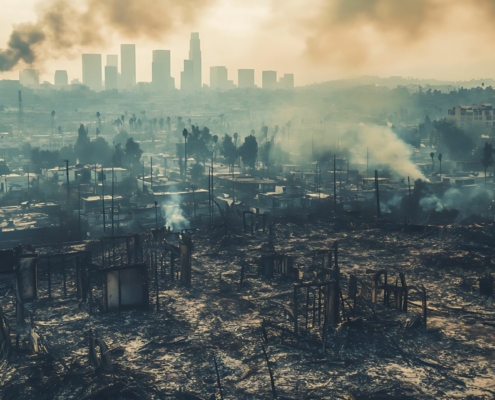
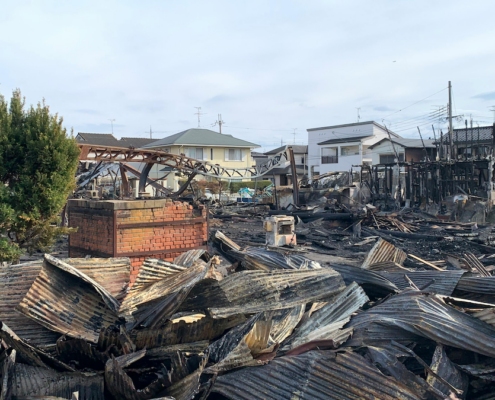
One year after the Palisades and Eaton fires, the physical damage still remains — empty lots, foundations without homes, quiet neighborhoods waiting to return. For Minjee Kim, assistant professor of urban planning at the UCLA, the devastating wildfires presented a rare chance to rethink Los Angeles’ most fire-prone areas, a chance she says, that was largely missed.

“The destruction was so massive,” Kim says. “It presented the city and the county with a chance to think big and to think differently. Unfortunately, that didn’t happen.”

Headshot of Professor Minjee Kim

Professor Minjee Kim

Kim’s perspective comes from a long career that spans architecture, planning, and real estate development. Trained as an architect in South Korea, she later shifted to urban planning to have a bigger impact, earning her master’s and doctoral degrees at MIT while she worked in the planning department in the city of Cambridge.

For Kim, the problem extended beyond the speed of recovery to the framework guiding it. In the aftermath of the fires, there were widespread discussions about reimagining fire-prone neighborhoods and designing them to better withstand future climate-related disasters. But as rebuilding moved forward, those conversations failed to materialize into actual, on-the-ground changes.

“We’re essentially rebuilding exactly what was there before,” she says. “We’re not realigning streets, creating meaningful fire breaks, or rethinking evacuation routes in a comprehensive way. We’re not moving away from the most vulnerable areas or increasing density in safer locations.”

For Kim, resiliency is not just about fire-resistant materials, it’s about neighborhood-scale design and coordinated planning.

“Fire resiliency is about systems,” she says. “How infrastructure works together. How people move. How communities are protected as a whole.”

Kim served on the UCLA team of experts advising the Los Angeles County Blue Ribbon Commission, which recommended creating two intergovernmental, quasi-governmental entities: one focused on rebuilding and recovery, and another on fire prevention and management. These agencies were envisioned as vehicles for coordinating across jurisdictions, pooling resources, and acting at a regional scale.

“The destruction was so massive. It presented the city and the county with a chance to think big and to think differently. Unfortunately, that didn’t happen.”

Those recommendations have not been implemented.

“The root of the problem is lack of political will and administrative capacity,” Kim says. “Neither is built to support large-scale reimagination.”

Looking ahead, Kim anticipates construction activity accelerating in years two and three, plateauing by year four, and ultimately resulting in many residents returning.

However, who returns, and how quickly, hinges on who has the coverage and capital to do so.

Kim points out the biggest differential is homeowners’ insurance. In Altadena, many families were underinsured, leaving them without the financial resources to rebuild. In the Palisades, however, demand remains so strong that land parcels are selling for prices comparable to those of homes that once stood on them, giving homeowners far more flexibility in how they recover.

“This is where inequity really shows up,” Kim says. “Two communities experience the same disaster, but their paths to recovery look very different.”Kim is careful to acknowledge the work of public agencies and the state, noting that progress has been made, albeit slowly. Despite her critiques, Kim remains cautiously optimistic. She sees strong demand among residents to return, particularly in Altadena, and believes Los Angeles will recover.

“Los Angeles is a very resilient city,” she says. “It will recover from this horrific disaster.”

The larger question, she argues, is what kind of city emerges.

“One year out, we should be asking not just how fast we’re rebuilding,” Kim says, “but who the system is working for — and who it’s leaving behind.”

As climate-driven disasters become more frequent, Kim believes those questions must move from academic discussion into actual policy change.  For Los Angeles, the fires were not just a tragedy — they were a test.

Whether the city learns from it remains an open question.

Kim on Fire Recovery in Los Angeles

The Palisades and Eaton fires in January 2025 destroyed about 13,000 homes. Despite being one of the costliest disasters in U.S. history, according to Vox, only seven homes have been rebuilt.

With Los Angeles already facing a tight rental housing market and California experiencing a statewide housing shortage, the fires created significant political pressure to rebuild as quickly as possible.

Despite political backing, a year later, only about 900 homes are under construction.

Minjee Kim, an assistant professor of urban planning, claims that the system is ill-equipped for recovery in this Vox article. “The system structurally is not built for rebuilding and recovery,” Kim said. “You just need a whole different animal to enable comprehensive reconstruction.”

The rebuilding process requires multiple permits, which take time and money to obtain. Kim said regulatory hurdles are not caused by any single agency. “When you zoom into regulation as an issue, it’s not individual departments that are delaying the process,” she said. “It’s more like the entirety of the network of reviews that needs to happen that is an impediment to a faster recovery.”

Kim on the Rebuilding Efforts After the Palisades Fire

Rebuilding efforts are ongoing following the destructive Palisades Fire that swept through southern California this January. Los Angeles Mayor Karen Bass released a statement that 340 homes are actively being built, and with recent rebuilding plans being approved, that number is projected to increase further.

This news has been received with disappointment by some, taking into account the thousands of buildings, including schools and businesses, that were lost in the fire.

The Guardian cited Assistant Professor of Urban Planning Minjee Kim’s insights on the rebuilding efforts. She stated that although the figure cited in Bass’ statement seems relatively small, the number of homes being rebuilt should be increasing exponentially in the future. She expresses hope that though it may take five or ten years for rebuilding to be complete, the Palisades can be restored similar to its previous state before the fire.

“It’s all about the community and people’s attachment to their community,” said Kim. “I think there’s enough core that remains in Palisades and enough families that really want to go back and rebuild – it won’t be a completely new neighborhood.”

After January wildfires, Luskin students help one vulnerable community build resilience

by Joey Waldinger

This spring, as Los Angeles recovered from wildfires that devastated Altadena and Pacific Palisades, a class of UCLA urban planning graduate students was learning how to help vulnerable neighborhoods prepare for the next one.

In assistant professor Minjee Kim’s Site Planning Studio, students spent the quarter immersed in Solano Canyon, repeatedly visiting the hillside community neighboring Dodger Stadium and meeting with residents to develop practical strategies for wildfire resilience.

The class was a crash-course in the realities of urban planning — unexpected challenges, stakeholder relationships and tight deadlines. But these challenges, Kim said, pushed everyone to grow, creating a deeply fulfilling educational experience and laying the foundation for further research on regional wildfire resilience.

“Working with actual stakeholders who had land ownership, resources or authority over the areas we were proposing ideas for — that level of real-worldness wasn’t something I envisioned,” Kim said. “It made the class really challenging but at the same time really rewarding. I’m so grateful to the entire class for being extremely passionate and dedicated about the project, and to the people of Solano Canyon.”

A service to Los Angeles

Kim was still planning her studio curriculum when the fires broke out in January.

“It seemed like a disservice to the community and the broader L.A. region if I didn’t address the wildfires in some way,” she said.

Not wanting to burden recently affected communities, Kim began researching other communities vulnerable to potential fire events. Through the city of L.A.’s Urban Design Studio, she connected with community organizers in Solano Canyon who were already working to reduce wildfire risks.

Sara Harris Ben-Ari, a co-founder of community group 1866 in Historic Solano Canyon, has lived in Solano Canyon since 2000. Fires have sparked in the neighborhood almost monthly for at least a decade, and Harris Ben-Ari and her neighbors have been working to reduce fire risks for nearly as long. But after the Eaton Fire — when burning embers flew into her yard— she pursued solutions with more urgency.

When Kim reached out to discuss a collaboration, Harris Ben-Ari said it felt like a perfect match.

“It was a godsend to have a group of really smart young students who are working at that level and have that level of training, attention … who really want to learn about landscape design and resiliency and geography as it applies to public planning and policy,” she said.

Planning for equitable fire resilience

Nestled within Elysian Park, vibrant Solano Canyon is the last remaining part of Chavez Ravine, a historic neighborhood razed in 1959 to clear space for a massive public housing project known as Elysian Park Heights, which never materialized, and later Dodger Stadium. Solano Canyon is located in one of the state’s highest fire severity zones, though its density and relative affordability are unique among most communities included in fire resilience discourse.

“I thought this would be a great opportunity for the students to work in a diverse and urban environment that is very different from affluent neighborhoods that already have resources to make their communities more fire resilient,” Kim said.

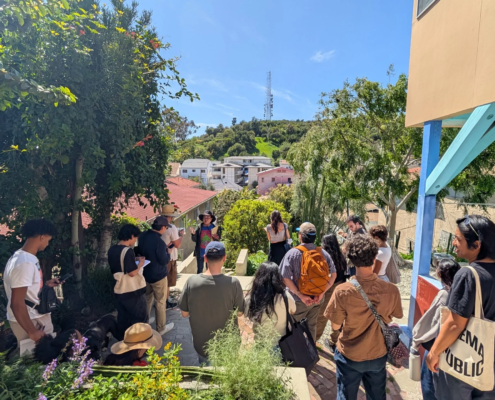
Students took this opportunity head on. During the first Saturday of the quarter, Harris Ben-Ari and fellow 1866 co-founder Lydia Moreno led the class on a neighborhood tour, pointing out fire hazards such as wooden infrastructure, overgrown grasses and invasive eucalyptus trees. Kim urged the students to revisit the area individually throughout the quarter.

Micah Wilcox, a second-year master’s student, said that as the quarter progressed, the class increasingly resembled a project that professional urban planners would encounter in the field. Working in teams, students presented weekly updates on their projects, honed visual and public-speaking skills, and learned to work as a team under tight deadlines.

“To just get dropped into a group and say, ‘Hey, you have a deadline, you guys need to put this together’ — that’s a foundational skill,” Wilcox said. “That’s what we do in the real world.”

Building community ties

UCLA students present maps and findings at various stations in a room. Credit: Minjee Kim

Community engagement is another foundation of urban planning that was baked into the class. And in the real world, as Kim’s class learned, community engagement is not always easy.

For the midterm, students invited residents to a presentation analyzing the neighborhood’s wildfire risks and vulnerabilities. Presenting to community members instead of engaging with them sparked tension, while concerns about fires started by the neighborhood’s unhoused population complicated things further.

“We did not realize that [the living quarters of unhoused people] was a major source of fire events in Solano Canyon, and when the community members started bringing up this issue, we didn’t have a good answer,” Kim said.

Kim describes the midterm as a turning point in the class. By the final, the class shifted to a design charette format, where the students created interactive stations that invited participation and input from the residents. She added that students steadfastly advocated for community members to work with their unhoused neighbors in reducing fire ignitions, instead of trying to “sweep away the issue.”

“It wasn’t us presenting information to them. It was more like we are learning from you, and here are some of the ideas and thoughts we can share with you,” Kim said. “So it was very much a cooperative, positive conversation.”

Overall, though, Harris Ben-Ari said the community was impressed by the students’ professionalism and thoughtfulness. The students’ work, she said, stood in stark contrast to what Solano Canyon residents often experience from officials — just holding obligatory meetings without really considering community needs.

“Everybody really felt like they were heard,” she said. “And if they didn’t, they felt like they could explain how they would be better heard and understood.”

What’s next?

Most of Kim’s research focuses on zoning and land use, but her studio class touched off an ongoing project on wildfire resilience. Over the summer, Kim has been working with two graduate students on a report summarizing the class’s recommendations and proposals, and illustrating how Solano Canyon can serve as a model for similarly positioned communities.

“It’s going to be a case study of Solano Canyon, but framed in a way that is helpful for the broader L.A. region in making hillside communities more fire resilient,” she said.

For Harris Ben-Ari and her neighbors, the students’ maps, research and other resources will help them apply for grant funding and push for more support from the city.

“It’s one more very solid tool in the toolbox.”

Rebuilding for Resilience: Minjee Kim on Post-Fire Urban Planning In the Building Better Cities podcast, Minjee Kim discusses how the aftermath of L.A.’s wildfires presents a chance to reimagine recovery—through sustainable, equitable, and long-term urban planning.

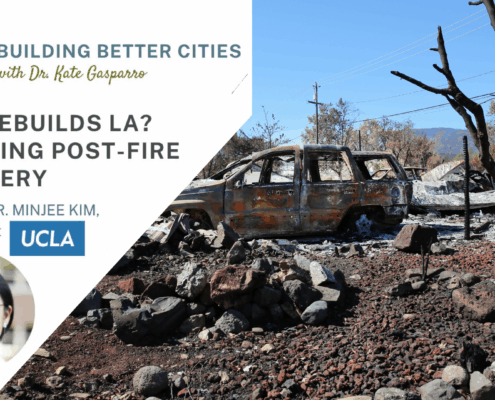
Dr. Minjee Kim, assistant professor of urban planning at UCLA Luskin, was featured on the Building Better Cities podcast in the episode titled “Who Rebuilds LA? Planning Post-Fire Recovery with Dr. Minjee Kim.” In the wake of the devastating LA wildfires, Kim presents this disaster as an opportunity to rethink how cities rebuild with long-term resiliency in mind. “The L.A. fires presented the opportunity to think large scale,” she says. “I see the Los Angeles fires that happened as an opportunity to think about urban planning and development in the long term… in terms of resiliency and fire resiliency, but also in terms of what is a good sustainable form of urban development.”

In conversation with host Kate Gasparro, Kim discusses how post-disaster recovery can serve as a launchpad for long-term, equitable urban planning—if supported by the right governance structures. Drawing from her research and experience advising the L.A. County Blue Ribbon Commission on post-fire recovery, she explores potential models for regional redevelopment agencies, citing examples from San Francisco, New York City, and Cincinnati.

Minjee Kim Weighs In on the Rise of Gated Communities in the U.S. In a recent CNBC feature, Prof. Kim weighs on the growing rise of popularity in gated communities across America.

Dr. Minjee Kim, assistant professor of urban planning, was featured in CNBC’s “Why Americans Keep Moving Into Gated Communities,” which aired on July 18. The segment explores the growing trend of Americans choosing to live behind gates and walls, driven largely by a desire for safety, stability, and control in uncertain times.

Kim highlights that gated communities are often marketed not just as secure, but as exclusive and desirable. “The whole point of creating HOAs and possibly gating, is to create that location premium,” she explains. “You are essentially creating this marketing that this place is a desirable place to live. You’re paying a premium to live in a homogenous environment.”

While residents may be drawn by the promise of safety and order, the broader societal impacts are more complex. Gated communities can deepen economic and racial segregation, divert resources away from public infrastructure, and contribute to social fragmentation by isolating residents from the wider civic community.

Watch the full feature here.