Use this category ONLY for short items intended for the Luskin’s Latest blog. Do NOT tag the entries with any other categories.

Minority Fellowship Recipients Advocate in D.C.

As awardees of the Council on Social Work Education’s (CSWE) master’s Minority Fellowship Program (MFP), UCLA Luskin MSW candidates Michelé Jones, Desiree Lopez and Jennifer Grijalva traveled this past March to Washington, D.C., where they gained valuable experience in policy and advocacy. The program aims to reduce health disparities and improve behavioral health care outcomes for racially and ethnically diverse populations by increasing the number of culturally competent master’s-level behavioral health professionals serving racial/ethnic minority populations. Recipients of the one-year fellowship receive specialized training, a monetary stipend and other professional development support. “The MFP program has provided me with professional development and access to mental health practitioners of color, which have been invaluable to my second year of social work education,” explained recipient Desiree Lopez. The 41 fellows gathered in Alexandria, Virginia, for the annual spring training and spent a morning on Capitol Hill, where they educated Congressional staff members about the importance of the MFP program. Grijalva described the spring conference as “a space filled with MSW students of color who were passionate about social justice issues around the country,” an experience that was “inspirational and empowering.” Jones was excited to use her skills as an advocate and gain a better understanding of policy during the training. “I was able to discuss the importance of having more mental health professionals of color in the field with members of the Senate in my own district. I left the training in D.C. extremely empowered and more prepared to begin my career,” she said.


Loukaitou-Sideris and González Study Link Between Gentrification and Traffic Collisions

Anastasia Loukaitou-Sideris, professor of urban planning and associate provost for academic planning at UCLA; Silvia R. González, a doctoral student and researcher at the Center for Neighborhood Knowledge; and Karen Chapple of UC Berkeley conducted a study to analyze the relationship between gentrification, traffic safety and transit-oriented development (TOD). The study, “Transit Neighborhoods, Commercial, Gentrification, and Traffic Crashes: Exploring the Linkages in Los Angeles and the Bay Area,” analyzed the number of collisions near rail stations in L.A. County and the San Francisco Bay Area in both gentrified and non-gentrified areas. The authors had hypothesized that residential and/or commercial gentrification leads to more traffic collision due to increased traffic and increased use of two or more modes of transportation, but the study did not find a significant relationship between residential gentrification and traffic safety in Los Angeles County or the Bay Area. It did, however, find that pedestrians and cyclists are at a higher risk of collision around commercially gentrified stations. Loukaitou-Sideris, González and Chapple suggest that policymakers and urban planners pay special attention to commercially gentrified areas. They conclude that “complete street strategies, traffic calming measures, protected bike lanes, controlled intersections, and other traffic safety improvements and regulations can help respond to this threat” of traffic collisions around commercially gentrified TOD stations. The study is part of an ongoing research partnership with the Urban Displacement Project, a research and action initiative at UC Berkeley.


Latinx Conference Seeks to Break Down Borders

The student-led Latinx Caucus at UCLA Luskin collaborated with the Council on Social Work Education to host the 17th Annual Latinx Community Conference: Breaking Down Borders, Más Allá de la Frontera. The April 27 event brought together social services professionals and scholars to discuss issues facing the Latinx community, focusing specifically on immigration. “Immigration permeates every level of service, and without considering it holistically while also considering it within our specialties, we risk taking on a limited understanding of this complex social concern,” said MPP candidate Kassandra Hernandez, one of several student organizers. The event started with a blessing circle, followed by an address by Dean Gary Segura. Beth Caldwell MSW ’02, a professor at Southwestern Law School, gave the keynote address. Caldwell’s most recent research explores the consequences of deportation to Mexico with an emphasis on deportees who grew up in the United States. The daylong conference covered a wide spectrum of topics relating to the experiences of the Latinx community. Experts led workshops on mental health, educational barriers, domestic violence, LGBTQ issues, and the deportation of immigrant youth and families. Conference attendees enjoyed entertainment by the Mariachi de Uclatlán group during lunch and Changüí Majadero during the evening networking reception. Historically, Social Welfare students have taken the lead on organizing the community conference; this year, the scope was broadened to encourage full participation by Public Policy and Urban Planning students, as well.

Conference photo gallery available on Flickr:

Latinx Conference 2019


Overcoming ‘Imposter Syndrome’ and Other Tips for Women in the Workplace

UCLA Director of Ombuds Services Kathleen Canul shared insights about navigating gender politics in the working world with UCLA Luskin students and staff at an April 25, 2019, workshop. Bias and discrimination persist in some workplaces, requiring women to armor up, forge alliances with other women and at times employ “ninja-like maneuvering” to advance in an organization, she said. Drawing from her career in psychology and conflict resolution, as well as her experiences parenting three young women, Canul talked about the pitfalls of “impostor syndrome.” Self-doubt can derail career opportunities and damage self-esteem, she said, but she shared a secret with the audience of about 30 women: “You’re not alone.” Impostor syndrome afflicts even those at the highest rungs of power. The cure, she said, is developing a keen understanding of one’s own value — “that internal sense of who you are and why you’re here and what you’re good at.” A person’s viewpoints are shaped by gender, culture and upbringing, and women should embrace these differences, Canul said. “We have the ability to be disarming, belying stereotypes and shifting perspectives,” she said. “As we continue to enter the workforce, as we continue to advance in corporations and higher education, the more people know us — and I mean know us for our experiences, our gender, our ethnicity and our cultural and racial background — it will open doors for others.” The workshop was sponsored by UCLA Luskin’s Association of Master of Public Policy Students; Diversity, Disparities and Difference (D3) Initiative; and Career Services.

Urban Planning Professor and Alumna Honored

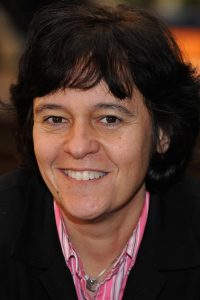
Anastasia Loukaitou-Sideris

Urban Planning Professor Anastasia Loukaitou-Sideris and alumna Carolina Martinez MA UP ’09 were honored for their work advocating for stronger, healthier communities during the American Planning Association’s recent national conference in San Francisco. Martinez, policy director at the Environmental Health Coalition, and the Paradise Creek Planning Partnership were awarded one of the highest honors, the 2019 National Planning Excellence Award in Advancing Diversity & Social Change. Martinez worked with low-income communities of color in National City, California, to create a comprehensive community plan to clean up the toxic environment near their homes and provide affordable housing near transit. The creation of the Paradise Creek apartments demonstrates that community-based planning can bring about environmental justice. As the principal investigator of UCLA Luskin Center for Innovation’s “SMART Parks: A Toolkit,” Loukaitou-Sideris was awarded the National Planning Achievement Award for Best Practice-Silver. The toolkit equips park managers, designers and advocates with a centralized guide to improve parks and shows that that good planning can increase efficiency that benefits the community overall. “I’m delighted by the department’s awards at the 2019 National Planning Conference,” Urban Planning Chair Vinit Mukhija said. “They demonstrate the excellence of our students and faculty members and are a testament of the department’s commitment to the profession.” Mukhija led UCLA Luskin Urban Planning’s delegation at the conference, where nearly 6,500 experts from planning, government, higher education and allied professions shared their knowledge and insights.


Author/Activist Randy Shaw on ‘Generation Priced Out’

Author, attorney and activist Randy Shaw visited UCLA Luskin on April 15, 2019, to discuss his latest book, “Generation Priced Out: Who Gets to Live in the New Urban America.” As the working and middle classes find themselves priced out by skyrocketing rents and home values, Shaw dissected the causes and consequences of the national housing crisis. Shaw is a housing policy influencer and advocate for people experiencing homelessness. In 1980, he co-founded the Tenderloin Housing Clinic, San Francisco’s leading provider of housing for homeless single adults. At the talk hosted by Urban Planning, Shaw said he decided to write “Generation Priced Out,” his sixth book on activism, after the 2016 Ghost Ship tragedy, which resulted in the deaths of 36 people when a fire broke out in a former warehouse in Oakland. Shaw initially planned to focus on Los Angeles, San Francisco and Oakland but ended up broadening the scope of his book to include other progressive cities that claim to support inclusion, including Austin, Denver and Portland. Shaw said the book highlights the hypocritical rhetoric of progressive cities whose policies price out working-class people. Many books about gentrification are misleading, he added. The absence of affordable housing policy and opposition to new construction contribute to the gentrification of urban spaces, he said. While discussions about gentrification often villainize developers, Shaw argued that “the real profiteers of gentrification are homeowners.” To solve the national housing crisis, Shaw advocates for a combination of rent control and housing construction. — Zoe Day

Armenta Publishes Research on Unauthorized Immigrants and Police

Amada Armenta, an assistant professor of urban planning, co-authored the research article “Beyond the Fear of Deportation: Understanding Unauthorized Immigrants’ Ambivalence Toward the Police,” which was recently published in American Behavioral Scientist. Armenta and co-author Rocío Rosales examined unauthorized Mexican immigrants’ perceptions of and experiences with police in Los Angeles and Philadelphia. While much of the existing research focuses on undocumented immigrants’ negative attitudes toward police as a result of fear of deportation, Armada and Rosales used in-depth interviews and ethnography to gain a better understanding of the immigrants’ perceptions of police. Their research article found that most undocumented immigrants are ambivalent about American police, “believing them to be both trustworthy and overly punitive.” Interviews indicated that “compared with police forces in Mexico, [many undocumented immigrants] believe that U.S. police are honest, hardworking and trustworthy.” Even those who do not hold the police in high regard may choose to trust them under certain circumstances. “Positive interactions with the police can shape immigrants’ legal attitudes such that they feel empowered to call the police for help,” the article noted. The study is a valuable addition to research on minorities’ relationships with police, which is mostly focused on the experiences of African American citizens. Armenta is the author of an award-winning book on immigration enforcement in Nashville, Tennessee, and is currently working on a second book examining the legal attitudes of undocumented immigrants in Philadelphia.


Abrams Publishes Research on Child Incarceration, Adult Health

Professor Laura Abrams, chair of Social Welfare, recently co-authored an article in Academic Pediatrics investigating the relationship between child incarceration and subsequent adult health outcomes. The United States is the world leader in youth incarceration, and research by Abrams and co-principal investigator Elizabeth Barnert, an assistant professor of pediatrics at the David Geffen School of Medicine at UCLA, aimed to bridge the data gap on repercussions from child incarceration. The study used data from the National Longitudinal Study of Adolescent to Adult Health to compare adult health outcomes in individuals grouped by age of first incarceration. The study compared individuals first incarcerated before age 14 with those first incarcerated at 15-17 years old, 18-20 years old and 21-24 years old. Among the adult health outcomes analyzed were physical health, such as mobility limitations, and mental health, including depressive symptoms and suicidal thoughts. After controlling for sociodemographic and ecological factors, the study found that “child incarceration independently predicted adult mobility limitations, adult depression and adult suicidal thoughts,” confirming the link between younger age at first incarceration and worse adult health. The research also identified sociodemographic disparities in child incarceration, finding that “individuals first incarcerated as children were disproportionately of color, more likely to be from lower socioeconomic backgrounds, and more likely to have been raised in a single-parent household.” The findings will likely have repercussions in the health arena. The report concluded, “Child incarceration displays even wider sociodemographic disparities than incarceration generally and is associated with even worse adult physical and mental health outcomes.”


Segura Receives Distinguished Career Award

UCLA Luskin Dean Gary Segura received the Distinguished Career Award during the annual convention of the Midwest Political Science Association in Chicago. The honor was presented April 5, 2019, by the association’s Latino/a Caucus, which also recognized Melissa Michelson, a political science professor at Menlo College in Atherton, California. Named UCLA Luskin’s dean in 2016, Segura helped launch the School’s Latino Policy & Politics Initiative, a research laboratory tackling domestic policy issues affecting Latinos and other communities of color. He is also co-founder and senior partner of the polling and research firm Latino Decisions. Segura’s work focuses on political representation, social cleavages and the politics of America’s growing Latino minority. He has written several publications, directed expansive polling research and served as an expert witness on the nature of political power in all three of landmark LGBT marriage rights cases in 2013 and 2015.


Loukaitou-Sideris Co-Authors New Book on Transit-Oriented Development

A new book co-authored by Anastasia Loukaitou-Sideris, professor of urban planning at UCLA Luskin, takes a novel and critical look at the effects of compact development around urban transit systems. “Transit-Oriented Displacement or Community Dividends? Understanding the Effects of Smarter Growth on Communities” (MIT Press), is the work of Loukaitou-Sideris and Karen Chapple, professor of city and regional planning at UC Berkeley, who studied the “realities on the ground” surrounding the question of who wins and who loses with the creation of new transit accessibility. “Gentrification — and the often ensuing displacement — are not stable but dynamic and changing processes that are not often well captured by the collection of census data that occurs every five or 10 years,” Loukaitou-Sideris said. “We learned a lot about gentrification in specific neighborhoods — not readily obvious from census data — from interviews with community groups and from multiple visits to these neighborhoods,” she said. The authors note that, although gentrification does entail increasing land rents and housing prices, it is also about “losing the sense of place in a neighborhood that you grew up in and have lived for many years, that now looks different and serves different socio-demographic groups.” Loukaitou-Sideris said the intention of the book is not to “send the message that we need to stop building TODs and higher-density housing around transit stops, where appropriate. But we want to send a notice to planners and policymakers that they also need to enact or continue anti-displacement policies in these areas to protect existing residents from displacement.”