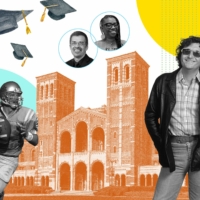
UCLA for Life: Meyer Luskin Now a centenarian, the esteemed philanthropist — who, with his wife, Renee, has donated close to $200 million to UCLA — remains as true a Bruin as ever.
In the landscape of American philanthropy and entrepreneurship, there are few more compelling stories than that of Meyer Luskin ’49.
Born in 1925 in a rough-and-tumble New York City tenement to Lithuanian parents, he was raised in the “near ghetto” of 1930s Boyle Heights in East L.A. before being admitted to UCLA at the age of only 16. He went on to tremendous success as an innovative businessman, but with a crucial difference from many of his peers: For Meyer and his wife, Renee Luskin ’53, success has meant something to be measured not by what has been earned, but by what has been shared.
At the age of 100, Luskin still exudes the zest for life that forged his success. In a lively and wide-ranging conversation, he discusses what UCLA taught him, his path to giving back and the sensation of eating a burger with his name on it.
Congratulations on your recent birthday! Let’s step back to 1942 when, as a smart, skinny teenager from Roosevelt High, you arrived at a young UCLA to study history. It must have been quite the culture shock.
I don’t remember my first day, but it was all overwhelming. There was a men’s gym and a women’s gym, the quad buildings and Kerckhoff, and that was about it. To me, it seemed giant and impressive, the buildings beautiful. Coming from Boyle Heights, which was kind of a ghetto, I remember feeling so small. There were no freeways, so it took me an hour and a half by surface transportation: trolley, bus and walking. I started carpooling with five people from Roosevelt. We would come in by car, a Chevrolet painted sky blue, arriving at ten to eight and meeting up to go home at 5 p.m. Then I would go to a job. We had little money at home.
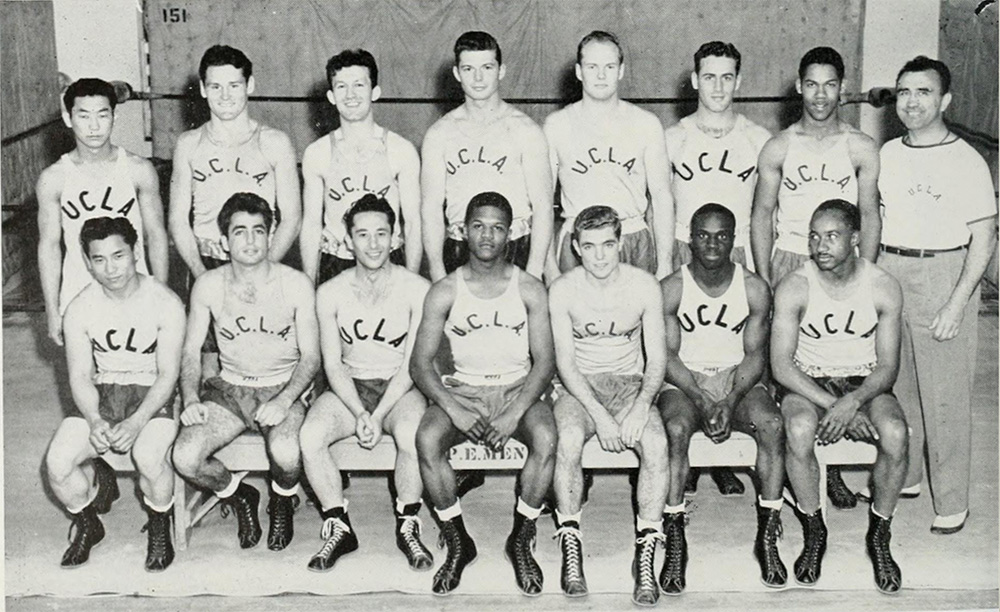
I bet all the girls noticed a sky-blue Chevy.
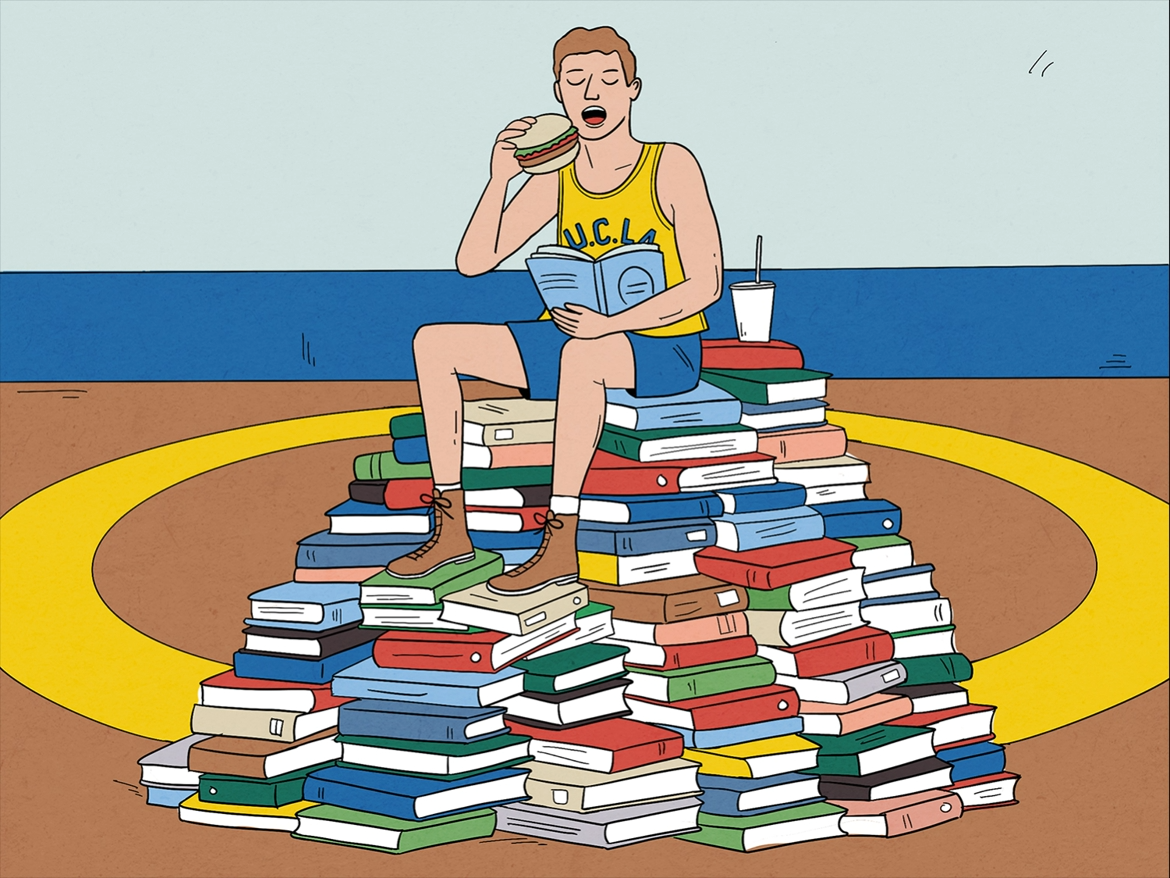
I did not date in my first year. In those days, you paid for everything on a date, and I was on a $30 scholarship that covered student fees and books. I devoured books. I was studying French history from 1760 to Napoleon, the revolutionary period. A professor would ask us to read a few pages, and I would read the book over the weekend. In my second semester, a professor asked me to grade papers, which was a big deal. I loved learning at UCLA.
As World War II spread, you joined the United States Army Air Corps, soon to become the U.S. Air Force, and served during the U.S. invasion of Okinawa.
I was not in the first wave, but I landed on Okinawa by climbing over the side of a ship by rope into a bobbing boat. The Okinawa campaign was the largest loss of life for the U.S. Army. [In 82 days, 49,000 Americans died, as well as 150,000 local Okinawans pressed into service and 80,000 Japanese soldiers.] It was horrible. Dropping the atomic bomb [over Hiroshima and Nagasaki] cost hundreds of thousands of lives, but a full invasion of Japan would have cost millions. There is nothing good about this. It was all horrible.
When you returned to UCLA at the age of 21, had you changed as a result of your wartime experience?
I felt lucky — two of my friends from Roosevelt died in Europe, and others were injured. When I was overseas, I was brooding about what I would do when I got home. I did not have the confidence to go into academia; I was just the little guy from the wrong side of the tracks. I knew I wanted to get closer to the money, so I switched my major to economics. And with the GI Bill of Rights and the California Veterans Bill, which paid me $1,000, I was able to return to UCLA and then get an M.B.A. at Stanford. And that allowed me to start my business.
You have been immensely successful, starting with recycling waste food into animal feed, and so on. But I get the impression that money was not your only objective in life. You have donated a lot to UCLA. Was that planned, or did it just emerge over breakfast one day?
Funny, it did. Over breakfast at home one Saturday morning, my wife and I looked at each other and said, “We are very well off financially — we should start giving some of this back while we can get the pleasure of doing it, rather than leaving it to a trust. I want to be able to do it in jeans or slacks rather than leaving it to a man in a navy blue suit.”
So we started small, with fellowships for history students, and then it built up. We also wanted to make sure it benefited both UCLA and the local community — town and gown — so we set up the Luskin Center for Innovation, through which we share research on health, air quality, heat and so on with the community. Now it has more than 25 researchers. People compliment me on this, when it’s really UCLA, but I will take the compliment.
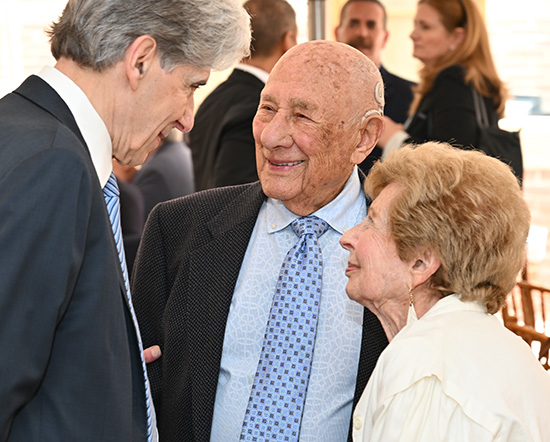
And I am very happy with the [UCLA Meyer and Renee] Luskin Conference Center, where scholars can not only meet during conferences but also make plans over breakfast and over a drink. Also, it’s very good food — Jeromy [Sung], the chef, is great. I am a salad guy, but every now and again, I will have the Luskin Burger.
Is that a bit odd? Eating food with your name on it?
Oh, yes. But it’s an Impossible [nonmeat] burger, and it tastes great!
You’re a huge student of history. What do you make of the times we’re living through? It feels like some are seeking to undo the Enlightenment, with higher education under siege and under threat.
Yes, both words. I am fearful to say we are at a crux between being a good democracy and a nation that is divided on what the concept of democracy is.
The fact is that many citizens look down on education. They don’t understand that education, being open to experience, is the key to a happier, better life. I don’t know which way the pendulum will swing. But I will do my best to help.
So where do you think UCLA, where you have done so much good, will be in another few years?
I think it will grow stronger and become a major source of scientific research and education with the Research Park. I am involved with the California Institute for Immunology & Immunotherapy, which we will build into a billion-dollar organization within the park. Plus, quantum research and studies into the biome, which will change medicine. I am an optimist by nature. And I am sure that UCLA will continue to change the world.




Leave a Reply
Want to join the discussion?Feel free to contribute!