UCLA MRED Students Reimagine the Future of Real Estate Through Award-Winning Capstone Project
The UCLA Master of Real Estate Development (MRED) program celebrated the culmination of its 2026 academic year with capstone presentations on July 1, showcasing students’ ability to apply interdisciplinary knowledge to complex, real-world development challenges.
Serving as the program’s culminating academic experience, the applied synthesis capstone immerses students in the practice of real estate development. Rather than completing a traditional research project, students integrate concepts from real estate finance, market analysis, urban planning, design, development, public policy and investment strategy to create comprehensive development proposals. The intensive three-week exercise concludes with presentations that simulate investment committee pitches before faculty and industry professionals.
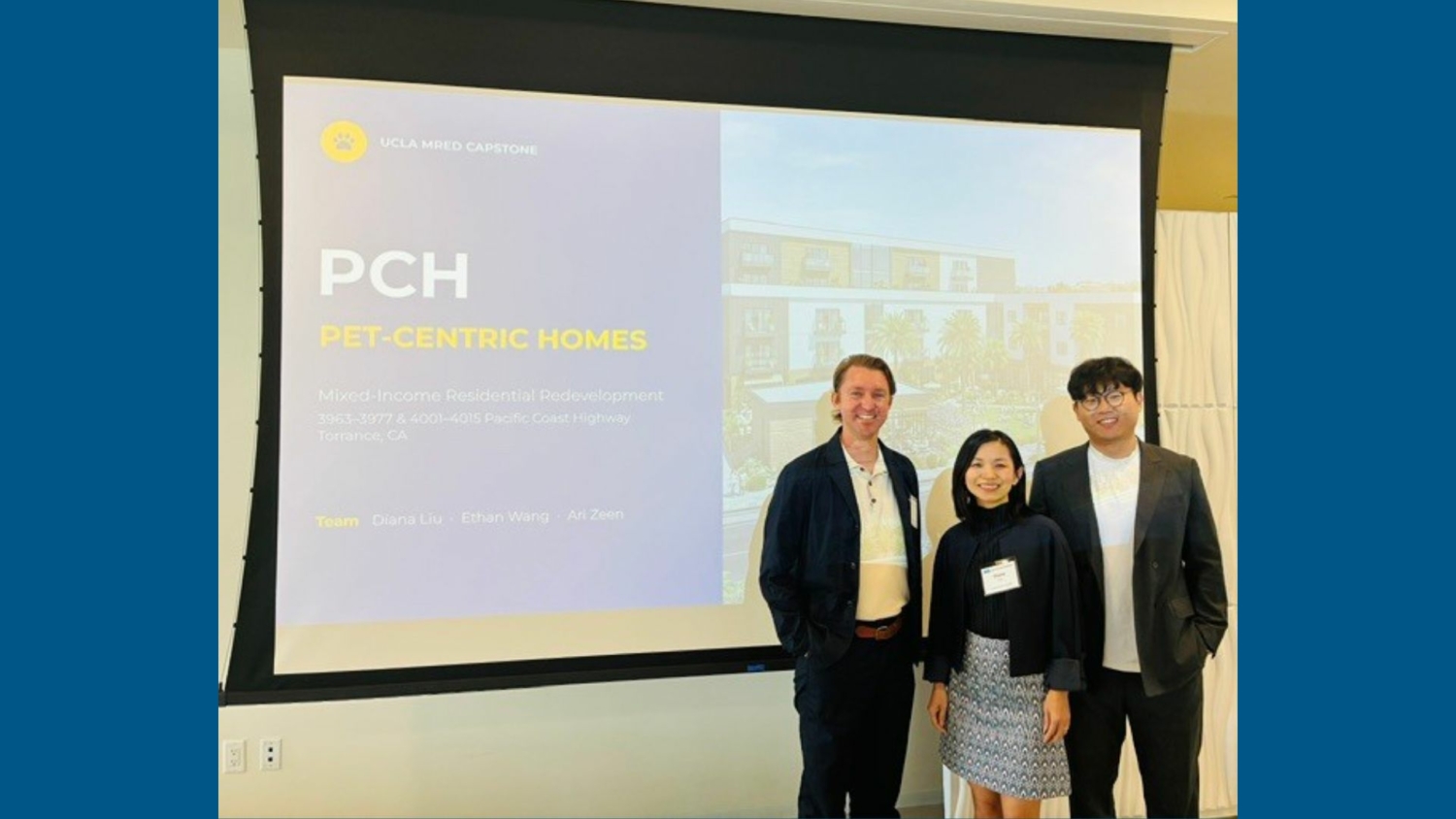
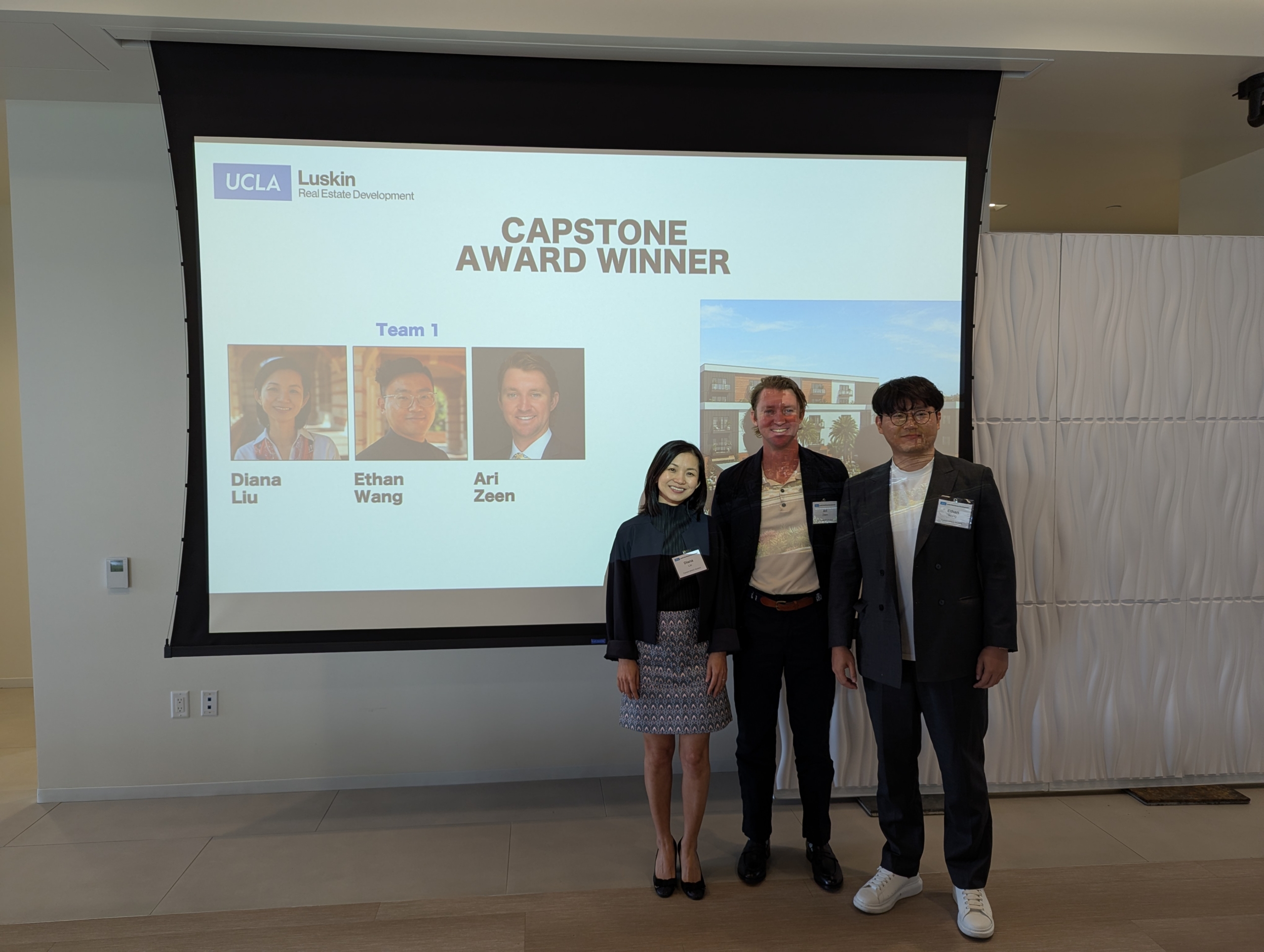
This year’s winning capstone, Pet-Centric Homes, was developed by Ari Zeen, Diana Liu and Ethan Wang. The project explored how intentionally designed residential communities can better serve pet owners while creating long-term value for developers, investors and residents.
“The most rewarding part was seeing all the pieces come together,” Zeen said. “The capstone gave us the opportunity to apply everything we learned throughout the MRED program — from design and planning to finance and market analysis — in a single, real-world project.” He added that leading the project’s design pushed him outside his comfort zone, and seeing the team’s vision come to life made the experience especially meaningful.
Grounded in market research and financial analysis, the proposal showcased the program’s emphasis on practical, innovative real estate development.
“One challenge that came up in every project was making sure our most creative ideas could work in the real world,” Liu said. “Every proposal had to balance market demand, planning requirements, design, and financial feasibility. As a team, we tackled that by constantly challenging our assumptions, incorporating feedback from industry professionals, and refining our ideas through multiple iterations.”
She added that the experience reinforced the role of real estate development as “where creativity meets execution.”
During the capstone, students selected from several development scenarios featuring sites with distinct market conditions, planning considerations and policy challenges. Each proposal required students not only to develop a feasible real estate project but also to consider broader strategies for addressing the social, economic and planning issues affecting the site.
The capstone presentations concluded with a networking event that brought together graduating students, alumni, newly admitted students, faculty and industry representatives.
Reflecting on the experience, Wang said the program reshaped how he approaches real estate development.
“My biggest takeaway is that great real estate lives at the intersection of creativity and discipline,” Wang said. “A differentiated concept only matters if the underwriting holds, and a clean pro forma only matters if there’s a real market behind it. MRED taught me to hold both at once — to tell a compelling story and defend every number behind it.”




Leave a Reply
Want to join the discussion?Feel free to contribute!