


• Public Policy
  • Social Welfare
  • Real Estate Development
  • Urban Planning
  • Luskin Home
  • Undergraduate Program
  • Stay in Touch
  • Events Calendar
  • Give Now
  • About
    • Our Dean
    • Board of Advisors
    • Contact Us
    • Visit Us
    • Diversity, Disparities and Difference
    • Communications
      • UCLA Luskin in the News
      • Luskin Forum Online
  • Departments
    • Public Policy
    • Real Estate Development
    • Social Welfare
    • Undergraduate Program
    • Urban Planning
  • Apply
    • Master of Public Policy
    • Master of Real Estate Development
    • Master of Social Welfare
    • Master of Urban and Regional Planning
      • Double Degree With Sciences Po
    • PhD in Social Welfare
    • PhD in Urban Planning
    • Undergraduate Programs
  • Faculty
    • All
    • Public Policy
    • Social Welfare
    • Urban Planning
    • Real Estate Development
    • Faculty Executive Committee
    • Open Positions
  • Student Affairs & Alumni
    • Career Services
      • Employers
      • Fellowships
    • Student Support
    • Graduate Resource Library
    • Alumni Relations
  • Support
  • Programs
    • Research Centers & Affiliated Research
    • CA Title IV-E Education Program
    • Global Public Affairs (GPA)
    • Data Analytics Certificate
    • Luskin Lecture Series
    • Luskin Summit
    • UCLA Luskin California Policy Briefing
    • Public Service Weekend
    • Commencement
  • Administration
    • Financial Services
    • Events Office
    • Information Technology
  • Search
  • Menu Menu

Archive for: Sonja Diaz

Redistricting Is Not a Simple Math Problem, Diaz Says

August 12, 2021/0 Comments/in Luskin in the News Sonja Diaz /by Zoe Day

Founding Director of the Latino Policy and Politics Initiative Sonja Diaz was featured in an NBC News article discussing the importance of accurate representation through redistricting. The Census Bureau’s release of data from the 2020 Census illustrated the growth of the Latino electorate over the past 10 years and “we want to ensure, through data and advocacy, that Latino political power does not decrease in the 2021 redistricting cycle,” Diaz said. The census data is a valuable tool for Latinos advocating for redistricting that reflects changing demographics. “It’s not a simple math problem. There’s politics involved and every state has a different process for how lines are drawn, whether it is the legislature or independent redistricting commissions,” she explained. “Ultimately, this country has had a storied history of vote dilution against communities of color, including Latinos and especially African Americans.”

Read the article

Diaz on Providing a Pathway to Citizenship

August 3, 2021/0 Comments/in Luskin in the News Sonja Diaz /by Zoe Day

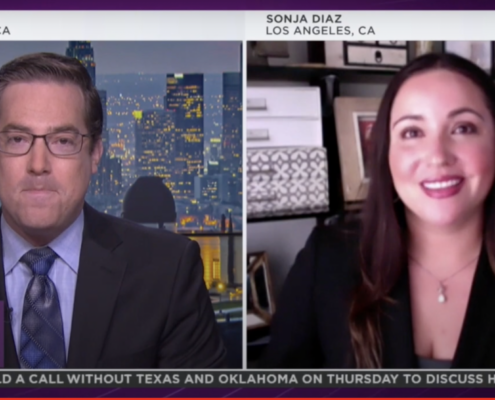
Sonja Diaz, executive director of the UCLA Latino Policy and Politics Initiative, was featured in a Spectrum News 1 interview about the recent ruling by a Texas federal judge that deemed Deferred Action for Childhood Arrivals (DACA) to be unlawful. According to Diaz, the central question is “can we provide a pathway towards work, towards opportunity for people who have known no other country but the United States?” There are currently 800,000 DACA recipients in the United States, and about one quarter reside in California. “When immigrants don’t trust the government, they are likely to stay in the shadows, not report crimes that are committed against them and not deal with substandard working conditions,” Diaz warned. The ruling could have important implications for Latino voters in the 2022 midterm elections. “It’s certainly an issue that should drive Latino turnout in upcoming elections if the stakes are made clear with active outreach and dedicated engagement,” she said.

Watch the interview

Diaz on Engaging Voters of Color in Recall Election

July 26, 2021/0 Comments/in Luskin in the News Sonja Diaz /by Zoe Day

Sonja Diaz, director of UCLA’s Latino Policy and Politics Initiative, authored an opinion piece in the Los Angeles Times about the importance of the upcoming recall election of Gov. Gavin Newsom. Despite starting as a political distraction, the election is a valuable “opportunity for Democrats to build lasting relationships with the state’s nonwhite electorate,” Diaz argued. There has been a significant increase in registered Latino and Asian American voters, who will play a critical role in the 2022 midterms. While voter turnout is generally much lower in midterm years, the recall election in September will be an opportunity to build and maintain engagement with voters. Diaz recommended developing field campaigns and on-the-ground outreach to mobilize communities of color to vote “no” on the recall and keep Newsom in office. “If successfully engaged in the state’s political process, those voters will support future candidates committed to inclusive and progressive policies to help all Californians,” she wrote.

Read the op-ed

UCLA Latino Policy and Politics Initiative Receives $3 Million in State Funding Ongoing commitment supports Latino-focused research, especially important as COVID-19 recovery gets underway

July 13, 2021/0 Comments/in For Faculty, For Policymakers, For Students, For Undergraduates, Latinos, School of Public Affairs Sonja Diaz /by Mary Braswell

The UCLA Latino Policy and Politics Initiative (LPPI) has received $3 million in ongoing annual state funding to conduct research and develop policy solutions to address inequities that disproportionately impact Latinos and other communities of color.

The state budget signed July 12 included funding for LPPI. The resources will be used to continue the organization’s applied research to help inform future policy efforts and to measure how government actions influence the economic, educational, health and quality-of-life outcomes for the state’s workforce.

“It is clear that California’s story — its future, its economic potential, its role as a national leader — is intertwined with the story of the Latino community,” said Sonja Diaz, founding director of LPPI. “We are honored that California has recognized the importance of investing in putting a data-driven lens to shape and implement a 21st century agenda, and we are ready to make sure that research and facts pave a path toward a more just and prosperous future for all Californians.”

The funding was championed by the California Latino Legislative Caucus, with leadership from Sen. Maria Elena Durazo and Assembly members Robert Rivas and Lorena Gonzalez, the chair, vice chair and former chair of the caucus.

“California is the world’s fifth-largest economy, and our innovation and prowess are made possible by the diverse and vibrant communities that demonstrated how essential they are during the pandemic,” Durazo said. “We need to understand how to better include and empower communities who represent California’s future, and there is no better partner to help us understand how to lead with justice and equity than UCLA LPPI.”  

The support for LPPI comes as California prepares for economic recovery following the COVID-19 pandemic, which had disproportionate and devastating public health and economic impacts on the state’s diverse Latino communities. 

“Data tell important stories about what’s working, who is getting left behind, and how our taxpayer investments can be efficient and equitable,” Gonzalez said. “We are proud to partner with UCLA LPPI to make sure we have a data-driven Latino lens on the vision of a vibrant California.”  

LPPI has been on the front lines of driving important policy conversations, particularly as it became clear that the COVID-19 crisis was particularly impacting underserved communities of color. Throughout the pandemic, LPPI research that drove policy outcomes included a report that looked at the racial disparities in what communities were receiving federal aid and on the impacts of the Latino physician shortage amid a public health pandemic. As the vaccination process got underway, LPPI convened more than 70 Latino leaders across the state to urge for better data and equity-driven implementation, which were implemented by the state.

The organization’s research is also focused on highlighting the importance of representation in democratic and civic institutions and processes, and what it means when Californians’ leadership does not represent the totality of communities it serves. For example, a research report highlighted the lack of Latino representation in the California Redistricting Commission, which helped generate action and attention on the selection process. At a national level, research included a report that advocated for the creation of a Latino-focused Smithsonian museum. 

LPPI was incubated at the UCLA Luskin School of Public Affairs and the UCLA Division of Social Sciences. 

Diaz on Newsom’s Advertising Appeal

June 24, 2021/0 Comments/in Luskin in the News Sonja Diaz /by Zoe Day

Director of the Latino Policy and Politics Initiative Sonja Diaz spoke to AP News about Gov. Gavin Newsom’s advertising strategies to boost his popularity and avoid a recall. Newsom’s campaign has aired three ads on television, including one ad in Spanish attempting to tie the recall to extremist Republicans who have been referencing comments by the recall’s lead proponent, Orrin Heatlie, about putting microchips  in immigrants. Another ad focuses on the cash payments in Newsom’s proposed state budget, which would deliver $1,100 in one-time cash payments to families, plus other relief. According to Diaz, Newsom’s positive ad presents messaging that will resonate with families and young people who have been hard hit by the pandemic because it highlights the cash payments, help for businesses and an expansion of preschool education. “This is something that I think is really targeted to talk to the policy choices that are going to help younger Californians,” she said.

Read the article

Latinas Left Behind as Pandemic Roiled U.S. Workforce UCLA study reveals a complex picture that helps explain the driving factors behind their high unemployment rate

June 16, 2021/0 Comments/in School of Public Affairs Sonja Diaz /by Mary Braswell
Since the COVID-19 pandemic began, Latinas have not only experienced disproportionately high unemployment rates, but they also are dropping out of the workforce at higher rates than any other demographic group.

A new report by the UCLA Latino Policy and Politics Initiative examines unemployment figures for Latinas as well as changes in the number of Latinas in the U.S. labor force since the beginning of the COVID-19 pandemic.

The analysis also examines the reasons for Latinas’ exit from the labor force, including three main drivers:

  • Latinas are disproportionately employed in leisure, hospitality and related low-wage industries that were particularly vulnerable to pandemic-related closures.
  • A lack of access to education and training for higher-wage opportunities disincentivizes Latinas’ participation in the labor force overall.
  • Latinas are disproportionately responsible for family care obligations versus Latino men, and they are more likely to stay at home than U.S. mothers of other racial backgrounds. That burden was exacerbated during the pandemic because of the closure of schools and day care centers.

“A strong economic recovery that prepares us for a prosperous future is dependent on a stable Latino workforce made up of both men and women,” said Kassandra Hernández, a research analyst at the initiative and a co-author of the report. “Yet this analysis clearly shows that Latinas are being left behind, which could cost the U.S. economy billions of dollars.”

Before the pandemic, Latinos were expected to make up the fastest-growing segment of the U.S. labor force over the next decade, with women in particular driving that trend, according to the U.S. Bureau of Labor Statistics. The UCLA analysis found that between 2019 and 2029, the number of Latinas in the workforce is expected to grow by 25.8%, far outpacing other demographic groups. The growth of Latinas in the labor force is expected to be nearly nine times the growth rate among white women.

The analysis also found that Latinas experienced the highest unemployment rates at the start of the pandemic — with a record high of 20.2% unemployed in April 2020. After that, unemployment rates for Black men and women were generally higher than they were for Latinas, but Latinas’ unemployment rates remained consistently higher than the national average and were almost two times those of their white counterparts throughout the year. As of December 2020, 9.1% of Latinas were unemployed, versus 5.7% of white women.

Declining unemployment figures published by the Bureau of Labor Statistics in recent weeks have obscured a more complex picture of Latinas in the workforce. For example, the UCLA study found that Latinas dropped out of the workforce at a higher rate than any other demographic group. From March 2020 to March 2021, 2.7% of Latina workers dropped out of the labor market — almost double the 1.7% drop among white women workers during the same period. The study noted that Latinas’ unemployment rate has leveled off somewhat, in part because previously unemployed Latinas have dropped out of the labor force altogether.

“Over the course of this pandemic, we have seen women of color struggle much more than white men, often because of their overrepresentation in low-wage sectors and because of their roles as primary caregivers to their families,” said Rodrigo Dominguez-Villegas, the initiative’s research director and a co-author of the report.

“As the country enters an economic recovery, we now have the opportunity to address the immediate needs of these women and to create a system that will address their needs in the long term. Providing better access to child care and skills training that provides opportunities for economic mobility would go a long way toward ensuring not only jobs but dignified work for women of color.”

In quantifying the loss in labor for Latinas relative to other groups, the UCLA report provides evidence that inequities that existed before COVID-19 remain. Returning to pre-pandemic conditions in the U.S. workforce will still leave millions of Latinas without access to true economic opportunity and social mobility, which ultimately would diminish the nation’s long-term competitiveness. Among the report’s recommendations to policymakers:

  • Increase the minimum wage
  • Strengthen the social safety net by increasing child care support, introducing mandatory paid family leave and expanding the child tax credit
  • Strengthen skills training and education programs to create greater access to higher-wage careers in which workers are less susceptible to losing jobs due to automation

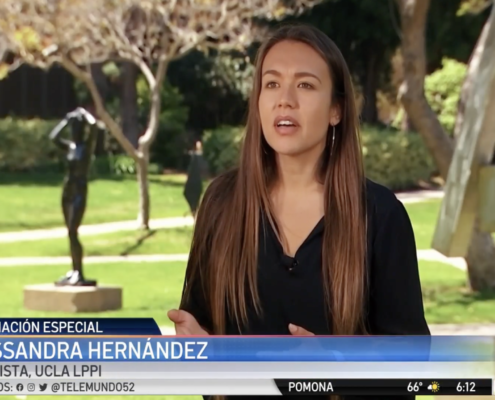
Uplifting Latina Voices Through LPPI, Telemundo Partnership Kassandra Hernández MPP '20 makes relevant research about the impacts of COVID-19 accessible to a Spanish-speaking community

June 2, 2021/0 Comments/in For Faculty, For Policymakers, For Students, For Undergraduates, Public Policy, Public Policy News, School of Public Affairs Sonja Diaz /by Zoe Day

By Zoe Day

During the COVID-19 pandemic, Latinas went from being one of the fastest-growing groups in the labor force to one that was hit hardest by unemployment, with 2.4 million Latinas out of work in April 2020.

This finding from the Latino Policy and Politics Initiative (LPPI) at UCLA Luskin is part of a broad body of research on the pandemic’s impact on Latino populations — research that is now being shared with a wider audience through a partnership with Spanish-language news station Telemundo 52.

LPPI research analyst Kassandra Hernández BA ’17, MPP ’20 sees the collaboration as an opportunity to uplift Latina voices and make relevant research more accessible to Latino populations.

“The reports we produce are nothing if no one reads them,” she explained. “We’re studying the impact [of the pandemic] on Latinas, and we would like to reach the people who are being impacted.”

A Telemundo newscast featuring Hernández focused on Latina participation in the labor market, which had been projected to experience substantial growth until the pandemic forced many Latinas to choose child-care duties over paid work. LPPI Director of Research Rodrigo Dominguez-Villegas also appeared in the segment, underscoring that “Latinas are overrepresented in sectors hardest hit by the pandemic.”

As a native Spanish speaker, Hernández welcomed the chance to connect with the populations that her research focuses on, in their own language.

“Different media outlets are accessible in different languages, but English doesn’t reach Latinas in the same way,” she said.

Two other Telemundo reports featured LPPI-affiliated scholars who shared their expertise on COVID-19’s impact on Latino populations. In one segment, Melissa Chinchilla, a research scientist who studies the intersection of housing, health and community development, explained how unemployment caused by the pandemic led many to move in with friends and family, increasing the risk of COVID-19 transmission within households.

“Affordable housing and the capacity to accommodate multigenerational families are issues that will require long-term investment,” Chinchilla said.

In another report, Yohualli Balderas-Medina Anaya, a medical doctor on the faculty of the David Geffen School of Medicine at UCLA, discussed the long-term symptoms experienced by some COVID-19 patients even after the infection has passed. Anaya expressed concern that some side effects will continue to affect patients for years.

Telemundo reporter Enrique Chiabra, a UCLA alumnus, presented the three-part series aimed at making information about the COVID-19 pandemic accessible for Spanish-speaking populations. That is a key priority for Hernández, who has worked with LPPI faculty experts including Executive Director Sonja Diaz to interpret research and push it into the public sphere.

“Academic research is often not as accessible to the communities it focuses on,” she said. “I want to analyze inequities and share knowledge; I don’t want to stay in the ivory tower.”

Hernández is a double Bruin who earned her bachelor’s degree in philosophy and labor and workplace studies. After graduation, she worked with AmeriCorps on food insecurity before going back to school to develop her skills in quantitative analysis.

“As a Latina, I have lived what I find in numbers,” said Hernández, a first-generation college graduate and the daughter of Mexican immigrants. She spoke about her own mother’s challenges balancing responsibilities as a domestic worker and the demands of being a parent and caretaker.

“I realized not everyone has those same experiences, but I can use numbers as evidence to validate my own story.”

Hernández said she chose the master of public policy program at UCLA Luskin because of the supportive faculty and the opportunity to engage with real-world issues. The experience “opened up my eyes to what I could do and how to analyze policy,” she said. 

Hernández’s research with LPPI has helped shed light on the gender norms and expectations that often push Latina women aside or confine them to the household. The partnership between LPPI and Telemundo, she said, helped break down stereotypes and recognize that Latinas should not be grouped together as a monolith.

As Hernández’s time with LPPI draws to a close, she is excited to meet the next cohort of fellows to continue advancing research and policy work to support Latinas. In the fall, she will pursue her Ph.D. in economics at UC Berkeley, building on her skills from UCLA Luskin to address inequality through policy research focusing on labor, income inequality, immigration, education, food access and environmental economics.

“Everything is connected,” Hernández said. “Inequality dictates access and quality of life.”

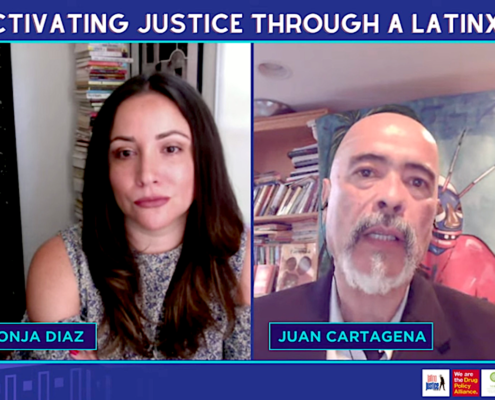
Activating Justice Through a 21st Century Latinx Lens UCLA co-hosts a dialogue featuring leading Latinx voices with the goal of sparking a full transformation of the criminal legal system 

May 21, 2021/0 Comments/in For Faculty, For Policymakers, For Students, For Undergraduates, Politics, Public Policy, Public Policy News, School of Public Affairs Kelly Lytle Hernandez, Sonja Diaz /by Mary Braswell

By Kacey Bonner

What would our criminal legal system look like if it was truly designed to reduce harm, advance public safety and end America’s legacy as the world’s leading incarcerator?

That was the question on everyone’s mind as leading Latinx elected officials, advocates, academics and media personalities convened to grapple with the issue of criminal justice — a topic of intense national debate.

Hosted by the UCLA Latino Policy and Politics Initiative (LPPI), LatinoJustice PRLDEF, the Drug Policy Alliance and the National Hispanic Caucus of State Legislators, the May 13-14 convening “Advancing Criminal Justice Reform Through a 21st Century Latinx Lens” had several goals: creating greater visibility of Latinos within the justice reform movement; identifying opportunities to build solidarity with other communities most impacted by the criminal legal system; and advancing transformative policy focused on justice rather than punishment.

“For too long, Latinos have been left out of the criminal justice conversation, even though we are the second most negatively impacted group by numbers behind Black people when it comes to our criminal legal systems,” said Sonja Diaz, founding director of the Latino Policy and Politics Initiative.

With conversations led by faculty experts such as UCLA Law Professor Jennifer Chacón, over 1,000 participants tuned in to hear from a multiracial cadre of 40 speakers covering topics including ending youth incarceration, defunding the police, and the intersection of the criminal legal and immigration systems – all through a Latinx lens.

Speakers including journalist Maria Hinojosa and author Julissa Arce led lively discussions about the opportunity to create more truthful and inclusive narratives in the criminal justice space and develop tailored solutions that address the underlying structural and systemic deficiencies that drive people to engage in harmful acts.

“It was so exciting to see this come together with so many brilliant people who were able to bring fresh perspective on the issue, the challenges and opportunities before us and how we can work in solidarity across race and experience to achieve common goals that make our communities safer and healthier,” said LPPI fellow Paula Nazario, one of the lead organizers of the convening. A UCLA graduate, Nazario is now pursuing her master of public policy at UCLA Luskin.

The event’s opening plenary session included Kelly Lytle-Hernández, a professor of history, African American studies and urban planning at UCLA. Lytle-Hernández gave attendees key insight into the impacts of the criminal legal system on Latinos, the structural racism propping up the system of incarceration and how the criminalization of immigrants is working to expand systems of mass incarceration.

Breakout sessions then enabled attendees to think about how they can demand better data that creates a clearer picture of the challenges and opportunities ahead and how Latino-facing organizations — both within and outside the justice reform space — can work together to create broad change.

Throughout the convening, conversation returned to the immense data and knowledge gap that obscures the true impact of the criminal legal system on Latinx individuals, families and communities. If this gap persists, there is a risk of creating solutions that fail to address challenges unique to Latinos who are systems-impacted and perpetuating inequities that exist in our current criminal legal system.

A conversation with Juan Cartagena, president and general counsel of Latino Justice PRLDEF, closed the two-day meeting. Cartagena said that, while the U.S. criminal legal system hasn’t changed much in the past five decades, it is on the precipice of big change — change made possible by communities that see an unprecedented opportunity to fundamentally transform systems of justice.

“We cannot lose sight of the fact that there have been amazing opportunities for organizing people around truth, and for having that truth talk to power,” Cartagena said.

“I think we’re stronger than ever to actually have conversations about dismantling systems, about what it means to invest in our communities in different ways and to think outside of every box at every corner so we can get things done.”


Latino USA’s Maria Hinojosa moderates the opening plenary session with podcast host David Luis “Suave” Gonzalez, author Julissa Arce, District Court Judge Natalia Cornelio and UCLA Professor Kelly Lytle-Hernández.

Jonathan Jayes-Greene of the Marguerite Casey Foundation moderates a “crimmigration” panel featuring Jacinta Gonzalez of Mijente, Abraham Paulos of Black Alliance for Just Immigration, UCLA Professor Jennifer M. Chacón and Greisa Martinez Rosas of United We Dream.


Diaz Highlights Opportunity to Expand Health Care Coverage

May 12, 2021/0 Comments/in Luskin in the News Sonja Diaz /by Zoe Day

In a Sacramento Bee article on Gov. Gavin Newsom’s budget priorities, Sonja Diaz, executive director of the Latino Policy and Politics Initiative, discussed the possibility of expanding Medi-Cal coverage to undocumented adults and seniors. Newsom is expected to release a revised state budget proposal this week with a huge budget surplus, which could be used to fund a variety of proposals to help Californians, including more stimulus checks, school funding and expanded health care coverage for undocumented adults. California recently expanded Medi-Cal coverage to undocumented children and adults up to 25 years old; expanding coverage to undocumented adults over 65 is estimated to cost the state about $250 million. “We’re in an unprecedented situation where we actually have resources to find robust and bold ideas that can correct failed systems,” Diaz said. “This includes expanding health care coverage to people irrespective of their immigration status and irrespective of their age.”

Read the article

Diaz Highlights Power of Latino Voters

May 5, 2021/0 Comments/in Luskin in the News Sonja Diaz /by Zoe Day

Latino Policy and Politics Initiative Director Sonja Diaz spoke to ABC7 about the role Latino voters are expected to play in the upcoming recall election faced by Gov. Gavin Newsom. Voter turnout has been historically lower for special elections, but Latino voters have turned out in large numbers in recent elections. “Our research showed that more Latinos in California cast a ballot in the 2020 presidential election than ever before,” Diaz said. She explained that both Asian Americans and Latinos are youthful demographic groups with increasing numbers of eligible voters. “This recall is really about a referendum of how we reopen — how our elected leaders including at the top, the governor, is able to ensure that people are having access to things to keep them not only safe, but making sure the world’s fifth-largest economy can continue to thrive,” Diaz said. She added that grassroots and civic engagement this year will carry into future races.

Watch the video

Page 4 of 10«‹23456›»

Recent Posts

  • Stoll on the Factors Influencing Migration Patterns within the U.S. January 9, 2026
  • Northern California Maintains Nation’s Lowest ICE Arrest Rate Despite National Surge January 9, 2026
  • One Year After the Fires, Recovery Remains Uneven January 8, 2026
  • Oil and Gas Companies Sacrificing Plastic-Burdened Communities January 7, 2026
  • A sixth-generation Altadena resident presents a community recovery roadmap after the fires January 7, 2026

Contact

UCLA Luskin School of Public Affairs

3250 Public Affairs Building - Box 951656
Los Angeles, CA 90095-1656

Campus Resources

  • Maps, Directions, Parking
  • Directory
  • Contact
  • Academic Calendar
  • Careers
  • Diversity
  • University of California
  • Terms of Use

Follow

The statements on this page represent the views of people affiliated with the Luskin School of Public Affairs and do not necessarily represent the views of the University of California, or UCLA or its Chancellor.

Posts and comments by individuals at UCLA on social media channels may not reflect the opinions or policies of UCLA, the University of California or the Luskin School, nor its benefactors and academic partners.

Scroll to top