Luskin Forum Highlights the School’s Multiple Perspectives

The winter 2015 edition of the Luskin Forum, titled “Engaging Multiple Perspectives,” is all about the diverse spectrum of ideas and research which have brought the Luskin to its present standing and continue to advance the school’s development and impact.

The magazine features stories ranging from the Luskin’s “Season of Service” for the underserved homeless population to professor Mark S. Kaplan’s work in suicide cause and prevention, along with highlights and achievements from many other faculty and students.

This edition of the Luskin Forum is available in print form and online via this link.

http://issuu.com/uclapubaffairs/docs/lfwi15


Luskin Center / EDF Report Featured on KPCC-FM

The latest edition of the Los Angeles Solar and Efficiency Report (LASER) was featured in an item on 89.3 KPCC-FM, the public radio affiliate in Pasadena.

In a segment by environmental reporter Jed Kim, Luskin Center deputy director Colleen Callahan highlighted the report’s finding that only 2 percent of Los Angeles County’s solar potential is currently being utilized.

“The fact that 98 percent is still untapped means that we have a tremendous resource sitting on a roof that really is going unused,” Callahan said.

The report estimates growing utilization to 10 percent would result in the creation of an estimated 47,000 jobs. Kim also spoke with Kokayi Kwa Jitahidi, a community organizer with the Los Angeles Alliance for a New Economy, who said that these efficiencies are best directed at low income communities.

“If we’re going to grow the green economy, if we’re going to grow energy efficiency, we have to start in those communities first,” Judahidi said.

Listen to the entire report here.

UCLA Luskin Postcard: Health Care Reform Salon with Mark Peterson

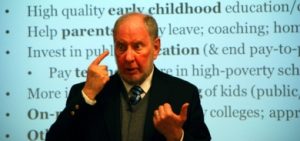
Mark Peterson, an expert in health care policy and a longtime watcher of efforts to reform medical insurance in the U.S., spoke to an exclusive group of UCLA Luskin friends at a Dean’s Associates Salon a few weeks after the Affordable Care Act’s coverage began to become active.

UCLA Luskin student writer Max Wynn sent this postcard from the evening.

On January 15th friends of UCLA Luskin gathered at Michael and Natalie Mahdesian’s Studio City home for the eleventh Dean’s Associates Salon.

The highlight of the evening was a discussion of the Affordable Care Act led by Mark A. Peterson, UCLA Luskin professor of public policy, political science and law. Former Massachusetts Governor Michael Dukakis, a visiting professor of Public Policy, provided closing remarks and perspective on the health care reform experience of his own state.

In his opening remarks, Mahdesian, a member of UCLA Luskin’s Board of Advisors, stated that the School trains leaders to come up with solutions to the problems and needs of our society. Health care is a universal need but health care reform is a complex issue, and the clarity of Peterson’s analysis reinforced Mahdesian’s reasoning for calling UCLA Luskin “one of the best [public affairs programs] on the west coast — if not the nation.”

The collected guests filled the Mahdesian’s spacious living room, and while some sat up right in their seats and others relaxed on couches, they all listened intently as Peterson spoke.

He began by explaining why the Affordable Care Act is such a complex piece of legislation, before tracing the fraught history of health care reform in this country up to the problems with the Act’s rollout last fall. However, the majority of his presentation was devoted to what he called “the implementation wars.”

Peterson characterized the national debate over Obamacare as a “civil war within our political ranks,” explaining that the vitriol of the debate was driven by an increasingly polarized Congress and the racial intolerance of a powerful minority within the conservative electorate.

This divisive rhetoric of the health care debate was a recurring theme throughout the night, but Peterson’s in-depth, factual analysis of Obamacare was a steady hand on the subject.

Peterson’s remarks were followed by a lengthy question and answer session, and the intimate setting fostered a lively discussion between Peterson and the attendees. Questions came from all corners of the room and the constructive nature of the discussion stood in stark relief to the divisiveness of the subject matter.

As the night wound down Dukakis delivered his closing remarks, emphasizing that, “Obamacare works…[and] it’s working in my state.”

As guests milled about afterwards the general consensus was that the night’s discussion had provided a level of context that is much needed, but rarely found, in the discourse surrounding health care reform.

If you would like to learn more about UCLA Luksin’s Dean’s Associates program, click here.

Crisis as an Opportunity: UCLA and Australian Department of Foreign Affairs and Trade host symposium to address water concerns for a warming planet

By Karen A. Lefkowitz

“It’s important to awaken all to the seriousness of drought and the lack of rain…the drought emphasizes that we do live in an era of limits and that we need solutions that are elegant.” On January 17 Governor Jerry Brown officially declared a drought emergency in California. On the other side of the world, Australia suffered through a 12-year drought that ended last year with widespread flooding. The 2012-2013 ‘angry summer’ was the country’s hottest on record and temperatures continue to rise this summer. These parallel challenges make Australia and the U.S. ideal partners on water resource responses. UCLA’s Institute of the Environment and Sustainability, International Institute, Luskin Center for Innovation, and School of Law Environmental Law Center partnered with the Australian Department of Foreign Affairs to host a “U.S.-Australian Dialogue on Water — The Coming Water Crisis: Solutions and Strategies” on January 13.

Legislative officials, industry specialists, legal experts, educators and scientists, economists and business executives, and non-profit professionals shared experiences and advanced the conversation on water sustainability. UCLA Chancellor Gene Block provided introductory remarks and Australia’s Minister for Trade and Investment Andrew Robb delivered the keynote speech. The symposium was part of the G’Day USA program of events that brings together leaders and key influencers in diverse industries to cultivate and enhance the Australia–United States relationship. Conference segments considered coping techniques for arid environments, blueprints for better water management, and new water sources for the future.

Ten Questions: J.R. DeShazo and solar power J.R. DeShazo explains how solar can provide up to a third of L.A.'s energy, without costing a bundle

by Alison Hewitt

Environmental economist J.R. DeShazo’s recent research is the basis of Los Angeles’ new solar power policy. DeShazo explains how solar can provide up to a third of L.A.’s energy, without costing a bundle.

J.R. DeShazo, the director of The UCLA School of Public Affairs Luskin Center for Innovation and an associate professor of public policy, describes himself as an

environmental economist. Most recently, he turned his focus to how Los Angeles can create policies that will encourage Angelenos to turn their rooftops into a glittering sea of solar panels. His research formed the basis of L.A.’s new solar plan. DeShazo sat down with UCLA Today writer Alison Hewitt to explain how solar could save L.A. Below is an edited Q&A.

Why bother with solar energy?
Solar power is completely underutilized in Los Angeles. All the unused capacity – on business rooftops, on top of parking lots, in fields – adds up to 5.5 gigawatts, which could meet about a third of L.A.’s energy needs. California is a leader in solar, thanks to state and federal subsidies, but Los Angeles’ Department of Water and Power still gets 44 percent of its energy from coal. That’s a lot for California.

So why haven’t more rooftops begun sprouting solar panels already?
The biggest obstacle to increasing the availability of solar energy right now is the cost of solar panels. They’re still really expensive. The price is beginning to fall, but for now, government incentives are vital to make the cost of solar panels pan out.

Your solution is a program called feed-in tariffs, which would raise utility rates a little bit so the city could create a solar fund. The fund would help volunteers afford solar panels, and actually hook them up to the grid so that we could all use the power they generate. Is this a new program?

Variations on feed-in tariffs are being used around the world, from Japan and Spain to Florida and Vermont. Germany’s feed-in tariff program is the best known. But when I studied these other programs, it was discouraging. No one else’s policy was right for Los Angeles. They were all too expensive.

How did you design a solar feed-in tariff program that would be affordable?
One big change from other programs is that we have to target commercial customers, not residential customers.

What makes commercial buildings better?
Businesses have larger rooftops and parking lots where you can install large banks of solar panels. Existing feed-in tariff programs have focused on residential rooftops, but you miss all the economies of scale that way. Federal tax subsidies can help reduce the cost, but only if you’re already paying a lot of taxes, as a company would. We want to include homeowners, nonprofits, schools and hospitals, but commercial properties have to be the main target.

Why would companies want to enter the solar power business and sell clean energy to the city?
Because the feed-in tariff system would provide a “reasonable rate of return” – a small profit. Solar power is still too expensive to pan out economically for most people, but if we buy it from feed-in tariff providers the same way we buy it from utility companies, they can make their money back. The city would buy the solar power for a slightly above-market rate using its solar fund.

Why would residents agree to pay a little more for power just so their neighbors or local companies could earn a profit selling them solar power?
Solar is the only renewable energy program that produces jobs in L.A. Wind farms will be elsewhere. Geothermal energy sources are far away. But we have a massive amount of unused solar capacity right here in Los Angeles.

We’re also known as the nation’s most polluted city. A solar power program can change the way we’re perceived and how Los Angeles thinks about itself. Los Angeles has very ambitious renewable energy targets, but we’re struggling to meet them. This plan was designed to help Los Angeles meet its renewable energy goals with the lowest possible impact to ratepayers.

How is your research being used by Los Angeles?

The details are still being negotiated at City Hall, but the mayor is using our research as the basis for his solar policy.

How could the energy landscape change if solar becomes as widespread as you hope?
This could change everything. So many people will have solar that we won’t need the Department of Water and Power – well, except on rainy days. There will be a big shift from energy delivery to energy reliability. Actually, it threatens power utilities’ business model, which is centered on production and transmission, not on distribution from sources all over the city. Power generation would become a public-private partnership.

What made you decide to research solar power policy?
The Luskin Center’s focus for our first three years is on environmental sustainability. Our mission is solving regional problems, local problems where we can have the biggest impact. We identify problems that need to be solved and look for a partner, like the City of Los Angeles, who can benefit from our research.­­­­­­­

Fernando Torres-Gil Confirmed by the U.S. Senate as a Member of the National Council on Disability

Associate Dean Fernando Torres-Gil has been named to an Obama administration post as a member and vice chair of the National Council on Disability.  This marks the third term of national service in a
presidential administration for Professor Torres-Gil, who previously served under President Bill Clinton and President Jimmy Carter.
Prior to his roles at UCLA, he served as a professor of gerontology and public administration at the
University of Southern California, where he is still an adjunct professor of gerontology. Before serving in academia, Prof. Torres-Gil was the first assistant secretary for aging in the U.S. Department of Health and Human Services and as the staff director of the U.S. House of Representatives Select Committee on Aging.  Prof. Torres-Gil also served as President of the American Society on Aging from 1989 to 1992.

Prof. Torres-Gil holds appointments as professor of social welfare and public policy in the UCLA School of Public Affairs and is the director of the Center for Policy Research on Aging.  Professor Torres-Gil is an expert in the fields of health and long-term care, the politics of aging, social policy, ethnicity and disability.

He is the author of six books and more than 80 articles and book chapters, including The New Aging: Politics and Change in America (1992), and Lessons From Three Nations, Volumes I and II (2007).  In recognition of his many academic accomplishments, he was elected a Fellow of the Gerontological Society of America in 1985 and the National Academy of Public Administration in 1995.  He also served as President of the American Society on Aging from 1989 to 1992 and is a member of the National Academy of Social Insurance.  He is currently a member of the San Francisco Bay Area Polio Survivors, the National Academy of Social Insurance and of the board of directors of Elderhostel, the National Committee to Preserve Social Security and Medicare, the AARP Foundation, the Los Angeles Airport Commission, and The California Endowment.