UCLA teams up with USC and civic partners to cool the Los Angeles region ShadeLA aims to expand urban tree canopy and shade infrastructure, building heat resilience for Angelenos

Los Angeles faces a growing challenge: heat. Record-breaking temperatures, combined with inadequate shade, are making it harder to walk to school, wait for a bus or play sports. Today, ShadeLA launches as a public campaign to raise awareness, spur action and create collaborations that will work to expand tree canopy and shade infrastructure while leaving a safer, more climate-resilient Los Angeles.

ShadeLA is led by USC Dornsife Public Exchange in collaboration with UCLA Luskin Center for Innovation, with participation by the city of Los Angeles, the county’s Chief Sustainability Office, LA Metro and the Los Angeles Organizing Committee for the 2028 Olympic and Paralympic Games, or LA28. The world will be watching Los Angeles over the next three years as the region hosts global sporting events like the 2026 FIFA World Cup and Super Bowl LXI, culminating with the 2028 Olympic and Paralympic Games. ShadeLA plans to leverage this unique window of attention and investments to expand access to shade around communities that need it most, as well as Olympic venue sites and other shade deserts — areas lacking adequate shade — in Los Angeles’ most heat-vulnerable neighborhoods.

ShadeLA is structured around four goals, each rooted in research, policy and community engagement:

  1. Expand shade through design competitions, new shade concepts and pilot projects
  2. Preserve and maintain shade through tree maintenance toolkits and stewardship models
  3. Guide the placement of new infrastructure using shade mapping, planning and other tools
  4. Inform and mobilize people through community shade planning events, story campaigns and toolkits for residents, businesses and schools

“ShadeLA is a powerful example of how UCLA research and collaborations lead to real-world impact,” said UCLA Chancellor Julio Frenk. “This project will greatly benefit communities across Los Angeles — and with the eyes of the world turning to our city in the lead-up to 2028, we have a unique opportunity to showcase what inclusive climate action can achieve.”

The campaign is powered by a growing list of community collaborators leading on-the-ground shade projects that help ensure solutions are locally driven and responsive to neighborhood priorities.

“For years, USC Dornsife Public Exchange has been leading the way on sustainable urban forestry. Now, we’re proud to be spearheading ShadeLA, an important initiative that leverages our cutting-edge research to improve quality of life for all of us in Los Angeles,” USC interim President Beong-Soo Kim said.

Heat is the largest weather-related killer facing Los Angeles, especially its vulnerable populations. A key solution: shade. It is one of the most effective, low-cost ways to reduce heat risk. Whether from a tree, canopy, awning or bus shelter, shaded areas can drop the “feels-like” temperature by 35 to 70 degrees Fahrenheit (or 20 to 40 degrees Celsius). It is simple, scalable and can be integrated into everyday spaces where people live, learn, work and play.

Los Angeles County has less shade than the national average. Urbanized areas of the county have an average of 21% shade at noon compared with the national average of 27%, according to the Luskin Center for Innovation’s national Shade Map, which is part of American Forests’ Tree Equity Score.

“We’re at a critical juncture as L.A. gets hotter, and we are thrilled to partner with USC to lead with evidence and to collectively envision a livable future for our region,” said Edith de Guzman, water and adaptation policy cooperative extension specialist at the Luskin Center for Innovation.

“ShadeLA is about more than trees and structures — it’s about people,” said Monica Dean, climate and sustainability practice director at USC Dornsife Public Exchange. “This campaign addresses heat not just as an environmental issue, but as a public health, infrastructure and community challenge.”

LA28 has pledged to weave shade planning and heat mitigation measures into its planning processes.

“LA28 is committed to incorporating sustainable solutions throughout the Games footprint,” said Becky Dale, vice president of sustainability at LA28. “ShadeLA supports not only keeping spectators cool during the Games, but also leaving a legacy of a cooler, greener Los Angeles for all Angelenos.”

By expanding shade in coordination with local communities, USC and UCLA aim to model collaborative climate action while creating safer, healthier public spaces for decades to come.

The article was originally published on UCLA Newsroom. Read the full article here.

Beyond shade: UCLA researchers improve radiant cooling to make outdoor temperatures feel cooler Approach uses low-cost, scalable, transparent and infrared-reflective surfaces and hydronic panels

A team of UCLA engineers and researchers has developed a new technique to make it feel up to 10 degrees Fahrenheit cooler outside while preserving a sense of safe and open space.

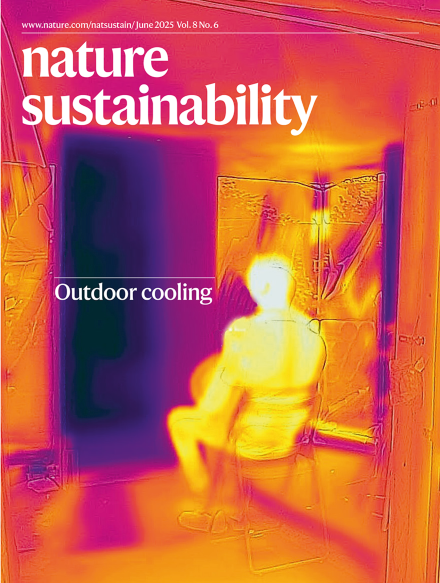
Nature Sustainability magazine shows thermal imaging of a person sitting in a folding chair inside a radiant cooling structure

Recently featured as the June cover story in Nature Sustainability, the UCLA-led study demonstrated a new way to harness radiant cooling. Instead of relying on dark and windowless spaces, such as a tunnel, to create radiant cooling that raises safety concerns for public outdoor spaces, the new approach combines water-cooled aluminum panels and see-through, infrared-reflective thin polymer film, which allows both efficient cooling and visibility — a top priority, especially for residents in urban communities.

As climate change accelerates, extreme heat events are occurring with greater intensity and frequency, threatening the safety of people who spend significant time outdoors. Active radiant cooling, which uses surrounding surfaces such as cool roofs or floors to absorb heat from a space, has recently emerged as a promising strategy for outdoor thermal comfort, as it offers cooling at a distance without the inefficiency of conditioning unconfined air. However, for radiant cooling structures to be effective, the overwhelming majority of their internal surfaces must be actively cooled, typically with opaque panels, raising practicality and safety concerns. The UCLA team found a way to address these issues.

The research was funded by the National Science Foundation and the UCLA Sustainable LA Grand Challenge’s Heat Resilient LA project.

“This low-cost and scalable design is a practical step beyond shade to help people who have to be outdoors on hot days, especially during periods of extreme heat,” said study co-author Aaswath Raman, an associate professor of materials science and engineering at the UCLA Samueli School of Engineering who specializes in developing new materials and technologies to help lower temperatures. “This additional level of cooling can bring some relief in outdoor places where traditional air conditioning simply isn’t possible, such as metro stops, parks and plazas.”

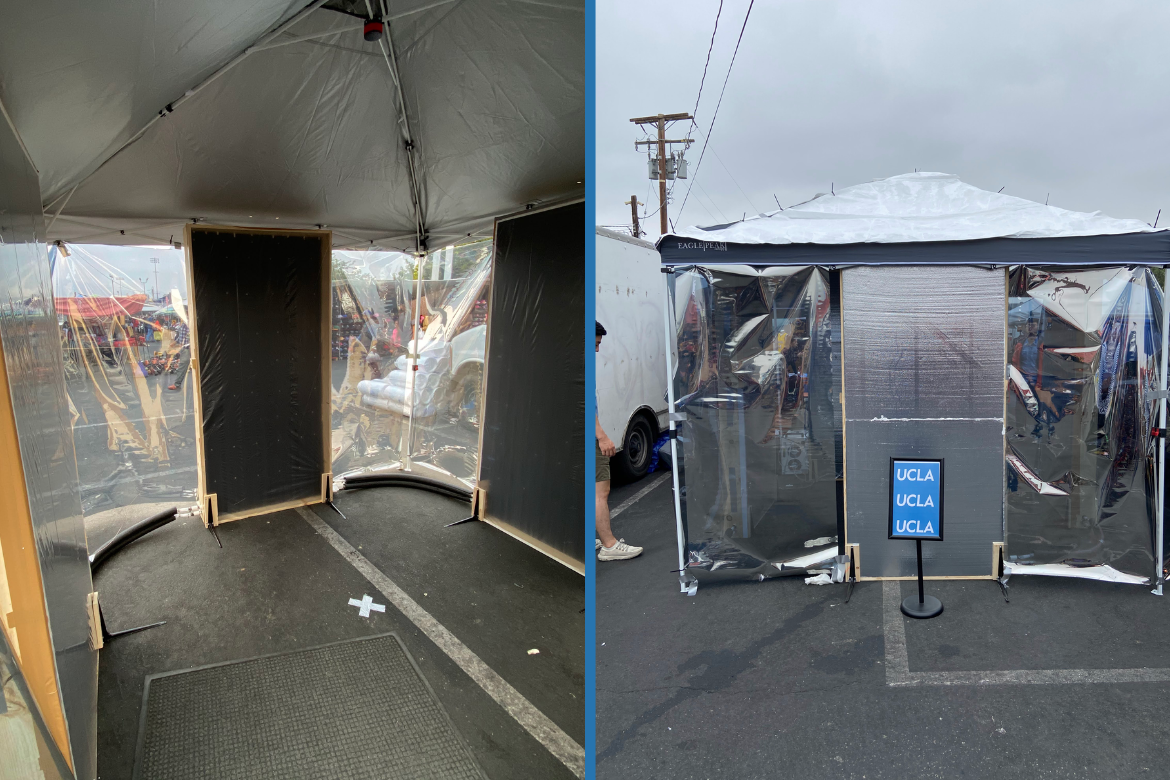
In field studies, the researchers conducted experiments on the UCLA campus and at the San Fernando Swap Meet on days when temperatures reached the mid-80s at each location. The team constructed a nearly 10-by-10-foot “tent,” comprising semi-transparent, infrared-reflective walls made of half-metallized thin polymer film; a roof built from radiative-cooling sheets; and three hydronic radiant-cooling panels made of aluminum sheets with cold water flowing behind them to keep the panels actively cool. To enhance cooling efficiency, the team also painted the inward-facing side of the panels black to absorb incidental heat, such as body heat from people within the structure. The semi-transparent walls allow occupants to see outside without visual obstruction.

Interior and exterior of a tent structure with three hydronic radiant-cooling aluminum panels and polymer film walls

Raman Lab/UCLA
The interior and exterior of the nearly 10-by-10-foot “tent.”

The researchers found that their structure had a mean radiant temperature of about 78 degrees Fahrenheit. This was not only lower than the ambient air temperature of approximately 84 degrees but also more than 10 degrees cooler than the mean radiant temperature of about 90 degrees that a person would have otherwise experienced due to heat radiating from surrounding surfaces. The team also surveyed participants who stood in the cooling structure, with most reporting feeling cooler and more comfortable than they would in shade alone.

“Radiant temperature” refers to a commonly experienced phenomenon: when a person’s perceived temperature differs from the actual air temperature. For example, when someone walks from an asphalt-paved parking lot to a grassy area, then to a space under a tree, the air temperature stays the same, but it feels cooler because the grass and shade shield the person from heat radiated by surrounding surfaces, such as asphalt. This effect helped inspire the researchers’ new approach to tackling heat.

“Cities need to think about shade as infrastructure,” said study co-author V. Kelly Turner, a UCLA associate professor of urban planning and geography and associate director of the Luskin Center for Innovation who studies heat equity. “This accessible design can help patch in where there is not enough shade for people to be comfortable outdoors on hot days.”

The paper’s lead author is David Abraham, a doctoral student in Raman’s research group at UCLA Samueli. Other authors include Dr. Mackensie Yore, an emergency medicine physician at UCLA Health; Kirsten Schwarz, an associate professor of urban planning at the UCLA Luskin School of Public Affairs and of environmental health sciences at the UCLA Fielding School of Public Health; Dr. David Eisenman, a professor-in-residence at the David Geffen School of Medicine at UCLA with a joint appointment at Fielding School; and Walker Wells, an urban planning lecturer at the Luskin School. Other authors from Raman’s group are undergraduate student Robert Yang, former graduate student Xin Huang and former postdoctoral scholar Jyotirmoy Mandal.

This article was originally published on UCLA Newsroom. Read the full article here.

Turner on the Power of Shade to Combat Urban Heat

UCLA Luskin urban planning professor Kelly Turner lends her expertise in urban planning and heat resilience to offer data-backed perspective on how shade — both leafy and architectural — is essential for public health. In a New York Times opinion piece, Turner challenges the conventional wisdom that shade makes public spaces less usable and desirable. She explains that shade can reduce outdoor heat burden as much as 30%, offering critical relief to vulnerable communities who bear the brunt of urban heat.

Turner most recently, in collaboration with American Forests, developed an innovative shade-mapping tool to identify where shade is most needed. These maps can guide transit planners to reroute bus stops to cooler corridors or encourage cities to add shade where it will have the most impact.

Though much of our current planning policy still prioritizes sunlight, Turner argues it’s time for a shift. As climate change accelerates, shadows shouldn’t be feared — they should be welcomed.

Luskin Alum Edgar Garcia MURP ’06 Welcomes Mayor Bass at Executive Directive Signing Edgar Garcia stands alongside Mayor Karen Bass as city advances protections for immigrants at historic Los Angeles landmark.

UCLA Luskin alum Edgar Garcia MURP ’06 helped mark a significant moment in Los Angeles history as he welcomed Mayor Karen Bass to El Pueblo de Los Ángeles Historical Monument on July 11, where she signed a new executive directive to strengthen city protections for immigrant communities.

“In 1931, our plaza here, was the site of the forced repatriation of U.S. citizens of Mexican heritage, where raids occurred on unsuspecting visitors…It’s a sad history but a powerful reminder of what we are facing today,” said Garcia. “The fear and trauma of so many back then, has once again been awakened across our city. But there’s also another history — one rooted in hope, unity and solidarity.”

From the painful legacy of forced repatriations in the 1930s to the sanctuary movement sparked at La Placita Church in the 1980s by Father Olivares, Edgar reminded us our city’s history holds both trauma and hope — and a responsibility to protect our most vulnerable.

Mayor Bass’ directive comes in response to a wave of recent ICE raids in Los Angeles. The directive requires all city departments to comply with L.A.’s sanctuary ordinance, submit preparedness plans, and expand access to resources through Immigrant Affairs Liaisons. It also forms a working group to guide LAPD response to ICE activity and seeks federal records on recent immigration enforcement actions.

Garcia currently serves as Interim General Manager of the El Pueblo de Los Angeles Historical Monument, where he uses his educational background in urban planning as a tool for preservation, education, and community empowerment. His leadership reflects a deep commitment to honoring Los Angeles’ diverse history while shaping how future generations engage with and protect the city’s cultural and historic spaces.

Edith de Guzman on How Extreme Indoor Heat is a Public Health Crisis De Guzman advocates for stronger renter protections amid Los Angeles’ rising temperatures.

Edith de Guzman of the UCLA Luskin Center for Innovation, is quoted in a Patch article highlighting the urgent need for air conditioning access in Los Angeles rental housing and the broader health impacts of rising temperatures on vulnerable communities.

“Extreme indoor heat isn’t just a climate issue — it’s a public health issue,” says de Guzman. “The effects of unsafe indoor heat are not hypothetical — we all know what it’s like to live through a heat wave. It affects everything: your ability to work, cook, sleep and even breathe.”

As Los Angeles braces for a future with triple the number of 95-degree days due to climate change, a new report by Strategic Actions for a Just Economy (SAJE) urges stronger tenant protections to ensure renters have access to air conditioning — which it calls a life-saving necessity during extreme heat. The report highlights that many low-income renters in South L.A. lack cooling options and fear retaliation if they request them, despite the severe health risks posed by prolonged indoor heat. While California law mandates heating, it does not require landlords to provide cooling, prompting calls for new policies to guarantee tenants the right to install or receive AC.

Dorothy Faye Pirtle blends public policy and culinary arts to increase food access

Family, community and food have always been at the core of Dorothy Faye Pirtle’s educational journey. Growing up African American and Korean American in what was once known as South Central Los Angeles, Pirtle, a dual master’s candidate in public policy and urban regional planning, has been a longtime social justice advocate.

“For me, it’s about leading an interdisciplinary life through school, food, cooking,” she said.

Pirtle’s interest in this life began in a very personal way. With few Asian ingredients found at local grocery stores, Pirtle’s mother, who is Korean, grew produce in their backyard. Pirtle was able to connect with that part of her heritage as she learned how to grow and cook her own food, such as using herbs like mugwort in savory dishes and knowing which types of lettuce were best for Korean lettuce wraps. One of Pirtle’s fondest childhood memories was eating her mom’s seaweed soup.

Her focus on community and activism also started early. At 12 years old, Pirtle witnessed the civil unrest that spread across Los Angeles in April 1992 following the acquittal of the officers charged in the beating of Rodney King. She would go on to attend community events and meet Asian American and Pacific Islander leaders such as Marcia Choo and K.W. Lee.

Lee, a pioneering Asian American journalist who called Pirtle his “adopted granddaughter” during her fellowship at the K.W. Lee Center for Leadership, taught her and other Koreans about cross-racial solidarity. Choo, who later wrote one of Pirtle’s recommendation letters for UCLA, also modeled for her the importance of community-building, service and engagement. They inspired her to think more deeply about racial inequality.

Community activism through food

Pirtle began her higher education journey at UC Irvine, where she majored in social science. She also received associate degrees in culinary arts/chef training, professional baking and restaurant management from Los Angeles Trade Technical College.

While living in South L.A. City after finishing trade school, Pirtle began to connect food, community and policy together.

Her local supermarket — which supports 75,000 people — shut down, leaving neighborhoods without fresh produce and other goods.

“If you wanted to buy a tomato or cilantro — or laundry detergent — where would you go? I created the California Black Council on Food Policy out of this need to address what was happening in my community,” she said.

The coalition has gone on to tackle food disparities through solutions driven by Black communities experiencing these issues.

Using her previous work experience managing farmers markets and working at a business development center, Pirtle devised the idea of helping entrepreneurs access resources within the farmers market space and created the nonprofit Lily of the Nile 1992. The organization, which she founded in 2021, operates farmers markets, farm stands and food distributions to bring California-grown produce to South Los Angeles. It provides research on farmers market programs and facilitates access to these markets even for those who are spatially segregated from them while also fostering community by celebrating African American culinary traditions.

Pirtle works with farmers from historically underrepresented backgrounds to help them write grants. She secured a Resilient Food Systems Infrastructure Program award for K&K Ranch, a family-owned farm, to purchase a refrigerated truck. She plans on establishing farmers markets across the area and hosting the farmers she writes grants on behalf of.

“This work is very much about relationships and honoring what people do,” Pirtle said.

From Lulu to the Luskin Center

Her farmers market expertise and culinary skills ultimately brought Pirtle to UCLA. She drew on this experience while working at Lulu at the Hammer Museum. Conceived by Alice Waters and David Tanis, the farm-to-table restaurant allows people to experience regenerative, sustainable and seasonal produce. As a forager, Pirtle sourced local food from farmers markets and from around L.A. for their rotating menu.

“I would ask the chef, ‘Is there something special you want to make, and is there an ingredient that you’re looking for?’ And then I would go out and find the item,” Pirtle said.

This work and the connections made at Lulu deepened Pirtle’s interest in pursuing further education at UCLA. Pirtle became a dual degree student because she believes public policy can take a finite amount of resources and create infinite public good, such as through programs like CalFresh and farmer subsidies to help address food insecurity and inequities.

For her, it was a full-circle moment: UCLA was always Pirtle’s dream school, and she recognizes UCLA professors Kimberlé Crenshaw and Cheryl Harris, both legal scholars on race and justice, as two of the main reasons why.

She plans to use the knowledge gleaned from her dual master’s to develop urban gardens and farmers markets in South L.A. Currently, she is working on developing a farmers market with her nonprofit Lily of the Nile 1992 and the Lulu Project, Lulu’s arm for regenerative food and community wellness.

“My impetus for attending graduate school was looking at the community I came from and figuring out how I can make a difference here,” she said. “It was about deepening my relationship to land, people and place.”

This article was originally published on UCLA Newsroom. Read the full article here.
APA Honors Urban and Regional Planning Alumna for Transportation Equity Research The award-winning capstone project sheds light on the toll of extreme commutes on low-income communities in the San Fernando Valley.

Alejandra Rios Gutiérrez MURP ’24 was recently honored with the Academic Award by the Los Angeles section of the American Planning Association (APA) for her capstone project, “Lost Hours, Lost Opportunities: The Toll of Extreme Travel on Lower-Income Communities in the San Fernando Valley.” The award, which recognizes innovation and community impact in the field of planning, was presented at the APA awards ceremony held June 26 in Downtown Los Angeles.

Gutiérrez’s research, conducted in partnership with Pacoima Beautiful, a leading environmental justice organization serving Northeast San Fernando Valley’s Latinx communities, explores the profound and often invisible burdens of “extreme travel”—defined in her project as commutes exceeding 180 minutes per day for all essential trips, not just work. Her project, which included in-depth interviews and surveys, illuminated how transportation challenges intersect with systemic issues like housing unaffordability, job sprawl, and limited transit access—leaving low-income residents with fewer choices and heavier costs.

“My capstone was inspired by past coworkers and friends whose extreme commutes had serious impacts on their lives,” Gutiérrez shared. “I saw how long commutes take a toll on overall well-being, especially for low-income workers who have fewer choices about where they live or work.”

Her project does more than document these struggles, it reframes the entire planning conversation. “It was important to me that the project not only document the problem but also challenge how we define ‘access’ and who we design for. I want to center people’s time, labor, and well-being as core planning issues.”

Gutiérrez’s work arrives at a critical moment as the East San Fernando Valley Light Rail Transit Project prepares to break ground. Her findings offer key policy insights that could help ensure the project serves the communities most impacted by extreme travel. “Receiving this award from APA Los Angeles is a meaningful honor, especially because the project was rooted in the experiences of people whose needs are often overlooked in planning processes,” she said. “It affirms the importance of making visible the realities faced by extreme commuters and reinforces my belief that equity-centered research and advocacy are essential to the future of planning.”

She credits her training and education at UCLA Luskin for shaping her values as a planner. “My time at UCLA Luskin shaped my approach by encouraging both a critical lens and a strong commitment to justice. The program gave me the tools to analyze complex systems, as well as the space to ask deeper questions about who planning serves, what values guide our decisions, and how we build accountability into our work.”

Read her project “Lost Hours, Lost Opportunities: The Toll of Extreme Travel on Lower-Income Communities in the San Fernando Valley” here.

Terriquez Helps Spotlight Forgotten Latina Lesbian Activists in Groundbreaking L.A. Exhibit Terriquez, director of the UCLA Chicano Studies Research Center and faculty at UCLA Luskin, supports powerful exhibition that brings long-overdue recognition to Latina lesbian activism in East Los Angeles.

A new exhibition showcasing archival collections of prominent Latina lesbians and narrating their involvement in LGBTQ+, immigrant, labor, and housing justice movements, will be presented at the Vincent Price Art Museum at East Los Angeles College.

Veronica Terriquez, director of UCLA’s Chicano Studies Research Center (CSRC) and professor of urban planning, supported the curation of the “On the Side of Angels” exhibition, which features materials from the CSRC Library archives: photography, posters, magazines, and video footage from the collections of policy and civil rights advocate Laura Esquivel, tenant rights attorney Elena Popp, and former CSRC librarian Yolanda Retter Vargas. The exhibition was co-curated by Vanessa Esperanza Quintero and Jocelyne Sanchez and is on view through August 30.

“Our mission is to share with the public as much history as possible, including highlighting historical moments — and people — who tend to not receive all the attention or credit for their important work,” Terriquez said. “We are incredibly proud of this exhibition because it features women who championed immigrant rights, safer working conditions, and broader acceptance of LGBTQ and other marginalized communities — efforts that have paved the way for cross-movement solidarity in Los Angeles and beyond.”

Terriquez is co-founder of the Latina Futures 2050 Lab, an initiative focused on uplifting Latina leaders, scholars, and changemakers by producing research and storytelling that informs policy, empowers communities, and shapes a more inclusive future.

Her scholarship at UCLA Luskin centers on social movements, youth civic engagement, and intersectional equity, with a particular focus on low-income communities of color.

Fernando Torres-Gil highlights systemic gaps in long-term elder Torres-Gil describes the U.S. long-term care system as “a huge for-profit industry."

Fernando Torres-Gil, professor of social welfare and public policy at the UCLA Luskin School of Public Affairs and director of the Center for Policy Research on Aging, was quoted in a recent Los Angeles Times article examining the rising costs of in-home elder care — which can reach up to $18,600 per month in Southern California. Torres-Gil described the U.S. long-term care system as “a huge for-profit industry,” emphasizing that America remains “behind the curve” compared to other countries that offer universal long-term care support. He described the American care system as “a huge for‑profit industry,” noting that unlike many other developed nations, the U.S. lacks universal long-term care financing—a failure that has left “Americans behind the curve.”

UCLA Latino Politics and Policy Institute Maps the Heat: New Dashboard Reveals Climate Inequities for Latinos New UCLA dashboard highlights stark environmental health disparities impacting Latino communities.

A powerful new tool from UCLA Luskin’s Latino Policy & Politics Institute reveals the disproportionate impact of climate-related health risks on Latino communities across California. Featured in a recent Los Angeles Times article, the Latino Climate and Health Dashboard showcases stark disparities in heat exposure, pollution levels, and environmental conditions in Latino-majority neighborhoods compared to predominantly white areas.

The dashboard, which covers 23 counties home to over 90% of California’s Latino population, shows that Latino communities experience an average of 23 more extreme heat days per year and often face infrastructure challenges like limited tree canopy and older, poorly ventilated housing. These factors, combined with a high prevalence of outdoor labor, intensify environmental and health vulnerabilities.

The dashboard aims to empower policymakers, advocates, and communities to take informed action. Explore the tool at latinoclimatehealth.org.