• Public Policy
  • Social Welfare
  • Real Estate Development
  • Urban Planning
  • Luskin Home
  • Undergraduate Program
  • Stay in Touch
  • Events Calendar
  • Give Now
  • About
    • Our Dean
    • Board of Advisors
    • Contact Us
    • Visit Us
    • Diversity, Disparities and Difference
    • Communications
      • UCLA Luskin in the News
      • Luskin Forum Online
  • Departments
    • Public Policy
    • Real Estate Development
    • Social Welfare
    • Undergraduate Program
    • Urban Planning
  • Apply
    • Master of Public Policy
    • Master of Real Estate Development
    • Master of Social Welfare
    • Master of Urban and Regional Planning
      • Double Degree With Sciences Po
    • PhD in Social Welfare
    • PhD in Urban Planning
    • Undergraduate Programs
  • Faculty
    • All
    • Public Policy
    • Social Welfare
    • Urban Planning
    • Real Estate Development
    • Faculty Executive Committee
    • Open Positions
  • Student Affairs & Alumni
    • Career Services
      • Employers
      • Fellowships
    • Student Support
    • Graduate Resource Library
    • Alumni Relations
  • Support
  • Programs
    • Research Centers & Affiliated Research
    • CA Title IV-E Education Program
    • Global Public Affairs (GPA)
    • Data Analytics Certificate
    • Luskin Lecture Series
    • Luskin Summit
    • UCLA Luskin California Policy Briefing
    • Public Service Weekend
    • Commencement
  • Administration
    • Financial Services
    • Events Office
    • Information Technology
  • Search
  • Menu Menu

Archive for category: School of Public Affairs

Message From the Dean

April 12, 2021/0 Comments/in Alumni, School of Public Affairs, Urban Planning /by Les Dunseith

Friends and Colleagues:

I am deeply saddened to report that our friend Marty Wachs, professor emeritus of Urban Planning, passed away Sunday night. Marty was a 50-year member of the Luskin and Urban Planning Community since his arrival as an associate professor of Urban Planning in 1971. He spent 25 of those years on the UCLA faculty.

Martin Wachs was a professor, chair (three terms), and the director of the Institute of Transportation Studies at UCLA who then spent a decade at UC Berkeley, where he was also chair and director of their Transportation Center. He also held appointments at UIC, Northwestern and Rand. Marty was the author of more than 160 articles and four books on transportation, land use and environment. He was an award-winning teacher and scholar, recognized for his research with a Guggenheim Fellowship, two Rockefeller Foundation fellowships, and he was the winner of a UCLA distinguished teaching award.

He was mentor to an entire generation of urban planners and urban planning scholars and a cherished friend of many of the Luskin faculty.

We are in touch with his wife, Helen, and will share details regarding arrangements as they become available. The Luskin School will plan an appropriate commemoration of his life and work, in consultation with his family, in the near term.

I know you all join me in offering our sincerest condolences to his family and friends.

In fellowship,

Gary

Gary M. Segura
Professor and Dean

Further coverage will follow. The Institute of Transportation Studies at UCLA is encouraging people to add remembrances of Martin Wachs in the comments section of a post on the ITS website. Email tributes also may be sent to rememberingmarty@its.ucla.edu

Report Sets Path Toward Clean Drinking Water for all Californians Study co-authored by UCLA Luskin researchers finds hundreds of public water systems are out of compliance

April 12, 2021/1 Comment/in Business and the Environment, Climate Change, Environment, For Faculty, For Policymakers, For Students, For Undergraduates, Luskin Center, Public Policy, Public Policy News, Research Projects, Resources, School of Public Affairs, Smart Water Systems Gregory Pierce /by Les Dunseith

By Michelle Einstein

California was the first U.S. state to legally recognize access to safe, clean and affordable water as a human right. But substantial parts of the state lack access to drinking water that meets those criteria.

A new study (PDF) published by the California State Water Board and supported by UCLA research identifies a risk for failure among a significant portion of the state’s small and medium-sized public water systems. The report is the first comprehensive analysis of how clean water is provided in California, and it estimates how much it would actually cost to deliver safe water to every resident.

The research was a collaboration between the UCLA Luskin Center for Innovation, the water board’s Needs Analysis Unit, Corona Environmental Consulting, Sacramento State University’s Office of Water Programs, the Pacific Institute and the University of North Carolina’s Environmental Finance Center.

Of the 2,779 public water systems evaluated in the study, nearly half are at some risk of failing to provide an adequate supply of safe drinking water. To measure the health of water systems, the researchers assessed each water system using 19 indicators for water quality, accessibility, affordability and operational capacity.

Based on those assessments, each system received an overall rating indicating how likely it would be to fail — from “not at risk” at the top end of the scale, to “potentially at risk” and “at risk” for the systems with the lowest scores. The researchers found 25% of water systems to be “at risk,” while an additional 23% are “potentially at risk.”

The study also identified locations where groundwater quality is out of compliance with the state’s safe water drinking standards. About one-third of domestic wells and one-half of state small water systems were found to be at a high risk for containing contaminants like nitrate and arsenic.

“Illuminating the extent of at-risk water systems is an important step,” said Gregory Pierce, the study’s principal investigator and an associate director at the Luskin Center for Innovation. “By more fully understanding the issues, we can move to more resilient and accessible water sources.”

The study noted that water quality and infrastructure issues vary substantially across the state. For instance, Kings County, in central California, has the highest proportion of at-risk public water systems (75%), while San Francisco County and Modoc County in the northern part of the state have zero at-risk systems.

The research incorporated a comprehensive evaluation of thousands of water systems and hundreds of thousands of wells, as well as input from water managers, environmental nonprofits and advocacy groups.

Among the other findings:

Holistic solutions can help.

  • In the short term, bottled water and home filtration systems can be used to help communities that need clean drinking water immediately. The researchers estimate that those short-term interventions would cost between $500 million and $1.6 billion over the next five to nine years.
  • Long-term solutions include enhancing water treatment; consolidating small, underperforming water systems; and providing experts to advise communities on how to improve those systems. The study estimates a wide range of total costs for those solutions, depending on which actions local systems adopt, but the midpoint estimate is about $5.7 billion.

More funding will be needed.

  • The Safe and Affordable Drinking Water Fund, which was established in 2019 to help bring adequate drinking water to disadvantaged communities, already provides critical financial support. But for all California communities to have reliably safe drinking water, more financial resources are likely needed.
  • Additional funding could come from a variety of sources, including the state legislature, the governor’s office and federal agencies.

The analysis suggests prioritizing funding for water systems that are currently most at risk and that are located in underserved communities. It also sets the stage for a deeper investigation of how the state can ensure safe, clean and affordable water for all — an especially salient issue as Congress is considering a federal infrastructure bill that would, in part, address the systems that deliver drinking water throughout the U.S.

“I’m optimistic that as a nation, we’re talking about upgrading our pipes and cleaning up our contaminated drinking water,” said Peter Roquemore, a co-author of the study and a researcher at the Luskin Center for Innovation. “Infrastructure might not always be glamorous, but the impacts of fixing our water systems would be huge.”

UCLA Researchers Evaluate Efforts to Curb Trade of Conflict Minerals Report finds ‘meaningful progress’ over past decade, but issues including child labor violations persist

March 30, 2021/0 Comments/in For Faculty, For Policymakers, For Students, For Undergraduates, School of Public Affairs Darin Christensen /by Mary Braswell

By Stan Paul

Over the past decade, the U.S. and other nations have implemented programs intended to monitor and mitigate human rights abuses and armed conflict related to mining operations around the world.

A new report co-authored by UCLA researchers has found that those so-called due diligence programs have fostered “meaningful progress” in the Democratic Republic of Congo, one of the countries targeted by the initiatives. But child labor and other violations are still taking place.

Tin, tantalum and tungsten are commonly used in computers and cell phones and a wide array of other electronics. In some countries like the DRC, those materials are designated as “conflict minerals” because the areas in which they’re mined are affected by armed violence — and in some cases, the violence is related to mining operations.

Researchers collected data in 2019 from 104 mine sites, as well as 1,054 households and 1,000 people living in villages around those mine sites, in the provinces of South Kivu and Maniema. They found that areas with due diligence programs see less interference by the armed forces of the Democratic Republic of Congo. Compared to areas without due diligence programs, more than 50% fewer mines in areas served by due diligence programs reported a military presence or improper taxation by soldiers.

The study also found that, in villages near the mines served by those programs, the number of households reporting a military presence was 27% lower than in villages without the programs.

However, the analysis also revealed that mines in the areas covered by the diligence programs do not have significantly lower rates of child labor than those outside of the programs’ purview. Some child labor was reported at roughly one-third of mines, whether they were covered by the programs or not.

“We uncovered reasons to applaud these programs, but also room for improvement, particularly with respect to child labor,” said Darin Christensen, co-author of the study and an assistant professor of public policy at the UCLA Luskin School of Public Affairs. “Unsurprisingly, the due diligence program is not a panacea — it reduces important risks associated with mining in the eastern Congo but does not eradicate all harms.

“In better isolating its impacts, we hope to clarify where further efforts are needed to promote sustainable livelihoods and human security in mining regions.”

Christensen is the co-founder (with UCLA professors Graeme Blair and Michael Ross) of the UCLA-based Project on Resources and Governance, which led the study’s research design and analysis. The report’s other contributors are the International Peace Information Service, a Belgian research institute; Sub-Saharan Field Research & Consulting Services, a Kenyan research agency; and Ulula, a Canadian software and analytics provider.

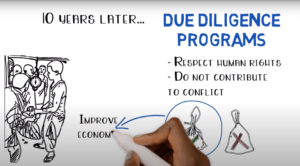
International efforts to mitigate or eliminate the negative impacts of conflict minerals have focused on keeping the minerals out of global supply chains. The aim is to break the link between mining and conflict by identifying and boycotting suppliers who contribute, willingly or unwillingly, to armed groups or human rights abuses, according to the report.

This strategy is reflected in regulatory efforts such as the 2010 Dodd-Frank Act in the U.S. and the European Union’s more recent Regulation on Conflict Minerals. Those policies require U.S. and European companies that source certain minerals from conflict-affected areas, like eastern Congo, to conduct due diligence around the production and processing of minerals to verify that suppliers respect human rights and do not contribute to conflict.

But more than a decade after Dodd-Frank, there had been scant research on whether due diligence programs are improving economic and security conditions.

The report also found that areas covered by due diligence programs report a greater presence of government regulators.

Researchers found that the proportion of households reporting tax collection and services provided by the government regulators who are responsible for monitoring the mining sector was 58% higher in areas served by the programs than in those that aren’t. However, when households were asked whether they felt secure, there was no statistical difference in responses between those in areas served by the program and those that were not.

View an animation about this study

Black Lives Matter Pioneer Named 2021 Commencement Speaker Patrisse Cullors, co-founder of the global movement, is an author, educator and artist who has dedicated her life to racial justice

March 30, 2021/0 Comments/in School of Public Affairs Gary Segura /by Zoe Day

By Zoe Day

Patrisse Cullors, co-founder of the Black Lives Matter movement, delivered a prerecorded address as part of the 2021 virtual commencement ceremony at the UCLA Luskin School of Public Affairs.

Cullors, an educator, artist and best-selling author who has been on the front lines of community organizing for 20 years, participated via on an online platform due to COVID-19 health concerns.

In 2013, the UCLA alumna created the #BlackLivesMatter hashtag on Twitter, which grew into an international movement for racial justice and reform. Last year, Time magazine named her one of the 100 most influential people in 2020.

“Patrisse Cullors is at the heart — and the foundation — of a movement for human rights, social change and genuine equality under the law,” UCLA Luskin Dean Gary Segura said in March when Cullors was announced as a speaker. “Her work and the work of those who follow is way past due.

“The time has long since come for our society to come to a reckoning regarding the violence and abuse we visit on Black Americans,” Segura said. 

As a teenager, Cullors became interested in activism and joined the Bus Riders Union, an advocacy group that fought for increased funding for bus systems in Los Angeles. She later started Dignity and Power Now, a coalition formed to shed light on brutality by sheriff’s deputies in county jails.

She has also led the JusticeLA and Reform L.A. Jails coalitions, helping them to win progressive ballot measures, fight against a $3.5 billion jail expansion plan in Los Angeles County, and implement the first Civilian Oversight Commission of the Los Angeles Sheriff’s Department.

Her activism has been informed by her studies of revolutionaries, critical theory and social movements around the world. She earned a bachelor’s degree in religion and philosophy from UCLA in 2012 and received her master’s in fine arts from USC.

In 2013, Cullors co-founded the Black Lives Matter Global Network Foundation with Alicia Garza and Opal Tometi in response to an acquittal in the killing of unarmed Florida teenager Trayvon Martin by a neighborhood watch volunteer. Today, the organization supports Black-led movements in the United States, United Kingdom and Canada and has been nominated for the 2021 Nobel Peace Prize.

In 2018, Cullors and co-author Asha Bandele published “When They Call You a Terrorist: A Black Lives Matter Memoir,” which became a New York Times best-seller.

In 2020, Cullors co-produced the 12-part YouTube series “Resist,” which chronicles the fight against Los Angeles County’s jail expansion plan. She also signed a multi-year production deal with Warner Bros. and has said she intends to use the contract to continue to uplift Black stories, talent and creators.

Cullors serves as the faculty director of Arizona’s Prescott College, where she designed the curriculum for a new master’s of fine arts program focusing on the intersection of art, social justice and community organizing.

Using Art and Technology, Proposal Aims to Increase Bike Commuting in L.A. Project by UCLA faculty envisions collaborative bicycle 'flows' that generate digital exhibitions across the city

March 23, 2021/1 Comment/in Environment, For Faculty, For Policymakers, For Students, For Undergraduates, School of Public Affairs, Transportation, Urban Planning Anastasia Loukaitou-Sideris /by Mary Braswell
By Jonathan Van Dyke

For many Los Angeles residents, the daily commute is frustrating. A project by three UCLA faculty members aims to change that — especially for those who ride to work on two wheels — by creating bicycle “flows” that produce real-time digital art exhibitions throughout the city.

One of the project’s goals is to make cycling to work feel as accessible and safe as other modes of travel, so the professors envision groups, or flows, of cyclists that would be organized by a smartphone app. The app would encourage reluctant or inexperienced cyclists to participate by pointing them toward those flows, suggest routes that are optimized for enjoyability and safety over efficiency or speed, and enable participants to share their experiences.

Those experiences, in the form of text, photos, videos and other creative submissions, would feed directly into digital murals throughout Los Angeles. The murals would be located in community spaces and transportation hubs around the city — including, for example, a large interactive display at the Los Angeles State Historic Park, adjacent to Chinatown — elevating biking to work to a collective creative experience.

“We envision the cooperative bike flows as a type of performative media artwork that is shared live with all of Los Angeles in public spaces and on the internet,” said Fabian Wagmister, the project’s principal investigator and the founding director of the UCLA Center for Research in Engineering, Media and Performance, known as UCLA REMAP.

“By inviting communities to think about bicycle riding as a way to express themselves in the urban landscape, we can strengthen commuters’ ownership of the system and offer a deeper level of engagement in the future of the city.”

The project, called Civic Bicycle Commuting, or CiBiC, is co-led by Anastasia Loukaitou-Sideris, distinguished professor of urban planning at UCLA Luskin, and Jeff Burke, co-director of REMAP and a UCLA professor in-residence of theater.

The project already is gaining some traction: In February, the initiative received $50,000 in funding  from the Civic Innovation Challenge, which is funded by the National Science Foundation in partnership with the U.S. Department of Energy and the U.S. Department of Homeland Security. CiBiC is now in contention for an additional grant of up to $1 million, which the researchers would use to create a prototype of the project.

CiBiC’s art-led approach makes it somewhat of an anomaly among most of the competitors in its category, “communities and mobility.” Most of the other proposals have origins in the STEM fields and social sciences.

To ensure the project incorporates the diverse experiences and needs of Los Angeles commuters, the researchers are soliciting input from Los Angeles neighborhood groups. Loukaitou-Sideris said the team will especially seek participation from low-income residents of Chinatown, Solano Canyon, Dogtown and Lincoln Heights.

“We want to hear from community groups and residents and understand how we can create something that is tailored to their needs,” she said.

The researchers also are collaborating with Eli Akira Kaufman, executive director of the Los Angeles County Bicycle Coalition, who said the project could demonstrate how transformative bicycle culture could be in Los Angeles if bicyclists could help create infrastructure that reflected their needs.

“Instead of allowing the built environment to dictate the culture of bicycling in Los Angeles, we need to uplift the culture of bicycling to make sure the built environment is defined by the social infrastructure and the people who use it,” he said.

Aggregated data from the app could also eventually be used to influence Los Angeles’ long-term infrastructure planning.

And Wagmister said the project stands to both reflect and amplify the city’s creative spirit: “We want to create an alternative transportation system in Los Angeles, one that values our collective creative capacity to transform the city for all.”

Undergrads Come Together During a Year of Staying Apart UCLA Luskin student group works to build peer-to-peer connections guided by the major's public service ethos

March 22, 2021/0 Comments/in Education, For Students, For Undergraduates, School of Public Affairs, Trailblazers /by Mary Braswell

By Mary Braswell

In the fall of 2020, Kaylen Gapuz was excited to begin her life as a Bruin but anxious about how to make campus connections at a time when COVID-19 demanded learning from afar.

So when she spotted an email invitation to pair up with a mentor through the Luskin Undergraduate Student Association, she quickly applied.

Throughout the first months of her freshman year, the public affairs pre-major talked weekly with senior Hannah Feller, who answered questions, offered advice and became “a good mentor, resource and friend, all in one, which I will forever appreciate,” Gapuz said.

This year, more than 70 students were matched with mentors, one of several initiatives launched by the association to strengthen the bonds among UCLA Luskin’s undergraduates, even as the pandemic kept them apart.

LUSA, as the group is known, came into existence in 2019, not long after the public affairs major debuted at UCLA. This year, by necessity, it greatly expanded its virtual reach.

A new website includes a blog inviting members to share their own takes on the issues that move them, and the group has hosted several remote gatherings guided by the public service ethos the major is known for. 

Throughout the year, members have come together for conversations on topics such as policing, environmental justice, gentrification and, of course, the tumultuous 2020 election. In the fall, a panel of candidates running for local office across California — including Nithya Raman, who would go on to win a seat on the Los Angeles City Council — appeared at a LUSA event to share personal stories of why they chose politics as an avenue for change-making. 

To draw Luskin undergrads to these gatherings at a time of chronic Zoom fatigue, LUSA’s leaders have been careful to choose timely topics while also offering social contacts, insights on navigating the major and advice on preparing for the working world. 

“The whole point of LUSA is to be a peer-to-peer environment,” said Feller, a public affairs and economics double-major who serves as the group’s president. 

At one LUSA session, Feller shared tips from her personal experience landing several internships — well before she was placed with the nonprofit World Trade Organization Los Angeles for her senior capstone experience.

“I’m by no means an expert on this topic, but I have had a fair share of finding internships, and a lot of this is information that older students taught me while I was going through the process,” Feller told the gathering. 

This type of programming offers a student’s eye view that complements the major’s curriculum and the resources offered by UCLA.

As one strategy to keep members engaged during an age of virtual connections, LUSA expanded its leadership team, Feller said. In addition to five elected executive board members, several other students stepped up to edit the blog, manage an active social media presence and organize special events.

Third-year public affairs major Samantha Schwartz was inspired to take on the mentorship initiative, an outreach to first- and second-year students at UCLA interested in learning more about the public affairs program.

In her weekly check-ins with Feller, Gapuz said, “Hannah was very much able to tailor the experience to the two of us,” and the women would chat about classes and professors, how to juggle the workload, and their shared interest in business consulting. 

“Especially this year, because of the remote nature of everything, it was just good to have a link to someone at a regular time when you know you can ask questions and not have to wonder what to do,” Gapuz said.

“Our mentorship pairing is what convinced me that the public affairs major is right for me.”

How the Weinstein Scandal Ignited a Movement Gains made in the #MeToo era are tempered by unresolved questions of accountability, journalist Megan Twohey tells a UCLA audience

March 10, 2021/0 Comments/in For Faculty, For Policymakers, For Students, For Undergraduates, School of Public Affairs Meredith Phillips /by Mary Braswell

By Mary Braswell

The New York Times investigation that exposed producer Harvey Weinstein’s long history as a sexual predator set off a chain of events that led to prison for the Hollywood power broker and empowerment for women around the world who stepped up to share their own stories of abuse.

Today, the story continues to unfold, with contours of the investigation now coming to light and nagging questions of accountability still unanswered, journalist Megan Twohey told a UCLA audience during a March 9 virtual lecture.

Twohey and Jodi Kantor shared a byline on that first blockbuster piece in the fall of 2017, part of a body of work that would earn their newspaper the Pulitzer Prize for Public Service. Both reporters were bowled over by the whirlwind of events that followed.

“One day we were working on this incredibly difficult story, and then just a few days later we started to see change happening everywhere,” Twohey said. “The #MeToo movement turned out to be more sweeping and durable than we could have ever predicted.”

Twohey’s talk was the latest in the UCLA Meyer and Renee Luskin Lecture Series, which brings together scholars as well as national and local leaders to address society’s most pressing problems, such as the culture’s long history of men getting away with abusing their authority. Though hundreds of powerful men have lost their jobs since Twohey and Kantor’s story broke, the fallout continues, including in the recent mini-series “Allen v. Farrow,” which documents the sexual abuse case against filmmaker Woody Allen.

As the team’s reporting continued over months and years, “there was also growing confusion and frustration that in some ways it felt like everything was changing — and then it also felt like nothing was changing at all,” Twohey said.

‘At a time when everything can feel stuck, and the very notion of “truth” is collapsing, we want you to know that journalism and facts can win.’ — Megan Twohey

The story, they realized, was less about one man’s misdeeds and more about a sprawling system of coercion and complicity that had facilitated predatory behavior for generations.

“The real moral of the Weinstein story began to dawn on us,” Twohey said. “For decades this man had racked up allegation after allegation and, instead of stopping him, more and more people had helped him.”

During the event, which drew viewers from around the world, Twohey described the pervasive use of non-disclosure agreements to buy the silence of women who lodged complaints.

“Nobody would say that a victim of sexual harassment or sexual assault shouldn’t receive financial recompense for what’s happened to them,” she said. “I think the real question here is the secrecy … that allows predators to cover their tracks and to keep hurting other people.”

The #MeToo movement transformed cultural norms, but there is still no consensus on how to handle sexual abuse cases, Twohey said.

“What is the scope of behavior under scrutiny?” she asked. “Are we talking only about allegations of rape and sexual harassment, or are we talking about grayer areas, like a boss’ awkward hand on an employee’s back?”

Complicating the conversation are charges that the #MeToo era has led to false accusations and quick ousters without due process.

But Twohey assured the audience that, “at a time when everything can feel stuck, and the very notion of ‘truth’ is collapsing, we want you to know that journalism and facts can win.”

Twohey and Kantor reveal details of their reporting journey, including information that was originally off the record, in their 2019 book “She Said: Breaking the Sexual Harassment Story That Helped Ignite a Movement.”

“When we started we had no idea whether Harvey Weinstein had done anything wrong. Remember, he was considered a humanitarian, a philanthropist,” Twohey told the Luskin Lecture audience.

Over the next several months, the two journalists approached a long list of sources, persuaded them to tell their stories, then appealed to them to go public. They also amassed records including Weinstein Company accounting records, human resources complaints, notes from internal conference calls, emails and more.

“When we went back to women to ask them to go on the record, we were asking them to stand on a body of evidence,” Twohey said.

Satisfied that the story was air-tight, the New York Times prepared to publish, knowing that Weinstein had launched a campaign to discredit the women who had come forward — and also aware that another journalist, Ronan Farrow, was racing to break the story. His reporting for the New Yorker, published a few days later, earned a share of the Pulitzer for Public Service.

Days after the stories went to press, Weinstein was fired from the film studio he co-founded. Within months, he was arrested and charged with rape in New York. In February 2020, he was sentenced to 23 years in prison.

At the Luskin Lecture, Twohey spoke with UCLA’s Meredith Phillips, an associate professor of public policy and sociology and chair of the undergraduate program at UCLA Luskin, about parallels between investigative journalism and social science research, two fields that require strict adherence to evidence from many sources.

Twohey said that throughout her coverage of the Weinstein story and its aftermath, she honored the distinction between journalism and advocacy.

“We reporters gather the facts, pick up a pen and hope that by revealing the truth we can help bring about change.”

Study Analyzes Energy Conservation Tactics During Peak Periods Research by Luskin Center for Innovation focuses on 'demand response programs' that encourage users to save energy when the electrical grid is under stress

March 10, 2021/1 Comment/in Climate Change, Digital Technologies, Environment, For Faculty, For Policymakers, For Students, For Undergraduates, Luskin Center, Public Policy, Public Policy News, Research Projects, Resources, School of Public Affairs, Sustainable Energy J.R. DeShazo /by Les Dunseith

By Colleen Callahan

New research by the UCLA Luskin Center for Innovation has identified how effective certain incentives can be in motivating people to use less energy in their homes.

Electricity providers often need to encourage customers to reduce consumption in order to prevent blackouts or to avoid having to activate additional power plants — often natural gas-powered plants that pollute the environment.

The researchers found that promotional messages about how customers could save money on their electricity bills or earn other financial rewards were effective at motivating them to use less energy.

For the study (PDF), which was funded by a grant from the California Energy Commission, the UCLA researchers assessed data from energy bills for more than 20,000 California households in territories served by Pacific Gas and Electric, Southern California Edison and San Diego Gas & Electric.

The customers all participate in “demand response programs,” which encourage users to save energy at times of high stress on the electrical grid, like during heat waves; they all also used one of two smartphone apps — Chai Energy or OhmConnect — that help users manage their home energy consumption. Often, the apps offered cash incentives to participants for adjusting their thermostats during times when demand for energy was highest.

The study revealed that offering participants financial rewards, on top of the amount of money they’d save simply for using less energy, had a measurable effect on reducing their energy use — although the amount of the financial incentive made relatively little difference. Collectively, the 20,000 households in the study had received over $1 million in rewards over the previous two years through those incentive programs, in addition to the savings on their electricity bills from using the apps.

Encouraging flexibility in our energy system is especially important as the nation’s infrastructure continues to shift to clean energy. For instance, weather can be unpredictable and impact the amount of electricity generated by solar panels or wind turbines. Demand response programs can be effective at reducing energy use during these times to avoid blackouts.

“In more good news for the environment, our study found that demand response programs result in overall reduction in energy use — not merely a shift of consumption to other hours or days,” said JR DeShazo, the study’s principal investigator and the director of the Luskin Center for Innovation.

That finding is particularly significant because some observers had suspected that demand response programs merely encouraged energy customers to shift their electricity use to other times of day — for example, by waiting to run their dishwashers or clothes dryers during overnight hours, when overall energy demand was lower — but without actually reducing the amount of energy they consumed. But the UCLA report concluded that customers’ energy consumption did not increase in the hours or days surrounding a demand response event, suggesting that the approach resulted in actual reductions in consumption.

The households with the greatest reduction in consumption during demand response events were those with solar panels, plug-in electric vehicles and automation devices — gadgets like smart thermostats that can automatically alter energy usage but can be overridden by the owner. For example, automation devices can delay charging an electric vehicle or turn down an air conditioner until an off-peak time.

“Automation devices make participating in demand response programs effortless, and ultimately rewarding,” said Kelly Trumbull, a co-author of the study and a Luskin Center for Innovation researcher. “They also help secure predictable and reliable energy savings.”

Demand response providers typically reward users based on their energy conservation relative to an energy consumption goal assigned by the utility. Researchers found that households reduce their energy use more when that consumption goal is more ambitious, assuming all other factors are constant.

“This finding underscores the importance of setting baselines and communicating them to customers,” DeShazo said. “If we are asked to do more, we often will.”

The study recommends actions utilities and third-party demand response providers — like the ones that market the energy management apps — can take to maximize both the environmental and economic benefits of residential demand response programs, including:

  • Offering financial incentives and emphasizing the economic benefits to participants.
  • Supporting the adoption of automation devices like smart thermostats.
  • Inducing greater energy savings by setting ambitious conservation targets for customers.

Most Californians, depending on their electricity providers, are eligible to participate in existing demand response services.

Pride and Perseverance: The Story of Long Hoang A public affairs student with an outgoing personality finds inner meaning amid the forced isolation of COVID-19

March 4, 2021/0 Comments/in School of Public Affairs, Trailblazers /by Hon Hoang

A public affairs student with an outgoing personality finds inner meaning amid the forced isolation of COVID-19

Read more →

2020 Stimulus Program Failed to Reach State’s Most Economically Vulnerable Districts UCLA report is a call to action for policymakers as they craft new economic recovery plans

March 3, 2021/0 Comments/in For Faculty, For Policymakers, For Students, For Undergraduates, Politics, Public Policy, Public Policy News, School of Public Affairs /by Mary Braswell

A new UCLA study found that the 2020 federal stimulus program that offered forgivable loans to small businesses affected by the pandemic might have widened economic disparities.

The study, by the UCLA Latino Policy and Politics Initiative and the UCLA Center for Neighborhood Knowledge, examined data for California congressional districts, and the authors assert that aid largely failed to reach the districts with the greatest need.

The California districts with the lowest average household incomes and highest proportions of people of color received the lowest amounts of support through the Paycheck Protection Program, the study found. The 10 districts that received the least funding have a median household income of a little over $66,000, and people of color make up 66% of their populations.

By comparison, the 10 districts that received the most paycheck protection funds have a median household income over $108,000, and a smaller proportion of residents of color, 53%. In fact, although a plurality of Californians are Latino, none of the 14 districts with majority-Latino populations were among the top 10 districts in terms of receiving paycheck protection funds.

According to the authors, the fact that more stimulus aid went to districts with economic bases that were stronger to begin with will only exacerbate pre-pandemic economic inequalities that have made communities of color more vulnerable to economic shocks.

As the Biden administration and Congress discuss ongoing federal recovery efforts, fixing the inequities of previous stimulus efforts should be a priority, said Rodrigo Dominguez-Villegas, research director at the UCLA Latino Policy and Politics Initiative and a co-author of the report.

“The pandemic has devastated communities of color, which have lost jobs and income at disproportionate rates, with scant support from the federal government,” Dominguez-Villegas said. “In order to emerge from the pandemic and into the recovery without greater inequality, we need action now to uplift the people who need help the most.”

A previous study by the two research centers produced similar findings about the racial inequities of the Paycheck Protection Program. By presenting data at the congressional district level, the new report should give policymakers an even clearer picture of the winners and losers created by previous stimulus efforts, said Silvia González, a staff researcher at the Center for Neighborhood Knowledge and a co-author of the report.

And although the report focuses on California, it should help officials in other states understand the importance of equity and racial justice in upcoming federal efforts, the authors write.

“Neighborhoods across the nation will emerge from the pandemic with fewer community-serving businesses and lost jobs that may not be recovered if they do not get immediate financial support,” Gonzalez said. “Our congressional leaders must ask themselves whose paychecks need the most protection and prioritize small entrepreneurs who otherwise stand to lose it all during this crisis.”

The report recommends that future stimulus efforts provide targeted support for minority-owned businesses and provide detailed data to specifically track how the new efforts influence racial and income inequality. It also recommends that some of the relief funds be invested in outreach campaigns to ensure that business owners are aware of the funding programs and understand how to submit funding applications.

The report was made possible by a grant from the Wells Fargo Foundation.

Page 20 of 83«‹1819202122›»

Recent Posts

  • What would it take to make housing, energy, and transportation affordable in California? January 14, 2026
  • Kim on Fire Recovery in Los Angeles January 13, 2026
  • Brian Taylor on the Retirement of New York’s MetroCard January 12, 2026
  • Stoll on the Factors Influencing Migration Patterns within the U.S. January 9, 2026
  • Northern California Maintains Nation’s Lowest ICE Arrest Rate Despite National Surge January 9, 2026

Contact

UCLA Luskin School of Public Affairs

3250 Public Affairs Building - Box 951656
Los Angeles, CA 90095-1656

Campus Resources

  • Maps, Directions, Parking
  • Directory
  • Contact
  • Academic Calendar
  • Careers
  • Diversity
  • University of California
  • Terms of Use

Follow

The statements on this page represent the views of people affiliated with the Luskin School of Public Affairs and do not necessarily represent the views of the University of California, or UCLA or its Chancellor.

Posts and comments by individuals at UCLA on social media channels may not reflect the opinions or policies of UCLA, the University of California or the Luskin School, nor its benefactors and academic partners.

Scroll to top