• Public Policy
  • Social Welfare
  • Real Estate Development
  • Urban Planning
  • Luskin Home
  • Undergraduate Program
  • Stay in Touch
  • Events Calendar
  • Give Now
  • About
    • Our Dean
    • Board of Advisors
    • Contact Us
    • Visit Us
    • Diversity, Disparities and Difference
    • Communications
      • UCLA Luskin in the News
      • Luskin Forum Online
  • Departments
    • Public Policy
    • Real Estate Development
    • Social Welfare
    • Undergraduate Program
    • Urban Planning
  • Apply
    • Master of Public Policy
    • Master of Real Estate Development
    • Master of Social Welfare
    • Master of Urban and Regional Planning
      • Double Degree With Sciences Po
    • PhD in Social Welfare
    • PhD in Urban Planning
    • Undergraduate Programs
  • Faculty
    • All
    • Public Policy
    • Social Welfare
    • Urban Planning
    • Real Estate Development
    • Faculty Executive Committee
    • Open Positions
  • Student Affairs & Alumni
    • Career Services
      • Employers
      • Fellowships
    • Student Support
    • Graduate Resource Library
    • Alumni Relations
  • Support
  • Programs
    • Research Centers & Affiliated Research
    • CA Title IV-E Education Program
    • Global Public Affairs (GPA)
    • Data Analytics Certificate
    • Luskin Lecture Series
    • Luskin Summit
    • UCLA Luskin California Policy Briefing
    • Public Service Weekend
    • Commencement
  • Administration
    • Financial Services
    • Events Office
    • Information Technology
  • Search
  • Menu Menu

Archive for category: School of Public Affairs

Inspiration From Tragedy: Candler Weinberg Finds a New Path Losing his home to wildfire prompted a change in direction for a young man whose love for community service led him toward UCLA Luskin

May 26, 2021/0 Comments/in School of Public Affairs, Trailblazers /by Hon Hoang

Losing his home to wildfire prompted a change in direction for a young man whose love for community service led him toward UCLA Luskin

Read more →

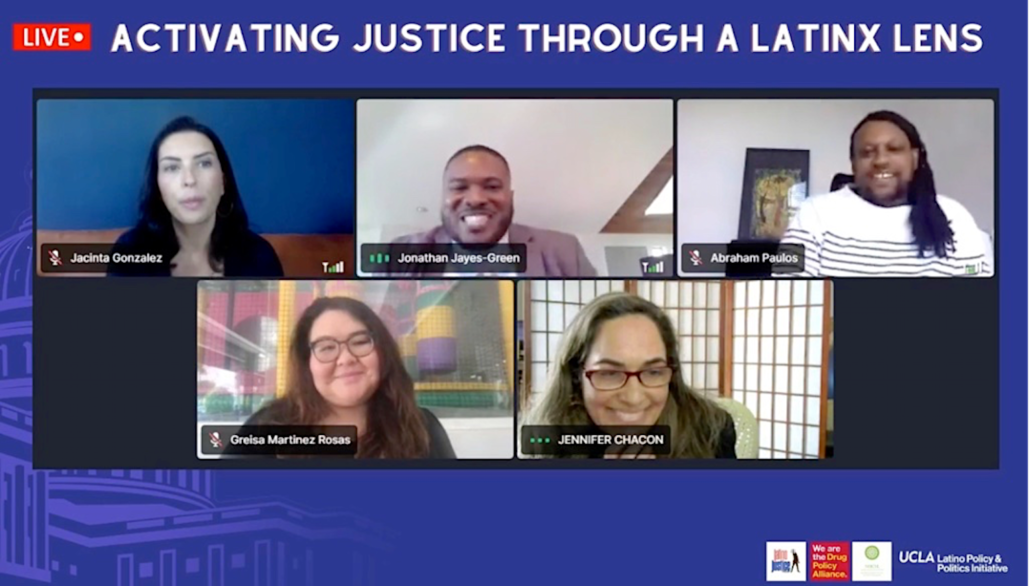
Activating Justice Through a 21st Century Latinx Lens UCLA co-hosts a dialogue featuring leading Latinx voices with the goal of sparking a full transformation of the criminal legal system 

May 21, 2021/0 Comments/in For Faculty, For Policymakers, For Students, For Undergraduates, Politics, Public Policy, Public Policy News, School of Public Affairs Kelly Lytle Hernandez, Sonja Diaz /by Mary Braswell

By Kacey Bonner

What would our criminal legal system look like if it was truly designed to reduce harm, advance public safety and end America’s legacy as the world’s leading incarcerator?

That was the question on everyone’s mind as leading Latinx elected officials, advocates, academics and media personalities convened to grapple with the issue of criminal justice — a topic of intense national debate.

Hosted by the UCLA Latino Policy and Politics Initiative (LPPI), LatinoJustice PRLDEF, the Drug Policy Alliance and the National Hispanic Caucus of State Legislators, the May 13-14 convening “Advancing Criminal Justice Reform Through a 21st Century Latinx Lens” had several goals: creating greater visibility of Latinos within the justice reform movement; identifying opportunities to build solidarity with other communities most impacted by the criminal legal system; and advancing transformative policy focused on justice rather than punishment.

“For too long, Latinos have been left out of the criminal justice conversation, even though we are the second most negatively impacted group by numbers behind Black people when it comes to our criminal legal systems,” said Sonja Diaz, founding director of the Latino Policy and Politics Initiative.

With conversations led by faculty experts such as UCLA Law Professor Jennifer Chacón, over 1,000 participants tuned in to hear from a multiracial cadre of 40 speakers covering topics including ending youth incarceration, defunding the police, and the intersection of the criminal legal and immigration systems – all through a Latinx lens.

Speakers including journalist Maria Hinojosa and author Julissa Arce led lively discussions about the opportunity to create more truthful and inclusive narratives in the criminal justice space and develop tailored solutions that address the underlying structural and systemic deficiencies that drive people to engage in harmful acts.

“It was so exciting to see this come together with so many brilliant people who were able to bring fresh perspective on the issue, the challenges and opportunities before us and how we can work in solidarity across race and experience to achieve common goals that make our communities safer and healthier,” said LPPI fellow Paula Nazario, one of the lead organizers of the convening. A UCLA graduate, Nazario is now pursuing her master of public policy at UCLA Luskin.

The event’s opening plenary session included Kelly Lytle-Hernández, a professor of history, African American studies and urban planning at UCLA. Lytle-Hernández gave attendees key insight into the impacts of the criminal legal system on Latinos, the structural racism propping up the system of incarceration and how the criminalization of immigrants is working to expand systems of mass incarceration.

Breakout sessions then enabled attendees to think about how they can demand better data that creates a clearer picture of the challenges and opportunities ahead and how Latino-facing organizations — both within and outside the justice reform space — can work together to create broad change.

Throughout the convening, conversation returned to the immense data and knowledge gap that obscures the true impact of the criminal legal system on Latinx individuals, families and communities. If this gap persists, there is a risk of creating solutions that fail to address challenges unique to Latinos who are systems-impacted and perpetuating inequities that exist in our current criminal legal system.

A conversation with Juan Cartagena, president and general counsel of Latino Justice PRLDEF, closed the two-day meeting. Cartagena said that, while the U.S. criminal legal system hasn’t changed much in the past five decades, it is on the precipice of big change — change made possible by communities that see an unprecedented opportunity to fundamentally transform systems of justice.

“We cannot lose sight of the fact that there have been amazing opportunities for organizing people around truth, and for having that truth talk to power,” Cartagena said.

“I think we’re stronger than ever to actually have conversations about dismantling systems, about what it means to invest in our communities in different ways and to think outside of every box at every corner so we can get things done.”


Latino USA’s Maria Hinojosa moderates the opening plenary session with podcast host David Luis “Suave” Gonzalez, author Julissa Arce, District Court Judge Natalia Cornelio and UCLA Professor Kelly Lytle-Hernández.

Jonathan Jayes-Greene of the Marguerite Casey Foundation moderates a “crimmigration” panel featuring Jacinta Gonzalez of Mijente, Abraham Paulos of Black Alliance for Just Immigration, UCLA Professor Jennifer M. Chacón and Greisa Martinez Rosas of United We Dream.


Now or Never for Immigration Reform? Congressman from Texas opens LPPI webinar by expressing optimism that progress can be achieved with Democrats in power in Washington — if they act quickly

May 6, 2021/0 Comments/in Diversity, For Faculty, For Policymakers, For Students, For Undergraduates, Latinos, Politics, Public Policy, Public Policy News, School of Public Affairs, Social Welfare, Social Welfare News, Urban Planning /by Les Dunseith

By Kassandra Hernandez and Les Dunseith

U.S. Rep. Joaquin Castro of Texas sees Democrats in power in Washington, D.C., and thinks the time may finally have arrived for comprehensive reform of U.S. immigration policy.

“It’s not very often that Democrats have control of the presidency and both chambers of the Congress,” Castro said during a May 4 webinar hosted by the UCLA Latino Policy and Politics Initiative. “There’s a real opportunity here to pass comprehensive immigration reform and put 11 million undocumented folks — many of whom are ‘Dreamers’ or others, like their parents, who have been here for generations — on a path to citizenship.”

Castro, who introduced one of four immigration-related bills currently making their way through the political process in Washington, knows it won’t be easy, given the narrow Democratic majorities in both houses and longstanding GOP opposition to immigration reform that includes citizenship. Still, waiting too long could doom the effort.

As the 2022 midterm elections draw closer, elected officials will become “very cautious about the votes that they take,” Castro noted. “So, there’s got to be a lot of momentum and a big push to get immigration reform done this year.”

Castro’s comments came during a 10-minute live interview with webinar moderator Russell Contreras, a justice and race reporter at Axios, that set the tone for a panel discussion with scholars and political experts focusing on the challenges and opportunities for U.S. immigration reform.

During the interview, Castro spoke about why immigration policy reform is so important to him. He represents a district in the San Antonio area that is home to many Mexican Americans like himself.

“In our community, there’s an incredible sense of fairness, there’s obviously an incredible sense of family,” said Castro, whose mother is a renowned community activist and whose twin brother is former presidential candidate Julian Castro.

“There is a permanent class of conservative politicians … who want to use the immigration issue as a way to scare Americans and make them think that there is a lot of brown people who are going to come into the country and harm them,” Castro said. “But you see Mexican American communities being very favorable toward giving immigrants a path to citizenship because they understand that experience. To them, [an immigrant] was their parent or their grandparent. So, when they hear all of the fear-mongering, most of the time, they don’t buy into that.”

Castro said he hopes an umbrella bill that includes comprehensive immigration reform can be passed during this session of Congress, although it has not yet come to a vote. He noted that two other immigration bills have already made it through the House, however, and he urged the U.S. Senate to move forward with that legislation.

Cecilia Menjívar, a professor of sociology at UCLA who is an expert on immigration issues, argued that such piecemeal reform probably has a greater chance of success. Although the current social and political environment is unlike any in recent history, she said systemic barriers are likely to continue to impede sweeping immigration reform efforts.

Joining Menjívar on the virtual panel were Angélica Salas, executive director of the Coalition for Humane Immigrant Rights, Los Angeles (CHIRLA), and Andrew Selee, president of the Migration Policy Institute. All the speakers agreed that the national stance must recognize the complexities of the issue beyond border security and militarization.

Immigration reform is deeply interconnected with labor rights, access to education, health care and violence in other countries, they noted.

“You can legalize the people in the U.S., but if you don’t deal with the system that keeps us out and kicks us out, then you are not doing service to our community,” Salas said.

The so-called border crisis is actually a regional international policy problem, Selee said. “If you have lots of people coming in an irregular fashion, we need to rethink how we facilitate a legal path to immigration.”

Salas called for an urgent change in enforcement. “The detention system is a for-profit system,” she said. “Too many corporations [make] money off of the detention of our people.”

U.S. immigration policy also needs to account for the economic contributions made by the millions of undocumented workers throughout the country, Selee said.

Menjívar cautioned that immigrants should be recognized in a manner that avoids “reducing them to a dollar sign,” noting the many “social and cultural contributions [immigrants] have made to this country over decades.”

Selee pointed out that almost half of immigrants today have college degrees, representing potential talent that can help catalyze economic recovery in the wake of COVID-19.

“Unlock that potential, [and] it would fit in really well in a moment where we are trying to recover economically,” he said.

View a recording of the webinar


Unpaid Utility Bills Are Disproportionately Piling Up in L.A. Study shows 25-30% of Angelenos have unpaid energy and water bills, with debts unevenly impacting people of color

May 4, 2021/0 Comments/in Climate Change, Diversity, Environment, For Faculty, For Policymakers, For Students, For Undergraduates, Latinos, Public Policy, Public Policy News, Resources, School of Public Affairs, Smart Water Systems, Social Welfare, Social Welfare News, Urban Planning /by webteam

A new report authored by the UCLA Luskin Center for Innovation and Center for Neighborhood Knowledge measures the extent of utility debt accumulation among customers served by the Los Angeles Department of Water and Power. 

Disparities in unpaid bills predate COVID-19 but have deepened since the pandemic’s outbreak. Using data from a November 2020 California State Water Resources Control Board survey, the researchers found one-quarter to one-third of all Los Angeles households faced financial difficulties paying for their utilities. 

“We didn’t expect the magnitude to be this big,” said Silvia R. González, co-author of the study and a senior researcher at the Luskin Center for Innovation. “For many families, this means choosing between keeping their lights on or skipping meals or medical treatment.”

The debt burden is unevenly distributed across Los Angeles — 64% of the population in severely affected neighborhoods are Latino. Black communities also face disproportionate debt, and racial disparities persist even after accounting for socioeconomic characteristics. Further, the study found that lower-income neighborhoods, residents with limited English proficiency and renters face unequal debt burdens. 

Early on in the pandemic, Gov. Gavin Newsom suspended water and energy utility shut-offs, which has provided continued utility access for households in California. But accumulating debt has not been forgiven, and this crisis will need to be resolved once the suspension is lifted. 

Researchers said they hope to guide policymakers and utility operators in formulating targeted debt-relief programs, and calls for financial support from COVID-19-related aid to ensure that vulnerable Angelenos will still have access to water and energy after the pandemic.  

“We need an equitable relief plan,” González said. “These communities are already historically underserved areas and they’ve been left behind more broadly during the pandemic. These debts will be impossible for many families to repay.”

Jack Rothman’s ‘Delayed Harvest’: Poetry That Grasps People Emeritus professor of social welfare publishes a collection of poems to link readers to his nine decades

April 28, 2021/0 Comments/in For Faculty, For Students, School of Public Affairs, Social Welfare /by Stan Paul

By Stan Paul

Jack Rothman, professor emeritus of social welfare at UCLA Luskin, has written numerous books — more than 25 — during his long academic career, most of them on community organizing and multiculturalism.

Among those titles is a book on the film industry and a recent chronicle of his search for his ancestral home, a Jewish village, or shtetl, in Ukraine — a place that didn’t appear on any map at the time.

His most recent literary effort is a book of poetry published during the worldwide pandemic titled, “The Voice of Consciousness: Poems Composed After Ninety.” (Tebot Bach)

“My poems dig into the past, embrace the present, look to the future,” Rothman wrote in the book’s introduction. The book is organized into three sections: Musings, Family and Humor. Some of the poems deal with his long-term interests in social issues, such as peace, social justice, and inequality. Rothman describes his straightforward verse style as accessible, “like low-hanging fruit you can easily reach and digest.”

“Too much poetry nowadays,” he says, “is abstract and hard to fathom.”

The collection is the product of a poetry workshop that Rothman, now 94, started attending in his early 90s. A few poems in the collection were written before then, like “The 1%,” which was previously published in The Huffington Post. The rest, about 95%, he says, were written in the last few years.

Rothman, who garnered numerous awards and honors for his academic research, describes himself as “a proponent of social activism and a supporter of progressive causes.” He has written political opinion pieces over the years that appeared in publications including The Nation, Social Policy, The Humanist and the Los Angeles Times. But, he explained, “With time, I found that poetry became a tighter, more cogent way to express my thinking and feelings about what is important to me.”

The section Musings includes titles such as “Precious Consciousness,” “A Struggle for Language” and “Renewal,” where “Hundreds of students/Chant/Carrying posters/Demanding climate change action/Speaking hope amidst the waste.”

In Humor, Rothman takes a poke at the political with “Voting,” “America Ain’t Got No Social Classes” and even the former occupant of the White House in “The Donald.”

Rothman says as teacher he always liked telling stories and discusses the origins of his poetry in his latest book.

My poetry springs from the comic
I was born with a funny bone
Or was it many funny bones
I’ve merged humor and poetry

In fact, in his 70s, Rothman took up stand-up comedy, which resulted in gigs at local venues including The Comedy Store, The Improv and Pasadena’s Ice House.

His work wanders from mundane and daily observances to memories of his childhood in Depression-era America to hope for his grandson in the next generation. For example, Rothman, who grew up in New York, the son of Jewish immigrants from Eastern Europe, paints a portrait of an August day in 1935, remembering his father.

Pop, an immigrant,
Owns a candy store

Somewhat shabby and worn
On a Street corner in Queens…

Always a hard worker
The Great Wall Street Crash
Battered Pop’s life
In a double disaster
He lost his wife the same year
And I a toddler of two
Lost my mother…

In “Ode to My Miata,” Rothman uses the image of his prized silver sports car, which “remained streamlined and sporty/Ever youthful,” as he “sprouted signs of aging.” The well-cared-for car is passed on to his grandson, “who now navigates the Miata/with the care and love/That I had bestowed upon it.”

Leaning on my cane
I see a glint on the horizon
An auto and a young man
Flowing along the Southern California Sunset

And lastly, a simple object gives voice to consciousness for Rothman. In “The Yellow Pencil,” he concludes:

“My Yellow pencil may be worn out
The eraser a stump
Just give us a little more time
And we’ll compose
A lasting anniversary rhyme
For my wife”

The book is dedicated to his wife, Judy, “Companion and Helpmate Extraordinary.”

As for the future, Rothman says, along with his other interests, he’ll keep writing poetry.

Traffic on the 405 Can Be Awful, but Let’s Get Real ‘The idea that someone would take this seriously is, well, alarming,’ says UCLA Professor Brian Taylor

April 23, 2021/0 Comments/in School of Public Affairs, Transportation, Urban Planning Brian D. Taylor /by Les Dunseith

By Les Dunseith

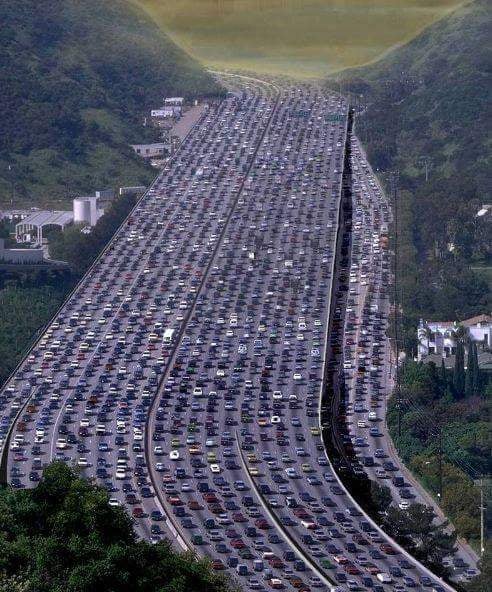
Anyone who has driven through the Sepulveda Pass during rush hour knows that traffic on Interstate 405 can be a nightmare. Still, it’s not as bad as it was made to seem in an altered photo that’s making the rounds on Facebook.

The image shows 19 (!) lanes of bumper-to-bumper traffic snaking along the freeway just north of the Getty Center, about 3 miles from the UCLA campus. And when an Associated Press reporter decided to fact-check the photo, she turned to Professor Brian Taylor, director of the UCLA Institute of Transportation Studies. 

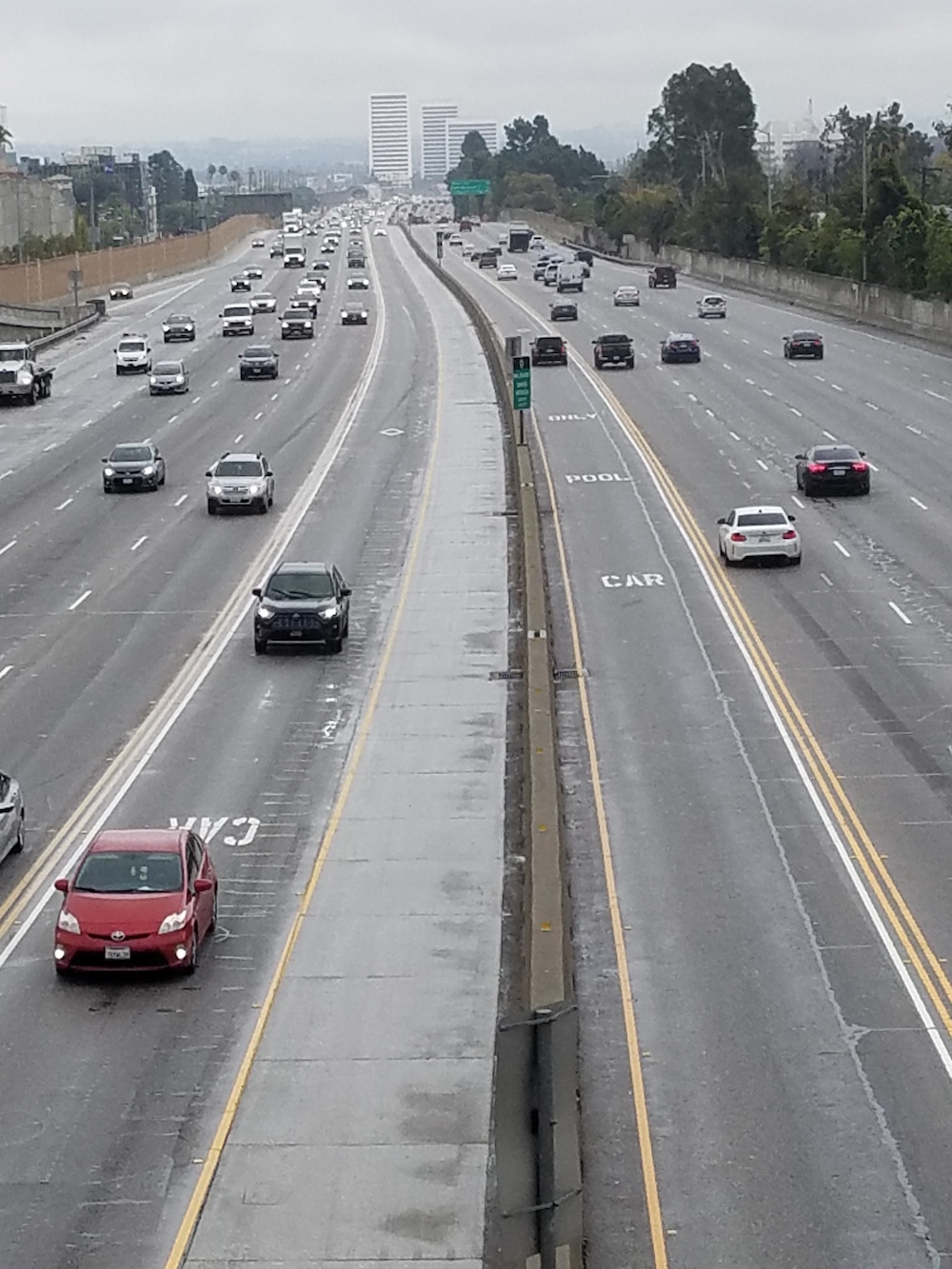
Not only did Taylor have the insight necessary to debunk the altered photo, but he even had a recent picture of the real 405 to prove it. 

Here’s the fake picture:

And here’s the photo by Taylor, taken in approximately the same location (although looking southbound, the opposite direction), which offers proof that there are not 19 lanes in that stretch of freeway, but 12 — including carpool lanes in each direction that were added in 2011 and 2012 during the infamous “Carmageddon” project.

A photo of the 405 taken in March by UCLA Institute of Transportation Studies Director Brian Taylor because, he says, “who wouldn’t go around taking pictures of freeways?”

In its story about the picture, the AP provides a link to the original photograph that had been doctored to produce the viral fake, saying it appears to have been captured in 1998. It shows five lanes of traffic in each direction, with far fewer cars.

Taylor, a professor of urban planning and public policy at the UCLA Luskin School of Public Affairs, wrote to the AP reporter that the false image “has been bouncing around for years.” 

“It’s a bit of obvious hyperbole to (I assume) make a point about continually widening freeways to address growing traffic levels,” Taylor wrote. “The idea that someone would take this seriously is, well, alarming.”

Thanks to the AP and Taylor, Facebook has now added a notification that the photo has been altered.

Decarbonizing California Transportation by 2045 Report to state outlines policy pathways to meet the zero-carbon time crunch

April 21, 2021/0 Comments/in Business and the Environment, Climate Change, Development and Housing, Electric Vehicles and Alternative Fuels, Environment, For Faculty, For Policymakers, For Students, For Undergraduates, Luskin Center, Public Policy, Public Policy News, School of Public Affairs, Transportation, Urban Planning J.R. DeShazo /by Les Dunseith

Transportation is the largest source of greenhouse gas emissions in California. In order to achieve the state’s goals of carbon neutrality by 2045 and avoid the worst impacts of climate change, decarbonizing this sector is essential. But such a transition is unlikely to occur rapidly without key policy intervention, according to a new study that included research from the UCLA Luskin Center for Innovation.

A team of transportation and policy experts from the University of California released a report April 21 to the California Environmental Protection Agency (CalEPA) outlining policy options to significantly reduce transportation-related fossil fuel demand and emissions. Those policy options, when combined, could lead to a zero-carbon transportation system by 2045, while also improving equity, health and the economy. A second study, led by UC Santa Barbara, identifying strategies to reduce in-state petroleum production in parallel with reductions in demand, was released simultaneously.

The state funded the two studies through the 2019 Budget Act. The studies are designed to identify paths to slash transportation-related fossil fuel demand and emissions while also managing a strategic, responsible decline in transportation-related fossil fuel supply.

The University of California demand study was conducted by researchers from the UC Institute of Transportation Studies, a network with branches at UC Davis, UC Berkeley, UC Irvine, and UCLA. The UC Davis Policy Institute for Energy, Environment, and the Economy coordinated the report’s policy management, and the UC Davis Center for Regional Change led the study’s equity and environmental justice research.

Bringing about a zero-carbon transportation future will be challenging but not impossible, the report states. Doing so requires urgent actions and a long-term perspective. Importantly, a major upfront investment in clean transportation through incentives and new charging and hydrogen infrastructure will soon pay off in net economic savings to the California economy, with net savings in the next decade growing to tens of billions of dollars per year by 2045.

The report recommends flexible policy approaches that can be adjusted over time as technologies evolve and more knowledge is gained.

“This report is the first to comprehensively evaluate a path to a carbon neutral transportation system for California by 2045,” said Dan Sperling, director of the UC Davis Institute of Transportation Studies. “We find that such pathways are possible but will rely on extensive changes to existing policies as well as introduction of some new policies. The study also prioritizes equity, health and workforce impacts of the transition to zero-carbon transportation.”

Researchers from the UCLA Luskin Center for Innovation led the study’s workforce analysis. Achieving carbon neutrality in California’s transportation sector could create over 7.3 million job-years of employment over the next 25 years, according to the researchers. These jobs would result from “greening” many existing occupations and creating new occupations.

“This presents the state with a golden opportunity to create not only new, high-quality jobs, but also ensure that many existing industries and occupations transition to better practices,” said J.R. DeShazo, director of the Luskin Center for Innovation and professor of public policy.

KEY POLICY STRATEGIES

 Zero emission vehicles: Many of the report’s policy options are centered on a rapid transition to zero-emission vehicles (ZEVs), which is expected to dramatically reduce greenhouse gas emissions and improve local air pollution as the state’s electric grid is also decarbonized.

Light-duty and heavy-duty vehicles are responsible for 70% and 20% of the state’s transportation emissions, respectively. The report suggests a combination of enhanced mandates, incentives, and public charging and hydrogen infrastructure investments to speed the adoption of ZEVs. For medium and heavy-duty vehicles, key policy priorities include increasing the availability of charging stations for long-haul freights, electricity pricing reform to make depot charging more affordable, and priority lanes and curb access for zero-emission trucks, among other possibilities.

Vehicle miles traveled: Even with widespread ZEV use, reducing overall vehicle miles traveled is necessary to reduce traffic congestion and emissions from vehicle manufacturing, and to enhance quality-of-life and land-use benefits related to traffic. The report suggests policies that encourage active, shared and micromobility transportation, telecommuting, and land-use changes that reduce people’s reliance on automobiles and enhance community connectivity.

Fuels: About 86% of transportation fuel is petroleum. Shifting toward low-carbon clean energy requires major investments in electricity and hydrogen. Low-carbon liquid fuels compatible with internal combustion engines will be needed to reduce emissions while the transition to ZEVs progresses, as well as in some specialized applications, like aviation. California can support the needed investments in clean fuels with mandated blending levels, new incentives and credits to stimulate investment in very low-carbon liquid fuels for aviation, shipping and legacy combustion engine vehicles.

Getting to zero: Some residual emissions remain in every scenario examined. The report states that at least 4 million to 5 million metric tons per year of negative emissions capacity (equal to 2.5% of current transportation emissions) is needed by 2045 to counteract those residual emissions. These could come from carbon capture and sequestration projects that pull carbon from the air to store it underground, as well as so-called sequestration by natural or working lands.

BENEFITS

In addition to direct economic benefits beginning around 2030, the transportation decarbonization policies could also lead to health, equity and environmental justice, and workforce and labor benefits.

Health: Transportation is a major cause of local air pollution and contributes to climate change. Particulate matter harms lungs and hearts, while nitrogen oxide compounds contribute to ozone pollution and other health impacts. The report found that cleaner heavy-duty vehicles would significantly reduce pollution in many of the state’s most vulnerable communities. The health benefits of reducing local pollution will grow with the deployment of clean transportation technologies and could translate to more than $25 billion in savings in 2045.

Equity and environmental justice: Transportation in California carries a legacy of inequity and damage to disadvantaged communities. These communities often lack quality public transportation or viable transportation choices. Highways have been built with little consideration for displacement, and many communities of color have been divided by freeways, perpetuating historic segregation policies like redlining. The report identifies options that prioritize equity in transportation investments and policies.

For example:

  • Continue to support electric vehicle incentives targeted to lower-income buyers and underserved communities, including used vehicles.
  • Prioritize deploying electric heavy-duty vehicles in disadvantaged communities and magnet facilities such as commercial warehouses in those communities.
  • Support transit and zero-emission services and charging stations in disadvantaged communities. This can help reduce vehicle miles traveled and increase accessibility while avoiding displacement.
  • Avoid siting non-renewable fuel production facilities in disadvantaged communities, engage communities disproportionately affected by transportation sector emissions in decision-making concerning the siting of new infrastructure and investments associated with achieving carbon neutrality, and continue to carefully monitor and control local pollutants.

“We must confront the legacy of the lack of public and private investment where Black, indigenous and people of color live and work,” said Bernadette Austin, acting director of the UC Davis Center for Regional Change. “This report identifies ways to strategically invest in sustainable infrastructure while intentionally avoiding disruptive and damaging infrastructure in our most vulnerable and disadvantaged communities.”

Workforce: The transition to a carbon-neutral transportation system will disrupt jobs in some sectors while creating new jobs in others, like clean vehicle manufacturing and electric and hydrogen fueling infrastructure. The report suggests that California prioritize the needs of impacted workers. In addition, wherever ZEV-related industry expansion creates quality jobs, state policy should focus on creating broadly accessible career pathways.

Economy: The transition to ZEVs is expected to generate savings for consumers and the economy well before 2045. Within the next decade, the cost of owning and operating ZEVs is projected to drop below that of a conventional gasoline or diesel vehicle. That is because battery, fuel cell and hydrogen costs will continue to decline; electricity costs will be much less than petroleum fuel costs; and maintenance costs of ZEVs will be less. These savings can be invested elsewhere by households and businesses.

For further information about this report, contact Samuel Chiu or Kat Kerlin at UC Davis.

UCLA Team Wins $7.5 Million NRG COSIA Carbon XPRIZE Researchers developed technology for turning carbon dioxide into concrete

April 19, 2021/0 Comments/in Climate Change, Environment, For Faculty, For Policymakers, For Students, For Undergraduates, Public Policy, Public Policy News, School of Public Affairs, Urban Planning J.R. DeShazo /by Mary Braswell
By Christine Wei-li Lee

A group of UCLA engineers has become the first university team to win the grand prize in the NRG COSIA Carbon XPRIZE global competition. By mitigating the carbon footprint of concrete, the team’s invention could eventually be a major step in the global battle against climate change.

The UCLA CarbonBuilt team, led by Gaurav Sant, a professor of civil and environmental engineering at the UCLA Samueli School of Engineering, won $7.5 million in the competition’s track for technologies related to coal-fired power generation.

The winning technology is a first-of-its-kind, eco-friendly approach for taking carbon dioxide emissions directly from power plants and other industrial facilities — emissions that would otherwise go into the atmosphere — and infusing them into a new type of concrete invented by the team. As it hardens and gains strength, the specially formulated concrete permanently absorbs and traps the greenhouse gas.

Through extensive research at UCLA and testing at the Integrated Test Center, a facility outside of Gillette, Wyoming, the researchers demonstrated that their process reduced the carbon footprint of concrete by more than 50% while producing concrete that was just as strong and durable as the traditional material.

Each CarbonBuilt concrete block stores about three-quarters of a pound of carbon dioxide — a significant amount considering an estimated 1 trillion concrete blocks will be produced annually by the year 2027.

Sant joined the UCLA faculty in 2010. He and a group of staff scientists, postdoctoral scholars and doctoral students began the research that led to the award in 2014. A team from the UCLA Luskin Center for Innovation, led by Director JR DeShazo, supported the venture with public policy and economic guidance.

“Congratulations to the UCLA team and especially Gaurav for this significant achievement,” DeShazo said.

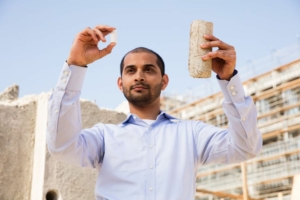
Gaurav Sant, a professor of civil and environmental engineering who leads the UCLA team, holds samples of the concrete produced using the eco-friendly technology.

Sant directs the UCLA Institute for Carbon Management and also holds a faculty appointment in the UCLA Engineering materials science and engineering department.

“As a third-generation civil engineer, I have been fascinated with the role that construction has played in solving societal challenges,” he said. “To have spent the past decade developing a solution to mitigate the carbon footprint of concrete with a phenomenal team, and to have won the NRG COSIA Carbon XPRIZE doing something I’m passionate about, is an ultimate dream come true.”

Sponsored by NRG Energy and Canada’s Oil Sands Innovation Alliance, the $20 million NRG COSIA Carbon XPRIZE competition was launched in September 2015 to find ways to beneficially use carbon dioxide emissions. The nonprofit XPRIZE Foundation challenged a global community of problem-solvers to develop technologies for turning carbon dioxide from coal and natural gas power plant emissions into valuable products. A Canadian team called CarbonCure won the competition’s other track, for natural gas-based power generation.

UCLA’s entry was one of 47 submissions from 38 teams in seven countries. CarbonBuilt, formerly known as CO2Concrete, was named one of the 10 finalists in October 2017.

Sant said the original inspiration for the winning technology came from an unlikely source: seashells.

“Seashells are made of calcium carbonate, which is nature’s original cementation agent,” he said. “We were really motivated by the idea of how seashells were held together. And that’s how we really set about to turn carbon dioxide into concrete.”

Challenged by experts in academia and industry who said it couldn’t be done, Sant and his team spent the next seven years on a mission to prove them wrong.

First, the UCLA researchers developed a new formula for cement, which is the binding agent in concrete. They used hydrated lime, or portlandite, which can absorb carbon dioxide quickly, to replace traditional calcium silicate cement, known as ordinary portland cement. Then, the team created a method in which carbon dioxide taken directly from flue gas is quickly absorbed by portlandite as the concrete hardens.

In addition to absorbing carbon dioxide into the concrete, CarbonBuilt’s Reversa process reduces the amount of ordinary portland cement needed to produce concrete by between 60% and 90%. The process also occurs at ordinary temperatures and pressures. As a result, CarbonBuilt concrete has a much smaller carbon footprint than conventional concrete. That could go a long way toward reducing the world’s greenhouse gas output, since the production of traditional cement used in concrete is the cause of nearly 9% of the world’s carbon dioxide emissions.

Another compelling advantage of the new technology is that it is cost-effective. Unlike other carbon-mitigation technologies that require an expensive setup to capture the carbon dioxide emissions or purify them, the CarbonBuilt process allows for carbon dioxide in power and industrial plants’ flue gas to be utilized directly and converted at its source without those extra steps.

“It’s a transformative, eureka moment for UCLA and for science and engineering,” said Jayathi Murthy, the Ronald and Valerie Sugar Dean of UCLA Engineering. “Through sheer tenacity and determination, Gaurav and his team were able to turn a research project into an innovative technology that can solve a real societal problem and drive positive change in the world.”

To advance to the finals, the UCLA researchers demonstrated that their technology could consume 135 kilograms (about 297 pounds) of carbon dioxide in 24 hours. In 2017, the team had to meet certain technical requirements, subject to verification by an independent firm. Those results were then evaluated by a panel of expert judges from academia and industry who assessed the amount of carbon dioxide that was converted into CarbonBuilt concrete, as well as the engineering, environmental and economic value of the construction material.

Originally scheduled for February 2020, the competition’s final round was postponed due to the COVID-19 pandemic. In June 2020, the UCLA team deployed to the Integrated Test Center to demonstrate its system on an industrial scale. The demonstration ran for four months and produced nearly 150 metric tons (more than 330,000 pounds) of CarbonBuilt concrete blocks. Some of the concrete blocks were donated to the Eastern Shoshone tribe for housing projects on the Wind River Reservation in Fort Washakie, Wyoming.

The funds from the NRG COSIA Carbon XPRIZE award will support innovative carbon-mitigation research and technology development at UCLA Engineering. CarbonBuilt, which is a private company founded by Sant, has secured rights related to the project’s patent portfolio owned by UCLA to commercialize the technology.

Prior to winning the grand prize, the team has raised $10 million toward the development of the CarbonBuilt technology. In addition to a $500,000 award from the XPRIZE Foundation in 2018 for reaching the finals, Sant secured a $1.8 million grant in 2019 from the Department of Energy. (Additional testing to complete the DOE grant recently concluded at the National Carbon Capture Center in Wilsonville, Alabama.) And the Anthony and Jeanne Pritzker Family Foundation contributed $1.5 million in 2017.

Many UCLA faculty members have contributed to the team’s success, including Center for Innovation Director DeShazo, a professor of public policy and of civil and environmental engineering; Dante Simonetti, an assistant professor of chemical and biomolecular engineering; Laurent Pilon, professor of mechanical and aerospace engineering and of bioengineering; Richard Kaner, a distinguished professor of chemistry and biochemistry and of materials science and engineering; and Mathieu Bauchy, an associate professor of civil and environmental engineering.

Additional team members include current and former UCLA Engineering project scientists Dale Prentice, Gabriel Falzone, Iman Mehdipour and Bu Wang; Hyukmin Kweon, a former UCLA postdoctoral scholar; Zhenhua Wei, a former doctoral student in civil and environmental engineering; Camly Tran, executive director of the Institute for Carbon Management; and seasoned industry advisers including Edward Muller, Stephen Raab and CarbonBuilt CEO Rahul Shendure.

Serious Impacts of Coronavirus Felt Broadly Across Los Angeles County UCLA Luskin survey details effect of falling incomes, COVID-19 health issues and pandemic-related restrictions on Angelenos’ quality of life

April 19, 2021/0 Comments/in Development and Housing, Digital Technologies, Diversity, Education, Environment, For Faculty, For Policymakers, For Students, For Undergraduates, Health Care, Latinos, Politics, Public Policy, Public Policy News, Research Projects, School of Public Affairs, Social Welfare, Social Welfare News, Social Welfare PhD, The Lewis Center, Urban Planning Zev Yaroslavsky /by Les Dunseith

By Les Dunseith

Residents of Los Angeles County have been deeply affected by the COVID-19 crisis, with significant numbers citing the pandemic’s adverse impact on their finances, health and children’s education, according to UCLA’s sixth annual Quality of Life Index.

“A year ago we speculated about how resilient our region would be in the year to follow,” said Zev Yaroslavsky, director of the Los Angeles Initiative at the UCLA Luskin School of Public Affairs, who oversees the index. “We now know that Los Angeles County has demonstrated robust resilience, but a significant toll has been exacted on our residents by the tumultuous events. Many of our residents — especially younger ones — are anxious, angry and steadily losing hope about their future in Los Angeles.”

This year’s Quality of Life Index, or QLI, was based on interviews with 1,434 county residents over a 20-day period beginning on March 3, just as vaccinations were beginning to fuel optimism about a possible return to more normal life. Last year’s survey, conducted in the earliest stages of the pandemic, found high levels of anxiety about the possible impacts of COVID-19. Twelve months later, respondents said many of those fears had come to pass:

  • More than half of those surveyed (54%) reported that they or a close family member or friend had tested positive for the coronavirus.
  • Forty percent said their income went down because of the pandemic, with 22% saying it dropped “a lot” and 18% reporting “some” decline. Roughly 1 in 5 (18%) said they had lost their job at some point during the COVID-19 crisis.
  • Three-quarters of parents (76%) with school-age children felt their kids had been “substantially hurt, either academically or socially,” by pandemic-related distance learning and quarantine experiences.

In addition, nearly a fifth (17%) of all respondents reported that their income declined “a lot” in the past year and that they also suffered at least two specific negative impacts, such as a job loss, a wage or salary reduction, a decline in work hours or difficulty paying their rent or mortgage. This group was disproportionately composed of women under age 50, single people, renters, those without college degrees and those with household incomes of less than $60,000.

“These are among the most vulnerable individuals living in our county,” Yaroslavsky said.

The QLI, a joint project of the UCLA Luskin Los Angeles Initiative and The California Endowment with major funding provided by Meyer and Renee Luskin, asks a cross-section of Los Angeles County residents each year to rate their quality of life in nine categories and 40 subcategories. Full results of this year’s survey were made available April 19 as part of UCLA’s Luskin Summit, which is taking place virtually.

Mirroring last year’s result, this year’s overall quality-of-life rating held steady at 58 (on a scale of 10 to 100), which is slightly more positive than negative. But researchers noted that marked changes emerged among specific racial and ethnic groups, especially with younger residents.

Younger Angelenos: Sinking optimism, tempered by race

Reflecting a trend seen in recent QLI surveys, the county’s younger population — those between the ages of 18 and 49 — rated their quality of life lower than older residents, and the pandemic seems to have exacerbated that disparity.

“The varied manifestations of COVID-19,” Yaroslavsky said, “fell most heavily on the shoulders of younger county residents.”

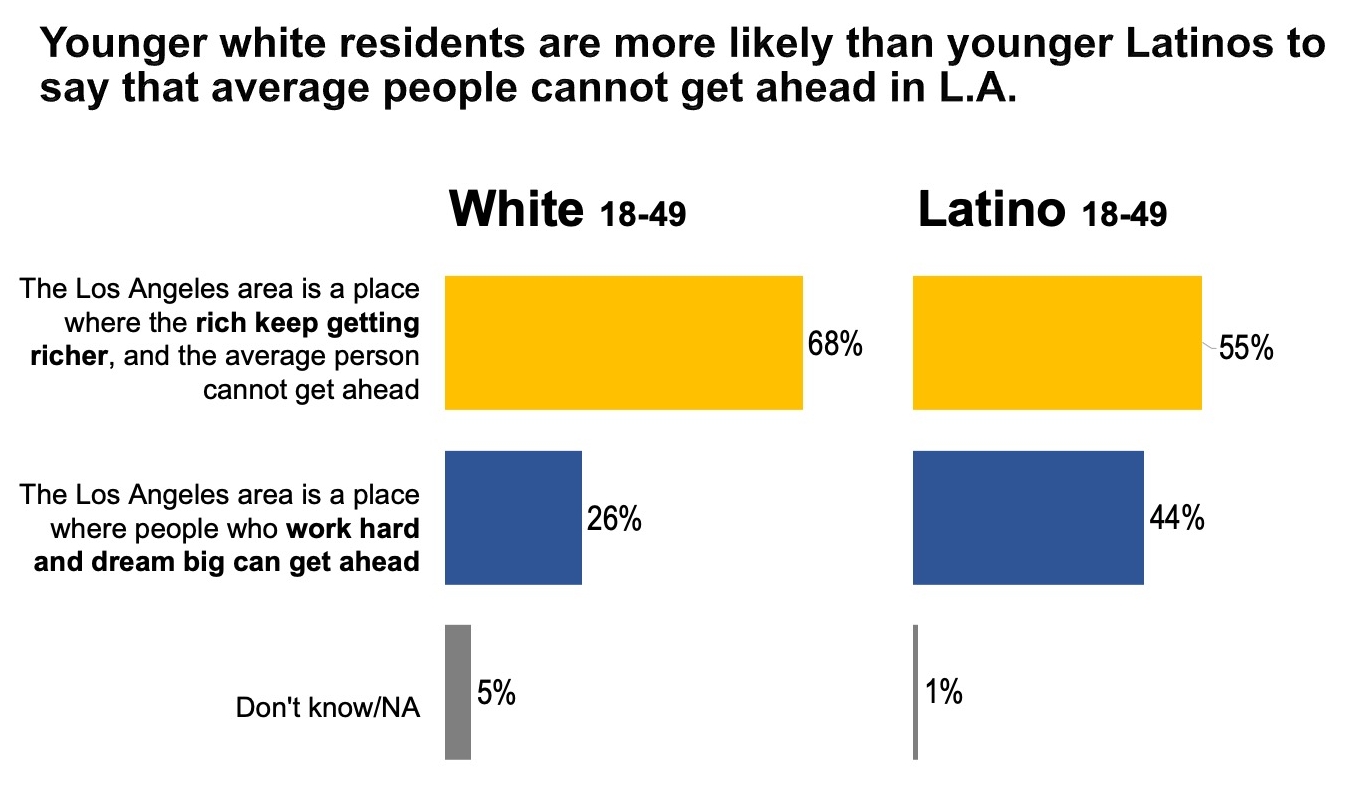
In particular, researchers observed a growing belief by younger Angelenos that the cost of living in the region is threatening their ability to make ends meet, get ahead or gain some sort of financial security.Yet even among this demographic, the survey revealed a distinct divergence in views between Latinos and whites, the two largest racial/ethnic groups in the county. While they have faced demonstrably harder challenges in the region, Latino residents overall were more positive about their quality of life than whites — and this was particularly pronounced among younger residents.

“Repeatedly, younger Latinos are more positive about their own conditions and express greater approval and positivity toward the variety of public officials and governmental entities that affect their lives,” said Paul Maslin, a public opinion and polling expert with Fairbank, Maslin, Maullin, Metz & Associates (FM3 Research) who has overseen the QLI survey process since 2016. “Among younger white residents in Los Angeles County, a greater sense of frustration and even bitterness is apparent.”

The survey uncovered a number of noteworthy differences in these two groups’ views of the pandemic, public officials and the opportunities available in the region:

  • Younger white residents were evenly split over whether the handling of the pandemic had been fair or unfair to “people like them” (48% vs. 49%), whereas younger Latinos reported that it had been fair to them by a 2-to-1 margin (65% vs. 33%).
  • About two-thirds (68%) of younger whites believe the Los Angeles area is a place where the rich get richer and the average person can’t get ahead, compared with only 55% of younger Latinos.
  • Younger Latinos had more favorable views of Los Angeles Mayor Eric Garcetti (57%) and Gov. Gavin Newsom (53%) than younger whites, 57% of whom had unfavorable views of Garcetti and 62% unfavorable views of Newsom.
  • Younger white residents rated the response to the pandemic — across all levels of government — much more harshly than younger Latinos. Only about a third of whites approved of the response of federal, state and county governments and local school districts. Latinos’ ratings of approval were at least 20 points higher for every level of government and for local school districts.
  • However, in terms of paying their rent, more younger Latinos (43%) reported falling behind than did young whites (31%).

The 2021 QLI: Resilience and change

While this year’s quality-of-life rating remained at 58 overall, reflecting a remarkable resilience among county residents, several significant shifts within the nine major categories that make up the survey tell a different story.

This was most noticeable in the education category, where the satisfaction rating of respondents with children in public schools dropped from 58 last year to 52 this year, one of the most dramatic one-year declines in any category in the QLI’s history.

Satisfaction ratings for public safety also fell over the past year, from 64 to 60, influenced significantly by a growing concern over violent crime. And respondents’ rating of the quality of their neighborhoods dropped from 71 to 68.

On the other hand, satisfaction with transportation and traffic rose from 53 to 56, which researchers attribute to a significant reduction in commuter traffic caused by pandemic-related workplace shutdowns.

With regard to the workplace, 57% of employed respondents said they currently work from home or split time between home and their place of work. As to the future, 77% said they would prefer a mix of working from home and their workplace when the pandemic ends, with just 16% wanting to “almost always work at home.”

The 2021 UCLA Luskin Quality of Life Index is based on interviews with a random sample of residents conducted in both English and Spanish, with a margin of error of plus or minus 2.6%. The QLI was prepared in partnership with the public opinion research firm Fairbank, Maslin, Maullin, Metz & Associates (FM3 Research).  The full reports for 2021 and previous years are posted online by the UCLA Lewis Center for Regional Policy Studies.

In Memoriam: Martin Wachs, Renowned Transportation Scholar The prolific author and educational leader was an award-winning teacher and caring mentor to generations of urban planners

April 13, 2021/0 Comments/in Alumni, School of Public Affairs, Urban Planning /by Les Dunseith

By Stan Paul

Martin Wachs, distinguished professor of urban planning at the UCLA Luskin School of Public Affairs, died unexpectedly April 12 at his home in Los Angeles. He was 79.

“Marty Wachs was mentor to an entire generation of urban planners and urban planning scholars and a cherished friend of many of the Luskin faculty,” wrote Dean Gary Segura in a memo about Wachs’ passing to the Luskin School community.

Throughout his five decades of service to the University of California — which included teaching and serving in top research and leadership posts at both UCLA and UC Berkeley — Wachs earned a reputation as a world-class scholar and expert in the field of transportation planning. He garnered numerous accolades and academic awards.

Wachs was a prolific author, writing and collaborating on more than 160 articles and four books on relationships between transportation, land use and air quality, and the use of performance measurement in transportation planning. He also was interested in many related aspects and social issues, including professional ethics, aging, the environment and finance.

He came to UCLA in 1971 as an associate professor in a newly founded Graduate School of Architecture and Urban Planning, and Wachs was widely known as an outstanding teacher and caring mentor. In the wake of his death, numerous colleagues, former students and friends have shared memories and tributes that will be collected on a page of remembrances over the coming weeks.

Among one generation of planners influenced directly by Wachs is Brian Taylor, who studied under Wachs as an urban planning doctoral student at UCLA Luskin.

“The number of students who studied under Marty is legion,” said Taylor, professor of public policy and urban planning at the Luskin School and director of the Institute of Transportation Studies, which was founded by Wachs. “It’s just a veritable who’s who in the area of transportation policy and planning.”

Wachs’ dedication to students and colleagues included supporting their work and aspirations before, during and long after their studies.

“He was a mentor to people who did and did not study with him,” Taylor recalled. “He’s the person that we went to … late in our careers for advice about things.”

“He clearly enjoyed the role of teacher,” said Chris Tilly, professor and current chair of urban planning at UCLA. “I can’t think of how many times I walked past his office and heard him listen carefully, then offer thoughtful advice to a student, whether an undergrad, a [master’s of urban and regional planning], or a Ph.D. student — not your typical emeritus.” 

Tilly also described Wachs as an “influential person who built institutions, organized things and people, and made change. He did much to build our department. We have all lost someone who greatly enriched our lives.”

Anastasia Loukaitou-Sideris, distinguished professor of urban planning and the former chair of urban planning, said, “Marty was a giant in the field of transportation, someone who early on set the stage for the advancement of transportation planning and policy and who kept contributing to it till now.” She added, “For me, Marty was also an inspiring mentor and role model, a trusted friend, and a wonderful colleague and collaborator. I will miss him dearly.”

At the time of his death, Wachs was collaborating and consulting with colleagues on research, working on papers, actively mentoring students and looking forward to attending a socially distanced game of his beloved L.A. Dodgers, said Taylor, noting that Wachs was also a longtime UCLA basketball season ticketholder.

Taylor described Wachs as a first-class scholar, an exemplary teacher and a caring person. “He was an extraordinarily kind and generous person. … That’s just who he was. He was a true mensch.”

Wachs was deeply committed to public service and over his career served on advisory boards and commissions at the local, state and national levels, including the South Coast Air Quality Management District and the U.S. Department of Transportation. He was a member of professional and honorary societies and served on editorial boards for transportation and planning journals and publications.

In a 2006 tribute to Wachs at his retirement from the University of California, Robert Cervero, a former UCLA urban planning doctoral student and now professor emeritus of City & Regional Planning at UC Berkeley wrote: “I had the privilege of being around Marty as a student and colleague over the past 30 years. It is an unspoken truth by those in the transportation planning academy that Marty is the gold standard on how to be a professor — sharp, decisive and demanding, yet warm, caring and approachable. His profound and lasting influence on the field and today’s generation of transportation planning professionals and scholars is unparalleled.”

In 2000, he served as chair of the Transportation Research Board of the National Academies of Science, Engineering and Medicine. He retired from the University of California in 2006 and later, in 2010, stepped down from a role as senior principal researcher and director of the Transportation, Space and Technology Program at Rand Corp. in Santa Monica.

More recently, Wachs was a member of the California High-Speed Rail Peer Review Group and, in 2016, he was chosen to serve as chair of a design commission for the famed “gateway to New York,” the Port Authority Bus Terminal of New York.

His honors included a Guggenheim Fellowship, two Rockefeller Foundation Humanities Fellowships, a UCLA Alumni Association Distinguished Teaching Award, the Pyke Johnson Award (twice, four decades apart) for the best paper presented at an annual meeting of the Transportation Research Board and the Carey Award for service to that board. He also was named a Distinguished Planning Educator, the highest honor the Association of Collegiate Schools of Planning bestows on a faculty member.

Prior to coming to UCLA, Wachs was an assistant professor in civil engineering at Northwestern University and an assistant professor in systems engineering at the University of Illinois at Chicago. He earned his bachelor’s degree in civil engineering from City University of New York in 1963, followed by master’s and doctoral degrees in civil engineering from Northwestern University in 1965 and 1967, respectively.

Wachs also served as a U.S. Army captain. 

He is survived by his wife, Helen; daughter, Faye Wachs; son, Steven Wachs; son-in-law, Navid Ardakani; daughter-in-law, Shirley Tse-Wachs; grandson, Ziya; and granddaughter, Leia.

An online memorial service was held Thursday, April 15, 2021.

In lieu of flowers or gifts, Wachs’ family has requested that those interested in making a donation contribute to the Urban Planning Professors Emeriti Fund, specifying that the gift is being made in his memory. Proceeds from this fund support the Martin Wachs Fellowship in Transportation, which provides financial assistance to promising students studying transportation policy and planning at UCLA.

Gifts can also be made by check payable to the UCLA Foundation. Please include “Fund #90695Q” in the memo field and send the donation to the UCLA Foundation, P.O. Box 7145, Pasadena, CA 91109. 

The Wachs family also encourages gifts to be made in Marty’s memory to other causes or charities of importance to individual donors.

Page 19 of 83«‹1718192021›»

Recent Posts

  • Experts Question Trump’s ‘Narco-Terrorist’ Claims Against Venezuela’s Maduro January 16, 2026
  • UCLA student wins fourth consecutive national transportation prize January 15, 2026
  • U.S. Inequality Through the Housing Lens: A Conversation with José Loya January 15, 2026
  • What would it take to make housing, energy, and transportation affordable in California? January 14, 2026
  • Kim on Fire Recovery in Los Angeles January 13, 2026

Contact

UCLA Luskin School of Public Affairs

3250 Public Affairs Building - Box 951656
Los Angeles, CA 90095-1656

Campus Resources

  • Maps, Directions, Parking
  • Directory
  • Contact
  • Academic Calendar
  • Careers
  • Diversity
  • University of California
  • Terms of Use

Follow

The statements on this page represent the views of people affiliated with the Luskin School of Public Affairs and do not necessarily represent the views of the University of California, or UCLA or its Chancellor.

Posts and comments by individuals at UCLA on social media channels may not reflect the opinions or policies of UCLA, the University of California or the Luskin School, nor its benefactors and academic partners.

Scroll to top