• Public Policy
  • Social Welfare
  • Real Estate Development
  • Urban Planning
  • Undergraduate Program
  • Stay in Touch
  • Events Calendar
  • Give Now
  • About
    • Our Dean
    • Board of Advisors
    • Contact Us
    • Visit Us
    • Diversity, Disparities and Difference
    • Communications
      • UCLA Luskin in the News
      • Luskin Forum Online
  • Departments
    • Public Policy
    • Real Estate Development
    • Social Welfare
    • Undergraduate Program
    • Urban Planning
  • Apply
    • Master of Public Policy
    • Master of Real Estate Development
    • Master of Social Welfare
    • Master of Urban and Regional Planning
      • Double Degree With Sciences Po
    • PhD in Social Welfare
    • PhD in Urban Planning
    • Undergraduate Programs
  • Faculty
    • All
    • Public Policy
    • Social Welfare
    • Urban Planning
    • Real Estate Development
    • Faculty Executive Committee
    • Open Positions
  • Student Affairs & Alumni
    • Career Services
      • Employers
      • Fellowships
    • Student Support
    • Graduate Resource Library
    • Alumni Relations
  • Support
  • Programs
    • Research Centers & Affiliated Research
    • CA Title IV-E Education Program
    • Global Public Affairs (GPA)
    • Data Analytics Certificate
    • Luskin Lecture Series
    • Luskin Summit
    • UCLA Luskin California Policy Briefing
    • Public Service Weekend
    • Commencement
  • Administration
    • Financial Services
    • Events Office
    • Information Technology
  • Search
  • Menu Menu

Tag Archive for: research

Posts

Torres-Gil Selected as American Academy of Social Work and Social Welfare Fellow

December 8, 2022/0 Comments/in Luskin's Latest Blog Fernando Torres-Gil /by Mary Braswell

Professor Fernando Torres-Gil, director of the Center for Policy Research on Aging at UCLA Luskin, was elected as a 2023 fellow by the American Academy of Social Work and Social Welfare. The academy is dedicated to advancing social good through high-impact research, scholarship and practice, and its prestigious fellows program recognizes individuals who have made exceptional contributions to the field of social work and social welfare. Torres-Gil’s multifaceted career spans the academic, professional and policy arenas. He is a professor of social welfare and public policy whose research focuses on health and long-term care, disability, entitlement reform and the politics of aging. At the Center for Policy Research on Aging, established in 1997, Torres-Gil has directed studies into major policy issues surrounding Social Security, Medicare, long-term care, and the societal implications that accompany the aging of the baby boom generation and their children. His portfolio of public service includes presidential appointments in the Carter, Clinton and Obama administrations, several positions at the state and local level, and leadership posts at philanthropic and nonprofit organizations. A prolific writer, Torres-Gil has co-authored several op-eds, articles and books, including 2018’s “The Politics of a Majority-Minority Nation: Aging, Diversity, and Immigration.” Torres-Gil and 13 other fellows will be formally inducted at the American Academy of Social Work and Social Welfare’s annual conference in January. Previous fellows from the UCLA Luskin Social Welfare faculty include Laura Abrams, Ron Avi Astor, Aurora Jackson, Stuart A. Kirk, James Lubben. Robert Schilling and the late Yeheskel “Zeke” Hasenfeld.


Abrams and Boston University Dean Call for Social Workers to Use Knowledge for Change Scholars must wrestle with the root causes of social inequality and strive toward bettering people's lives, they write

November 21, 2022/0 Comments/in For Faculty, For Policymakers, For Students, For Undergraduates, School of Public Affairs, Social Welfare, Social Welfare News Laura Abrams /by Mary Braswell

Professor Laura Abrams, chair of UCLA Luskin Social Welfare, and Dean Jorge Delva of Boston University’s School of Social Work (BUSSW) are co-authors of a newly published journal article looking at the opportunities and obligations of social work research.

Published by the Journal of the Society for Social Work & Research, “Social Work Researchers: From Scientific Technicians to Changemakers” is a call to action for social work scholars to direct their efforts toward high-impact research that produces findings that can be applied in a timely manner to influence programs, policies or movements that improve the lives of the most marginalized and oppressed populations.

Abrams and Delva note that amid recent social tumult, global challenges and increased attention to racism and anti-Blackness, there has been an increase in demand for research that is both scientific and attentive to social, racial, economic and environmental justice.

They say, however, that an empirical push in social work research has resulted in “a focus on quantity over impact; undue emphasis on publishing in journals, often in non-social-work journals that have high impact factors but are separated from our practice community; engagement in ‘traditional’ modes of scholarship that do not necessarily challenge the status quo; and pursuit of NIH funding as an end in itself.”

The authors acknowledge the value of National Institutes of Health funding but write that the “narrow focus on NIH as an arbiter of a successful scholar … has also reinforced the top-down, parachuting type of research whereby researchers drop into a community, conduct their research and depart with little to no involvement by and impact on the community.”

Pushing toward evidence without a solid anchor to communities is a phenomenon that the authors attribute to pressures within academia to attain ever-greater funding, power and prestige — pressures fed by incomplete measures of success such as the U.S. News & World Report rankings.

Delva and Abrams point to a paradigm shift, saying the next generation of social work scholars is ready for change. New momentum exists for the belief that current research practices function as tools of white supremacy, patriarchy and oppression, which is an idea advanced as early as 1968, when the National Association of Black Social Workers urged the National Conference on Social Welfare to publicly repudiate the welfare system.

Delva and Abrams say that social work must reach beyond the goal of implementing health research into practice and also wrestle with the root causes of social inequalities. In the same way that science alone could not have improved women’s lives without women’s rights movements, social science can only make an impact with communal support and momentum, the co-authors write.

Abrams, whose research centers on improving the well-being of youth and adults with histories of incarceration, joins Delva, the Paul Farmer professor and director of the Center for Innovation in Social Work & Health at BUSSW, in imploring academic leaders to make a more concerted effort to elevate and reward work based on public impact, community participatory research and social movements.

UCLA Social Welfare Marks 75 Years of Distinguished Research

November 16, 2022/1 Comment/in Luskin's Latest Blog Laura Abrams /by Mary Braswell

UCLA Social Welfare scholars from around the country returned to campus this week to recognize milestones in teaching and research over the past 75 years, as well as the work still ahead to advance justice in both academia and the broader society. The gathering of Social Welfare PhD students, doctoral alumni, faculty and staff, held at the UCLA Luskin Conference Center on the evening of Nov. 14, kicked off a yearlong commemoration of the Social Welfare program’s diamond anniversary. Professor Emeritus Rosina Becerra shared insights from her three decades in leadership positions at the university, including as dean of the School of Social Welfare in the 1980s and ’90s and later as vice provost of faculty diversity and development. Guests also heard from Karina L. Walters PhD ’95 MSW ’90 BA ’87, a professor of social work at the University of Washington and member of the Choctaw Nation, and Darcey H. Merritt PhD ’06 MSW ’03, associate professor at New York University and co-editor-in-chief of the research journal Children and Youth Services Review. Merritt will soon join the University of Chicago faculty as a full professor. Becerra, Walters and Merritt are distinguished scholars and also women of color, and they spoke of progress yet to be made to achieve full equity in the academy. The celebration of UCLA Social Welfare’s 75th anniversary will continue throughout the academic year, culminating on Saturday, May 6, with an alumni reunion and the annual presentation of the Joseph A. Nunn Alumnus of the Year award.

View photos from the event on Flickr.

Social Welfare Research At UCLA: Past, Present, Future


Wray-Lake Wins Grant to Study Youth Civic Engagement

November 2, 2022/0 Comments/in Luskin's Latest Blog Laura Wray-Lake /by Mary Braswell

Laura Wray-Lake, professor of social welfare, received a $200,000 grant from AmeriCorps as part of the 2022 National Service and Civic Engagement Research Project. The grant is one of 21 awards totaling $3.7 million to university scholars around the country to support research on civic engagement, social cohesion, volunteering and national service programs. Wray-Lake’s scholarship is primarily focused on youth civic engagement, and her study will seek to identify effective strategies for supporting adolescents and young adults working to create a more just and equitable society. Working in collaboration with Elan Hope of Policy Research Associates and Emily Greytak of the American Civil Liberties Union, Wray-Lake will document the varied experiences and goals of youth activists and explore the role played by racial, ethnic, sexual and gender identities. The team will employ a multi-method approach that includes a survey of 1,500 young social change agents and an assessment of a social justice training program. “Our youth hold abundant potential to address society’s problems on local, national and global scales,” Wray-Lake said. “This project will help identify how best to support and sustain their civic engagement over time.”


Grant to Support Study of ‘Lifers’ Who Are Given a Second Chance Project led by Laura Abrams of UCLA Social Welfare will focus on people convicted of offenses committed when they were under 18

November 1, 2022/0 Comments/in For Faculty, For Policymakers, For Students, For Undergraduates, School of Public Affairs, Social Welfare, Social Welfare News Laura Abrams /by Mary Braswell

Social Welfare chair Laura Abrams  has received a grant of $860,000 to lead an extensive national study of young people sentenced to life in prison who are ultimately given a chance at freedom.

The three-year study, funded by the Houston-based philanthropy Arnold Ventures, aims to build a base of knowledge that supports safe and equitable sentencing and “second-look” policies for people sentenced to life for offenses committed before they were 18 years old. Many have spent years or decades behind bars.

“This research seeks to answer critical policy questions,” Abrams said. “Can we develop a set of evidence-informed policies that provide second chances for people serving long sentences for violent crimes? Can we reduce our overreliance on long sentences in the future without compromising public safety?”

Abrams and an interdisciplinary team of scholars from across the country will focus on a subset of the “lifer” population — the roughly 2,800 people who were convicted of homicide as minors after being tried in adult criminal courts.

Harsh sentences of youth convicted of violent offenses increased dramatically during the “tough on crime” 1980s and 1990s, but two U.S. Supreme Court rulings over the past 10 years held that mandatory life sentences for minors are unconstitutional. This paved the way for the release of hundreds of people.

Working with data collected by the nonprofits the Campaign for the Fair Sentencing of Youth and the Sentencing Project, Abrams and her colleagues will track those who have been freed as well as those who remain incarcerated to determine whether releases are conducted equitably. They will also assess the level of preparation for reentry into the community and the risk of a return to criminal behavior.

The team includes experts from UCLA, University of Cincinnati, Johns Hopkins University, University of Michigan, Northwestern University and Temple University, representing disciplines such as social work, human development and behavior, public health and criminology.

While the research will focus on those incarcerated as minors, the findings can be used as a foundation for broader reforms of sentencing and second-chance policies.

“This study has strong potential to inform policies related to the over 50% of U.S. prisoners serving sentences of 10 years or more,” Abrams said.

Schwarz Selected as NSF Program Director

October 20, 2022/0 Comments/in Luskin's Latest Blog Kirsten Schwarz /by Mary Braswell
Kirsten Schwarz, associate professor of urban planning, has been named a program director of the National Science Foundation’s Division of Environmental Biology. In the new role, she will help select which research projects are supported by the foundation’s $8.8 billion budget. Schwarz, one of only three scientists selected by the NSF’s environmental biology division from a nationwide pool of applicants, “has already made significant contributions to the program through her scientific expertise in urban ecology,” said Kendra McLauchlan, the program’s director. Schwarz’s scholarship at UCLA focuses on environmental hazards and amenities in cities, ranging from lead contamination in soil to how shade can improve health by reducing the extreme effects of heat. Her new responsibilities include interacting with potential principal investigators, forming and facilitating merit review panels, and recommending funding decisions. “I’m grateful for the support that NSF has provided to my career, and I’m especially looking forward to connecting new researchers with the programs that can support and expand their work,” Schwarz said. “Most of all, I’m looking forward to learning from new colleagues and playing a small part in supporting great science with the broadest possible impacts.” Schwarz has a joint appointment in the environmental health sciences department of the UCLA Fielding School of Public Health, and is a faculty affiliate at the UCLA Kaiser Permanente Center for Health Equity. She has taught at UCLA since 2020.

Read the full story


Megan Mullin Becomes an Endowed Chair and Faculty Director at UCLA Luskin Environmental politics scholar joins Luskin Center for Innovation leadership team as urgent climate change challenges face California and the country

September 13, 2022/1 Comment/in Climate Change, Education, Environment, For Faculty, For Policymakers, For Students, For Undergraduates, School of Public Affairs Colleen Callahan, David C. Turner III, Gregory Pierce, Megan Mullin /by Mary Braswell

By Stan Paul and Michelle Einstein

Megan Mullin — an award-winning scholar of American political institutions and behavior, focusing on environmental politics —  has joined the UCLA Luskin School of Public Affairs, filling two endowed roles. 

In January, she joined the faculty of UCLA Public Policy as the Meyer and Renee Luskin Endowed Professor of Innovation and Sustainability. Mullin, currently a professor at Duke University’s Nicholas School of the Environment, has also been appointed the new faculty director of the Luskin Center for Innovation. Meyer and Renee Luskin recently endowed both the professorship and faculty director roles.

“Megan Mullin is a unique scholar whose work, at the intersection of environmental protection and the policy process, is perfectly suited to take the Center for Innovation to the next level,” said Gary Segura, former dean of the Luskin School.

Mullin’s appointment comes amid challenges facing California and the country relating to heat, drought and wildfires related to climate change. The path to solutions is steeped in politics — from the level of local communities to the nation’s capital.

“I explore environmental policies that are just, effective and environmentally sustainable. Governance research can help ensure that policies are successfully implemented,” Mullin said.

Her areas of research include the governance and finance of urban water services, public opinion about climate change and the local politics of climate adaptation. 

“Megan understands the factors necessary for action – from the role of public opinion and elections, to how environmental policy is affected by the complex layers of American federalism,” said Public Policy chair Mark A. Peterson. “My colleagues and I are thrilled that Megan will be joining our department as she also takes on the faculty director role at the Luskin Center for Innovation.”

As faculty director, Mullin plans to build upon the center’s work solving environmental challenges through collaborative, actionable research.

“I’m delighted to help advance the Luskins’ vision of bringing UCLA’s expertise to confront our biggest public challenges. The center is bringing that vision to life by collaborating with decision-makers and community members to make on-the-ground impact in environmental policy,” Mullin said. “I look forward to joining that important work and furthering it.”  

Mullin brings a breadth of qualifications for the position. In addition to her role at the Nicholas School, she also held appointments at Duke’s Department of Political Science and Sanford School of Public Policy. Mullin is a 2020 Andrew Carnegie Fellow and serves on the leadership team for C-CoAST, a National Science Foundation-funded interdisciplinary initiative to study human-natural interactions in coastal systems. Recipient of five awards from the American Political Science Association, she earned a Ph.D. in political science from UC Berkeley.

“Megan is one of the nation’s most esteemed social scientists addressing the local politics of inequitable access to clean water and climate adaptation,” said Gregory Pierce, formerly the acting co-director of the Luskin Center for Innovation. “She will increase our local and national impact through her scholarly and community-engaged understanding of how to affect change at a critical time.”

In a recent article in Nature, Mullin explained why Americans have been slow to respond to the climate crisis and argued that “it is time to bring political knowledge to bear on decisions about protecting people from its consequences.”

Mullin envisions expanding upon the center’s work with a governance lens. Her research aims to understand political feasibility. Specifically, Mullin wants to increase the Luskin Center’s influence on environmental policies in California and more recent work on the national stage. 

“There are so many lessons learned from California’s environmental innovations that can be applied elsewhere,” Mullin said. “That’s not just about helping California learn, but also understanding what’s transportable to different contexts.” 

“She will bring an integrated set of research skills, teaching experience and policy impact that’s a fantastic fit,” said Peterson, a professor of public policy, political science and law at UCLA. 

Mullin plans to start teaching courses in the spring quarter and said she believes that students are an important bridge for research and practice. 

“And yes, I really love teaching and mentoring students,” Mullin said. “That’s an excitement about Luskin – the extent to which the center is integrating students into so many different parts of its activities.” 

She also welcomes the Luskin School’s focus on the intersection of policy, planning and social welfare. “That intersection is a powerful combination to understand environmental policy at the local level,” Mullin said. “For instance, confronting climate change also requires thinking about housing and social services. And considering how communities have enormously different risks and capacities. This is a unique opportunity to bring all of those pieces together.” 

Mullin is the recipient of a Duke University award for excellence in graduate student mentoring. She teaches and advises students in the areas of environmental politics, local politics and water governance in the United States.

“So many of my former students are now out working in environmental professions, and that’s how I understand what challenges they’re confronting. That informs my research agenda. It’s an ongoing conversation,” said Mullin, whose research has been funded by the National Science Foundation, the U.S. Geological Survey, the Carnegie Corporation, the JEHT Foundation, and the John Randolph Haynes and Dora Haynes Foundation. 

Mullin’s appointment completed the Luskin Center for Innovation’s leadership transition following the departure of JR DeShazo, the founding faculty director, who was appointed dean of the LBJ School of Public Affairs at the University of Texas in 2021.

As the faculty director of the center, Mullin joined an existing executive team with Pierce,  V. Kelly Turner and Colleen Callahan. Pierce and Callahan continue to serve in executive leadership roles, and Turner is taking on a new leadership role furthering her research on climate action.

UCLA, Hebrew University Receive $1.3 Million in Grants for Collaboration to Deter School Violence Top scholars, educators and practitioners will join forces to foster safe and welcoming schools

September 13, 2022/0 Comments/in Education, For Faculty, For Policymakers, For Students, For Undergraduates, School of Public Affairs, Social Welfare, Social Welfare News Ron Avi Astor /by Mary Braswell

Updated September 2023

Grants from The Rosalinde and Arthur Gilbert Foundation and an anonymous donor will support a new partnership between UCLA and the Hebrew University of Jerusalem focused on developing school violence prevention strategies that ensure that campuses are safe and welcoming places for children worldwide.

The UCLA-HU Collaboration for Safe Schools is a $1.3 million, two-year pilot program connecting university students, scholars and practitioners globally and across disciplines to share research and insights related to the complex underlying causes of school violence.

Through exchange programs and conferences held on each campus, the partnership will bring top U.S. and Israeli scholars together with K-12 educators, administrators and social workers; policymakers and experts in law and criminology; and graduate and undergraduate students focused on fields related to social education.

The first conference, to be held at the Hebrew University in Jerusalem, will focus on how to ensure safety at schools in areas that are experiencing extreme strife at the political and social levels. Both the U.S. and Israel are experiencing such debates and tensions, with a significant impact on students. Recruitment of partnering research teams at Hebrew University and UCLA will begin in the fall of 2023.

The Collaboration for Safe Schools will also invite participants to share knowledge on gun violence, bullying and cyberbullying, youth suicide and substance abuse, as well as forms of hate including antisemitism, Islamophobia, racism, and bias against LGBTQ and immigrant communities. The alliance will lead to a deeper understanding of culturally appropriate ways to create thriving school environments. It will also stress the importance of a school curriculum that prizes not just academic success but social and emotional maturity, and makes room for integration of the arts into a holistic education that builds safe, healthy communities.

The program will operate under the leadership of two internationally recognized experts in school safety: Ron Avi Astor of UCLA and Mona Khoury-Kassabri of Hebrew University. Astor is the Marjorie Crump Endowed Professor of Social Welfare at the UCLA Luskin School of Public Affairs, with a joint appointment in the UCLA School of Education and Information Studies. Khoury-Kassabri, Hebrew University’s vice president of strategy and diversity, is the Frances and George Katz Family Chair at the Paul Baerwald School of Social Work and Social Welfare.

“In our current unprecedented and unsettling times, such collaborations are more important than ever,” says Astor, who has worked with thousands of schools to reduce victimization of students in a career spanning three decades.

Khoury-Kassabri, an authority on community-level social justice policies and interventions that prevent juvenile delinquency, says, “This partnership will promote the worldwide reduction in hate between groups using education, exchanges and scientific data, both in the U.S. and Israel.”

The pilot program is envisioned as a prelude to what will become the UCLA-Hebrew University Center for Safe Schools, operated jointly by the two universities. The center will leverage the wide-ranging research, academic, training and field expertise of the two campuses and serve as a multidisciplinary hub supporting school safety efforts worldwide.

Read the January 2023 Luskin Forum story about Astor’s work

UCLA Luskin Research Helps Guide Public Health Response to Ongoing Monkeypox Outbreak Ian Holloway is among researchers working with health officials to develop evidence-based strategies

September 1, 2022/1 Comment/in For Faculty, For Policymakers, For Students, For Undergraduates, Global Public Affairs, Health Care, HIV/AIDS, Research Projects, School of Public Affairs, Social Welfare, Social Welfare News, Social Welfare PhD Ian Holloway /by Les Dunseith

By Les Dunseith

UCLA Luskin researchers are helping shape local and state health policy decisions in the wake of the monkeypox virus outbreak.

Ian Holloway, director of the Hub for Health Intervention, Policy and Practice at UCLA Luskin, is one of the researchers leading the effort. The Social Welfare professor was asked to sit on the scientific advisory committee to the California Department of Public Health soon after the first case in the United States was reported in mid-May.

Holloway, who aims to use research-based evidence to shape local and state public health policy regarding monkeypox, is now in the early stages of microsimulation modeling in relation to the disease. He and his researchers can model various scenarios using this advanced statistical approach, which allows policymakers to view and understand different hypotheticals.

“What if we can vaccinate 50% of those who are at risk by a certain time — what impact will that have on transmission?” Holloway asked. “What if we can get all of those who test positive for monkeypox on treatment within a certain time frame to reduce the risk of transmissibility — what will that mean for the evolution of the virus?”

Holloway has stressed the need to prioritize an equity-focused response in communities of men who have sex with other men, particularly among racial and ethnic minority gay men. In an August 18 editorial published by the American Journal of Public Health, he outlined a four-point strategy for how to scale up monkeypox vaccinations without further stigmatizing gay men.

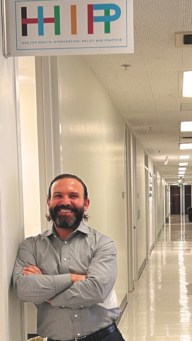
man smiles as he stands beneath sign that designates office location for research hub

Ian Holloway of the Hub for Health Intervention, Policy and Practice. Photo by Mary Braswell

“My hope in working with Los Angeles County and the California Department of Public Health is that we can be really strategic and use research evidence to inform public health policy,” Holloway said. “One thing that’s promising for monkeypox vaccination is that we saw very high levels overall of vaccination for COVID-19 among LGBT communities in general, and gay men specifically. However, we still saw disparities by race and ethnicity.”

Extending eligibility

He supports an August 24 decision by the Los Angeles County Public Health Department to follow national guidance and extend eligibility to more people despite an ongoing shortage of the monkeypox vaccine. Doing so will bolster efforts to reach racial and ethnic minority communities, he said.

The new strategy involves a process known as dose splitting, in which a vial that usually contains two doses is split into up to five doses and administered in a way that retains effectiveness despite the lower dosage. Traditionally the vaccine is administered in a subcutaneous manner into the fat behind the triceps muscle. The new strategy is for a shallow intradermal injection into a layer of skin under the arm. This method typically leads to higher immune responses and faster drug uptake.

“Hopefully, that will mean we can get more doses to people,” Holloway said. “But public health departments really have to start planning to reach large communities of gay, bisexual and other men who have sex with men.”

In cities like Los Angeles, Holloway noted, people getting vaccinated tend to be more affluent and can afford to take time off work when they get a text reminder saying it’s their turn. “It’s much more challenging to reach those with lower incomes who are disproportionately part of racial and ethnic minority communities,” he said.

Holloway also leads the Gay Sexuality and Social Policy Initiative at UCLA, which focuses specifically on the unique experiences of gay men related to sex and sexuality. Although monkeypox is spread through any type of intimate contact, 98% of U.S. infections in the current outbreak have been among men, primarily those who have sex with other men.

Alex Garner, co-director of the initiative, is also director of community engagement at MPact Global, a worldwide organization dedicated to improving the health and well-being of gay, bisexual and queer folks, and advancing human rights. Garner has advised the World Health Organization (WHO), UNAIDS, and the European Centre for Disease Prevention and Control on communication strategies and community engagement relating to the disease. He said the outbreak has further demonstrated the structural inequalities that exist in health care.

“At the same time, we can’t allow stigma to be worse than the disease,” Garner said. “To not provide adequate investment and care for people of color, migrants, sex workers and LGBTQ folks only reinforces the idea that our lives do not matter.”

The stigma problem

Holloway and Garner are among those lobbying to change the name of the disease to something less stigmatizing than monkeypox such as MPX, which is favored by state public health officials.

Advising gay men without stigmatizing them — a frequent problem during the HIV epidemic — requires sensitivity in how information is communicated. Holloway’s team at UCLA has been active in working with community partners like the Los Angeles LGBT Center on education and raising awareness.

Initially, GSSPI put out a set of infographics about protecting oneself from exposure to the virus and how to identify the symptoms, which are similar to a severe flu. Infected individuals usually develop a rash and then lesions during a painful illness that can last up to four weeks.

So far, no one in the United States has died in an outbreak that now totals more than 40,000 cases worldwide and over 3,000 in California. Los Angeles County has the highest rate of infection in the state.

The outbreak spread quickly but is unlikely to disappear nearly as fast. The vaccine needs to be administered twice, four weeks apart, with 85% immunity not achieved until two weeks after the second dose. “We have a long road in front of us in terms of being able to get our communities protected through vaccination,” Holloway said.

The task at hand is both urgent and daunting, while the health and social ramifications are far-reaching. That’s why Holloway has enlisted assistance from Brian Keum, who also teaches in the department of social welfare, and Zachary Steinert-Threlkeld of UCLA Luskin Public Policy for another monkeypox-related research endeavor.

The project involves data mining of a Twitter database developed by Steinert-Threlkeld that goes back to 2014. By tracking homophobic hate speech, UCLA Luskin researchers will be able to document the types of hate speech relating to the monkeypox outbreak and inform communication strategies to confront online homophobia.

“There’s been a surge in homophobic hate speech online,” Holloway said. “The goal of this second project is understanding the ways in which homophobic hate speech online is evolving in parallel to the spread of (monkeypox) and through social media networks.”

He noted that social media can be a powerful way to spread both negative and positive information — greater attention was drawn to the outbreak in June when actor Matt Ford started posting videos on Twitter and TikTok about his symptoms and treatment, for example.

“I’m also interested in the ways in which gay communities are caring for themselves using social media during this time,” Holloway said.


A Graduation Milestone for Luskin Public Affairs Majors

August 18, 2022/0 Comments/in Luskin's Latest Blog /by Mary Braswell

UCLA Luskin’s undergraduate Class of 2022 had the distinction of beginning a school tradition: the in-person exhibition of yearlong research projects that are the hallmark of the bachelor of public affairs program. During the Public Affairs Capstone Showcase in June at UCLA’s Royce Hall, graduating seniors shared their work on capstone projects benefiting more than 50 internship hosts, including UCLA research centers, Los Angeles government officials and agencies, state legislators, and nonprofits with local, national and international reach. Through poster boards and digital presentations, students at the showcase summarized their research and recommendations for an audience of peers, faculty, staff and internship partners. Rebecca Crane, who earned her doctorate in urban planning at UCLA Luskin in 2021, served as the capstone instructor, guiding the students through a three-quarter journey that honed their skills in applying public affairs course concepts to real-world problem-solving. Students who produced exceptional work were honored with the Public Affairs Experiential Learning Outstanding Capstone Award after review by a faculty advisory committee. The Class of 2022 is only the second graduating class in the Luskin undergraduate program. Members of last year’s cohort presented their capstone projects in a virtual setting due to the COVID-19 pandemic.

View winners of the Outstanding Capstone Award along with other honorees in the 2022 Luskin Undergraduate Awards Program.

View photos of the Public Affairs Capstone Showcase on Flickr.

Undergraduate Capstones 2022

Page 6 of 19«‹45678›»

Recent Posts

  • Scrutiny Grows Over Measure ULA Claims, Mike Manville Weighs In December 12, 2025
  • Why Small Businesses Fail: Key Findings from the Wall Street Journal December 11, 2025
  • UCLA Luskin Faculty Win Grants to Internationalize Curriculum December 10, 2025
  • Q&A with Maleeyah Frazier: Youth Activist and a Voice for Black Students December 8, 2025
  • Cohen on Prolonged Withdrawal Symptoms After Discontinuing Antidepressant Use December 5, 2025

Contact

UCLA Luskin School of Public Affairs

3250 Public Affairs Building - Box 951656
Los Angeles, CA 90095-1656

Campus Resources

  • Maps, Directions, Parking
  • Directory
  • Contact
  • Academic Calendar
  • Careers
  • Diversity
  • University of California
  • Terms of Use

Follow

The statements on this page represent the views of people affiliated with the Luskin School of Public Affairs and do not necessarily represent the views of the University of California, or UCLA or its Chancellor.

Posts and comments by individuals at UCLA on social media channels may not reflect the opinions or policies of UCLA, the University of California or the Luskin School, nor its benefactors and academic partners.

Scroll to top