• Public Policy
  • Social Welfare
  • Real Estate Development
  • Urban Planning
  • Luskin Home
  • Undergraduate Program
  • Stay in Touch
  • Events Calendar
  • Give Now
  • About
    • Our Dean
    • Board of Advisors
    • Contact Us
    • Visit Us
    • Diversity, Disparities and Difference
    • Communications
      • UCLA Luskin in the News
      • Luskin Forum Online
  • Departments
    • Public Policy
    • Real Estate Development
    • Social Welfare
    • Undergraduate Program
    • Urban Planning
  • Apply
    • Master of Public Policy
    • Master of Real Estate Development
    • Master of Social Welfare
    • Master of Urban and Regional Planning
      • Double Degree With Sciences Po
    • PhD in Social Welfare
    • PhD in Urban Planning
    • Undergraduate Programs
  • Faculty
    • All
    • Public Policy
    • Social Welfare
    • Urban Planning
    • Real Estate Development
    • Faculty Executive Committee
    • Open Positions
  • Student Affairs & Alumni
    • Career Services
      • Employers
      • Fellowships
    • Student Support
    • Graduate Resource Library
    • Alumni Relations
  • Support
  • Programs
    • Research Centers & Affiliated Research
    • CA Title IV-E Education Program
    • Global Public Affairs (GPA)
    • Data Analytics Certificate
    • Luskin Lecture Series
    • Luskin Summit
    • UCLA Luskin California Policy Briefing
    • Public Service Weekend
    • Commencement
  • Administration
    • Financial Services
    • Events Office
    • Information Technology
  • Search
  • Menu Menu

Archive for category: Diversity

How Laws and Policies Can Close — or Widen — Gender Gaps New book by UCLA researchers shows that progress toward gender equality has stalled, particularly for caregivers in the U.S.

February 28, 2023/0 Comments/in Diversity, Education, For Faculty, For Policymakers, For Students, For Undergraduates, Global Public Affairs, Public Policy, Public Policy News, Research Projects, School of Public Affairs Jody Heymann /by Les Dunseith

By Les Dunseith

A comprehensive review of economic gender equality in 193 countries by the UCLA WORLD Policy Analysis Center identifies global trends and exposes policy gaps that include shortcomings when it comes to caregiving.

When the authors of a new open-access book first began tracking maternity leave policies around the world in 2000, they were alarmed to find that 18 countries had no national paid leave in place for working mothers. Today, seven remaining countries still lack such protection — five small island nations, Papua New Guinea, and the United States of America.

The book, “Equality within Our Lifetimes,” pulls together information from more than a decade of research that has also been collected into a robust, freely downloadable database. Co-author Jody Heymann, a professor at UCLA and founding director of WORLD, said that through the 1980s gender equality was rapidly advancing.

“There were more women entering the workforce. There were increased economic opportunities for women, increased educational opportunities,” she said. “That progress has completely stalled.”

The country’s gender wage gap has barely budged for 15 years. What’s more, it’s even broader among parents. In 2021, the average mother working full-time in the U.S. still earned just 73 cents for each dollar earned by a father working full-time.

Because U.S. women remain predominantly responsible for all types of caregiving, it’s not just new mothers who are impacted by the continued lack of federal paid family leave and other legal protections for caregivers in the workplace. The authors cite studies that show women are three times as likely as men in the U.S. to lose their jobs or to leave the workforce because they’re caring for an ill adult.

The economy has felt the impacts. From 2000 to 2019, the U.S. dropped from 7th to 23rd in a ranking of 36 high-income countries on women’s participation in the labor market, Heymann noted. Amid COVID-19, women’s labor force participation fell to its lowest rate since 1987 and has yet to fully recover — with Black and Latina women experiencing the greatest losses.
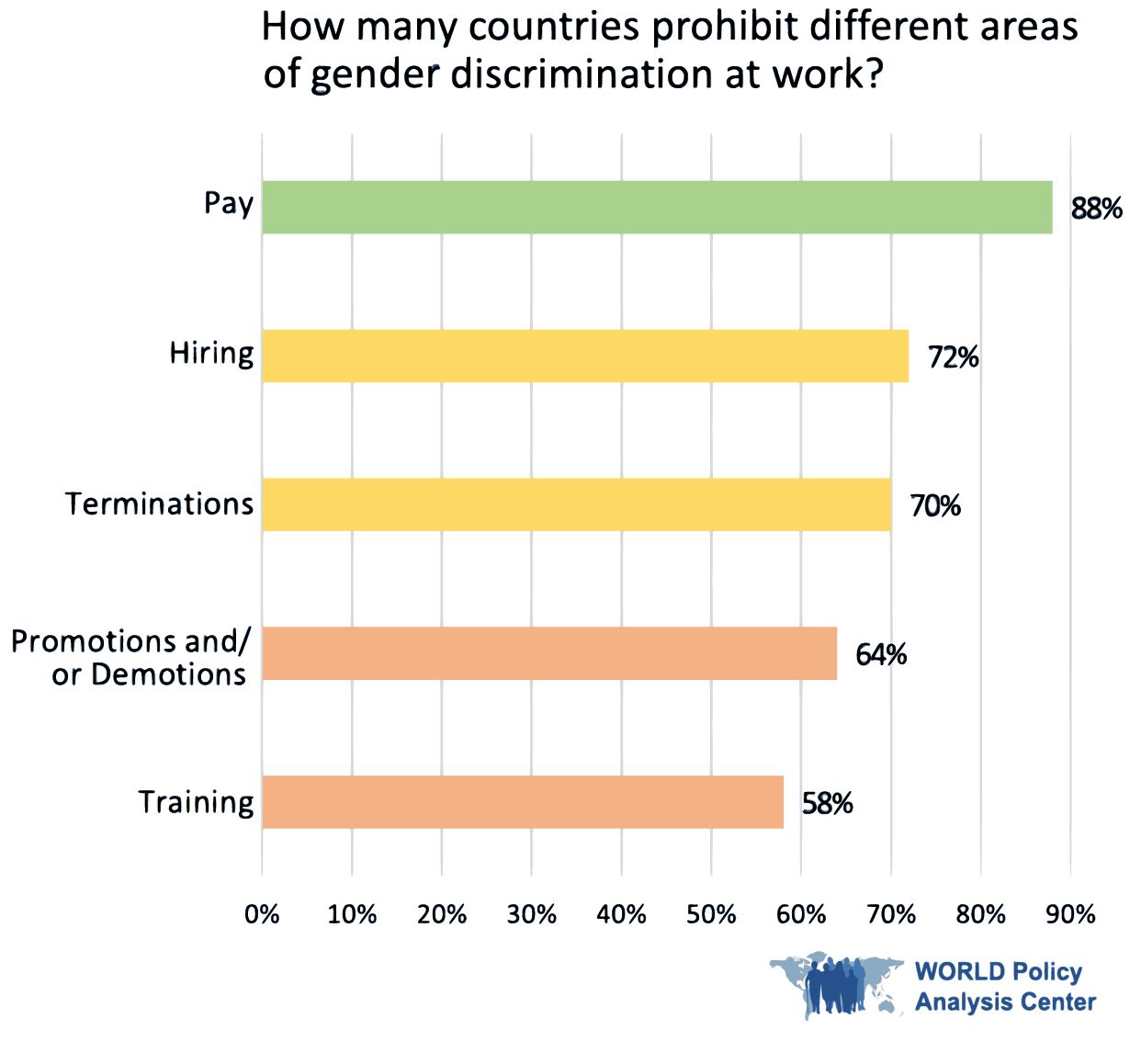
Heymann and her research team analyzed national laws and policies in all 193 countries of the United Nations. Among their findings:

  • Although nearly all countries (93%) now prohibit at least some form of gender discrimination in the workplace, only half prohibit discrimination based on family responsibilities.
  • In 1 in 5 countries, employers can legally discriminate against women of color because laws fail to prohibit employment discrimination based on both gender and race.
  • Over five years since #MeToo went global, 1 in 4 countries still fail to explicitly prohibit sexual harassment at work. In about one-third of countries, the law is silent on employer retaliation, meaning women can be fired if they report harassment.
  • Two- thirds of countries fail to provide paid leave to care for a child during routine illnesses or to take them to the doctor.
  • A majority of countries (58%) provide no paid leave to care for an ill spouse, and 61% offer no paid leave to care for an aging parent.
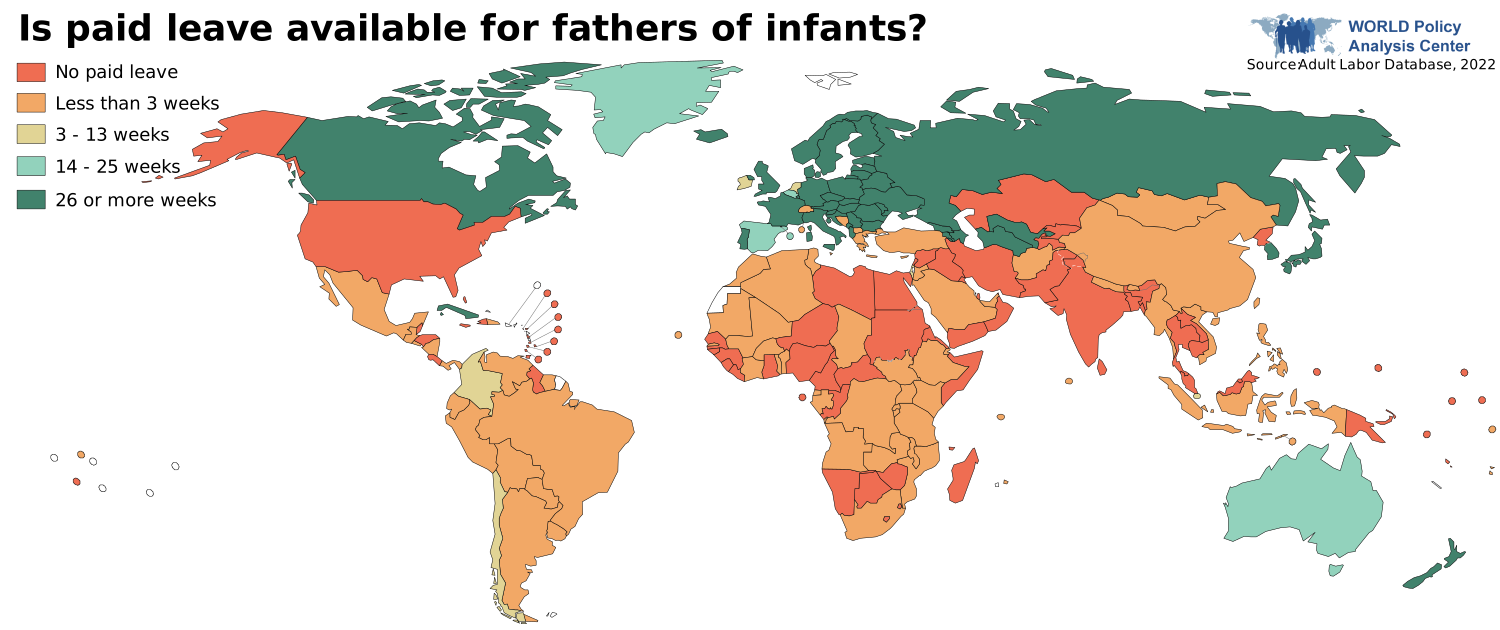
color coded map

Fathers of infants have far less paid leave available to them than do mothers.

More encouraging for the authors is a worldwide trend toward paid leave for new fathers. Between 1995 and 2022, 71 countries enacted paid leave for dads, increasing the share of countries globally with leave from 24% to 63%. The U.S is not among them.

In the United States, some private employers and 11 states, including California, now offer paid parental leave, although inconsistently. Co-author Aleta Sprague, an attorney and senior legal analyst at WORLD, said the negative impact of not providing paid family leave at the national level is far-reaching.

“It’s no longer in question that our lack of support for new parents and other caregivers is driving women to leave the labor force,” Sprague said. “And that in turn is a barrier to economic growth.”

UC Press is releasing the book — authored by Heymann, Sprague, and co-author Amy Raub, principal research analyst at WORLD — at roughly the halfway point of the Sustainable Development Goals, a 2015 United Nations commitment to ensure equal rights across the globe by 2030. It is being distributed online, accompanied by briefing papers and downloadable assets in multiple languages, as part of a commitment to making top university research readily available to everybody, Heymann said.

The book presents new research on the extent and pace of policy change in 193 countries as well as new longitudinal studies of policy impact, bolstered by case studies that show how change can occur. The lesson from around the world is that solutions exist from every political perspective.

“The way you get to 187 countries providing paid maternity leave, the way you get to every other major economy providing paid sick leave except for the United States, is that there are conservative solutions, there are progressive solutions, there are middle-of-the-road solutions,” Heymann said.

There’s little disagreement among the general public about the need for paid family leave. The Family Medical Leave Act, a 1993 law that guarantees unpaid, job-protected leave for specified family and medical reasons only for some employees, has proven to be inadequate. Heymann said polls have shown that across party lines and across states, paid family leave is popular.

“People want parents to be able to take time to care for a newborn child. They want adults to be able to take time to care for a dying parent,” Heymann said. “And they don’t want American parents to drop into poverty because of it.”

So, is it possible to achieve gender equality in our lifetimes?

“It is completely within our reach,” Heymann said. “There are solutions that can be achieved in real time, that are feasible.”

Sprague’s answer is similar. “I think we know how to get there. One thing that this book illustrates is how feasible it is and how much of a difference a few key policy changes can make.”

Moreover, Heymann emphasized, the standard arguments against some of those key policies in the U.S. overlook critical evidence about their potential for impact. “Too often, policymakers highlight the costs of paid leave without acknowledging its overwhelming payoffs,” she said. “The evidence is clear that when women in particular have access to paid leave for family caregiving needs, they are far more likely to stay in the workforce — and even slightly narrowing the gender gap in labor force participation would boost our GDP by hundreds of billions. It’s a powerful investment.”

Heymann pointed to studies from McKinsey, the World Bank, and others demonstrating how advancing gender equality pays huge dividends.

“At core, gender equality is a basic human right,” she continued. “But it also yields tremendous economic value—and the U.S.’s continued inaction comes at a high cost to us all.”


To conduct the studies referenced in this book, a multilingual, multidisciplinary research team systematically analyzed the laws and policies of all 193 U.N. member states. They also rigorously analyzed the impacts of legal changes around the world. The book is being distributed through UC Press, and downloadable resources are being made available on the website of the UCLA WORLD Policy Analysis Center.

The WORLD Policy Analysis Center (WORLD) at UCLA is the largest independent global policy data center, capturing over 2,500 social, economic, health, and environmental quantitative legal indicators for all 193 U.N. countries. With an international, multilingual, and multidisciplinary team, WORLD collects and analyzes information on every country’s rights, laws, and policies in areas including education, health, adult labor and working conditions, child labor, poverty, constitutional rights, discrimination, childhood, gender, marriage, families, aging, and disability. Heymann, the center’s founding director, is a distinguished professor of public policy, medicine, and health policy and management at UCLA with appointments in the Fielding School of Public Health, Luskin School of Public Affairs and David Geffen School of Medicine. She is also dean emeritus of the Fielding School.


 

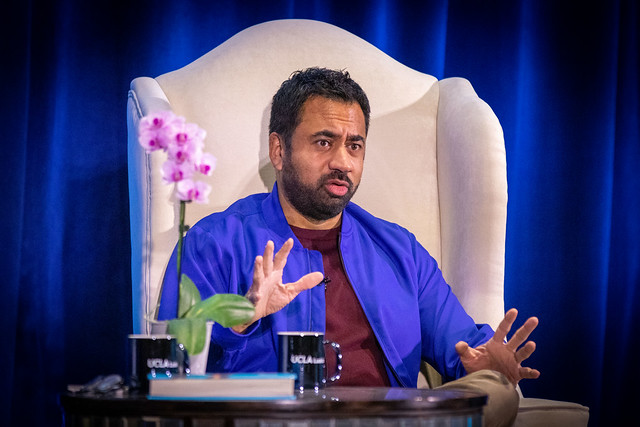
Kal Penn on Working for Change in Hollywood and Politics The actor, author, public servant and UCLA alumnus shares his multilayered life story with a Luskin Lecture audience

November 9, 2022/0 Comments/in Diversity, For Faculty, For Policymakers, For Students, For Undergraduates, Politics, Public Policy, Public Policy News, School of Public Affairs Anastasia Loukaitou-Sideris, Jim Newton /by Mary Braswell

By Mary Braswell

To understand the folly of viewing people through a one-dimensional lens, just look at Kal Penn’s resume.

The UCLA alumnus has played stoners, doctors and Santa Claus on the big and small screens. As part of the Obama White House, he mobilized voters, helped shape policy and advocated for the arts. Now, he’s added a new entry to his list of achievements: bestselling author.

Penn published his darkly funny memoir “You Can’t Be Serious” in 2021, and he returned to campus on Nov. 3 to share tales from his circuitous life journey as part of the UCLA Meyer and Renee Luskin Lecture Series.

Penn, a familiar face to viewers of “House,” “Designated Survivor” and the “Harold & Kumar” stoner movie franchise, was moved to write the book during the COVID-19 pandemic, when many people were re-examining their career choices and life priorities.

“Maybe I do have a story to tell,” he realized. “Maybe now is the time to share how you can have the blessing and privilege of working in two totally different careers.”

His story begins in New Jersey, where he grew up as the child of Indian immigrants — two scientists who fretted about their son’s desire to make a living as an actor. His career arc started on a middle school stage, when Penn brought down the house as the Tin Man in “The Wiz,” even breaking through to boys who had bullied the drama kids.

“I just thought, wow, what an incredible experience, that something as simple as a school play and a joke that was improvised made somebody change their minds,” he remembered.

“There’s a magic to this in terms of having a captive audience and being able to introduce them to characters and perceptions that are different from theirs. And that really motivated me to want to be an actor.”

After graduating from UCLA in 2000 with degrees in sociology and theater, film and television, Penn tried to make his way in an entertainment industry that, despite its broad reputation as a bastion of liberal values, clung to all forms of racism.

In some roles that he auditioned for, a brown face and Indian accent were the top criteria, not the talent, humor and heart needed to develop a believable character.

Penn recalled his attempts to persuade a sitcom director that the character he was playing would be much funnier if he didn’t descend into South Asian stereotypes — and that it would mean a lot to his young cousins, fans of the show.

“‘This is not a conversation we’re having,’” Penn said he was told. “‘Your little cousins should feel lucky that you’re allowed to be on TV to begin with. And so should you.’”

Woman receives copy of book in outdoor settingA member of the audience receives a complimentary copy of Penn’s memoir, “You Cant Be Serious.” Photos by Les Dunseith
Woman receives copy of book in outdoor setting
Young woman at microphone
Man at desk signing books in conference center lobby

Despite such tales of entrenched bigotry, Penn assured the UCLA audience that change, though slow, can definitely be measured. Sometimes it’s for business reasons, he said, citing the diversity of programming in the era of streaming platforms, which are funded through subscriptions rather than ad revenues that have a chilling effect on risk-taking.

Penn jumped from Hollywood to national politics during the Obama administration, when he served as White House liaison to young Americans, Asian Americans and the arts community and worked on policy matters including health care, immigration and LGBTQ rights. He was a national co-chair for the Obama/Biden reelection campaign in 2012 and served on the President’s Committee for the Arts and Humanities.

With that insider perspective on politics and governance, Penn weighed in on the current state of civil discourse in America. Speaking days before the contentious midterm elections, he acknowledged, “It is a dark time.”

One member of the audience, a student pursuing a master of public policy, sought Penn’s advice to young people called to public service but experiencing frustration and fear that they won’t be able to make a difference.

Don’t lose sight of important gains that have already been made, Penn counseled.

“When I do university lectures, a lot of times the tone of certain questions is like, ‘I can’t believe you worked for a moderate like Barack Obama.’ To me, what a great benchmark of progress, because at the time he was a progressive president.”

The notion that a generation of Americans now takes for granted the passage of the Affordable Care Act, repeal of “Don’t Ask, Don’t Tell” and protections extended to DACA students is a sure sign of progress, Penn said. Just this year, a landmark climate bill passed “because so many young people were pushing the White House to do something.”

During the on-stage conversation moderated by Jim Newton, editor of UCLA’s policy-oriented magazine Blueprint, more nuances of Penn’s humanness came through. Many of his loved ones are private by nature, so not until his memoir was published did some readers learn that Penn is gay and engaged to his partner, Josh. His proudest accomplishment is earning a graduate certificate in international security from Stanford University, and he aspires to one day serve his country as a U.S. ambassador. And in answer to a question from the audience, Penn revealed that his favorite soup is matzo ball.

Penn’s appearance was part of the UCLA Luskin School of Public Affairs’ signature Luskin Lecture Series, aimed at igniting dialogue on the most pressing policy challenges of our time.

Following the conversation, audience members snaked around the Centennial Ballroom at UCLA’s Luskin Conference Center, waiting to speak with Penn as he signed copies of his autobiography, complimentary to those who had registered to attend. They included students from the worlds of theater, film, global studies and public affairs, and Penn had a universal charge for each of them:

“Complacency is the greatest danger. … Just because things have progressed doesn’t mean they’re not going to slide back in any way, both in terms of diversity and career but also in terms of democracy.

“When you’re complacent, the other side will absolutely win.”

View photos from the lecture on Flickr.

Kal Penn Luskin Lecture

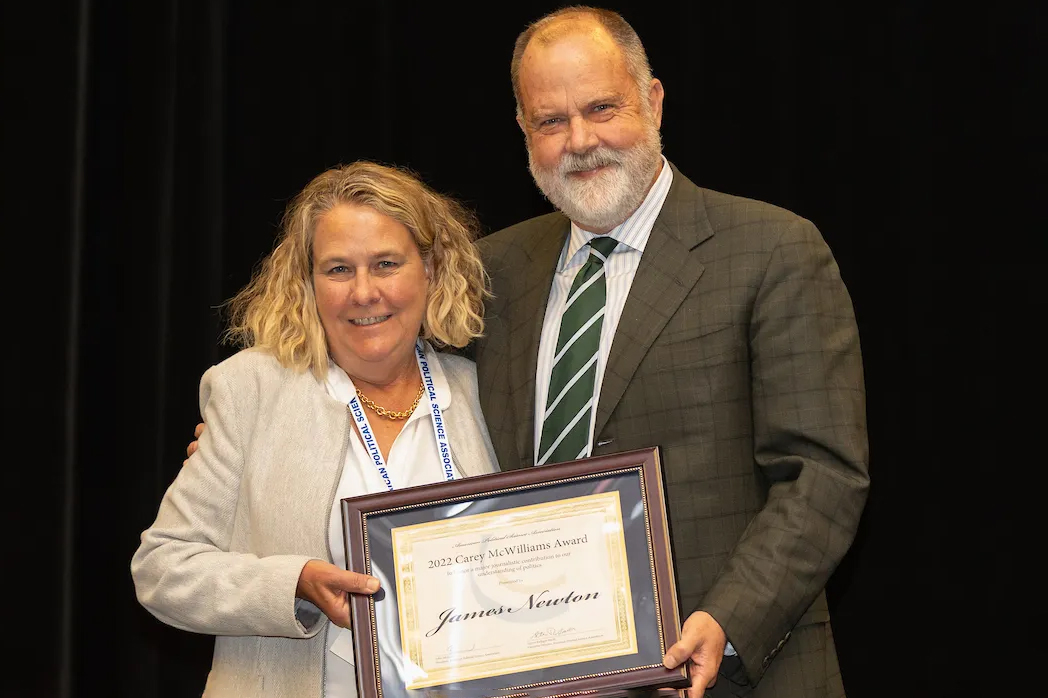
Jim Newton Receives 2022 Carey McWilliams Award Editor-in-chief of UCLA Blueprint magazine receives honor recognizing journalistic contributions to society’s understanding of politics  

September 15, 2022/0 Comments/in Diversity, Education, Environment, For Faculty, For Policymakers, For Students, For Undergraduates, Health Care, Politics, Public Policy, Public Policy News, School of Public Affairs Jim Newton /by Les Dunseith

By Les Dunseith

UCLA’s Jim Newton is the winner of the Carey McWilliams Award, which honors a journalist or organization each year for intellectual forthrightness and political independence.

Newton is the founding editor-in-chief of Blueprint magazine, which is based at the UCLA Luskin School of Public Affairs. He’s also a lecturer in the departments of public policy and communications studies.

The McWilliams Award has been given since 1982 by the American Political Science Association in memory of a California lawyer who became an influential political leader, author and editor. McWilliams edited The Nation magazine from 1955 to 1975 and wrote landmark books that focused on migrant farm workers in California and the World War II internment of Japanese Americans.

“I’m deeply honored by this prize and especially by the thought that it binds my name, in some small way, to that of McWilliams, who has long been a personal polestar of integrity and wisdom,” Newton said.

The award, which recognizes Newton’s work at UCLA and other accomplishments, was officially presented Sept. 14 in Montreal at the association’s annual meeting. He has written several books about historical figures of political importance with a California connection, including former CIA chief and Secretary of Defense Leon Panetta, Supreme Court Justice Earl Warren and former Gov. Jerry Brown. At the Los Angeles Times, he was a reporter, editor, columnist, bureau chief, editorial page editor and editor-at-large.

Past recipients of the award include well-known broadcast journalists such as Judy Woodruff, Bill Moyers, Lesley Stahl and Nina Totenberg; other respected newspaper writers such as Seymour Hersh, Molly Ivins and Ronald Brownstein; authors and professors; plus chroniclers of political discourse from a diverse array of outlets that includes the New York Times, Washington Post, Cook Political Report, the Congressional Quarterly, National Public Radio and the Huffington Post.

UCLA Luskin colleague Zev Yaroslavsky first became aware of Newton’s tough-but-fair journalistic approach during his time as an elected official in Los Angeles.

“Jim’s coverage of the LAPD — and the reforms spawned by the Rodney King beating and the Rampart scandal — is still the gold standard” for news reporting in Los Angeles, Yaroslavsky wrote in a letter recommending Newton for the McWilliams award.

Henry Weinstein, a former L.A. Times colleague who is now on the faculty at UC Irvine Law, also wrote an award nomination letter. “He is a potent and graceful practitioner of what I call ‘the Journalism of Illumination’ — articles and books that take a reader deep into important subjects, regardless of whether they occurred yesterday or 75 years ago — just as McWilliams did in an earlier era.”

A third recommendation letter came from a former Times colleague who has continued to work with Newton as a frequent writer for UCLA Blueprint, Lisa Fung. She praised Newton’s ability to build connections among the worlds of politics, journalism and academia.

“It’s become increasingly difficult to understand the motivations of government and policy officials, but through his work as a writer, editor, author and educator, Jim is leading the charge to bring about change and to show people why they should care,” Fung wrote.

Newton said his appreciation of McWilliams grew while writing his book about Warren, the former chief justice of the United States. In fact, as governor of California, Warren clashed with McWilliams and actually fired him from a government job in part because he was an outspoken critic of the internment of Japanese Americans during World War II.

“McWilliams is the only principled person at the time who stood up and said, ‘This is a bad idea,’” Newton said.

He founded Blueprint magazine, which is based at the Luskin School and distributed online and in print twice yearly, as a way to connect intellectuals to policymakers in light of what he perceives as a growing need.

“The policy universe, in particular, had really been stripped of a lot of its research apparatus just over the time that I had been covering it,” Newton said. “It’s true at the city, county and state levels — legislative analysts just don’t have the firepower they once did.”

Filling that gap was the germinating notion of Blueprint, which often highlights academic researchers who are tackling policy questions.

“Let’s make policymakers aware of the research that might inform policy, and let’s also engage researchers in what’s going on in the policy universe,” Newton said.

He imagines an elected official facing a difficult policy issue and eager to find a fresh, independent perspective.

“Instead of just listening to labor or business, you realize that there’s some thoughtful, nonpartisan research that’s being done that can help guide you to a good answer,” said Newton, whose goal is making scholarly research accessible to a non-academic audience.

 “We don’t want it to be an academic journal,” he explained. “That’s why it’s brightly colored, and it’s designed the way it is, with illustrations and graphical presentations in print and online.”

UCLA scholars are often featured, but the magazine’s focus extends beyond the university.

“So, we write about Norman Lear or David Axelrod or Joe Stiglitz or Jerry Brown — people who are broadly interesting and who are concerned with culture and politics and civic life,” Newton said.

Blueprint’s press run has been reduced in recent years amid financial constraints, and a plan to publish quarterly instead of twice-yearly was shelved in part because of pandemic-related challenges. But Newton is hopeful for a return to the magazine’s full reach — and even expansion. Meanwhile, production has endured, and reporting for the fall edition is currently underway.

“It’s themed around fear,” said Newton, who noted that fear can be constructive when it drives urgency of action around issues like homelessness or climate change. But, of course, fear also has the potential for harm as a tool for some politicians.

“Immigration would be a good example of the kind of illogical fear of other people that results in policy that’s profoundly misguided,” he said.

The theme is particularly timely with political rhetoric heating up as midterm Congressional elections and races for mayor of Los Angeles and the governor of California loom in November. Fear not, the next edition of Blueprint will be available in mid- to late-October to shed light on the political shadows. 

UCLA’s Jim Newton receives the Carey McWilliams Award from Lisa Martin, president-elect of the American Political Science Association. Photo from APSA


Ian Holloway Named Editor-in-Chief of Sexuality Research and Social Policy At a time when people’s sexuality and reproductive rights are at issue, UCLA professor hopes to make relevant academic insight more readily available to policymakers

July 27, 2022/0 Comments/in Diversity, Education, For Faculty, For Policymakers, For Students, For Undergraduates, Health Care, HIV/AIDS, Research Projects, School of Public Affairs, Social Welfare, Social Welfare News, Social Welfare PhD Ian Holloway /by Les Dunseith

By Les Dunseith

Ian Holloway, a professor of social welfare at the UCLA Luskin School of Public Affairs, has been named editor-in-chief of Sexuality Research and Social Policy.

The peer-reviewed academic journal publishes research on sexuality and the implications of that research on public policy across the globe. It has traditionally been focused primarily on an academic audience, but Holloway intends to work with the editorial board to expand the journal’s reach and impact in response to a wave of anti-LGBT legislation in the United States and issues such as the ongoing criminalization of same-sex sexual behavior in many countries.

“I think that this historical moment really calls upon us, as academics, to make sure the work we’re producing reaches policymakers and other decision-makers, including practitioners and the folks who are designing programs in government and public health settings,” said Holloway, who is director of the UCLA Hub for Health Intervention, Policy and Practice and its Gay Sexuality and Social Policy Initiative.

He envisions promoting research from the journal via social media, soliciting more special issues on timely and relevant topics, and putting short summaries of key findings atop articles — written in layperson’s language to make academic work that is relevant to ongoing policy debates more widely accessible.

“Those of us who’ve been writing peer-reviewed articles for academic journals for years have a particular style of writing, a particular format of writing, that may not be conducive to lay audiences,” Holloway noted. “But lay audiences include policymakers who may not have the time, the energy or the expertise to wade through an academic article on a particular topic.”

At a time when people’s sexuality and the reproductive rights of pregnant people are at issue, Holloway sees his new role as an opportunity to make a difference.

“A lot of times, policy decisions are not evidence-based,” he said. “They’re based in moral judgment or religious views.

“But we have robust scientific evidence that is based on sexual liberty and the impact of social policy on sexuality. And I would like to make that academic discourse more relevant and available to those who are making decisions for the future of our country and for communities across the globe.” 

As editor-in-chief, Holloway will have the final say on every manuscript that is published in the journal, about 150 articles a year. He was selected for a five-year term as editor-in-chief through a peer-nomination process that included a recommendation from the outgoing editor, Christian Grov of the City University of New York, and interviews with representatives of Springer Nature, the journal’s publisher.

“The previous editor did an incredible job of building up the journal, and he increased the number of submissions,” Holloway said. “I’m grateful to Dr. Grov for all of his hard work and look forward to continuing to grow the journal in terms of its impact in the real world beyond the ivory tower.”


$1.5 Million Grant Will Support Institute’s Social Justice Mission Marguerite Casey Foundation's award to Luskin Institute on Inequality and Democracy will bolster efforts that link academic pursuits to community organizing

July 21, 2022/0 Comments/in Development and Housing, Diversity, Education, For Faculty, For Policymakers, For Students, For Undergraduates, Latinos, Politics, Research Projects, School of Public Affairs, Social Welfare, Social Welfare News, Social Welfare PhD, Urban Planning Ananya Roy /by Les Dunseith
By Les Dunseith
The UCLA Luskin Institute on Inequality and Democracy has received a $1.5 million grant from the Marguerite Casey Foundation to bolster the institute’s ongoing programs in support of social justice movements in Los Angeles and elsewhere.

The institute is among four recipients of grants totaling $6 million from the foundation, which are intended as a bridge between social justice scholarship and social movements.

“We believe that bold investments in ideas about how to shift power in society must be matched with bold investments in organizing efforts that help bring them to life,” foundation President and CEO Carmen Rojas said in announcing the grants.

The new funds will help the institute, launched in 2016 and based at the UCLA Luskin School of Public Affairs, continue to advance social justice in cooperation with colleagues and community partners, said Ananya Roy, the institute’s founding director and a UCLA professor of urban planning, social welfare and geography.

“We have been building an interinstitutional space connecting university-based and movement-based scholars in the shared work of research and scholarship to analyze and challenge dispossession and displacement in U.S. cities and communities,” Roy said.

As part of that work, Roy and her colleagues and partners are seeking to ensure that increased government spending on public programs in the wake of the COVID-19 pandemic benefits those most in need rather than further entrenching race and class inequality, exploitation and oppression.

Rojas, who, like Roy, earned a Ph.D. in city and regional planning from UC Berkeley, stressed that organizing efforts supported by the grants “should be multiracial and durable in nature to ensure that their impact reflects the character of the communities they aim to serve and leaves those communities changed, more informed, more free and better able to shape our democracy and economy.”

In applying for the grant, the institute pledged to support efforts to “advance the collective power of those who have been excluded, evicted, criminalized, banished and disappeared by liberal democracy, from the unhoused to climate refugees.”

The institute’s grant-related plans include:

  • Expanding its signature activist-in-residence program.
  • Hosting a distinguished speakers series focused social and racial justice movements, with particular attention on scholars based in the global South. To this end, the series will use both in-person and virtual formats.
  • Organizing “freedom schools” that bring together movement-based and university scholars for theoretical and methodological training related to social justice.
  • Initiating a program to unite leading university and movement-based scholars around a shared vision and narrative of housing justice that reaffirms housing as a reparative public good.
  • Creating doctoral student and faculty seed grants to support research at the intersection of ideas and organizing.

Also receiving $1.5 million grants from the foundation were the Portal Project of the Social Justice Initiative at the University of Illinois Chicago; Haymarket Books, a nonprofit publisher based in Chicago; and the Highlander Research and Education Center, a grassroots organizing and movement-building organization active in Appalachia and the American South.

Connecting the Dots on Climate Change Environmental scholar Robert Bullard charts a path to a more equitable future — if America can avoid repeating past mistakes  

May 17, 2022/0 Comments/in Alumni, Climate Change, Development and Housing, Diversity, Education, Environment, For Faculty, For Policymakers, For Students, For Undergraduates, Global Public Affairs, Public Policy News, School of Public Affairs, Social Welfare News, Social Welfare PhD, Urban Planning Susanna Hecht /by Les Dunseith

By Les Dunseith

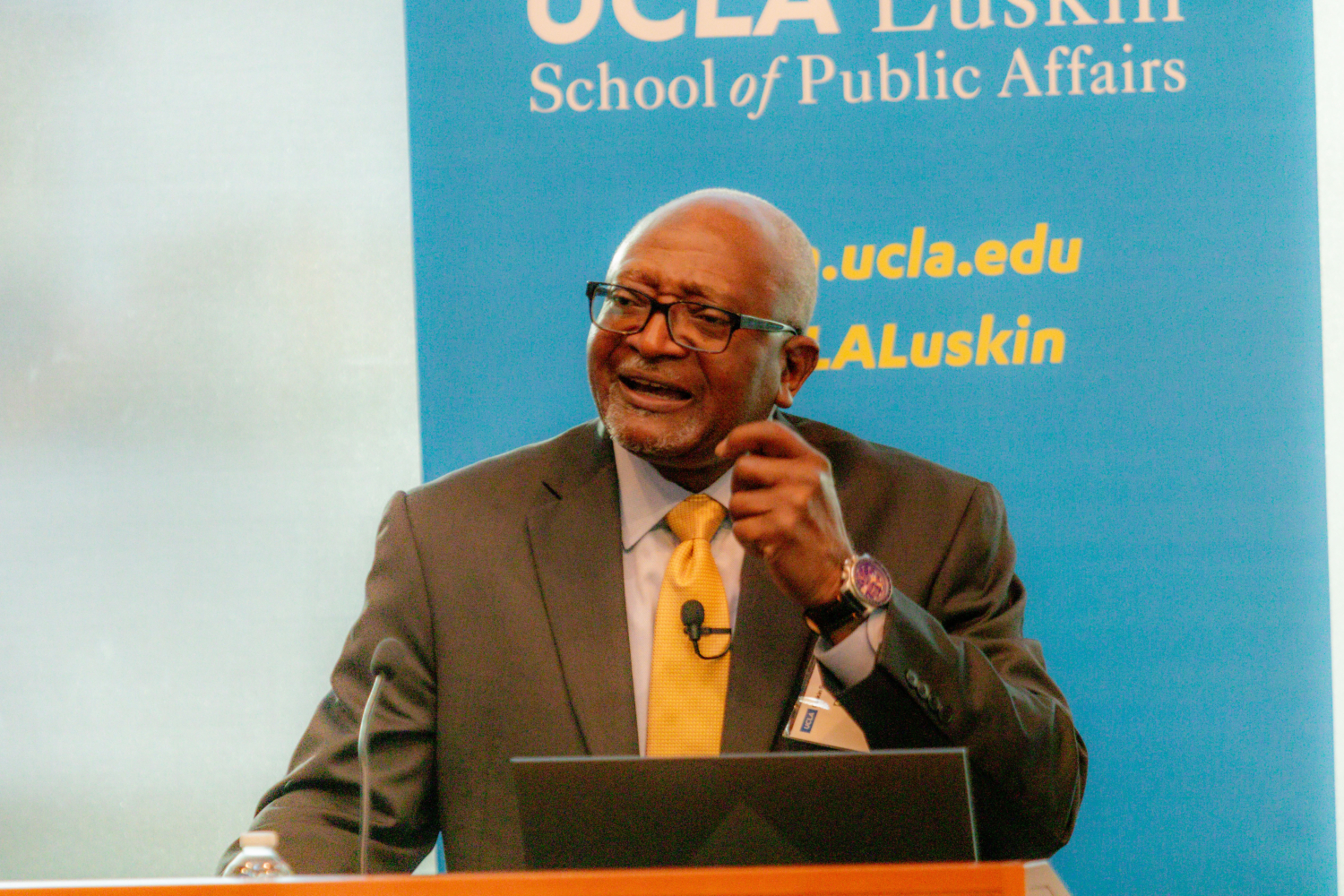
Robert Bullard has been called professor, dean, author, policy influencer, important thinker, movement starter and the father of environmental justice. But that’s not how he chose to describe himself during a May 12 talk at UCLA.

“I do what’s scientifically called kick-ass sociology,” Bullard said playfully in his opening remarks to a roomful of students, faculty, staff and other interested parties, plus an online audience. “And what I’ve tried to do is to make it simple, make it plain, make it real and connect the dots.”

The renowned scholar from Texas Southern University has written 17 books. “But it’s really just one book — don’t tell anybody,” Bullard said slyly. “The central glue that connects all of those volumes? Fairness, justice and equity.”

He often blended humor into his discussion of serious topics such as America’s history of racial discrimination and the growing global climate crisis. Titled “The Quest for Environmental and Climate Justice,” Bullard spoke and took audience questions for more than an hour in the Bruin Viewpoint Room of Ackerman Union as part of the UCLA Luskin Lecture series. It was presented in conjunction with the Harvey S. Perloff Environmental Thinkers Series and UCLA Urban Planning’s 50th anniversary celebration.

In his introductory remarks, Dean Gary Segura of the UCLA Luskin School of Public Affairs said, “At the Luskin School, we try to have conversations about things that actually matter — climate degradation, environmental degradation and its impact on working class and poor people of color — and for which there is a desperate need for solutions.”

Bullard is known for his courage and “his insights into how questions of race figure into environmental justice,” said the evening’s emcee, Susanna Hecht, a geographer and professor of urban planning who also serves as director of the Brazilian Studies Center at UCLA.

“He is a person who has a broad perspective and broad horizons,” Hecht said. “His work has expanded to embrace a range of topics that evolved at the center of environmental, civil rights, human rights and the question of race and vulnerability under climate change, as well as patterns of pollution in both urban and industrial landscapes.”

So, what is environmental justice?

Bullard sees it as an essential notion that all people and communities are entitled to equal protection to ensure they have adequate housing, quality health care, and access to the energy and transportation they need in their daily lives. Civil rights and human rights.

The reality rarely matches the ideal, however. He cited as an example a study that showed government relief after a natural disaster going primarily to wealthier, predominantly white communities rather than to poorer, predominantly Black areas.

“We know that all communities are not created equal,” Bullard said. “There are some that are more equal than others.”

Without action, disparities are likely to grow as industrial pollution further degrades our planet, he said.

“Climate change will make it worse on the populations that are already suffering,” Bullard said. “Those who have contributed the least to the problem will suffer the most. That’s the inequity that we’re talking about. You can’t have your basic human rights if even the right to breathe has been taken away from you.”

closeup of the face of speaker Robert BullardCalifornia is a leader in environmental equity and climate change responses, Robert Bullard told the audience during his UCLA Luskin Lecture on May 12.
closeup of the face of speaker Robert Bullard
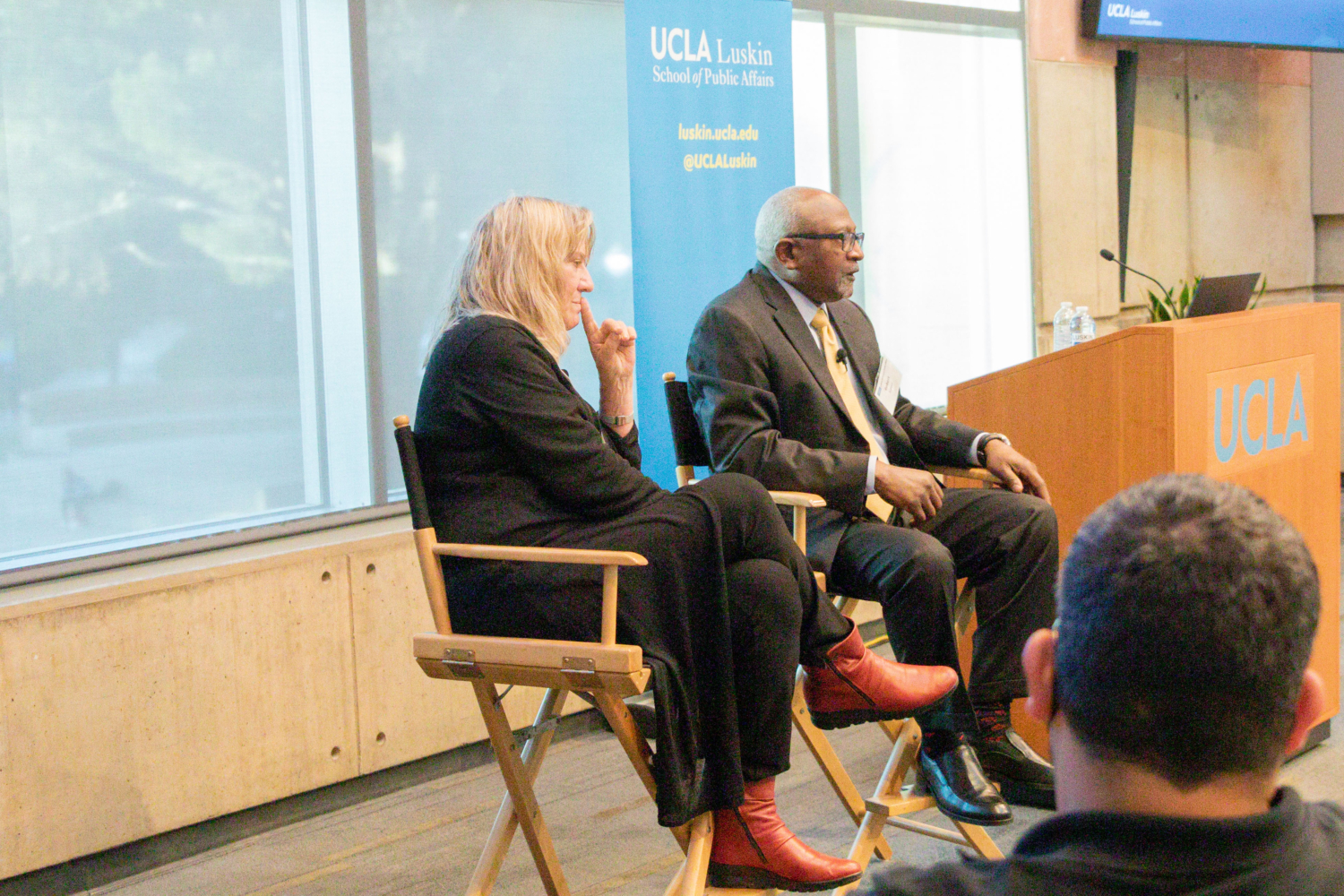
a female professor from UCLA and a male professor from Texas sit in the front of a lecture room after a lecture at UCLA
a crowd of people sit in chairs in a lecture room

Despite decades of experience documenting human nature at its worst, Bullard has not given in to despair.

“I’m hopeful and optimistic that we can get this right. I’ve been working on this for 40 years, but we don’t have another 40 years. We only have, maybe, a dozen to get this right,” Bullard said.

He cited California as a leader in environmental equity and climate change responses and noted the state’s history of finding out-of-the-box solutions in technology and government, as well as its highly regarded universities.

“Let California be California. That’s my answer. Push the envelope as far as you can,” Bullard said.

“And so, I’m looking to young people. I’m looking at your faces,” he told his audience of mostly young scholars. “You are the majority now. I’m a boomer and proud of it. But millennials, zoomers, Gen X, Y and Z — you outnumber my generation. Take the power.”

—

View photos from the event on Flickr.

Robert Bullard Luskin Lecture

Gary Segura Reappointed to 2nd Term as UCLA Luskin Dean

May 5, 2022/0 Comments/in Diversity, Education, For Faculty, For Policymakers, For Students, For Undergraduates, Latinos, Public Policy, Public Policy News, School of Public Affairs, Social Welfare, Social Welfare News, The Lewis Center, Urban Planning Evelyn Blumenberg, Lois Takahashi, Mark A. Peterson, Todd Franke /by Les Dunseith

Gary Segura will be continuing as dean of the UCLA Luskin School of Public Affairs.

An announcement to the UCLA campus was issued May 5 by Michael S. Levine, interim executive vice chancellor and provost. Here is the text of that announcement:

Following the customary administrative review, I am pleased to share that Gary Segura has been reappointed for a second term as the dean of the Luskin School of Public Affairs. The review committee praised Dean Segura for his leadership skills, his commitment to faculty excellence and diversity, and his pioneering efforts to elevate and expand his school’s academic offerings.

Since his appointment in 2016, Dean Segura has fostered within the Luskin School a deep commitment to academic excellence and to equity, diversity and inclusion that has led to a highly diverse pool of students in the school’s programs and the appointment of renowned scholars in areas such as poverty and inequality, immigration, criminal justice, education policy and more. In 2021, Luskin School faculty members were among the top 2% for scholarly citations worldwide in their respective fields. The Luskin School is one of the most diverse schools of its kind in the UC system and amongst public affairs programs throughout the country.

Over the last five years, Dean Segura has helped to cement the Luskin School’s status as a leader in research, teaching and practice across the areas of social welfare, urban planning and public policy. Recognizing growing demand for his school’s programs, in 2018 he led the development of the undergraduate major in public affairs, which provides a multidisciplinary foundation in social science theories, data collection and analysis. Additionally, the school launched a certificate program in data analytics in fall 2021 and added a new dual master’s degree program offered jointly by our Urban Planning Department and the Urban School of Sciences Po in Paris.

Dean Segura also co-founded the UCLA Latino Policy and Politics Initiative in 2017 to address inequities and spread awareness of the most critical domestic policy challenges facing Latinos and other communities of color. The initiative received $3 million in ongoing annual state funding for its research, advocacy and mobilization efforts.

We are grateful to have such a dedicated leader as Dean Segura at the helm of the Luskin School. Chancellor Block and I look forward to his continued efforts to strengthen and advance the public affairs disciplines at UCLA and to the impact his work will have on diverse communities near and far.

Please join me in congratulating Dean Segura on his accomplishments over the past five years and in wishing him success throughout his second term.

Sincerely,

Michael S. Levine
Interim Executive Vice Chancellor and Provost

Mayoral Roundtable Highlights Launch of Luskin Summit 2022 With a theme of “Research in Action,” the fourth annual series resumes with five webinars spotlighting UCLA’s role in understanding and solving issues of current public concern 

January 19, 2022/0 Comments/in Business and the Environment, Climate Change, Development and Housing, Diversity, Education, Environment, For Faculty, For Policymakers, For Students, For Undergraduates, Global Public Affairs, Health Care, Latinos, Politics, Public Policy, Public Policy News, Research Projects, School of Public Affairs, Social Welfare, Social Welfare News, Social Welfare PhD, Transportation, Urban Planning /by Les Dunseith

By Les Dunseith

A roundtable discussion about the upcoming election of a new mayor in Los Angeles and four other sessions focusing on timely policy issues made up the agenda when the UCLA Luskin School of Public Affairs launched its fourth annual Luskin Summit.

Of the 10 currently declared mayoral candidates, U.S. Rep. Karen Bass has the advantage of name recognition and national political experience, panelists agreed. But City Councilman Kevin de León was also cited as a favorite of many voters based on his prior experience in Sacramento and name recognition from an unsuccessful 2018 bid for U.S. Senate. 

The panelists included Steve Soboroff and Wendy Greuel, former mayoral candidates themselves. 

Soboroff, who ran for mayor in 2001 in a race won by James K. Hahn, said, “At this point, I think it’s Karen, plus one. And everybody else is trying to be that one.”

He cited Bass’ experience as an elected official at both the state and national levels. “A lot has to do with bringing resources from D.C. and from Sacramento to Los Angeles. And she has the best chance of bringing resources that the others can’t.”

Greuel, who ran for mayor in 2013 in a race won by Eric Garcetti, sees this year’s mayoral election as very close, with even greater uncertainty because of COVID-19 and its ever-evolving impact on society and public opinion. 

“Normally, if you were ahead [in polls] five months out, you’re good, you know, and it’s not going to change,” Greuel said about speculating on a political candidate’s prospects for victory. “Now, it changes on a weekly basis.”

Like the mayor’s race, the Luskin Summit was impacted by COVID-19, with the launch event taking place on a remote platform after having been originally planned as an in-person conference. This year’s theme is “Research in Action,” and the sessions include recent research from the Luskin School that relates to current policy issues. The Summit series will continue through April.

The other sessions on Jan. 19 were moderated by faculty members at UCLA Luskin whose areas of expertise include housing policy, climate change, transportation, and class and racial inequality. Recordings of all five sessions are available online.

Author and UCLA Luskin faculty member Jim Newton, the editor of UCLA Blueprint magazine, led the questioning during the mayoral panel. The panelists were Soboroff, Greuel, longtime officeholder and current UCLA faculty member Zev Yaroslavsky and Antonia Hernandez, the president and CEO of the California Community Foundation.

They agreed that homelessness is likely to remain a dominant issue as the mayoral candidates vie for voter attention and approval prior to the June 7 primary and a likely Nov. 8 runoff election.

“I think in every public opinion survey that’s been done in town for candidates … homelessness is No. 1 and nothing else comes close,” Yaroslavsky said. “But it’s more than just homelessness. From my point of view, many people just feel that the wheels are coming off the city and it’s just not working.”

Hernandez said voters are eager for leadership and trustworthiness. 

“They want to have a sense of the person —  not the political person but the real person. You’re electing a whole package, a whole human being,” she said. “I think the public is really tired of platitudes, you know: ‘I’m going to solve homelessness in the first year.’ Well, it took us 40 years to get to where we are.”

Yaroslavsky said candidates also must navigate sometimes unrealistic voter expectations. 

“It’s better to underpromise and overdeliver,” he said. “You’ve got to be honest with the people. One of the lessons I learned in 40 years in politics is that the electorate has a very sensitive BS-sniffing meter. They know when they’re being conned.”

Hernandez expressed similar thoughts:  “If it’s not honest, it’s not realistic, then the platitudes aren’t going to get you any votes,” she said.

Homelessness was also the focus of the Luskin Summit session led by Ananya Roy, a professor of urban planning, social welfare and geography who is director of the UCLA Luskin Institute on Inequality and Democracy.

In opening remarks, Miguel Santana of the Weingart Foundation set the stage for a discussion about expanding housing security for L.A.’s unhoused population without losing sight of each individual’s right to self-determination. 

“The thing that’s been missing at the heart of homeless service solutions are the actual voices of the people who have been impacted,” said UCLA alumna Ashley Bennett, a founding member of the community organization Ground Game LA. 

Joining Roy and Bennett was Gary Blasi, a UCLA professor emeritus of law whose scholarship has shed light on the plight of renters in California. 

“Homelessness begins with eviction,” he said. “These are not two separate things, they’re tightly linked.”   

A third session taking place during the Summit launch event focused on another issue of huge current public concern: climate change. The session zeroed in on the dangers of rising heat.

Climate change has increased the frequency and lethality of wildfires, floods and hurricanes, said moderator Kirsten Schwarz, associate professor of urban planning. “This session will explore design and policy interventions that can create more livable and resilient cities, specifically focusing on interventions aimed at protecting the most vulnerable populations,” she said.

Among the panelists was Kelly Turner, assistant professor of urban planning and the interim co-director of the Luskin Center for Innovation at UCLA. She spoke about possible mitigation strategies and the importance of partnering with communities that are most vulnerable to extreme heat.

“The burden of heat is incredibly inequitable,” Turner said. “We learn more from talking to the community members about all the pernicious ways heat can impact people and their daily lives. Involving these community groups is going to be essential to any solution.”

Other panelists were Veronica Padilla-Campos MURP ’06, executive director of the nonprofit Pacoima Beautiful; Kristen Torres Pawling MURP ’12, sustainability program director at the Los Angeles County Chief Sustainability Office, and Helen Dowling, data manager for the Public Health Alliance of Southern California. 

The Luskin School of Public Affairs is well-known for its research on transportation issues, and Adam Millard-Ball, associate professor of urban planning, moderated a session that included new research on the widespread impact of Uber, Lyft and other ride-hailing companies on a community’s economic, environmental and equity goals.

 “How can ride-hailing best serve the public interest?” he asked. “Certainly, on the positive side, ride-hailing is an important mobility option, particularly for people who don’t have a car or perhaps people who can’t drive. But at the same time Uber and Lyft mean more traffic and more local air pollution.”

About a fifth of drivers simply drive around, burning more gasoline and creating more congestion and pollution, according to Millard-Ball and fellow presenter Joe Castiglione, deputy director for technology, data and analysis at the San Francisco County Transportation Authority. 

Also participating in this panel was Saba Waheed, research director at the UCLA Labor Center, who noted that gig workers have few employment protections.

The fifth panel discussion of the Summit launch event focused on the impacts of the COVID-19 pandemic on systemic class and racial inequality.

Paul Ong, research professor and director of the Center for Neighborhood Knowledge at UCLA Luskin, was joined by Silvia González, a former colleague at CNK who now works with the UCLA Latino Policy and Politics Initiative; Karen Umemoto, a professor of urban planning and director of the UCLA Asian American Studies Center; and Vickie Mays, a professor of psychology and health services at UCLA.

“Clearly we all understand the last two years has transformed the way we live, work and socialize,” Ong said. “The pandemic has been a once-in-a-century public health crisis, but beyond that, it’s also a pandemic that has generated dramatic economic disruption.”

He noted that racial disruption has been another byproduct, including a rise in hate crimes directed at Asians and health disparities experienced by other races.

The panelists also discussed the so-called digital divide and how unequal access to high-speed internet connections have impacted education, social and racial relationships during the pandemic. 

“I think one of the things that we don’t really know exactly the impact of yet is the impact on children for those who don’t have internet access,” Umemoto said.  

Leading the city toward solutions to such issues is an expectation of the Los Angeles mayor. Among voters’ biggest concerns is rising crime and how the LAPD should approach it. Los Angeles is among the cities increasingly turning to community policing tactics. 

“It’s preventative policing. It’s getting involved with the communities. It’s having a hundred different programs to keep kids from submitting to gangs and submitting to the influences that make them break laws,” said Soboroff, a longtime member of L.A.’s Board of Police Commissioners. “A candidate needs to understand that.”

Yaroslavsky, whose legacy as an officeholder includes police reform, is interested in seeing how the mayoral candidates talk about crime. 

“How will the candidates frame it? Are you going to land on one end or the other?” he asked. “I’ve always maintained that good community and police relations, and public safety, are not mutually exclusive.”

The choice of mayor is important, the panelists said, even though the mayor of Los Angeles has limited authority to enact unilateral change.

“In Los Angeles, we have 21 people — 15 council members, one mayor and five supervisors — that control everything,” Soboroff said. “The issue is not about taking power; it’s about giving up power … so something can get done.” 

Hernandez said candidates like Bass, de León, City Attorney Mike Feuer and City Councilman Joe Buscaino all have solid records as public servants. 

“They are good, decent people. They have served in different positions in government, and … you know that they care deeply about the place,” she said. “So, the real issue is how are they going to bring us together and make us believe that government can work for the people.”

Greuel, whose deep public service experience includes being the current chair of the Board of Advisors at UCLA Luskin, said winning the San Fernando Valley remains pivotal to the mayor’s race. Yaroslavsky agreed, but noted that changing demographics in the Valley, and throughout Los Angeles, mean that strategies that won past elections may not hold true anymore.

“It’s a much more complicated electorate now,” he said. 

The Luskin Summit is scheduled to resume Feb. 15 with a session focusing on voter suppression attempts. Sessions to follow will look at policy issues from a global perspective. Details about the Luskin Summit series can be found online, and interested parties may register at this link. 

Luskin Summit 2022 will close April 22 with a two-session event focusing on the Quality of Life Index, a project under the direction of Yaroslavsky in his role with the Los Angeles Initiative at UCLA, and a roundtable discussion about the importance of governors in California moderated by Newton. It will be presented both virtually and in-person on the UCLA campus if COVID-19 protocols allow. 

This year’s Luskin Summit sponsors are the Weingart Foundation, the Wasserman Foundation, the David Bohnett Foundation, the California Wellness Foundation and the Los Angeles Rams. The media partner is ABC7 in Los Angeles.

Stan Paul and Mary Braswell also contributed to this story.

Wells Fargo Provides $500,000 for LPPI, CNK Research The grant to UCLA research groups will support policy solutions to benefit small business owners of color

December 3, 2021/0 Comments/in Business and the Environment, Climate Change, Diversity, For Faculty, For Policymakers, For Students, For Undergraduates, Latinos, Politics, Public Policy, Public Policy News, Research Projects, School of Public Affairs Paul Ong /by webteam

A new grant of $500,000 from Wells Fargo will support efforts by researchers affiliated with the Luskin School to determine best practices and policy solutions to benefit businesses operated by persons of color.

The award will go to the UCLA Latino Policy and Politics Initiative (UCLA LPPI) and the Center for Neighborhood Knowledge (CNK) for research aimed at increasing access to capital, technology and environmentally sustainable practices for these businesses.

“COVID-19’s disparate impact on small business owners of color highlighted the enduring legacy of structural barriers that impede economic opportunity and social mobility for large swaths of working Americans,” said Maria Samaniego, deputy director of UCLA LPPI. “This grant will allow us to develop policy research and resources that are specifically tailored to the needs of communities of color, which have the power to transform small business ownership in ways that will drive our economy for generations.”

UCLA LPPI and CNK will focus on understanding how to broaden access to financial services and technology tools. They will also explore how to best leverage public, private and social partnerships to boost the entrepreneurship potential of small businesses owned by Latinos and other people of color. The findings will lead to more informed decisions about post-COVID economic recovery policy relating to minority-owned businesses. Another goal will be increasing labor force participation in those communities.

“We cannot ignore the bright spotlight the pandemic has put on inequity, nor the responsibility and opportunity we have to close gaps in resources that have existed for far too long,” said Jenny Flores, head of small business growth philanthropy at Wells Fargo. “Investing in UCLA LPPI and CNK will offer an in-depth view into how the public and private sectors can better support and accelerate access for business owners of color who will be at the forefront of building an inclusive economy.”

Research Professor Paul Ong, director of CNK, pointed to previous research from UCLA that has identified economic and social impacts of the COVID-19 pandemic and produced insight into how society’s systems and institutions often work against the interests of people in disadvantaged communities. “With this funding, we will be able to pinpoint the exact systemic barriers and to generate the knowledge to remove them for future generations,” he said. “Equally important, new insights will inform new practices that create greater equity for people of color.”

Support from Wells Fargo will also enable UCLA LPPI and CNK to identify best practices in sustainability that small businesses can adopt to help them meet the challenges presented by climate change.

Endowed Chair Awarded in Honor of Former Dean Gilliam New chair in social justice will benefit the research of Manisha Shah, a professor whose global policy focus includes child health and intimate partner violence

November 15, 2021/0 Comments/in Alumni, Diversity, Environment, For Faculty, For Policymakers, For Students, For Undergraduates, Global Public Affairs, Health Care, Politics, Public Policy, Public Policy News, School of Public Affairs, Social Welfare News Gary Segura, Manisha Shah /by Les Dunseith

By Les Dunseith

The Luskin School of Public Affairs presented its newest endowed chair to Professor Manisha Shah on Nov. 9 with the chair’s namesake, former Dean Frank Gilliam, and its benefactors, Meyer and Renee Luskin, in attendance.

The Franklin D. Gilliam, Jr. Chair in Social Justice, which was created by the Luskins as part of their naming gift to the Luskin School in 2011, will provide financial support for Shah’s research throughout a five-year term as holder of the chair. She is a professor of public policy who joined the UCLA Luskin faculty in 2013.

Gilliam’s long tenure at UCLA as a professor and then dean ended in 2015 when he became the chancellor of the University of North Carolina at Greensboro. He said it is an honor to have his name attached to an award focusing on social justice.

“I am extremely humbled and honored that the Luskins have created an endowed professorship in my name,” Gilliam told an audience of about 75 invited guests who assembled on the festively redecorated third-floor rooftop of the Public Affairs Building.

The social justice focus of the endowment was particularly meaningful for Gilliam. “These are issues I’ve spent my entire professional and personal life working on and I continue to do so today,” he said.

As the holder of the endowed chair, Shah said she plans to further her attempts to understand the barriers that prevent women and girls around the world from living their best lives, an issue that led her to found the Global Lab for Research in Action at UCLA in 2019.

“What do we do at the lab? Through a gender lens, we focus on hard-to-reach populations, understudied populations, and we look at groups like adolescents and sex workers and low-income women. We study critical issues related to child health and intimate partner violence and sexual health,” Shah said during her remarks. “Ultimately, the idea is that we’d like to shift public conversation and eventually shift some of the social norms.”

Gilliam, who first hired Shah to join the faculty at UCLA, expressed pride and excitement that she had been chosen as the inaugural holder of the chair in his name.

“She is a remarkable person, a remarkable intellect,” Gilliam said. “Her work is so important. It spans disciplines like economics and public policy and really social welfare, quite frankly. She focuses on the most understudied topics and the most overlooked populations. … This is big stuff.”

Current Dean Gary Segura noted the pivotal role that Gilliam played in bringing social justice to the forefront during his time as dean, shaping the sometimes-disparate disciplines within the Luskin School into a unifying vision.

“Frank Gilliam, perhaps more than any single other leader in the School’s history, shaped the social justice mission and identity of the Luskin School of Public Affairs,” Segura said.

Professor Manisha Shah describes her scholarship, which focuses on women and girls around the world. Photo by Les Dunseith

In his remarks, Meyer Luskin said his observations of Gilliam’s leadership and priorities helped lead him toward making the $50 million naming gift to the Luskin School a decade earlier.

“I saw dedication, courage, morality and ethics, empathy, much resourcefulness, strength and kindness, intelligence, hard-working, visionary, loyalty, a great sense of humor, and a man most devotedly committed to justice and equality,” he said.

Segura thanked the Luskins for their foresight and generosity in endowing the new chair, plus three other previously awarded chairs benefitting professors at UCLA Luskin.

Gilliam said their selflessness is well-represented among people associated with the professions of social work, public affairs and urban planning that are taught at the Luskin School.

“The people who work in your area often go unnoticed. They don’t do it for the fame, they don’t do it for the fortune,” he said. “This is hard work, it’s complicated work. It’s real work … on the ground, dealing with real-world policy problems that affect the society.”

Gilliam surveyed the crowd of family, friends and former colleagues who had gathered to celebrate Shah and recognize an endowment that will forever carry his name. Ultimately, said the former professor, dean and current chancellor, it’s about passion for the cause, the mission, embodied for Gilliam in the words spoken by Meyer Luskin when they first met:

“My goal in life is to make the world a better place.”

View additional photos:

Gilliam Endowed Chair

Page 3 of 17‹12345›»

Recent Posts

  • One Year After the Fires, Recovery Remains Uneven January 8, 2026
  • Oil and Gas Companies Sacrificing Plastic-Burdened Communities January 7, 2026
  • A sixth-generation Altadena resident presents a community recovery roadmap after the fires January 7, 2026
  • Risks of Privatization of Fannie Mae and Freddie Mac January 6, 2026
  • Pandemic Relief Programs Helped Small Businesses Survive, but Fraud Risk Remains January 5, 2026

Contact

UCLA Luskin School of Public Affairs

3250 Public Affairs Building - Box 951656
Los Angeles, CA 90095-1656

Campus Resources

  • Maps, Directions, Parking
  • Directory
  • Contact
  • Academic Calendar
  • Careers
  • Diversity
  • University of California
  • Terms of Use

Follow

The statements on this page represent the views of people affiliated with the Luskin School of Public Affairs and do not necessarily represent the views of the University of California, or UCLA or its Chancellor.

Posts and comments by individuals at UCLA on social media channels may not reflect the opinions or policies of UCLA, the University of California or the Luskin School, nor its benefactors and academic partners.

Scroll to top