• Public Policy
  • Social Welfare
  • Real Estate Development
  • Urban Planning
  • Luskin Home
  • Undergraduate Program
  • Stay in Touch
  • Events Calendar
  • Give Now
  • About
    • Our Dean
    • Board of Advisors
    • Contact Us
    • Visit Us
    • Diversity, Disparities and Difference
    • Communications
      • UCLA Luskin in the News
      • Luskin Forum Online
  • Departments
    • Public Policy
    • Real Estate Development
    • Social Welfare
    • Undergraduate Program
    • Urban Planning
  • Apply
    • Master of Public Policy
    • Master of Real Estate Development
    • Master of Social Welfare
    • Master of Urban and Regional Planning
      • Double Degree With Sciences Po
    • PhD in Social Welfare
    • PhD in Urban Planning
    • Undergraduate Programs
  • Faculty
    • All
    • Public Policy
    • Social Welfare
    • Urban Planning
    • Real Estate Development
    • Faculty Executive Committee
    • Open Positions
  • Student Affairs & Alumni
    • Career Services
      • Employers
      • Fellowships
    • Student Support
    • Graduate Resource Library
    • Alumni Relations
  • Support
  • Programs
    • Research Centers & Affiliated Research
    • CA Title IV-E Education Program
    • Global Public Affairs (GPA)
    • Data Analytics Certificate
    • Luskin Lecture Series
    • Luskin Summit
    • UCLA Luskin California Policy Briefing
    • Public Service Weekend
    • Commencement
  • Administration
    • Financial Services
    • Events Office
    • Information Technology
  • Search
  • Menu Menu

Archive for category: School of Public Affairs

Report Focuses on Deaths of Unhoused People During Pandemic Luskin Institute on Inequality and Democracy analysis delves into coroner’s data between March 2020 and July 2021

December 2, 2021/0 Comments/in Development and Housing, For Faculty, For Policymakers, For Students, For Undergraduates, Health Care, Public Policy, Public Policy News, Research Projects, School of Public Affairs, Social Welfare, Social Welfare News, Urban Planning Ananya Roy /by Les Dunseith

By Les Dunseith

A newly released report from the UCLA Luskin Institute on Inequality and Democracy examines coroner’s data to provide a detailed profile of people in Los Angeles County who may have been unhoused when they died during the worst months of the COVID-19 pandemic. 

The report looks at publicly available data from the Los Angeles County Examiner-Coroner’s website and filters it based on locations of death closely affiliated with unhoused status. Researchers identified 1,493 persons who may have been unhoused when they passed away on Los Angeles County’s streets or in outdoor spaces between March 2020 and July 2021. 

Researchers looked separately at the 418 deaths that occurred in L.A. County hotel or motel rooms during the same time period. The report argues that these deaths should also be examined because such locations served as a primary site of residency for the unhoused amid the pandemic as part of the state’s COVID-19 response targeting the homeless population, known as Project Roomkey, or because these persons were likely experiencing dire housing precarity and relied on hotel and motel rooms as housing of last resort.

Nearly half of those who died in hotel/motel locations were white and almost 30% were women. Roughly 3 in 5 of the deaths were attributed by the coroner to drug or alcohol overdose.

At a time when public concern about overdoses is growing, the report calls for a deeper understanding, viewing such deaths “not as individual acts of overdose but rather as a collective condition of suffering caused by displacement.” The report also includes profiles of two unhoused community members who died during this time, Tony Goodwin and Salvy Chic. 

Institute Director Ananya Roy, professor of urban planning, social welfare and geography, wrote in the report: “We have felt the imperative to present this analysis of coroner’s data because it provides an understanding of key patterns and trends that are of direct relevance to the struggle for justice and freedom in Los Angeles.” 

Other key findings include: 

  • Over 35% of the deaths were at locations designated as sidewalks.
  • The average age at the time of death was 47.
  • The coroner attributed nearly half to an accidental manner of death, with less than one-fifth attributed to natural causes. Among the accidental deaths, almost 40% were attributed by the coroner to drug or alcohol overdose. 

Chloe Rosenstock, a UCLA undergraduate student and Street Watch LA organizer, was a co-author of the report, which is titled, “We Do Not Forget: Stolen Lives of L.A.’s Unhoused Residents During the COVID-19 Pandemic.” It was prepared in cooperation with the After Echo Park Lake research collective led by Roy, with guidance from Unhoused Tenants Against Carceral Housing (UTACH) and organizers in Street Watch LA and Ground Game LA.

Endowed Chair Awarded in Honor of Former Dean Gilliam New chair in social justice will benefit the research of Manisha Shah, a professor whose global policy focus includes child health and intimate partner violence

November 15, 2021/0 Comments/in Alumni, Diversity, Environment, For Faculty, For Policymakers, For Students, For Undergraduates, Global Public Affairs, Health Care, Politics, Public Policy, Public Policy News, School of Public Affairs, Social Welfare News Gary Segura, Manisha Shah /by Les Dunseith

By Les Dunseith

The Luskin School of Public Affairs presented its newest endowed chair to Professor Manisha Shah on Nov. 9 with the chair’s namesake, former Dean Frank Gilliam, and its benefactors, Meyer and Renee Luskin, in attendance.

The Franklin D. Gilliam, Jr. Chair in Social Justice, which was created by the Luskins as part of their naming gift to the Luskin School in 2011, will provide financial support for Shah’s research throughout a five-year term as holder of the chair. She is a professor of public policy who joined the UCLA Luskin faculty in 2013.

Gilliam’s long tenure at UCLA as a professor and then dean ended in 2015 when he became the chancellor of the University of North Carolina at Greensboro. He said it is an honor to have his name attached to an award focusing on social justice.

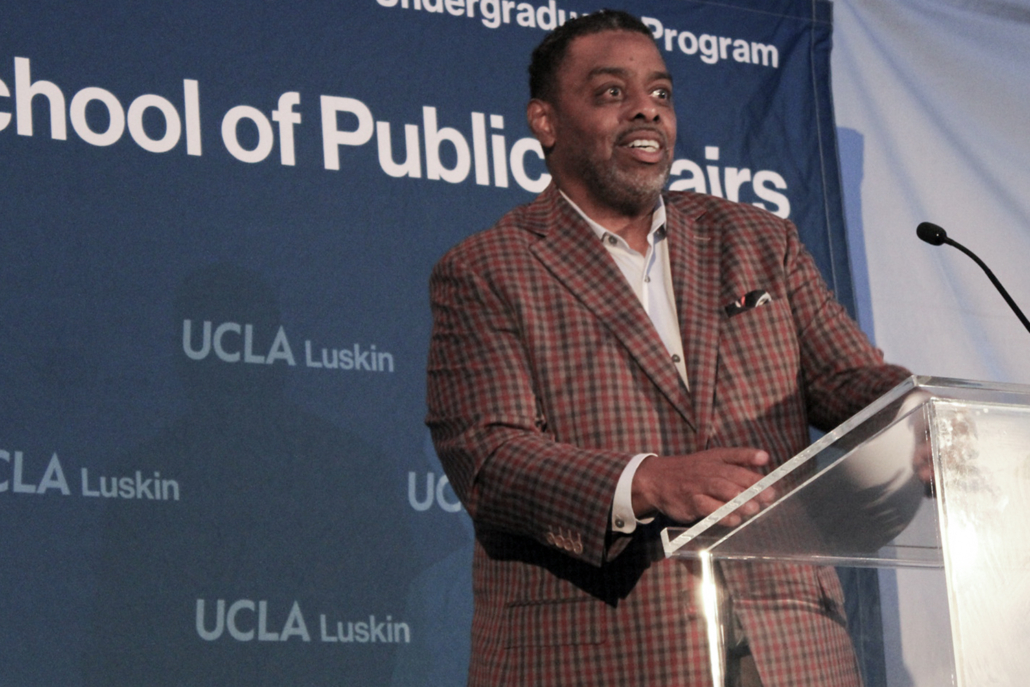
“I am extremely humbled and honored that the Luskins have created an endowed professorship in my name,” Gilliam told an audience of about 75 invited guests who assembled on the festively redecorated third-floor rooftop of the Public Affairs Building.

The social justice focus of the endowment was particularly meaningful for Gilliam. “These are issues I’ve spent my entire professional and personal life working on and I continue to do so today,” he said.

As the holder of the endowed chair, Shah said she plans to further her attempts to understand the barriers that prevent women and girls around the world from living their best lives, an issue that led her to found the Global Lab for Research in Action at UCLA in 2019.

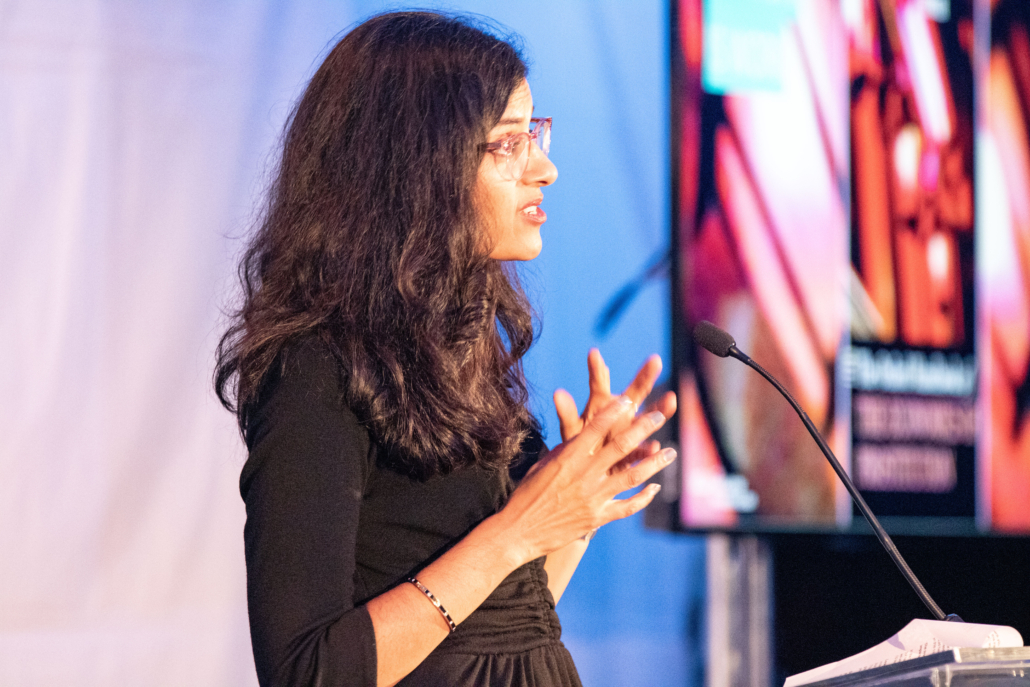
“What do we do at the lab? Through a gender lens, we focus on hard-to-reach populations, understudied populations, and we look at groups like adolescents and sex workers and low-income women. We study critical issues related to child health and intimate partner violence and sexual health,” Shah said during her remarks. “Ultimately, the idea is that we’d like to shift public conversation and eventually shift some of the social norms.”

Gilliam, who first hired Shah to join the faculty at UCLA, expressed pride and excitement that she had been chosen as the inaugural holder of the chair in his name.

“She is a remarkable person, a remarkable intellect,” Gilliam said. “Her work is so important. It spans disciplines like economics and public policy and really social welfare, quite frankly. She focuses on the most understudied topics and the most overlooked populations. … This is big stuff.”

Current Dean Gary Segura noted the pivotal role that Gilliam played in bringing social justice to the forefront during his time as dean, shaping the sometimes-disparate disciplines within the Luskin School into a unifying vision.

“Frank Gilliam, perhaps more than any single other leader in the School’s history, shaped the social justice mission and identity of the Luskin School of Public Affairs,” Segura said.

Professor Manisha Shah describes her scholarship, which focuses on women and girls around the world. Photo by Les Dunseith

In his remarks, Meyer Luskin said his observations of Gilliam’s leadership and priorities helped lead him toward making the $50 million naming gift to the Luskin School a decade earlier.

“I saw dedication, courage, morality and ethics, empathy, much resourcefulness, strength and kindness, intelligence, hard-working, visionary, loyalty, a great sense of humor, and a man most devotedly committed to justice and equality,” he said.

Segura thanked the Luskins for their foresight and generosity in endowing the new chair, plus three other previously awarded chairs benefitting professors at UCLA Luskin.

Gilliam said their selflessness is well-represented among people associated with the professions of social work, public affairs and urban planning that are taught at the Luskin School.

“The people who work in your area often go unnoticed. They don’t do it for the fame, they don’t do it for the fortune,” he said. “This is hard work, it’s complicated work. It’s real work … on the ground, dealing with real-world policy problems that affect the society.”

Gilliam surveyed the crowd of family, friends and former colleagues who had gathered to celebrate Shah and recognize an endowment that will forever carry his name. Ultimately, said the former professor, dean and current chancellor, it’s about passion for the cause, the mission, embodied for Gilliam in the words spoken by Meyer Luskin when they first met:

“My goal in life is to make the world a better place.”

View additional photos:

Gilliam Endowed Chair

Stoll Named Director of UCLA’s Black Policy Project A key priority is making research into the state of Black California accessible to policymakers and the public

November 10, 2021/0 Comments/in For Faculty, For Policymakers, For Students, For Undergraduates, Public Policy, School of Public Affairs, Urban Planning Michael Stoll /by Mary Braswell

By Jessica Wolf

Michael Stoll, professor of public policy and urban planning, is the new director of the Black Policy Project, which is housed at the UCLA Ralph J. Bunche Center for African American Studies.

Stoll’s goals for the project include commissioning a report to examine the demographic changes of Black California; generating research on wealth inequity in the state; and supporting California’s new task force on reparations, the first of its kind in the country.

Each of those efforts, he said, will involve UCLA students, and each will produce materials meant to be useful to policymakers and the public at large.

“We want to be a good public ally and create accessible research for the layperson — information that engages in affairs that are of interest to and about Black California,” he said.

Stoll also plans to build on a study he launched nearly 20 years ago: a broad analysis of the state of Black California. He intends to incorporate a new “equality index” that will help illustrate Black residents’ socioeconomic progress, considering several different measures, over the past two decades.

And he foresees events and panel discussions that would bring members of the campus and Los Angeles communities together with elected officials and other California decision-makers.

The Black Policy Project is one of several Bunche Center initiatives that will benefit from $5 million in funding from the 2021-22 California state budget.

It’s the largest amount of support the center has received in a single year from the state, said Kelly Lytle Hernandez, the center’s director and a UCLA professor of history, African American studies and urban planning.

In addition to the Black Policy Project, the funds will support initiatives including Million Dollar Hoods, an ongoing study of incarceration in Los Angeles, and the Bunche Fellows Program, which provides stipends for students to work with leading faculty whose research has a vested interest in improving Black lives.

Read full story


Gas Bill Debt Disproportionately Burdens Low-Income Neighborhoods As California’s utility shutoff ban ends, UCLA research shows where unpaid gas utility bills proliferated amid the pandemic

November 1, 2021/0 Comments/in Business and the Environment, Climate Change, For Faculty, For Policymakers, For Students, For Undergraduates, Latinos, Luskin Center, Public Policy, Public Policy News, Research Projects, Resources, School of Public Affairs, Social Welfare, Social Welfare News, Urban Planning /by webteam

By Lauren Dunlap

Unpaid bills for heating and cooking gas are unevenly distributed among Californians, according to a new report from the Center for Neighborhood Knowledge at UCLA Luskin in partnership with the Latino Policy and Politics Initiative (LPPI) and the Luskin Center for Innovation.

Since Oct. 1, customers who are behind on utility bills are no longer protected from shutoffs by a statewide order enacted in April 2020 in response to the COVID-19 pandemic. The study reveals clear patterns of inequity: Neighborhoods with high gas bill debt rates also have higher poverty rates, lower incomes, more renters than homeowners and higher proportions of Black and Latinx residents than the average neighborhood served by Southern California Gas.

The research team analyzed data from the utility, which provides gas service to about 50% of California residents. The team found that, as of February 28, 2021, 1 in 5 customers were at least 30 days behind on their gas bill payments, and almost 1 in 10 were at least 90 days behind. 

The report provides several lessons for policymakers to equitably relieve the burden of utility debt on customers. The authors recommend improving the data available on utility debt and shutoffs to lead to better-informed decisions. They also note the importance of targeting relief aid at the most affected, lowest-income households. 

The co-authors also emphasize a connection between their findings and the growing movement toward building electrification. Transitioning residential buildings to run on electricity alone is significant to avoid greenhouse gas emissions — especially since natural gas is composed primarily of methane, a major contributor to climate change. But this transition may impose high costs on people who already face utility debt. 

“When higher-income households stop using gas, lower-income households may be saddled with higher and higher gas costs,” said Silvia González ’09, MURP ’13, UP PhD ’20, director of research at LPPI. “It is essential to make electrification equitable, which means households don’t get left behind or stuck with increasingly unmanageable energy costs.” 

Because lower-income households could be negatively impacted by the fixed costs of gas service — the costs that don’t go down when there are fewer customers — the researchers advise that more research is needed to understand and mitigate this impact. 

This study is the third and final in a series examining utility debt inequity during the COVID-19 pandemic. Previous policy briefs focused on unpaid utility bills among Los Angeles Department of Water and Power and Pacific Gas and Electric Company customers. 


State Can Do More to Protect Californians From Extreme Heat, Report Finds Top environmental policy experts say a comprehensive approach is needed to deal with state’s deadliest global-warming side effect

October 27, 2021/0 Comments/in School of Public Affairs /by Mary Braswell

A comprehensive statewide approach would better protect Californians from the Golden State’s deadliest climate change side effect: extreme heat. That’s according to “Adapting to Extreme Heat in California: Assessing Gaps in State-Level Policies and Funding Opportunities,” a new study by the UCLA Luskin Center for Innovation. 

“We analyzed California’s current patchwork quilt of regulations and funding sources that have developed in various agencies of the state government. We found that when it comes to protecting people and communities from the risks of extreme heat, there are a lot of policy gaps, and many risks that could be mitigated have slipped between the cracks,” said JR DeShazo, the study’s co-author and founding director of the UCLA Luskin Center for Innovation who recently joined the University of Texas at Austin as dean of the LBJ School of Public Affairs.   

The authors note that California is planning to spend $800 million over the next two years to address extreme heat and is also developing a framework for heat preparedness. The scholars hope the report can help Sacramento identify and fill gaps in the state’s heat-protective strategies. 

California’s average temperatures are rising because of climate change. This summer was the hottest in state history, and Californians can expect more frequent and severe heat waves in the coming decades.

Death certificates show that heat exposure caused 599 deaths in California between 2010 and 2019, while a recent Los Angeles Times investigation analyzed the number of excess deaths during periods of extreme heat, and put that number at about 3,900. In addition to damaging physical and mental health, extreme heat makes it harder for students to learn, and harder for workers to do their jobs safely and maximize their earning potential. Extreme heat also forces families to pay more to cool their homes; especially for low-income Californians, this makes electricity shutoffs more likely.

“Adapting to Extreme Heat in California” details existing policies and programs addressing extreme heat exposure in seven “priority settings” — places where exposure to heat can be especially consequential.

“For example, our report assesses policies connected to extreme heat exposure at home and at workplaces, because that’s where most people spend most of their time. And because kids and elderly adults are especially vulnerable to heat-induced health impacts, we looked at schools, child-care facilities and assisted living facilities for seniors,” said Gregory Pierce, co-director of the UCLA Luskin Center for Innovation. Other priority settings analyzed in the report include transit stops, public outdoor spaces, prisons and other correctional facilities.

The report’s authors point out that there is no centrally responsible state authority to provide technical assistance, strategic funding or coordination to sister agencies to address the issue of heat, and that is a problem.

“We probably don’t want to put all statutory authority for heat risk regulation and resiliency into the hands of one agency — we’re not envisioning Homeland Security for heat. But Californians would benefit from a single authority that plays a robust coordinating and supporting role,” DeShazo said.

The researchers note that a central heat authority could conduct, commission and share research; coordinate development of statewide heat-risk-reduction policies; organize interagency cooperative efforts; promote public education; and fill in funding gaps.

The report’s other key findings include the following:

  • Most existing California heat-exposure standards are inadequate, or have limited compliance. And for some priority settings, there are no standards at all. For example, there are no rules about keeping kids in school or people at home safe from extreme heat. And while building codes require all residences to be equipped to keep occupants warm, there is no equivalent rule requiring that they keep residents sufficiently cool.
  • Most existing state programs do not make investments that explicitly target heat-vulnerable places or quantify heat risk-reduction benefits. The report’s authors reviewed over 20 programs overseen by 10 different state agencies that fund heat-relevant measures, such as the Urban Greening Program and the Low-Income Weatherization Program. None have heat-risk reduction as their primary objective.
  • Local planning efforts may not prepare cities adequately for extreme heat. For example, state laws (SB 379, SB 1035) require local governments to update their general plans to address climate adaptation and resiliency by 2022. But implementing effective heat-reduction strategies will require additional investments for training, staff capacity and funding.
  • Improving thermal comfort in public spaces and reducing urban heat island effects rely largely on voluntary state guidance. For example, California Building Energy Efficiency Standards require cool roofing materials, but only for newly constructed buildings, retrofits or building additions. And the CalGreenCode includes measures to reduce the urban heat island effect that results in city temperatures being higher than rural temperatures, but these measures are voluntary and lack readily accessible state financing assistance.

A growing body of research finds low-income communities and communities of color are disproportionately affected by extreme heat, due to structural discrimination and social inequities.

“Historically neglected communities have endured more than their fair share of harm from extreme heat and other effects of climate change, and must be front and center as California works on protecting its people as the world continues to warm,” Pierce said. “As the state considers a framework for heat preparedness and community resilience, equity must be a guiding principle.”

UCLA Scholars Aim to Help Shape President Biden’s Justice40 Initiative Report by Luskin Center for Innovation provides framework for environmental justice in disadvantaged communities

October 20, 2021/0 Comments/in Climate Change, Environment, For Faculty, For Policymakers, For Students, For Undergraduates, Luskin Center, School of Public Affairs Colleen Callahan, J.R. DeShazo /by Mary Braswell
One week after his inauguration, President Joe Biden ordered federal agencies to direct 40% of the government’s investments in climate and clean infrastructure to benefit people in disadvantaged communities. According to his executive order, the Justice40 Initiative is intended to “address the disproportionate health, environmental, economic and climate impacts on disadvantaged communities.”

Implementing the directive will not be simple, but a new report by scholars from the UCLA Luskin Center for Innovation, advised by environmental justice leaders, provides a framework that federal officials could use to maximize Justice40’s impact.

“One initiative alone can’t erase systemic racial and environmental injustices, but setting a strong, equity-centered framework for Justice40 is a first step in the right direction,” said Colleen Callahan, deputy director of the Luskin Center and a co-author of the report.

The report analyzes state-level programs seeking to address environmental justice through investments in clean energy and climate change action — already underway in some cases, and in planning stages in others — and identifies shortcomings, ongoing challenges and successes that could help inform the implementation of Biden’s plan.

The authors set forth three primary areas of emphasis for the initiative:

  • Resources. Focus investments on the people who need it most. Provide funding to under-resourced communities for physical infrastructure projects, like clean water systems, as well as technical support to help local officials and community organizations apply for and manage funds they might receive through Justice40. The authors also recommend that the initiative’s 40% funding goal should be considered the minimum percentage of investments in disadvantaged communities, and that the figure should represent direct investments — rather than counting trickle-down benefits — for those communities.
  • Empowerment. The initiative should pursue a ground-up approach by enabling those who live in under-resourced communities to help set policy and determine what local investments are made.
  • Accountability. The initiative must include guardrails to ensure that all government agencies and contractors involved further the goals of environmental, racial, economic and health justice. The scholars write that Justice40 could be a catalyst for the federal government to help institutionalize equity including by pushing back on entrenched practices and rules that uphold inequities in government.

The authors list five types of disparities that Justice40 should seek to address: pollution burdens, climate risk, communities’ limited ability to apply for and manage federal funding, effects on labor and jobs, and environmental policy costs. They also identify numerous states that have plans or have already begun taking action to address those concerns, which disproportionately affect communities of color and low-income households:

  • New York is planning to address those communities’ elevated exposure to pollution and its related effects on their health.
  • Virginia is planning to address the uneven effects of storms, rising sea levels and other effects of climate change.
  • California is investing in helping local officials and community groups apply for funding for under-resourced communities.
  • Illinois and Maryland are planning to help provide job training for workers transitioning into clean energy jobs and financial support for those whose careers are being affected by the loss of jobs in the fossil fuel industry.
  • The state of Washington is allocating funds to increase access to clean technology and lowering utility costs for low-income households.

The report explains that initiatives like those demonstrate that residents, workers and businesses can benefit from clean energy and climate investments across a range of sectors —  including agriculture, health, housing, energy, transportation and water infrastructure.

“A theme across the states we studied is a history of grassroots strategy and organizing by communities of color,” said Silvia González, a co-author of the report and the director of research at the UCLA Latino Policy and Politics Initiative. “In states such as California, New York and Illinois, those communities have helped shape investment plans and programs to be more equitable.”

The researchers specifically examine California Climate Investments, a statewide initiative that has directed billions of dollars to disadvantaged communities.

The research was funded in part by the Heising-Simons Foundation, the Climate and Clean Energy Equity Fund and the Hewlett Foundation. The report’s other authors are Daniel Coffee, a UCLA associate project manager, and J.R. DeShazo, the former director of the Luskin Center for Innovation and current dean of the LBJ School of Public Affairs at the University of Texas. The study’s advisers included leaders of GreenLatinos, the Asian Pacific Environmental Network, Kentuckians For The Commonwealth and other nonprofits.

A Platform for Elevating Student Voices As UCLA's student body president, public affairs major Breeze Velazquez embraces the role as an advocate for her peers

October 12, 2021/0 Comments/in Education, For Students, For Undergraduates, School of Public Affairs Meredith Phillips /by Mary Braswell

By Mary Braswell

During UCLA’s year of remote learning, Breeze Velazquez spent much of her time advocating for other Bruins.

Working one-on-one with students who believed they had been unfairly accused of academic dishonesty was not a role she had ever expected to play.

But it was one step on a surprising journey that led the senior public affairs major to seek and win the office of president of the UCLA Undergraduate Students Association Council.

“The crazy thing is, I never saw myself ever running for USAC,” Velazquez said. “I was an introvert. I had no social media up until last year.”

But in her public affairs coursework, as well as through internships with organizations like JusticeLA, MALDEF and Unite-LA, Velazquez found her own voice by helping others find theirs.

Her campaign for student body president focused on meeting the unique needs of first-generation, low-income students of color.

“I drew upon my own experiences and the experiences of my peers,” she said. “I grew up with a single mom. I grew up low-income, as well. And you know, I’m the first in my family to attend college.”

Those experiences helped shape a platform based on listening to the concerns of a wide range of students, then helping them connect with the right contacts in the UCLA administration. So far this year, this has included helping undocumented students navigate the university’s financial aid system and advocating for the creation of a special office to provide resources to those accused of academic dishonesty.

During the COVID-19 lockdown last year, UCLA saw an uptick in these cases, with students struggling to defend themselves over Zoom, said Velazquez, who at the time was the student body’s academic affairs commissioner. While providing guidance in these cases was not a formal part of her responsibilities, she decided to step in.

“One of the things I liked most about the role was the work that I got to do one-on-one with students,” she said. “I really fell in love with this project because I really see myself advocating for students in the future.”

Velazquez acknowledged that managing her academic workload, juggling several part-time jobs and serving in student government — which can be a lightning rod for criticism — has been physically and emotionally draining, especially during the pandemic.

She has leaned on friends and a tight-knit family, and has drawn support from the public affairs department she joined as a freshman pre-major.

“I just really found a community within the major. The students are so compassionate,” she said.

“And I look back on some of the professors I had who really supported me. Meredith Phillips, she was amazing,” Velazquez said of the undergraduate program’s founding chair. “I have gone to her for advice time and time again, even right now.”

Her coursework in public affairs, as well as Chicana/o and Central American studies — both intimate, interdisciplinary programs — has also helped bring her life goals into focus. Each department encouraged her to engage in the community and take advantage of course offerings from across campus, including in policy, education and law — fields she is interested in pursuing after graduation.

Until then, she’ll spend her year as student body president working to elevate the voices of students and helping them access UCLA resources.

“As difficult as it has been and as much as I never pictured myself taking on this role, … I know that I care about this and I’m strong enough because I was raised the right way,” she said. “My mom taught me that I’m a strong woman and no one’s going to deter what I need to get done.”

A New Role for a Climate Justice Expert  As associate faculty director at the UCLA Luskin Institute on Inequality and Democracy, Kian Goh brings a global perspective on environmental issues

September 27, 2021/0 Comments/in Diversity, For Faculty, For Policymakers, Global Public Affairs, School of Public Affairs, Urban Planning Ananya Roy, Kian Goh /by Les Dunseith

By Les Dunseith

UCLA’s Kian Goh, who studies the politics around cities’ responses to climate change, becomes an associate faculty director as of the fall quarter at the UCLA Luskin Institute on Inequality and Democracy.

She said the institute is a leader in working with and alongside movement-based organizations fighting for change.  

Goh, an assistant professor of urban planning at the UCLA Luskin School of Public Affairs, noted that the typical presumptions of objective research in the social sciences sometimes conflicts with the desire to see the problem from the point of view of oppressed groups, in order to challenge unjust systems and promote greater equity in decision-making in cities. Overcoming this hurdle as it relates to urban responses to climate change is one of the objectives of her recently published book, “Form and Flow: The Spatial Politics of Urban Resilience and Climate Justice.”

“This type of positional research is more attuned to how structural power actually works,” Goh said. “And it’s what I think the Institute on Inequality and Democracy does incredibly well. I’m so excited to be part of it.”

Ananya Roy, the inaugural director of the Institute which was founded in 2016, said Goh’s global perspective and her expertise in community responses to environmental problems are ideally suited to bolster the institute’s efforts to pair critical thought with social movements and activism in the interest of combating societal inequalities.

“Climate justice is of central concern to the institute’s current research priorities, from housing justice to abolition,” said Roy, professor of urban planning, social welfare and geography at UCLA. “It undergirds all of the ways in which we must understand racial capitalism and make change in the world and professor Goh is precisely the scholar whose rigorous research and capacious vision allows us to do so at the institute and beyond.”

Goh sees her new role as the next step in a progression from working architect to urban planning scholar.

While working as an architect in and around New York City in the early 2000s, Goh found her interests expanding beyond the buildings she was designing, especially regarding urban inequalities and the impacts of climate change.

“I would also be really interested in the history of that neighborhood — how it got to be in the condition that it was in,” she said. 

Goh witnessed first-hand the benefits of community involvement in recovery efforts in Brooklyn following Hurricane Sandy in 2012, and that experience contributed to her decision to focus on the topic while pursuing a doctorate in urban and environmental planning at the Massachusetts Institute of Technology. Her varied academic career began as an undergraduate at the College of Wooster in Ohio and continued at Yale, where she earned her Master of Architecture degree. She previously taught at Northeastern University in Boston, the University of Pennsylvania, the New School in New York and Washington University in St. Louis. 

Goh’s book focuses in part on the Rebuild by Design competition in New York City after Sandy as part of an examination of power relationships and civic activism. The book examines the conflicts that can arise when cities respond to climate change. She looks not only at initiatives in New York but also at the Rotterdam Climate Proof program in the Netherlands and the Giant Sea Wall plan in Jakarta, Indonesia, and analyzes the interconnections of ideas and influence among them.

Her scholarship is firmly grounded in participant observation. 

“When I look at environmental conflicts that are happening in Jakarta, for instance, I will look at what community activists working in the informal kampung settlements there are doing to protect their neighborhoods — from floods but also from eviction and displacement by the city, which claims that they are in overly vulnerable places that need to be cleared,” Goh explained. “This type of close, on-the-ground participatory research, plus a global lens, fits very well with how the institute sees its work.”

At the heart of Goh’s scholarship are people struggling with crisis, whether it be longer-term threats such as rising sea levels or more immediate dangers like wildfires or floods. Joining the faculty at UCLA Luskin five years ago has encouraged Goh to think about the types of environmental justice issues often seen in California, including water use. 

Goh noted the long history of proposals to revitalize the L.A. River from its current existence as a concrete channel whose primary purpose is flood control. 

“Oftentimes, we see some really ambitious ideas to make the river more ecological, more sustainable,” Goh said. Unfortunately, some of those grand ideas fail to contemplate how neighborhoods near the L.A. River would be impacted.

“So, we have projects that are ostensibly for sustainability and for climate protection,” Goh said. “But if they’re not done in a way that takes into account the voices on the ground, the communities that have previously been marginalized and pushed into some of these neighborhoods, then these people stand to be even further marginalized and potentially displaced.”

Thankfully, she is witnessing a greater acceptance among policymakers to look to community organizers and social movements for answers. 

“What I have seen in New York and also in Los Angeles is more government officials who are saying, ‘We need to look more toward what’s happening on the ground,’” Goh said. “What I think hasn’t happened enough is … how does that actually become part of the plans? There are folks who are doing all these focus groups and talking to people, trying to learn. But sometimes it just becomes a report that lies around somewhere.”

At the UCLA Luskin Institute on Inequality and Democracy, Goh sees a shared commitment to translate ideas into action. She describes her ideas about a research project around climate justice and cities:

“It revolves around two things — climate and power,” she said. “That the issue of climate change in cities is always a matter of who has the power in cities and who doesn’t.”

Goh intends to investigate how climate justice organizers build social movements in cities. She said researchers have shown that inequality matters in environmental planning — poorer people suffer most from environmental harms in cities. 

“It is not enough simply pointing out inequality without taking on the power relationships that are causing that inequality,” Goh said. She plans to work with colleagues at the institute to model a more democratic process in which urban governance decisions are made in cooperation with movement builders.

“These organizers and activists on the ground need to be seen as a necessary and integral part of how we think about planning for climate change,” she said. 
Bike Commuting Project Designed by UCLA Team Earns $1 Million Award CiBiC initiative, which will create digital art in real time, advances in NSF competition

September 23, 2021/0 Comments/in Climate Change, For Faculty, For Policymakers, For Students, For Undergraduates, School of Public Affairs, Transportation, Urban Planning Anastasia Loukaitou-Sideris /by Mary Braswell
By Jonathan Van Dyke
A UCLA project intended to make cycling to work safer and more accessible — in part by using digital art and the spirit of community — has earned a $1 million award in a competition backed by the National Science Foundation and the Department of Energy.

The prize will allow UCLA researchers to begin a one-year pilot program that they hope will help establish the plan as a lasting part of the Los Angeles commuting landscape.

The Civic Bicycle Commuting team, or CiBiC, was one of 17 groups chosen to receive awards of up to $1 million in the NSF’s Civic Innovation Challenge — and one of just six in the competition’s mobility track, which invited plans to improve urban transit while considering disparities between housing affordability and jobs.

Distinguished Professor of Urban Planning Anastasia Loukaitou-Sideris is one of three co-leaders of the UCLA project, which will take aim at the daily commute in Los Angeles by creating bicycle “flows” that produce real-time digital art exhibitions throughout the city. The planners are creating a smartphone app that would not only organize riders into groups, but also would encourage inexperienced cyclists to participate by suggesting routes that are optimized for enjoyability and safety over efficiency or speed, and would enable all participants to share their experiences.

“Our team is honored by this investment on our interdisciplinary, community-driven, art-based solution to the challenges of commuting in Los Angeles, making our city more sustainable and a better place to live,” said Fabian Wagmister, the project’s principal investigator and the founding director of the UCLA Center for Research in Engineering, Media and Performance, known as UCLA REMAP. “We look forward to collaborating with our community partners and taking this from concept to reality.”

In addition to Loukaitou-Sideris and Wagmister, CiBiC is co-led by Jeff Burke, co-director of REMAP and a UCLA professor in-residence of theater. Their mission was to create a ready-to-implement project that would address local sustainability challenges while minding inequality gaps. The project also is aligned with the goals of the UCLA Sustainable LA Grand Challenge, a campuswide initiative to help transform Los Angeles into the world’s most sustainable megacity by 2050.

During CiBiC’s pilot phase, it will focus on working with communities in Northeast Downtown Los Angeles that are most in need of better bicycling transportation options, including Chinatown, Solano Canyon, Lincoln Heights, Cypress Park and the William Mead Homes. The project leaders intend to gather input from community members as they finalize plans for the pilot phase.

CiBiC’s community partners include Los Angeles Metro, the Los Angeles County Bicycle Coalition and Los Angeles River State Park Partners; the team also is working with industry partners RideAmigos, Sorkhabi and SudoMagic, and Duke University’s Center for Advanced Hindsight.

Latinos in Labor Unions Were Better Protected From Job Losses During Pandemic UCLA study finds Latinos in non-union jobs were seven times more likely to become unemployed amid COVID-19 surge

September 6, 2021/0 Comments/in For Faculty, For Policymakers, For Students, For Undergraduates, Latinos, Public Policy, Public Policy News, School of Public Affairs Sonja Diaz /by Mary Braswell

Latinos in non-union jobs were seven times more likely than Latinos in labor unions to fall into unemployment during three key months early in the pandemic, according to a new report by the UCLA Latino Policy and Politics Initiative.

The report also found that Black and Latino union workers had higher wages than their counterparts in non-union jobs during the pandemic, but that both groups still received lower pay than white workers in union jobs.

Following previous studies demonstrating that Latinos faced disproportionate public health and economic consequences during the pandemic, the new report highlights the benefits that labor unions can provide to vulnerable workers during an economic crisis, said Sonja Diaz, the founding director of the Latino Policy and Politics Initiative.

“Labor unions gave us child labor regulations, work-free weekends and the collective power to demand better conditions,” Diaz said. “Our report shows that during economic downturns such as the one we faced amid COVID-19, union jobs can also provide much-needed stability for workers and their families.”

The report’s authors analyzed data from the Current Population Survey, which is conducted by the U.S. Census Bureau and U.S. Bureau of Labor Statistics, to understand the impact of the pandemic on employment rates, wages and union protections between January 2020 and June 2021. The time frame was chosen so the researchers could compare conditions from the outset of the pandemic in the U.S., the months of uncertainty that followed and the time period when policy actions began to spur an economic recovery.

Unionized workers of all races and ethnicities were less likely than non-union workers to experience job loss during the height of the economic downturn, but the report found that the effect was most pronounced among Latinos. For example, from April to June 2020, the employment rate for Latinos in labor unions fell by only 2.5%, while the employment rate for all union workers declined by 10.2%. During the same period, the employment rate for Latinos who were not in labor unions declined by 18.5%, representing a loss of nearly 4.3 million jobs.

Diaz said the nation’s economic recovery is inextricably tied to how well Latinos can bounce back from the setbacks they experienced during the pandemic. The report recommends policy actions including passage of the Protecting the Right to Organize Act of 2021, a bill that would make it harder for employers to obstruct organizing efforts. The legislation is currently awaiting action in the U.S. Senate.

“The economic devastation spurred by COVID-19 made it clear that it’s essential to build more resiliency and strengthen wages for the nation’s workers, particularly for groups that are most vulnerable during a crisis,” said UCLA research analyst Misael Galdamez, the report’s lead author. “Unionization is an important tool to give workers the economic stability and dignity that they deserve.”

Previous research by the Latino Policy and Politics Initiative has examined other aspects of how the pandemic has affected the nation’s economy and labor force, including one study which found that Latinas were more likely to drop out of the workforce than workers from other demographic groups.

Page 16 of 83«‹1415161718›»

Recent Posts

  • Experts Question Trump’s ‘Narco-Terrorist’ Claims Against Venezuela’s Maduro January 16, 2026
  • UCLA student wins fourth consecutive national transportation prize January 15, 2026
  • U.S. Inequality Through the Housing Lens: A Conversation with José Loya January 15, 2026
  • What would it take to make housing, energy, and transportation affordable in California? January 14, 2026
  • Kim on Fire Recovery in Los Angeles January 13, 2026

Contact

UCLA Luskin School of Public Affairs

3250 Public Affairs Building - Box 951656
Los Angeles, CA 90095-1656

Campus Resources

  • Maps, Directions, Parking
  • Directory
  • Contact
  • Academic Calendar
  • Careers
  • Diversity
  • University of California
  • Terms of Use

Follow

The statements on this page represent the views of people affiliated with the Luskin School of Public Affairs and do not necessarily represent the views of the University of California, or UCLA or its Chancellor.

Posts and comments by individuals at UCLA on social media channels may not reflect the opinions or policies of UCLA, the University of California or the Luskin School, nor its benefactors and academic partners.

Scroll to top