• Public Policy
  • Social Welfare
  • Real Estate Development
  • Urban Planning
  • Luskin Home
  • Undergraduate Program
  • Stay in Touch
  • Events Calendar
  • Give Now
  • About
    • Our Dean
    • Board of Advisors
    • Contact Us
    • Visit Us
    • Diversity, Disparities and Difference
    • Communications
      • UCLA Luskin in the News
      • Luskin Forum Online
  • Departments
    • Public Policy
    • Real Estate Development
    • Social Welfare
    • Undergraduate Program
    • Urban Planning
  • Apply
    • Master of Public Policy
    • Master of Real Estate Development
    • Master of Social Welfare
    • Master of Urban and Regional Planning
      • Double Degree With Sciences Po
    • PhD in Social Welfare
    • PhD in Urban Planning
    • Undergraduate Programs
  • Faculty
    • All
    • Public Policy
    • Social Welfare
    • Urban Planning
    • Real Estate Development
    • Faculty Executive Committee
    • Open Positions
  • Student Affairs & Alumni
    • Career Services
      • Employers
      • Fellowships
    • Student Support
    • Graduate Resource Library
    • Alumni Relations
  • Support
  • Programs
    • Research Centers & Affiliated Research
    • CA Title IV-E Education Program
    • Global Public Affairs (GPA)
    • Data Analytics Certificate
    • Luskin Lecture Series
    • Luskin Summit
    • UCLA Luskin California Policy Briefing
    • Public Service Weekend
    • Commencement
  • Administration
    • Financial Services
    • Events Office
    • Information Technology
  • Search
  • Menu Menu

Archive for category: Urban Planning

In Memoriam: Donald Shoup, Renowned UCLA Urban Planner and Parking Reform Pioneer Legendary Luskin professor, parking 'guru' and global figure in transportation and land use planning sparked a dedicated following of enthusiasts known as 'Shoupistas'

February 12, 2025/0 Comments/in For Faculty, For Policymakers, For Students, For Undergraduates, Public Policy, Public Policy News, School of Public Affairs, Transportation, Urban Planning Donald Shoup /by Mary Braswell

By Stan Paul

Donald Shoup, distinguished professor emeritus of urban planning, whose decades of teaching and scholarship at UCLA greatly influenced the field of land-use planning as well as generations of scholars, students and urban planners, died following a short illness on February 6, 2025, in Los Angeles. He was 86.

Shoup, a titan in the field of urban planning and specifically parking reform, is renowned for his pathbreaking research into how cities manage, or mismanage, parking spaces. This work, which demonstrated that seemingly mundane provisions in zoning codes had rendered many places overly dependent on driving, brought him academic accolades and made him an unlikely hero for a generation of urbanists determined to repair American cities. 

Among planners, government officials and activists, he became known as “UCLA’s parking guru,” a “parking rock star” and the “Shoup Dogg.” A Facebook group, thousands strong, sprung up organically to help spread his message. He even found his way into pop culture, as the subject of a YouTube animated feature on the television show “Adam Ruins Everything.”

Shoup was born in Long Beach in 1938 and earned his PhD in economics in 1968 at Yale University, where he also received master’s and bachelor’s degrees in economics and a BE in electrical engineering. He came to UCLA’s Institute of Government and Public Affairs in 1968 as a postdoctoral scholar and research economist — the same year as Harvey S. Perloff, the founding dean of the School of Architecture and Urban Planning. 

Donald Shoup’s social media bios described him as “Professor of Urban Planning at UCLA. Saving the world one parking space at a time.” Photo by Les Dunseith

Following his two-year appointment, Shoup taught at the University of Michigan but returned to UCLA in 1974 as an associate professor of urban planning, becoming a full professor in 1980. 

During his time at UCLA, he chaired the Department of Urban Planning, directed the UCLA Institute of Transportation Studies, and also held appointments and visiting and honorary scholar posts at several academic institutions, including Cambridge University, the University of Hawaii, the University of Buffalo, and the Beijing Transportation Research Center.  In 1993, he was invited to the White House in recognition of his research on employer-paid parking. From 2009-2017, he served as editor of the University of California’s ACCESS magazine. He retired from UCLA in 2015 as a distinguished professor.

Over the course of his career, Shoup won numerous awards. He was a fellow of the American Institute of Certified Planners, a select group of professional planners nominated by their peers in recognition of their “significant and transformational improvements to the field of planning and the communities they served.” In 2017, he received the Distinguished Educator Award from the Associated Collegiate Schools of Planning. The award, presented biennially, is the highest honor bestowed by the organization in appreciation of significant contributions that have made a difference to planning scholarship, education and practice. 

In 2021, he received the Dickson Emeritus Professorship Award honoring outstanding research, scholarly work, teaching and/or educational service performed at UCLA by an emeritus or emerita professor since retirement. 

Much of this prestige flowed from Shoup’s landmark book, “The High Cost of Free Parking,” which was first published in 2005. The book was the culmination of decades of his work and research on parking reform and parking as the link between land use and transportation.

Revised in 2011, “The High Cost of Free Parking”  has been translated into multiple languages, including Chinese, Russian, Romanian and Persian, and recorded as an audiobook. The book argues that cities make two crucial mistakes regarding parking. First, they fail to price the parking on their streets, and as a result curb spaces fill up and become hard to find. Second, to solve the problem they have created on the street, cities force into existence, through their zoning codes, excessive amounts of parking off street. In combination, these two errors compound each other. They lead cities to quietly subsidize cars, increase traffic congestion, worsen air pollution, encourage sprawl, degrade urban design, damage the economy, raise housing costs, reduce walkability, accelerate global warming, and make urban life more difficult for people who do not drive. 

Shoup’s proposed solution was to reverse these mistakes: start pricing the parking on-street, and stop requiring it off-street. The book became a classic in urban planning circles. Shoup wrote with wry wit and charm, and chose clarity over academic jargon, making it accessible. As a result, Shoup’s reform ideas gained steady acceptance in cities worldwide. The Parking Reform Network, a national nonprofit founded to advance Shoup’s ideas, has documented over 3,000 cities that have adopted some of his suggested reforms.  

In 2018, the American Planning Association included the publication of “The High Cost of Free Parking” in its timeline of key events in American city planning since 1900. Other books in this timeline included Rachel Carson’s “Silent Spring” and Jane Jacobs’ “Death and Life of Great American Cities.” A follow-up book that he edited, “Parking and the City” also became a vital resource for reformers; the planning website Planetizen included it in its list of top-10 books published in 2018.

Despite his retirement, Shoup was still a very active member of the UCLA Luskin community. He could often be seen in the corridors of the Luskin building or at the ITS offices. He was also scheduled to teach his famous parking class in the spring 2025 quarter.

He is survived by his wife Pat Shoup, brother Frank Shoup, his niece Allison Shoup, nephew Elliot Shoup, Elliot’s wife Megan and their three children.

Read more about Donald Shoup’s vast accomplishments and share your memories at this Tribute Page.

Tribute gifts in Don’s memory can be made to the Donald and Pat Shoup Endowed Fellowship Fund in Urban Planning at the UCLA Luskin School of Public Affairs, which will support fellowships for graduate students focusing on transportation studies. Gifts can also be made by check payable to the UCLA Foundation. Please include “Fund #82172E” in the memo field and mail to: The UCLA Foundation; PO Box 7145; Pasadena, CA 91109-9903
Mapping a Just Way Forward for L.A. As Los Angeles grapples with the impact of catastrophic fires, experts in public affairs provide context and insight

February 11, 2025/0 Comments/in Environment, For Faculty, For Policymakers, For Students, For Undergraduates, Politics, Public Policy, Public Policy News, Research Projects, Resources, School of Public Affairs, Social Welfare, Social Welfare News, Transportation, Urban Planning /by Mary Braswell

Experts from the UCLA Luskin School of Public Affairs are providing context and insight to news outlets covering Los Angeles’ catastrophic wildfires and the road to recovery. Here is a selection of their comments:

  • Liz Koslov, assistant professor of urban planning, on the need for humane and reasonable policies for recovery after the fires: “Rather than dream we can retreat our way out of the crisis, we must relearn, and learn anew, how to live with fire.” — New York Times     |     More from Koslov:  Bloomberg, Irish Times, The City
  • Megan Mullin, professor of public policy and faculty director of the UCLA Luskin Center for Innovation, on the importance of setting community-driven priorities for post-fire recovery: “Without forethought and without coordination, we’re going to risk a rebuild that amplifies the region’s inequality.” — Marketplace     |     More from Mullin:  Vox
  • Paul Ong, director of the UCLA Center for Neighborhood Knowledge, on the challenges of recovery in diverse neighborhoods: “Altadena is a litmus test about how committed we are to racial justice.” —  CBS Evening News      |     More from Pierce:  Los Angeles Times
  • Veronica Terriquez, professor of urban planning and director of the UCLA Chicano Studies Research Center, on the loss of Chicano historian Juan Gómez-Quiñones’s archives in the Palisades fire: “The loss of his papers, the loss of other people’s archives. … We’re losing something really precious.” — Los Angeles Times
  • Gregory Pierce, co-executive director of the UCLA Luskin Center for Innovation, on water supplies needed to battle the flames: “It happened so quickly and ferociously, I’m not sure having any level of water would have made a difference.” — Washington Post    |     More from Pierce:  NPR, New York Times, WhoWhatWhy, Today Explained, CNBC, Los Angeles Times
  • Anastasia Loukaitou-Sideris, interim dean of the Luskin School and distinguished professor of urban planning, on the inequalities arising from Southern California car culture, including wildfire risks heightened by climate change: Smog-producing cars became so central to life in the region because of “transportation policy that has quite favored the automobile and given a tremendous amount of investment to build the freeways.” — The Atlantic
  • Michael Manville, chair of UCLA Luskin Urban Planning, on the fires’ stressors on the Southern California housing market: “The upshot is that a lot of people who had been housed — who do have, for the most part, strong incomes — have just been thrust into the housing market, and they’re going to push up prices and rents, and also compete for contractors in an already tight labor market to get things rebuilt.”  — Commercial Observer    |    More from Manville:  Reason, New York Times
  • Chhandara Pech, deputy director of the UCLA Center for Neighborhood Knowledge, on research showing that language barriers prevented some Asian American residents from easily accessing emergency information during the fires: “Government agencies should not only focus on reaching the largest population that’s affected by the wildfires, but it should also prioritize supporting the most vulnerable and hard-to-reach communities.” — Los Angeles Times
  • Paavo Monkkonen, professor of urban planning and public policy, on streamlining the bureaucracy of home-building, a reform long-sought by affordable housing advocates and now coming to pass only in fire-affected areas: “Now suddenly we’re going to get it — but just for this.”  — New York Times     |    More from Monkkonen:   Libération
  • Michael Lens, professor of urban planning and public policy, on L.A.’s elevated housing prices: “Folks who haven’t had to really think about where they’re going to live next — who may have been living in, fortunately, stable housing situations for the last couple decades — are going to see a lot of sticker shock.” — LAist    |     More from Lens:  Los Angeles Times, Fortune
  • José Loya, assistant professor of urban planning, on the likelihood that more affordable housing options can be found farther from the fire zones: “L.A. is still a very, very large place.” — Los Angeles Times, Washington Post
  • Silvia González, director of research at the UCLA Latino Policy and Politics Institute, on an LPPI study finding that at least 35,000 Latino workers are facing loss of their livelihood due to the wildfires: ““This is going to be a five-, six-, seven-year recovery effort.” — Los Angeles Times     |     More from LPPI:  CBS8, New York Times, Spectrum News 1, Univision, CalMatters, Streetsblog LA, The Guardian, Science News
  • Edith de Guzman of the UCLA Luskin Center for Innovation on the perfect storm of conditions that led to the disaster: “There is an element of human hubris in this to think we can have full control. Nobody would blame officials for not stopping a hurricane — when a hurricane comes, it comes.” — The Guardian     |     More from De Guzman:  NPR All Things Considered, ABC News, NPR Morning Edition, Los Angeles Times
  • Stephen Commins, associate director of Global Public Affairs at UCLA Luskin, on the challenge of cleaning up homes and neighborhoods: “Every home has potential hazards — from older homes with asbestos to any home that contained paint cans, lithium batteries and other standard but toxic when incinerated household items.” — UCLA Newsroom
  • Zev Yaroslavsky, veteran public servant and director of the Los Angeles Initiative at UCLA Luskin, on the city’s preparations for the 2028 Olympics and Paralympics: “What we cannot allow to happen is for the Olympics to take away the government’s attention from the most important thing, which is to rebuild after the fire.” — New York Times      |     More from Yaroslavsky:  L.A. Times Today, New York Times
  • Adam Millard-Ball, director of the UCLA Institute of Transportation Studies, on disconnected streets and disaster preparedness: “We’re seeing that the least-connected streets are in places that have historically been affected by fire. We know that the places that have burned in the past are also likely to burn in the future, and that’s true even in urbanized areas as well.” — Bloomberg     |     More from Millard-Ball:  Streetsblog, Next City
  • Minjee Kim, assistant professor of urban planning, on political rhetoric surrounding government requirements for rebuilding damaged or destroyed homes: “For any rebuilding that needs to happen, there shouldn’t be any additional ‘development permit’ that needs to be secured.” — Politico


UCLA ITS Funds Research on Vulnerable Communities, L.A. Fire Response Five projects will explore transportation challenges and community engagement in disaster recovery

February 6, 2025/0 Comments/in For Faculty, For Policymakers, For Students, For Undergraduates, Public Policy, Public Policy News, School of Public Affairs, Social Welfare, Social Welfare News, Urban Planning Adam Millard-Ball /by Mary Braswell

California has long battled wildfires, but the scale and impact of recent fires have pushed emergency response systems to their limits. The fires that broke out in Los Angeles County in January presented new challenges as flames reached deeper into urban areas.

As recovery efforts begin, the fires have highlighted critical gaps in our region’s emergency response and transportation systems, especially for vulnerable communities. To assess and understand these challenges, the UCLA Institute of Transportation Studies is funding five rapid-response research projects, with results expected within one to three months:

  • Understanding mobility challenges for vulnerable communities with limited vehicle access — Tierra Bills, UCLA assistant professor of public policy and civil and environmental engineering
  • Improving evacuation plans for transit riders — Madeline Brozen, deputy director of the UCLA Lewis Center for Regional Policy Studies
  • Bridging gaps in evacuation and resilience strategies for older adults with disabilities — Yeonsu Song, UCLA assistant professor of nursing and medicine
  • Exploring community-driven approaches to infrastructure rebuilding — Megan Mullin, faculty director of the UCLA Luskin Center for Innovation
  • Strengthening street network resilience after disasters — John Gahbauer, UCLA ITS research consultant

The studies aim to support policymakers, transit agencies, emergency planners and local communities in shaping a more equitable and resilient approach to disaster response in the Los Angeles region.

UCLA ITS Director Adam Millard-Ball noted that the wildfire threat in Los Angeles is not going away. “We’re supporting research that can help us to be prepared for a future emergency, and to plan for rebuilding in an equitable, resilient manner,” Millard-Ball said.

Read full descriptions of the projects on the UCLA Institute of Transportation Studies site

View more fire-related research from the Luskin School


Former Greek Prime Minister Cites Roles of Innovation and Imagination in Democracy George Papandreou's UCLA visit includes a briefing on wildfire management with Luskin scholars

January 30, 2025/0 Comments/in Climate Change, Environment, For Faculty, For Policymakers, For Students, For Undergraduates, Public Policy, School of Public Affairs, Social Welfare, Urban Planning Anastasia Loukaitou-Sideris, Liz Koslov /by Mary Braswell

By Sean Brenner

Drawing vivid comparisons and contrasts between democracy’s standing in the world today and its origins in ancient Greece, George Papandreou outlined a vision for preserving and protecting citizens’ role in governance amid a global rise in authoritarianism.

Papandreou, who served as Greece’s prime minister from 2009 to 2011, spoke Jan. 22 at the UCLA Luskin Conference Center. He proposed the need for a “new democratic social contract.”

“If democracy is under siege, we must not merely defend it; we must reimagine it,” he said. “The challenges of climate change, inequality and technology demand innovation in governance.”

Papandreou, whose father, Andreas, and grandfather, Georgios, both also served as prime minister of Greece, enumerated a series of measures he said could help strengthen democracy. Among them: banning unlimited corporate donations to lobbyists, restoring democratic education in public service media, introducing wealth taxes on billionaires and requiring full transparency in political advertising.

“These are some ideas,” Papandreou said. “But politics in the way the ancients taught it was not what we have today, with polling, tweeting, soundbites and looking for donors. It was actually to expand their imagination of a better future. The ancient Greeks said, ‘We don’t need tyrants to tell us what to do. We don’t need monarchs or kings or high priests. We can decide our future. Therefore, we can imagine a better future.’

“So politics, which means being a good citizen, means that we can collectively think of a better future. … Let’s open our imagination. Let’s be open to new ideas.”

woman with dark hair and glasses at podium

UCLA Luskin’s Anastasia Loukaitou-Sideris cites George Papandreou’s support for “progressive democratic policies within and beyond the boundary of Greece.” Photo by Vince Bucci Photography

Anastasia Loukaitou-Sideris, interim dean of the UCLA Luskin School of Public Affairs, introduced Papandreou, citing his passion for progressive democratic policies, deep commitment to global cooperation, and belief that governments are responsible for protecting the environment.

During his UCLA visit, Papandreou held a separate meeting on the urgent issue of wildfire management with Loukaitou-Sideris; Liz Koslov, an assistant professor of urban planning who specializes in climate justice; and Nicole Lambrou, who received her PhD in urban planning at UCLA Luskin and is now an assistant professor at Cal Poly Pomona.

At his public talk, Papandreou expressed sympathy for Angelenos who have been affected by the wildfires.

“I stand here before you with a heavy heart, as in recent days you have witnessed the horror of entire neighborhoods reduced to ash, lives uprooted, dreams turned to smoke,” he said, relating the experience to his having witnessed severe fires and floods destroy homes and natural habitats in Greece. “No words can truly capture the anguish of watching the place you call home disappear in flames.”

The talk was organized by the UCLA Stavros Niarchos Foundation Center for the Study of Hellenic Culture, and sponsored in part by the UCLA College Division of Humanities and Division of Social Sciences, and the UCLA Luskin School of Public Affairs.

In her opening remarks, Sharon Gerstel, director of the Stavros Niarchos Foundation Center, highlighted its role as a nexus for intellectual and cultural programming based in a city that boasts a large and dynamic population of Greeks and Greek Americans.

Gerstel presented Papandreou with Greek and English versions of “Weaving Dreams: Kilims from Geraki, Laconia,” a book she co-edited that examines the history of textile art in the Greek village of Geraki.

Among the dignitaries in attendance were Christina Valassopolou, consul general of Greece in Los Angeles, and Andreas Kyprianides, honorary consul general of Cyprus in Los Angeles.

Watch the full lecture on the Stavros Niarchos Foundation Center’s YouTube channel

UCLA Launches New Master of Real Estate Development Program Greg Morrow, a real estate professional, educator and UCLA alumnus, will lead the Luskin School-based initiative

January 7, 2025/0 Comments/in Alumni, Business and the Environment, Climate Change, Development and Housing, For Faculty, For Policymakers, For Students, For Undergraduates, Public Policy, Public Policy News, School of Public Affairs, Urban Planning Anastasia Loukaitou-Sideris /by Mary Braswell
UCLA is launching a master of real estate development program, or MRED, which combines the resources of America’s top-ranked public university with hands-on learning from industry leaders in one of the world’s most dynamic real estate markets and learning labs.

The one-year UCLA Luskin MRED is a new kind of real estate program, distinguished by unprecedented collaboration with industry leaders and opportunities for students to apply their academic training to real-world challenges through case studies, site visits and competitions. Mentoring, internship and networking opportunities will give them further access to innovative thinkers and workplace experiences to enhance their career prospects.

The MRED program’s cutting-edge curriculum integrates academic and experiential learning to equip students with both the analytical and practical skills to succeed in a range of careers and a big-picture understanding of the real estate industry’s power to create meaningful community impact.

UCLA has appointed Greg Morrow, a real estate professional and educator who founded UC Berkeley’s MRED+Design program, to lead the new UCLA program. Morrow earned master’s degrees in city planning and architecture from MIT and a doctorate in urban planning from UCLA.

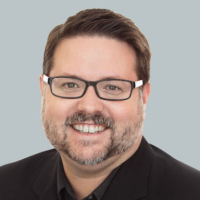
Headshot of a man with glasses

Greg Morrow

“I’m thrilled to be back in L.A. to launch an MRED program that is unlike any other in content, outlook and emphasis on real estate’s central role in shaping society,” Morrow said. “Working with our industry partners, we aim to cultivate future leaders who have superb professional skills and a deep understanding of socioeconomic and policy issues in order to create more livable, resilient, equitable communities.”

MRED students will study under and work alongside accomplished professionals, including developers, lenders, private equity investors, real estate and land use lawyers, affordable housing officials, policy leaders, architects, builders, construction executives, planners and innovators in sustainability. These industry experts helped design the curriculum and will teach most of the classes.

“We’re teaming up with UCLA’s faculty to ensure that students gain the essential skills to succeed in whichever real estate field they choose,” said Alex Rose, executive vice president for development at Continental Development Corp. and a member of UCLA Luskin’s board of advisors. “From day one, graduates of the UCLA Luskin MRED program will have the tools to contribute not just to their employers but to make a difference in their communities as well.”

The interdisciplinary program is housed in the Luskin School of Public Affairs’ urban planning department and will include courses in the Anderson School of Management, UCLA Law and other departments across the university. Students will also have access to broad real estate expertise at UCLA through the Ziman Center for Real Estate, Lewis Center for Regional Policy Studies and the innovative cityLab research center in the department of architecture and urban design.

The new program reflects the University of California’s effort to establish educational paths that address specific workforce needs. In addition to nuts-and-bolts real estate competencies, MRED students will be exposed to the latest trends in real estate —  from AI and new design paradigms to advanced construction techniques and financing tools. The program will also address key issues of affordability, equity, sustainability and how development interacts with larger urban development systems.

The curriculum is designed to develop students’ critical thinking, teamwork, communication and problem-solving skills, which are also essential for success in the workplace.

“Los Angeles is an ideal city in which to study real estate,” said Cecilia Estolano, a member of the Luskin board of advisors and a leading expert on contemporary urban planning issues with experience in economic and workforce development, land use, environmental equity and urban revitalization. “We have a diverse economy, dynamic neighborhoods and a range of real estate problems requiring bold, innovative, systemic solutions. UCLA’s MRED will challenge students to situate real estate development in a broader policy context.”

A cultural trendsetter that welcomes reinvention, Los Angeles is undergoing an ambitious urban transformation, including major housing and transit initiatives, as it prepares to host the 2026 World Cup, the 2027 Super Bowl and the 2028 Summer Olympics.

“Los Angeles has proven to be a laboratory marked by innovations that become models for the nation,” said Andy Cohen, co-chair of the Gensler design and architecture firm. “UCLA is at the heart of this global metropolis, giving students in this important new program front-line access to learn from the best so they can shape the real estate industry and build a better future for our cities — locally and internationally.”

“Luskin is a powerful platform that seeks to educate and challenge change-makers to tackle pressing societal issues,” said Anastasia Loukaitou-Sideris, interim dean of UCLA Luskin. “The new master in real estate program is a perfect fit for Luskin. We can’t wait to welcome our first class next year.”

The program is designed for applicants from diverse fields, within and outside real estate, and backgrounds.

“UCLA is a global brand that attracts leading scholars, students and industry partners and has a devoted international alumni network,” Morrow said. “By leveraging the best of UCLA and its alumni, the UCLA Luskin MRED program will build a global brand in real estate. Our graduates will not only change the industry but also change the face of real estate.”

A Celebratory Welcome to UCLA Luskin The entire School community gathers to make connections and launch the new academic year

September 27, 2024/0 Comments/in Alumni, For Faculty, For Students, For Undergraduates, Global Public Affairs, Luskin Center, Public Policy, Public Policy News, School of Public Affairs, Social Welfare, Social Welfare News, Urban Planning /by Mary Braswell

This year’s UCLA Luskin Welcome Week opened with the exciting announcement that UCLA has, for the eighth consecutive year, been named the No. 1 public university in the United States.

The news set a celebratory tone for a series of Luskin School events welcoming students, alumni, faculty, staff and friends back to campus to kick off the 2024-2025 academic year.

An orientation for graduate students brought public policy, social welfare and urban planning students together to learn about resources provided by the university and the Luskin School.

The undergraduate program hosted a luncheon for majors, pre-majors and students interested in learning more about the bachelor of arts in public affairs.

And the Block Party tradition continued for the 13th year, with the entire UCLA Luskin community gathering to make connections, learn about opportunities and organizations, enjoy the flavors of Los Angeles and greet the School’s benefactors, Meyer and Renee Luskin.

View photos from:

Graduate Student Orientation

UCLA Luskin Orientation 2024

Undergraduate Open House 

UCLA Luskin Undergraduate Open House 2024

13th Annual UCLA Luskin Block Party

UCLA Luskin Block Party 2024

View More Block Party Images from Stay Golden Photobooth


Luskin School Adds 2 Tenure-Track Faculty Social Welfare scholar focuses on health equity and race, while Urban Planning addition has experience in real estate development and land use policy

July 9, 2024/0 Comments/in For Faculty, For Policymakers, For Students, For Undergraduates, School of Public Affairs, Social Welfare, Social Welfare News, Urban Planning Sicong (Summer) Sun /by Stan Paul

By Stan Paul

Two new additions have joined UCLA Luskin’s faculty this summer, bringing research experience and teaching expertise to its graduate and undergraduate programs.

Sicong “Summer” Sun, most recently at the School of Social Welfare at the University of Kansas, is UCLA Luskin Social Welfare’s newest assistant professor. Minjee Kim, previously in Florida State University’s department of urban and regional planning, is a new assistant professor in urban planning.

Laura Abrams, professor and outgoing chair of Social Welfare, announced Sun’s appointment. “Summer is conducting critical work on the intersections of poverty, race and health and will add greatly to our mission of advancing knowledge, practice and policy for a just society,” she said.

Sun studied at the Brown School at Washington University in St. Louis, earning a doctorate and a master’s degree in social welfare, with a concentration in social and economic development and a specialization in research.

Their areas of interest include health equity and social determinants of health, race, ethnicity and immigration, as well as poverty, inequality and social mobility. One example of Sun’s work — the subject of their dissertation — is racial and ethnic differences in the relationship between wealth and health.

“My recent projects have been investigating how the relationship between wealth and health differ by race and ethnicity, how structural conditions shape people’s differential access to resources, thereby impacting their health and well-being,” Sun explained.

In addition to doing research, Sun will be teaching a graduate course this fall on the foundations of social welfare policy, followed in winter with a course on human behavior in the social environment focused on theoretical perspectives in social work and social welfare.

“I’m excited to expand my research, collaborate with colleagues across disciplines, and work with and learn from local community partners. I’m also looking forward to teaching and mentoring students,” Sun said. “I heard UCLA students are very passionate and smart, with many ideas to change the world. I’m eager to engage with them in the classroom, and support their research, practice and careers.”

Kim previously worked as an architect in Korea on projects from offices and buildings to parks, pavilions and master plans for new towns, turning to a career in academia upon developing an interest in public policy and planning. She earned master’s and doctoral degrees in urban planning at MIT.

“I really wanted to have a greater influence than standalone buildings or projects, which is what really got me interested in public policy as well as planning,” she said.

While pursuing her graduate degrees, she worked for the city of Cambridge as a research associate for the Community Development Department, and then at the development review unit at Boston’s Planning and Development Agency.

Kim began to realize how planning and real estate can have a synergistic relationship when working in these city departments. “I observed first-hand that when planners have an understanding of the real estate development process and the economics of it, they can use the tools under their belts to collaborate and negotiate with developers to identify solutions that can push real estate development towards more equitable outcomes,” Kim said.

Michael Manville, professor and chair of Urban Planning, said Kim’s diverse skill set will add value to the Design and Development concentration within Luskin Urban Planning, as well as to the new Master of Real Estate Development (MRED) program.

Kim’s vision for real estate development brings about positive change to historically marginalized communities. This is an approach that stands in sharp contrast to the historical practice of real estate development, which had been a tool for race and class exclusion, displacement and residential segregation. A new breed of equitable and socially responsible projects, Kim said, “can reduce the existing socioeconomic inequalities that have been created and perpetuated by past real estate development practices.”

Fittingly, Kim will be teaching graduate courses on public/private development and site planning, which will be about how planners, urban designers and developers can work together to identify creative solutions for building equitable, socially responsive and redemptive development projects. She will also teach a graduate course on zoning for equity, which she has taught previously as part of a multi-campus course in conjunction with Paavo Monkkonen, a UCLA Luskin professor of urban planning and public policy. In addition to these graduate courses, Kim will instruct students in the undergraduate major in public affairs.

“Minjee has already established herself as a productive scholar working at the intersection of land use regulation, real estate development and housing, so we’re thrilled to bring her on board,” Manville said.

Leadership Transition at UCLA Institute of Transportation Studies After more than two decades guiding research center's growth, Brian Taylor hands reins to Adam Millard-Ball

July 2, 2024/0 Comments/in For Faculty, For Policymakers, For Students, For Undergraduates, Public Policy, Public Policy News, School of Public Affairs, Urban Planning Adam Millard-Ball, Brian D. Taylor /by Mary Braswell

After 23 years at the helm, Brian D. Taylor has stepped down as director of the UCLA Institute of Transportation Studies, effective July 1. His successor is Adam Millard-Ball, professor of urban planning at UCLA Luskin.

Taylor has led UCLA ITS since 2001, playing a critical role in its expansion. Under his tenure, the institute has transformed from a small operation with limited staff and resources into a nationally influential research center with more than 75 scholars and staff conducting cutting-edge research in eight program areas. It has also established partnerships in several consortia, most recently being named the lead in a five-year, $7.5 million federally funded Center of Excellence on New Mobility and Automated Vehicles.

“I am honored to have collaborated with so many talented and motivated students, staff and faculty in building the UCLA Institute of Transportation Studies into the productive and influential transportation research center it is today,” Taylor said. “And I am confident that the institute will continue to effectively tackle our most pressing environmental, equity and technological transportation challenges in the years ahead.”

In recent years, UCLA ITS has

  • Joined the ITS branches at Berkeley, Davis and Irvine in 2016 to form a four-campus University of California Institute of Transportation Studies consortium;
  • Significantly expanded its California-focused transportation policy research in 2017 due to substantially increased annual state funding through the Road Repair and Accountability Act (SB 1);
  • Supported five graduate transportation degree programs in three UCLA Luskin academic departments that have recently climbed in their most widely recognized national rankings — Civil & Environmental Engineering (#12), Public Policy (#14) and Urban Planning (#1);
  • Supported the recruitment of three transportation engineering faculty since 2020 and the creation of master’s and doctoral degrees in transportation engineering.
  • Directed more than $3 million in funding to support graduate students;
  • Supported more than 20 former transportation students who have moved on to tenured or tenure-track faculty positions at leading universities around the world, including Harvard, UC Berkeley, UC San Diego and University of Virginia;
  • Broadened research focus areas to include access to opportunities, the environment, new mobility, parking, public transit, traffic, transportation & communities, and transportation finance.
Taylor’s Leadership Roles

Taylor worked professionally as a transportation planner/analyst for the Metropolitan Transportation Commission before pursuing a PhD in urban planning under the mentorship of Martin Wachs at UCLA. Taylor’s academic focus on transportation finance and governance made him a natural fit for policy engagement.

He began his academic career as an assistant professor at the University of North Carolina at Chapel Hill. In 1994, Taylor joined the UCLA faculty, one year after Wachs re-established the institute on campus. When Professor Wachs moved to UC Berkeley in 1996, Taylor became the only faculty member on campus dedicated primarily to transportation teaching and research. That same year, he became associate director under Donald Shoup, who had replaced Wachs as UCLA ITS director.

In addition to serving as UCLA ITS director since 2001, Taylor is a professor of urban planning and public policy. He also chaired the Urban Planning department for three years and was the director of the Lewis Center for Regional Policy Studies for seven years. In recent years he has been an associate director of the Pacific Southwest Region 9 University Transportation Center and this year was chair of the council of directors for the four-campus UC ITS.

Building on Two Decades of Momentum

New director Adam Millard-Ball brings a wealth of experience in data science and climate change policy.

Incoming director Millard-Ball brings a wealth of experience in data science and climate change policy. He joined UCLA Luskin in 2021, and served as acting director of UCLA ITS during the 2022-23 academic year. In that time, Millard-Ball oversaw TRACtion: Transformative Research and Collaboration, an initiative that brought together academic researchers and community advocates to identify barriers to a just and sustainable future for Los Angeles.”I’m thrilled to lead UCLA ITS, which Professor Taylor has led and built up with his colleagues for more than two decades,” Millard-Ball said. “I hope to maintain our contributions to research and policy for our local community in Los Angeles, for California and across the U.S., and increasingly internationally as we confront the global challenges of climate change.”

The future for UCLA ITS holds more collaboration with engineering scholars at UCLA, exploration of climate issues in relation to transportation, work on equity and community engagement, and integration of innovative methods in data science.

As for Taylor’s future, he’s not going very far.

“I plan to remain active in transportation scholarship and policy, and look forward to devoting more time to research, teaching and mentoring in the years ahead,” he said.

‘Tell Your Story in Your Own Words, So That No One Tells It For You’ A commencement message of empathy and resilience for UCLA Luskin’s Class of 2024

June 20, 2024/1 Comment/in Alumni, For Faculty, For Policymakers, For Students, For Undergraduates, Public Policy, Public Policy News, School of Public Affairs, Social Welfare, Social Welfare News, Urban Planning /by Mary Braswell

“If you want to go fast, go alone. If you want to go far, let’s go together.”

Paco Retana, a leading voice in community mental health, invoked this African proverb as he called on UCLA Luskin’s Class of 2024 to embrace a spirit of compassion and collaboration as they set out to put their educations to work.

“In a world increasingly divided by conflict, inequality and environmental crisis, love and respect are more essential than ever before,” Retana told the gathered graduates at two commencement ceremonies on June 14.

“Together, you have the potential to create a tapestry of positive change that is richer and more vibrant than anything you could achieve alone.”

Retana spoke to public policy, social welfare and urban planning scholars earning master’s and doctoral degrees at a morning ceremony at UCLA’s Royce Hall. Later in the day, he addressed students awarded the bachelor of public affairs at the Grand Ballroom in Ackerman Union.

“The superpower you all have — resilience, corazon, heart — has been the key to navigating life’s inevitable challenges and setbacks,” said Retana, who shared his own background to underscore the point.

Born in Pico Rivera to working-class parents who emigrated from Mexico and Costa Rica, Retana was labeled an underperformer in school. But he went on to become the first in his family to attend college, earning two UCLA degrees: a bachelor’s in psychology in 1987 and a master’s in social welfare in 1990.

For more than three decades, Retana has served Los Angeles’ vulnerable youth and marginalized communities and is now chief program officer at the nonprofit Wellnest. He mentors graduate students as part of UCLA Luskin’s Senior Fellows career leadership program, and he will soon become president of the UCLA Alumni Association.

Retana credited his family for their unshakable support and thanked all the loved ones who were present to cheer on the graduates. “Families are the quiet towers of strength that support us in ways we often take for granted,” he said.

Like many of the day’s speakers, Retana acknowledged that the Class of 2024 pursued their degrees during an often painful era.

For the undergraduates, this included beginning their college careers in 2020 as COVID-19 took lives, strained finances and kept people apart. Political polarization, a reckoning with racism and labor strife followed, and the schisms grew deeper this academic year with the devastating loss of life in the Middle East and protests that have divided campuses across the country, including UCLA.

“Today, we gather to celebrate the achievements and the bright futures of our graduating class. Yet we cannot ignore the recent conflicts and violence that have affected our universities, including our beloved UCLA,” Retana said.

“These events remind us of the critical importance of fostering environments where respect, empathy and dialogue are important.”

Students chosen by their peers to deliver commencement remarks also spoke of this difficult moment, calling for moral courage and solidarity. At the graduate ceremony, members of the audience were invited to leave the ceremony to join a pro-Palestinian rally outside.

Retana urged the entire Class of 2024 to “tell your story in your own words, so that no one tells it for you.”

“Your resilience and your heart not only help you to survive hardships, but also to thrive and reach your full potential, turning life’s trials into stepping stones for success.”

View photos of the graduate commencement

2024 UCLA Luskin School of Public Affairs Graduate Commencement

Watch the graduate commencement ceremony


View photos of the undergraduate commencement

UCLA Luskin School of Public Affairs 2024 Undergraduate Commencement

Watch the undergraduate commencement ceremony


L.A. Mayor Focuses on the Need for Housing Solutions During UCLA Luskin Summit Karen Bass visits campus to join discussions on the value of research about issues like homelessness, climate resilience, governance and equity in transportation

April 23, 2024/0 Comments/in Alumni, Business and the Environment, Development and Housing, Diversity, Environment, For Faculty, For Policymakers, For Students, For Undergraduates, Health Care, Latinos, Public Policy, Public Policy News, Research Projects, School of Public Affairs, Social Welfare, Social Welfare News, Social Welfare PhD, Transportation, Urban Planning Zev Yaroslavsky /by Les Dunseith

By Les Dunseith

On April 17, Los Angeles Mayor Karen Bass was the featured speaker as scholars, civic leaders and the philanthropic community came together to discuss policy issues during the sixth annual UCLA Luskin Summit.

What was on her mind? Housing.

Bass, who declared homelessness a state of emergency immediately upon taking office as mayor in December 2022, told the more than 300 people in attendance at the UCLA Luskin Conference Center that her office is now turning more attention to longer-term solutions after initially emphasizing urgency in getting unhoused people off the streets.

“It is not reasonable for somebody [needing shelter] to be able to stay around while we get housing built,” she said of the challenge to provide shelter for people in need amid an ongoing affordable housing crisis.

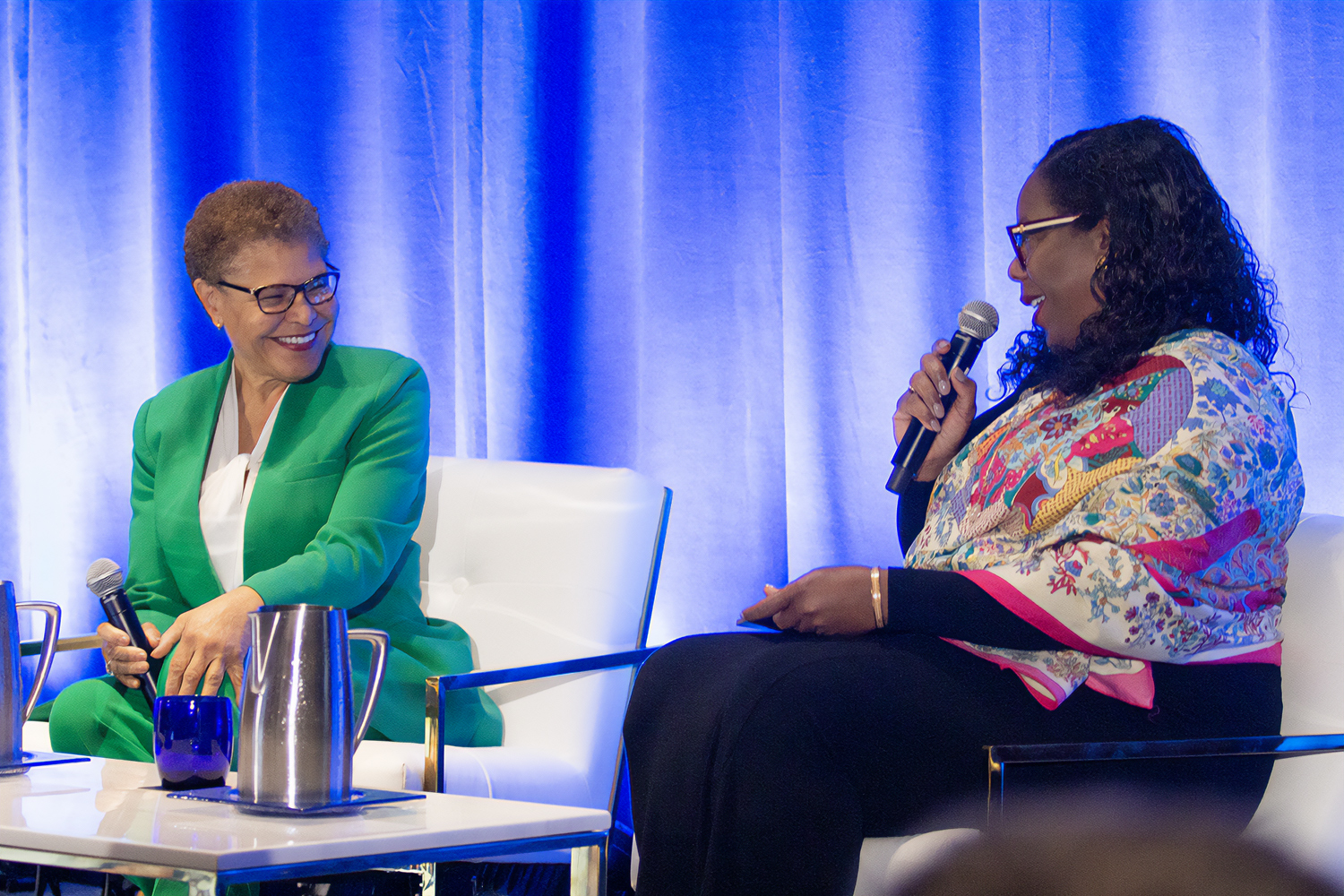
The mayor’s remarks were delivered during a discussion with Jacqueline Waggoner MA UP ’96, the current chair of the Luskin School’s Board of Advisors. Waggoner, who is the president of the Solutions Division for Enterprise Community Partners, said she was heartened by the mayor’s intense focus on homelessness, given the magnitude of the problem in Los Angeles.

Bass, a former congresswoman who now chairs the Homelessness Task Force for the U.S. Conference of Mayors, said that meeting with mayors around the country presents an opportunity to learn from others, and for other cities in the United States to benefit from what is being done in Southern California. She had announced a new housing initiative based on a program in Atlanta two days before speaking at the Luskin Summit.

“I feel good in terms of what we can do and how we should move forward,” said Bass, who then emphasized, “the biggest question is scale.”

two men in ties sit on stage as one speaks

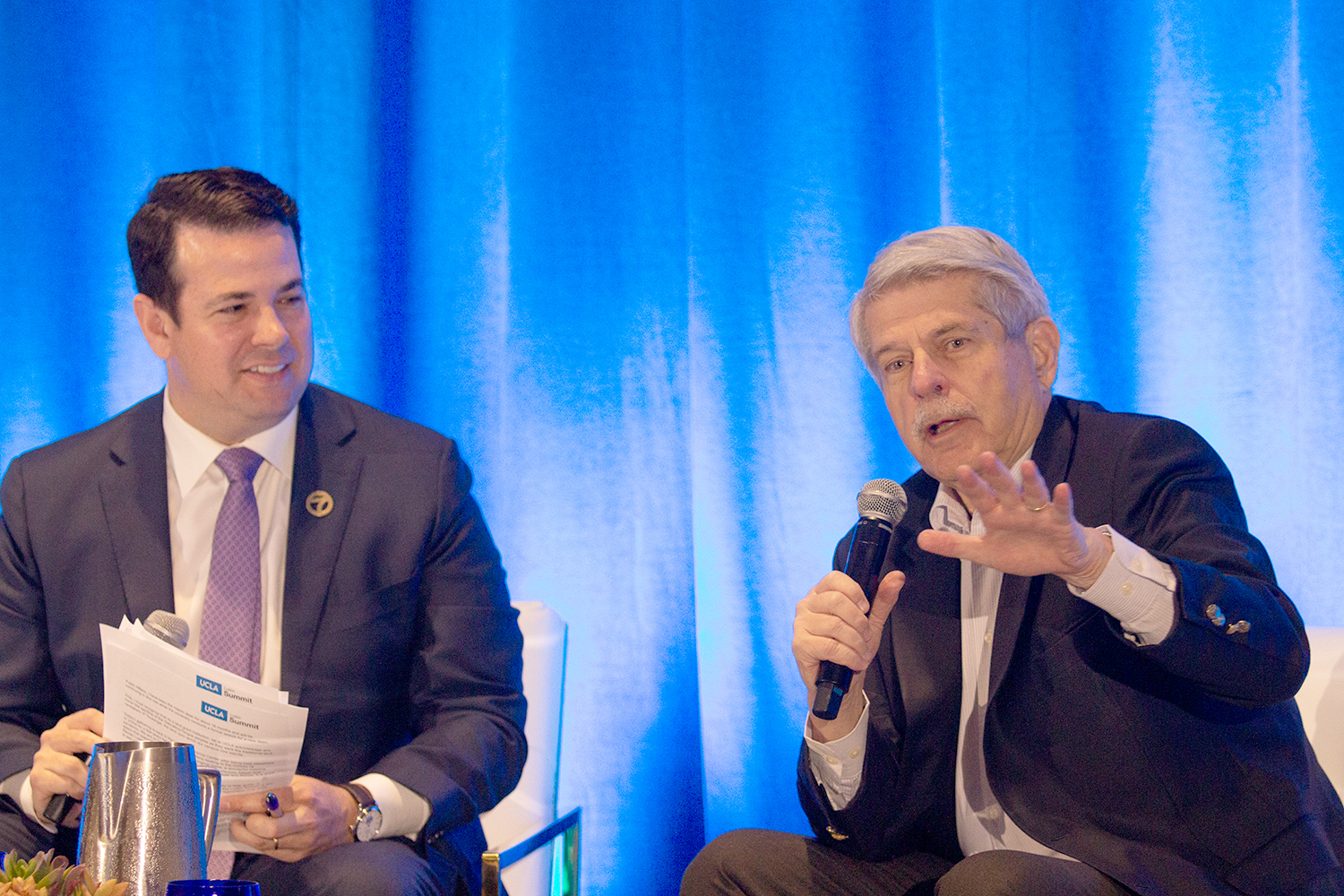
During an on-stage interview by ABC7’s Josh Haskell, left, the results of the ninth Quality of Life Index were unveiled by UCLA’s Zev Yaroslavsky. Photo by Stan Paul

Concerns over housing affordability was also a key takeaway from the ninth annual Quality of Life Index, which was publicly unveiled in the opening session of the 2024 Luskin Summit. The project at UCLA Luskin is directed by former Los Angeles public official Zev Yaroslavsky, now an adjunct faculty member at the UCLA Luskin School of Public Affairs.

Concerns over the high cost of living pushed the satisfaction of Los Angeles County residents back to its lowest-ever level, according to the annual survey, which received coverage as breaking news by media outlets that included the Los Angeles Times, area radio stations and the local affiliates of all four major U.S. broadcast TV networks.

More than half of respondents, or 59%, cited housing as the most important factor in their rating. During a Q&A moderated by reporter Josh Haskell of ABC7 in Los Angeles, Yaroslavsky pointed out that renters are feeling especially pessimistic about their futures.

“In our survey, we found that 75% of renters do not think they will ever be able to afford to buy a home in a place they’d like to live in Los Angeles County. Think about that — more and more people in our region see the American dream of homeownership slipping away,” Yaroslavsky said.

Yaroslavsky’s remarks were followed by six breakout sessions that examined timely policy issues from the perspective of scholarly research originating at the Luskin School and its affiliated research centers.

Summit attendees heard about studies and policy proposals in climate resilience, governance and equity in transportation. Panels made up of UCLA Luskin scholars and experts from the public, private and nonprofit sectors took on pressing issues affecting Los Angeles and beyond:

  • What strategies can governments adopt now to help communities withstand rising temperatures?
  • How is the Southland voter pool changing in this election year, and how can Los Angeles better provide representation for its 3.8 million people
  • How are government agencies and nonprofits meeting the transportation needs of the region’s most disadvantaged people?

Much of the conversation was guided by research conducted by the UCLA Luskin Center for Innovation, the Institute of Transportation Studies, the Lewis Center for Regional Policy Studies and the Latino Policy and Politics Institute.

two Black women chat while seated on a stage with microphones in handBoard of Advisors chair Jacqueline Waggoner emceed the discussion with Mayor Karen Bass. Photo by Stan Paul
two Black women chat while seated on a stage with microphones in hand
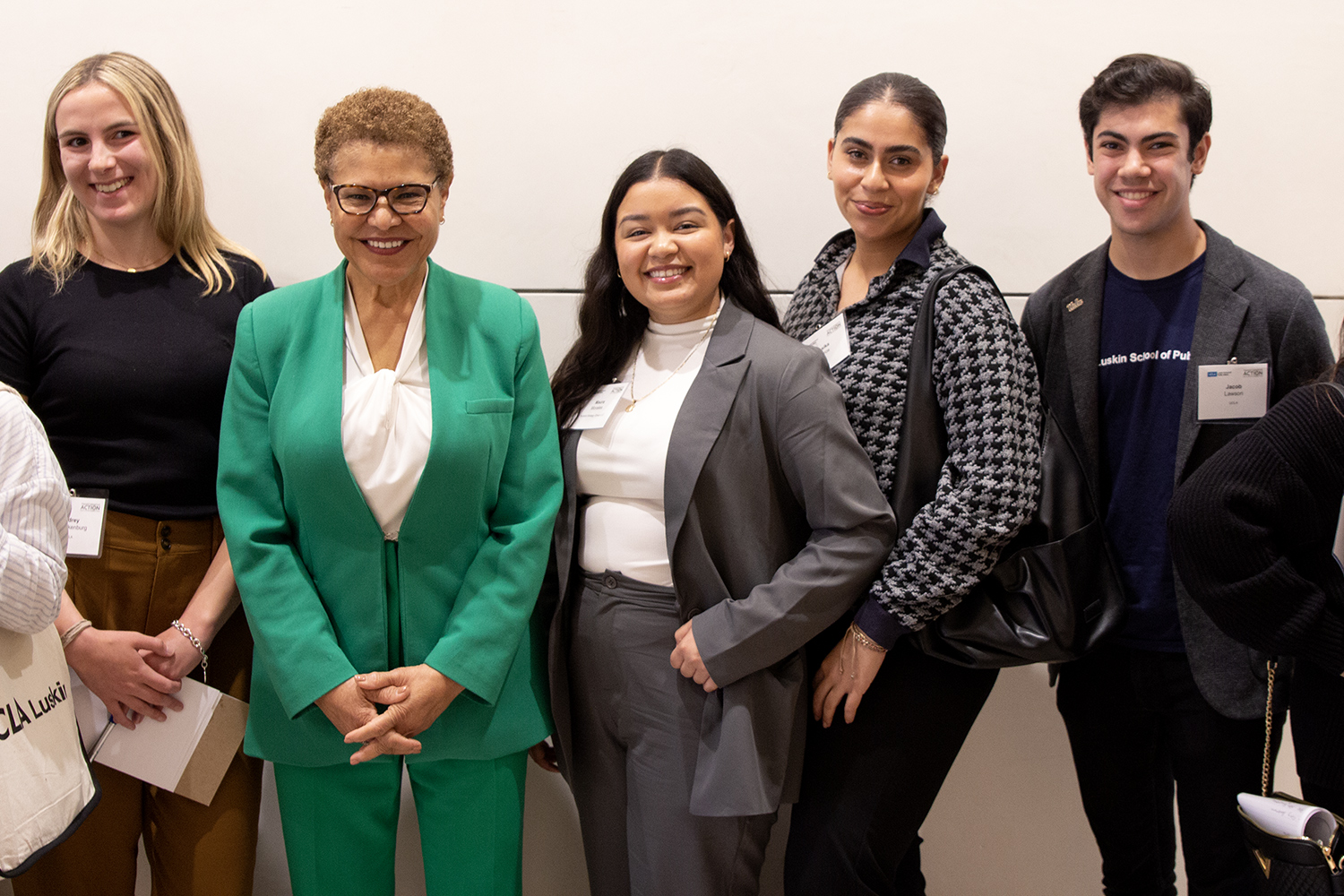
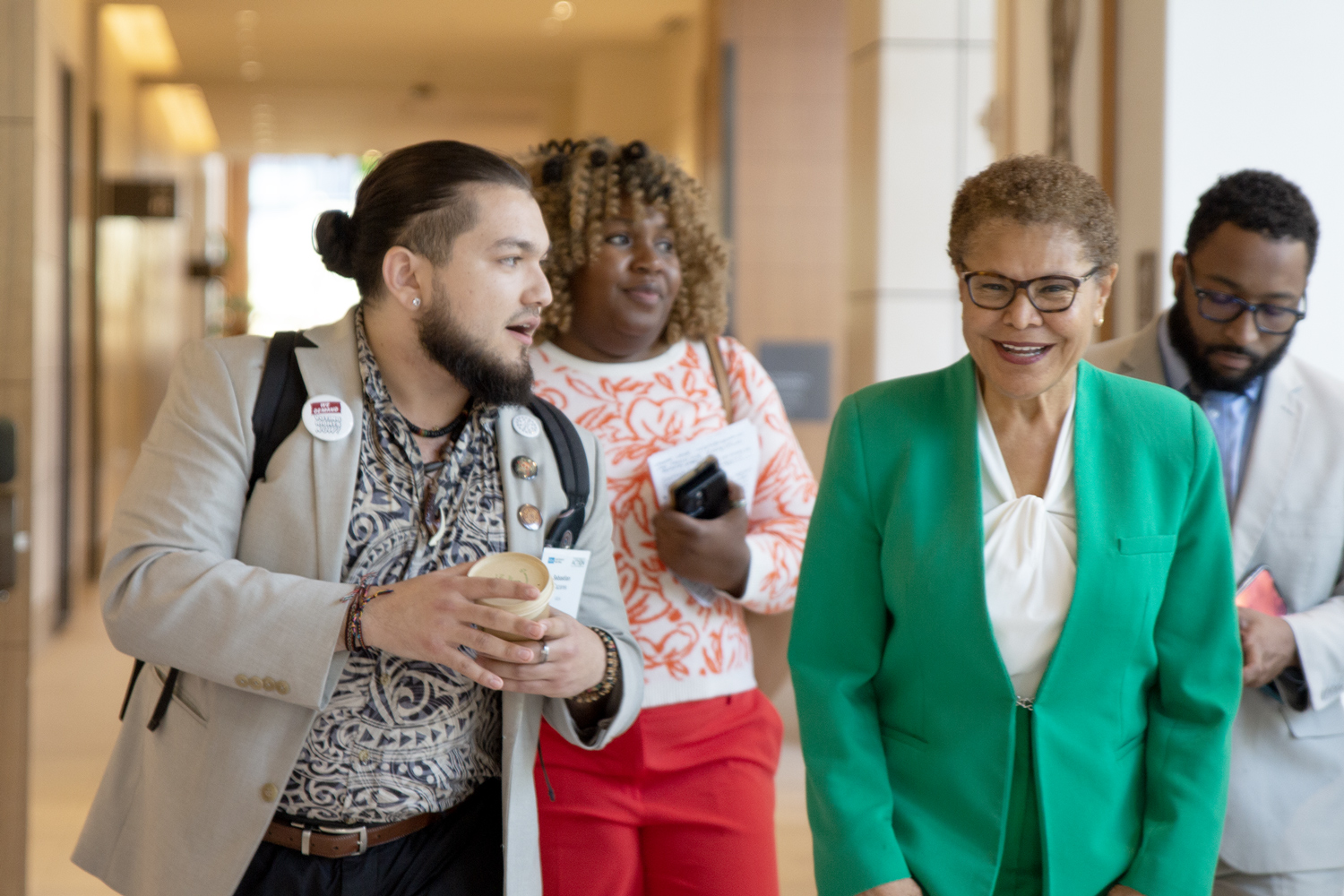
mayor in green poses with young people
mayor in green suite chats with young person as they walk
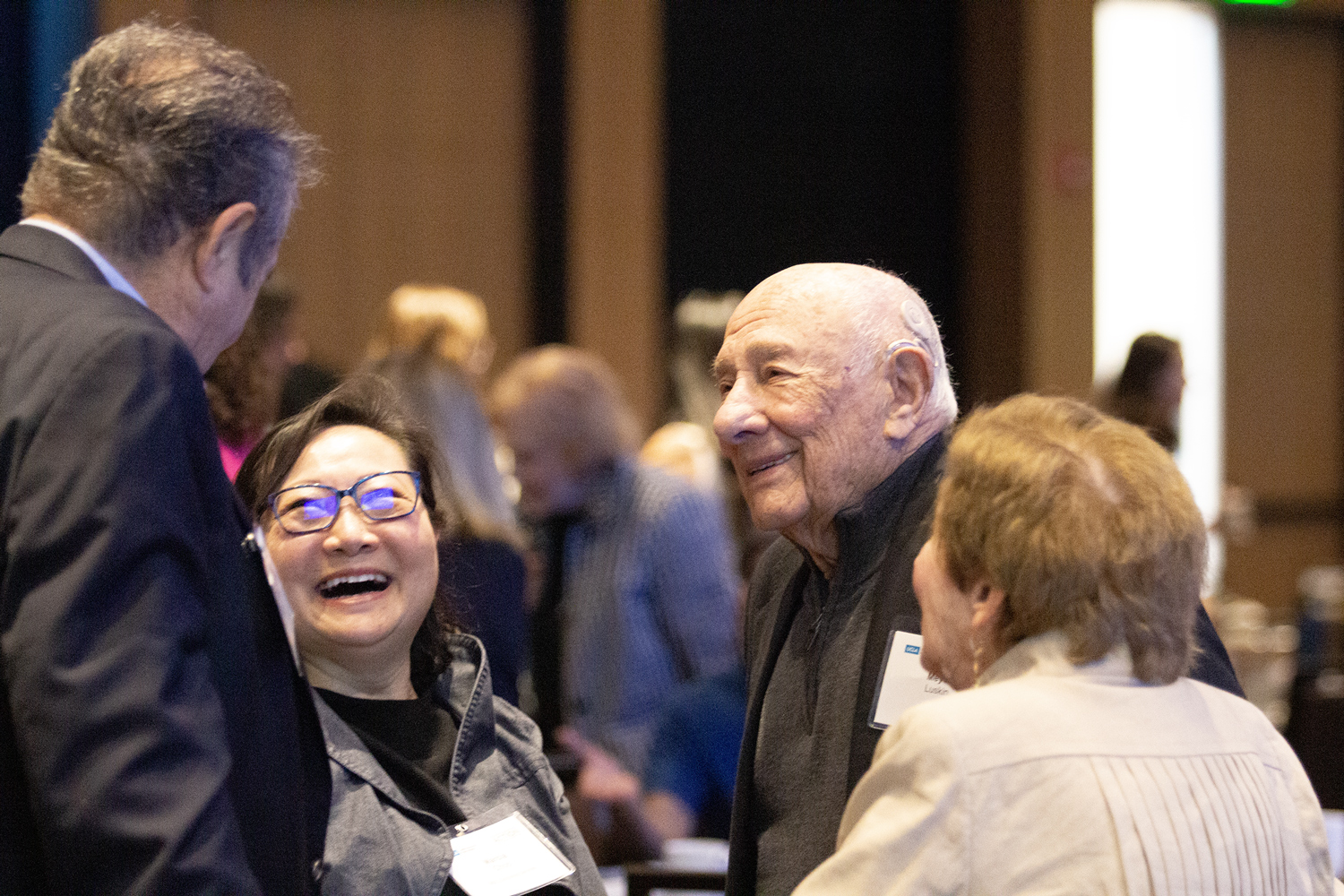
four people chat together inside a conference ballroom
people at tables in large ballroom

The session with the mayor was the final session of this year’s Luskin Summit. For about an hour, Bass answered questions and engaged in conversation with Waggoner, a native Angeleno with a longtime connection to the Los Angeles Homeless Services Authority (LAHSA).

Since Bass took office, Waggoner said she has noticed visible change in the homeless population. In the past, she would see people leave the streets, only to return soon after.

“I haven’t seen those same people in a year, and what I would say to you is that you are on the path to permanent solutions,” Waggoner said to Bass.

“But I’m never satisfied,” replied Bass, a former social worker. She understands that people experiencing homelessness need not just roofs over their heads, but social services.

“I come at it with a bias because my background is in health care, and I just think we need to do much, much more,” Bass said.

She noted that mental health is something that people often talk about in connection to the unhoused population, but treatment for chronic diseases such as diabetes, heart disease, high blood pressure and cancer are also important and deserve attention.

“I feel that health needs to be at the center,” Bass said.

Waggoner said that with homelessness spreading “in every neighborhood, people want to do something about it.”

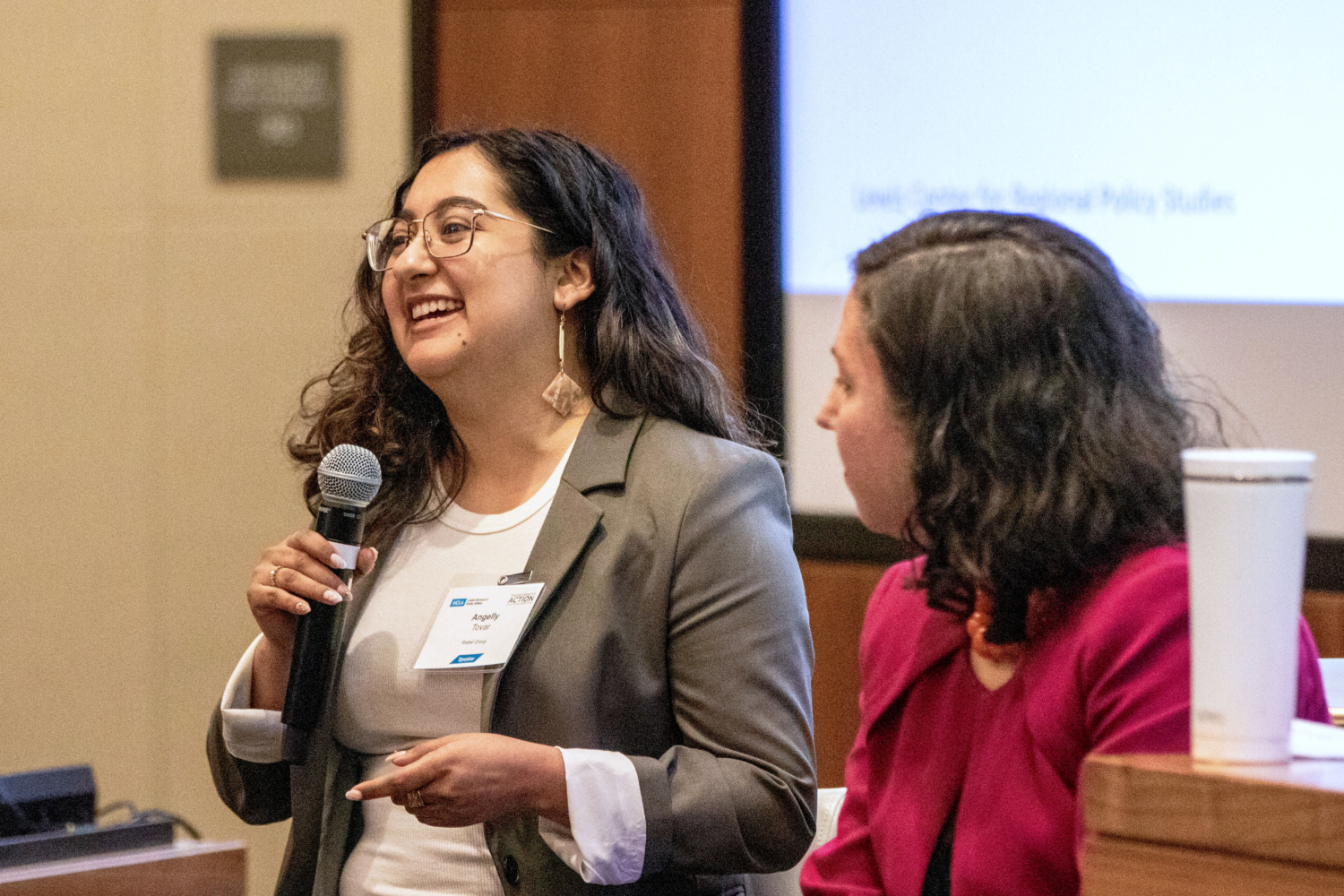
two women seatedAngelly Tovar of Rebel Group, left, and Avital Shavit of LA Metro discuss mobility solutions at a Summit breakout session. Photo by Mary Braswell
two women seated
two women seated
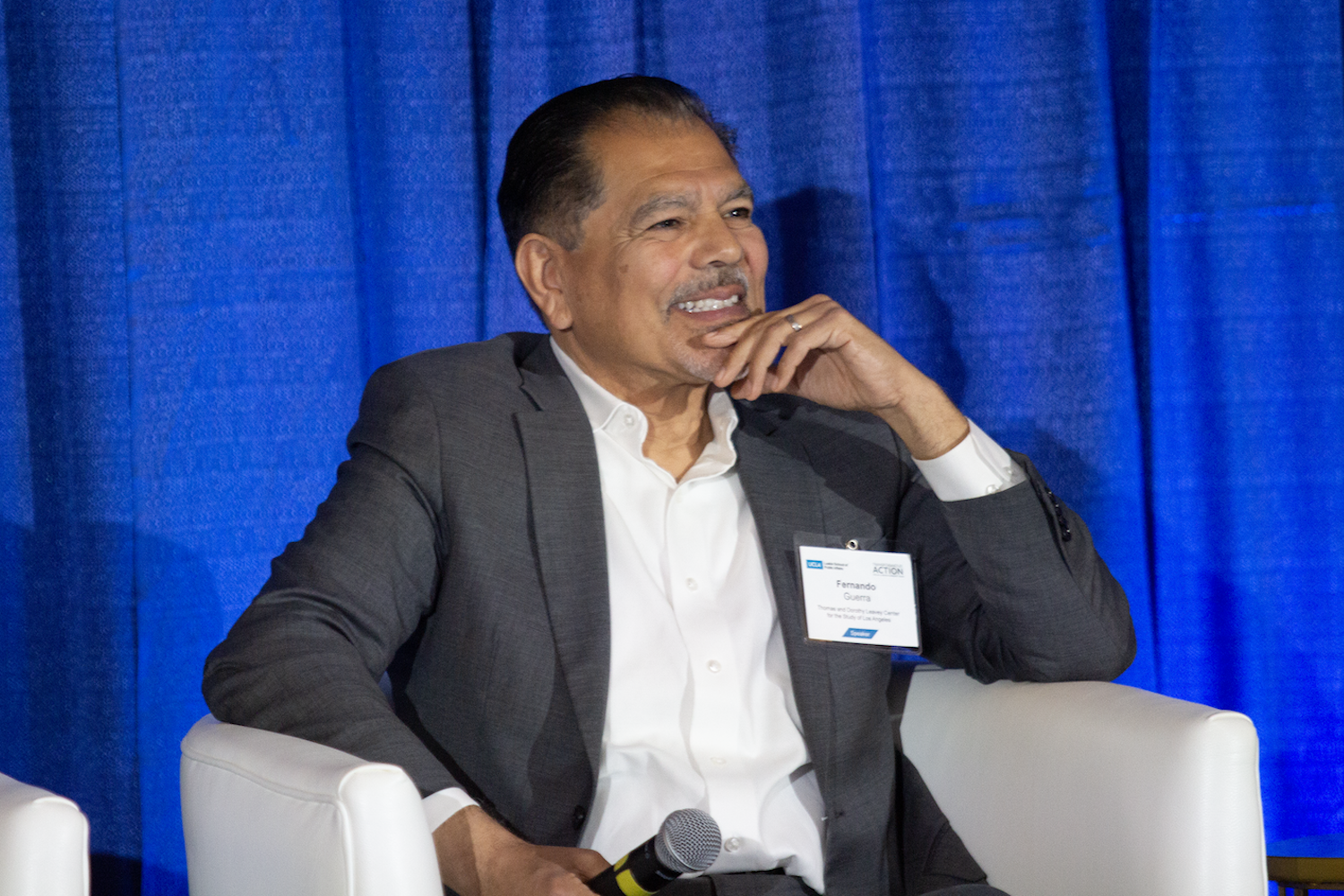
man seated, smiling
man seated, smiling
man pointing to screen

Noting UCLA Luskin’s public-private partnerships with organizations like Hilton Foundation, a Summit sponsor, Waggoner asked Bass about the role of businesses and other groups in helping to get people into permanent housing.

“We are a state of unbelievable wealth. We have many, many, many billionaires that live in the city, tons of multi-millionaires who do phenomenal charitable work,” Bass responded. “I feel good that we’ve been able to align the public sector. But now we need the private sector, we need private money … to expedite the building” of more affordable housing.

Relying on public money can be a slow process because of regulations, construction approvals and the need to juggle multiple funding streams.

“A private developer comes in and can get the development going,” Bass explained. “So, we are hoping that we can do a capital campaign. Everybody knows capital campaigns — buildings get built.”

During her discussion with Waggoner and the 25-minute audience Q&A that followed, Bass also talked about the city’s LA4LA plan to partner with private donors and business to purchase existing properties, including major hotels, to develop its system of long-term interim and permanent housing.

Noting the scale of the problem and an audience consisting of scholars, philanthropic leaders and community organizations, Waggoner pointed out that many people will need to play a part for Bass to realize her vision of a housing solution in Los Angeles.

“Everyone needs to have skin in this game,” Bass said.

The annual event is organized by the UCLA Luskin School of Public Affairs under the guidance of its Board of Advisors, and naming benefactors Meyer and Renee Luskin were among those in attendance. The event was supported by gifts from 12 local charitable organizations and businesses, many of which have been sponsors since the first Luskin Summit in 2019. This year’s theme was “Transformative Action.”

Mary Braswell and Stan Paul also contributed to this story. 

—

See additional photos on Flickr:

UCLA Luskin Summit 2024

Watch a recording of the mayor’s discussion with Waggoner and the audience Q&A on our Vimeo channel:


Page 6 of 45«‹45678›»

Recent Posts

  • Stoll on the Factors Influencing Migration Patterns within the U.S. January 9, 2026
  • Northern California Maintains Nation’s Lowest ICE Arrest Rate Despite National Surge January 9, 2026
  • One Year After the Fires, Recovery Remains Uneven January 8, 2026
  • Oil and Gas Companies Sacrificing Plastic-Burdened Communities January 7, 2026
  • A sixth-generation Altadena resident presents a community recovery roadmap after the fires January 7, 2026

Contact

UCLA Luskin School of Public Affairs

3250 Public Affairs Building - Box 951656
Los Angeles, CA 90095-1656

Campus Resources

  • Maps, Directions, Parking
  • Directory
  • Contact
  • Academic Calendar
  • Careers
  • Diversity
  • University of California
  • Terms of Use

Follow

The statements on this page represent the views of people affiliated with the Luskin School of Public Affairs and do not necessarily represent the views of the University of California, or UCLA or its Chancellor.

Posts and comments by individuals at UCLA on social media channels may not reflect the opinions or policies of UCLA, the University of California or the Luskin School, nor its benefactors and academic partners.

Scroll to top