• Public Policy
  • Social Welfare
  • Real Estate Development
  • Urban Planning
  • Luskin Home
  • Undergraduate Program
  • Stay in Touch
  • Events Calendar
  • Give Now
  • About
    • Our Dean
    • Board of Advisors
    • Contact Us
    • Visit Us
    • Diversity, Disparities and Difference
    • Communications
      • UCLA Luskin in the News
      • Luskin Forum Online
  • Departments
    • Public Policy
    • Real Estate Development
    • Social Welfare
    • Undergraduate Program
    • Urban Planning
  • Apply
    • Master of Public Policy
    • Master of Real Estate Development
    • Master of Social Welfare
    • Master of Urban and Regional Planning
      • Double Degree With Sciences Po
    • PhD in Social Welfare
    • PhD in Urban Planning
    • Undergraduate Programs
  • Faculty
    • All
    • Public Policy
    • Social Welfare
    • Urban Planning
    • Real Estate Development
    • Faculty Executive Committee
    • Open Positions
  • Student Affairs & Alumni
    • Career Services
      • Employers
      • Fellowships
    • Student Support
    • Graduate Resource Library
    • Alumni Relations
  • Support
  • Programs
    • Research Centers & Affiliated Research
    • CA Title IV-E Education Program
    • Global Public Affairs (GPA)
    • Data Analytics Certificate
    • Luskin Lecture Series
    • Luskin Summit
    • UCLA Luskin California Policy Briefing
    • Public Service Weekend
    • Commencement
  • Administration
    • Financial Services
    • Events Office
    • Information Technology
  • Search
  • Menu Menu

Archive for category: Urban Planning

L.A. County Residents’ Satisfaction With Quality of Life Matches Lowest in Year 9 of Survey High cost of housing is the most important factor impacting the annual Quality of Life Index, particularly among renters

April 17, 2024/0 Comments/in Diversity, Education, Environment, For Faculty, For Policymakers, For Students, For Undergraduates, Latinos, Politics, Public Policy, Public Policy News, School of Public Affairs, Social Welfare, Social Welfare News, Social Welfare PhD, Urban Planning Zev Yaroslavsky /by Les Dunseith

By Les Dunseith

Concerns over the high cost of living pushed the satisfaction of Los Angeles County residents back to its lowest-ever level, with renters feeling especially pessimistic about their futures, according to an annual UCLA survey.

The Quality of Life Index, or QLI, is a project of the Los Angeles Initiative at the UCLA Luskin School of Public Affairs  that measures county residents’ satisfaction in nine categories. The overall rating fell two points from last year to 53 on a scale from 10 to 100, marking the second time in three years it came in below the survey’s 55 midpoint since the index launched in 2016. That means a majority of respondents are dissatisfied with the overall quality of their lives.
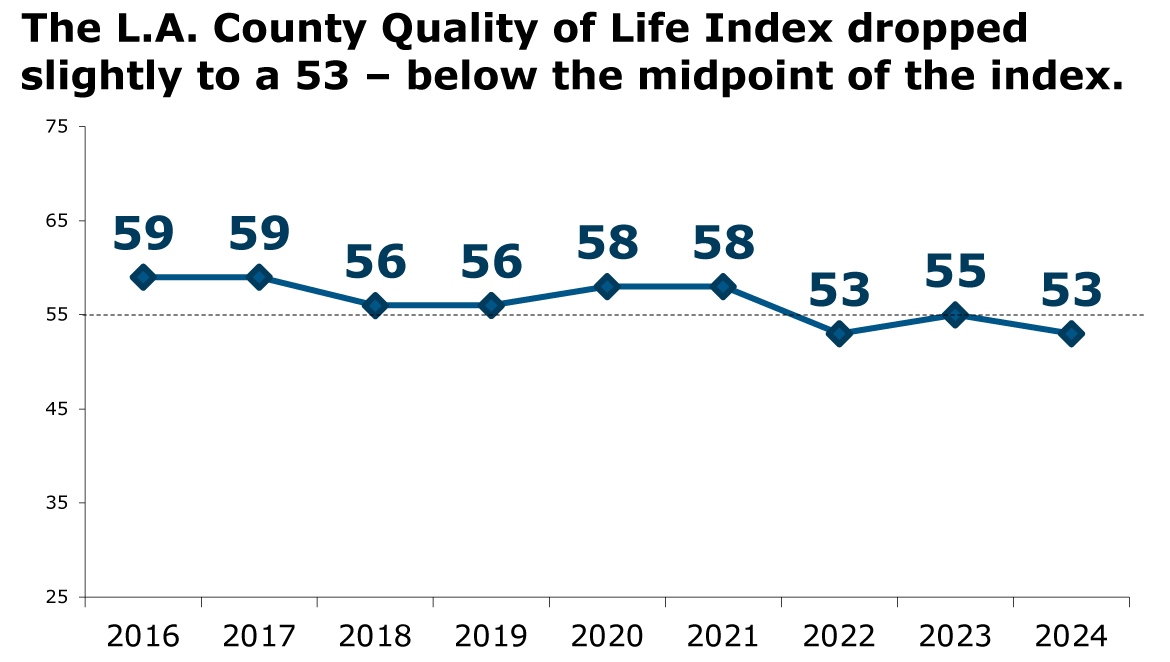
fever chart shows rating change over time

The cost-of-living rating dropped from 41 to 38, the lowest satisfaction score ever observed for any category in the survey. Although all major demographic subgroups rated the cost of living negatively, the lowest scores came from women, 36 (33 from those 50–64 years old) and Latinas, 36 — as well as renters, 35.

Zev Yaroslavsky, director of the study at UCLA, said renters, who make up nearly half of survey respondents, are being disproportionately affected by the economic and inflationary pressures facing the region. More than half, or 59%, cited housing as the most important factor in their rating.
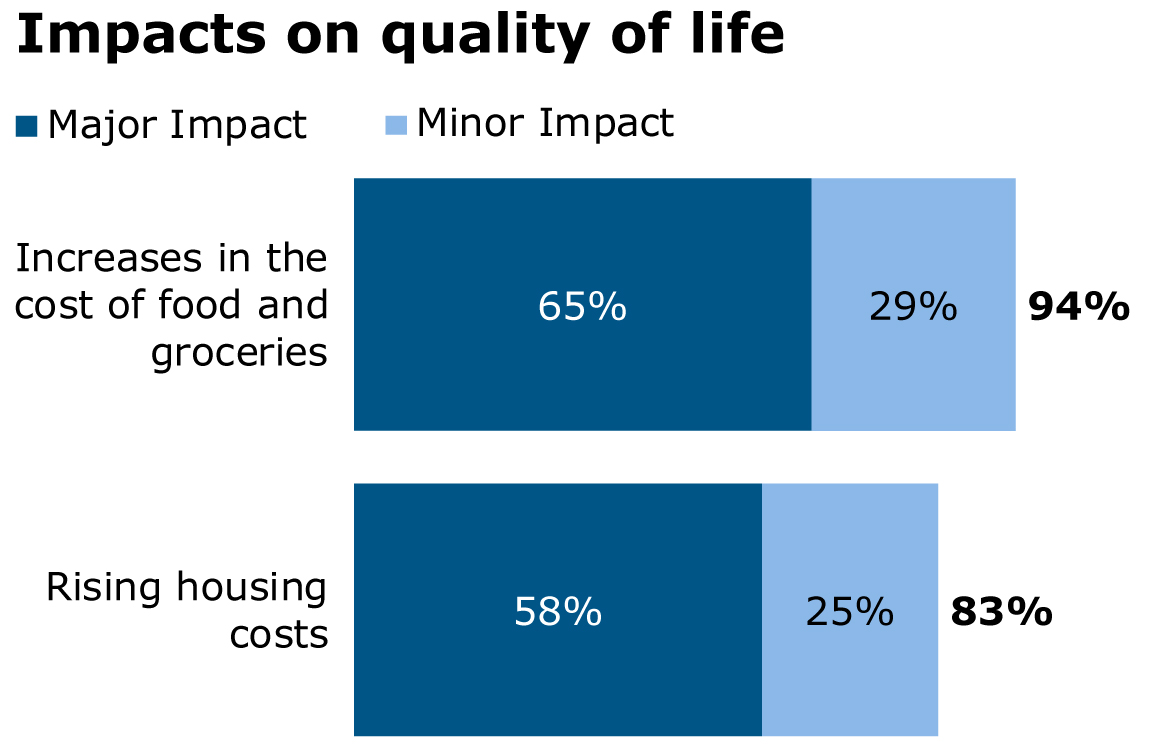
“Housing costs have gone up,” Yaroslavsky said. “And incomes have not gone up anywhere near commensurate with what’s happened to housing.”

While 61% of homeowners feel optimistic about their economic future in Los Angeles County, 51% of renters report being pessimistic. Only 23% of renters think they will be able to buy a home where they would want to live at some point in the future.
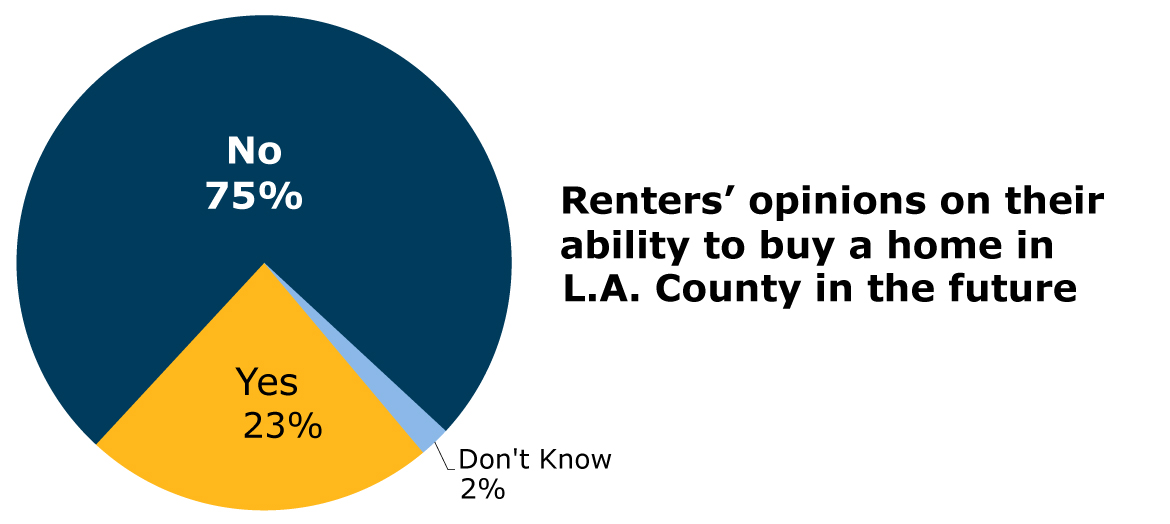
pie chart shows only one in four renters expect to buy a home eventually


This year’s survey also produced striking results on the issue of homelessness.

“We discovered very little optimism about whether the current programs and efforts to eradicate homelessness will work,” Yaroslavsky said.

More than half, or 60%, of respondents said homelessness in their area has gotten worse over the past year, with only 10% saying it has gotten better. Just 20% are more hopeful than they were last year that the homelessness situation in Los Angeles County will improve.

Respondents were also asked whether they worried about becoming homeless themselves, with the highest levels of anxiety expressed by people living in households earning less than $60,000 annually at 44%, renters 37% and African Americans 33%.

“Despite the best efforts of state and local officials, the public is more negative and less hopeful about solving homelessness,” Yaroslavsky said.

In an election year, do such findings signal possible voter upheaval?

“It feeds an overall sense that things aren’t working well,” said Yaroslavsky, a former elected official. He framed this year’s results in the context of nearly a decade’s worth of research showing positive results for neighborhood quality and racial/ethnic relations, but low marks in categories commonly associated with decisions by public officials.

“A main theme over the last nine years is that Angelenos love the neighborhoods where they live. We appreciate diversity and get along with others better than some people think. And the quality of life for most of us is pretty good,” he said. “But at some fundamental level, people think our governmental institutions are letting them down.”

The QLI showed minor changes from the previous year in most categories, although satisfaction with education fell three points to 48, the second-lowest score behind cost of living. While transportation/traffic jumped eight points in importance from 2023, it remained among the three lowest categories in quality-of-life importance.

Among Angelenos who are employed, 55% are working full time at a workplace away from their home. Of those, 59% of Latinos, 64% of African Americans, 63% of men over age 50 and 63% of Latino men always work away from home.

The last year has seen a modest decline in most ratings for elected officials.

  • Los Angeles County Sheriff Robert Luna is viewed favorably by 34% and unfavorably by 26%. Last year was 37% favorable and 21% unfavorable.
  • Los Angeles Mayor Karen Bass is viewed favorably by 42% and unfavorably by 32%, a drop from 46% favorable and 23% unfavorable in last year’s QLI.
  • Respondents had a slightly favorable view of the city councils in their cities: 37% favorable and 32% unfavorable. The Los Angeles County Board of Supervisors is viewed more negatively: 27% favorable and 35% unfavorable.

Regarding the environment, 25% of respondents said climate change had a major impact on their quality of life in the last year; 38% saw a minor impact. The 2024 QLI also asked about the availability of air conditioning: 75% of Angelenos have it in their homes but with substantial variation by region, income and race/ethnicity.

  • Some of the differences likely relate to climate patterns: 48% of residents in the ocean-cooled South Bay communities have air conditioning compared to 92% in the hotter San Fernando Valley.
  • Residents most lacking in air conditioning, 40%, are at the lowest end of the income scale (under $30,000 per year), compared to just 11% for those making over $150,000 per year. And 30% of renters do not have air conditioning.

This year’s QLI is based on interviews conducted in English and Spanish with 1,686 county residents from Feb. 22 to March 14. The survey’s margin of error is plus or minus 3%.

Funding for the Quality of Life Index is provided by Meyer and Renee Luskin through the Los Angeles Initiative. The full report is being published April 17 as part of UCLA’s Luskin Summit.

View the report and other information about this year’s study, plus previous Quality of Life Indexes, on the website of the UCLA Lewis Center for Regional Policy Studies.

text with report name and a map of Los Angeles County


The Power of Lived Experiences Three alumni share the personal stories that impact their policy efforts on homelessness — ‘the greatest moral and humanitarian crisis of our lifetime’ 

March 13, 2024/0 Comments/in Alumni, Diversity, Education, For Faculty, For Policymakers, For Students, For Undergraduates, Latinos, Politics, Public Policy, Public Policy News, School of Public Affairs, Social Welfare, Social Welfare News, Urban Planning Michael Fleming /by Les Dunseith

By Les Dunseith

Lourdes Castro Ramírez entered college as one of nine children from a tight-knit working-class family that had migrated from Mexico when she was 4. She had no idea how that background would guide her career as a policymaker focusing on housing affordability. 

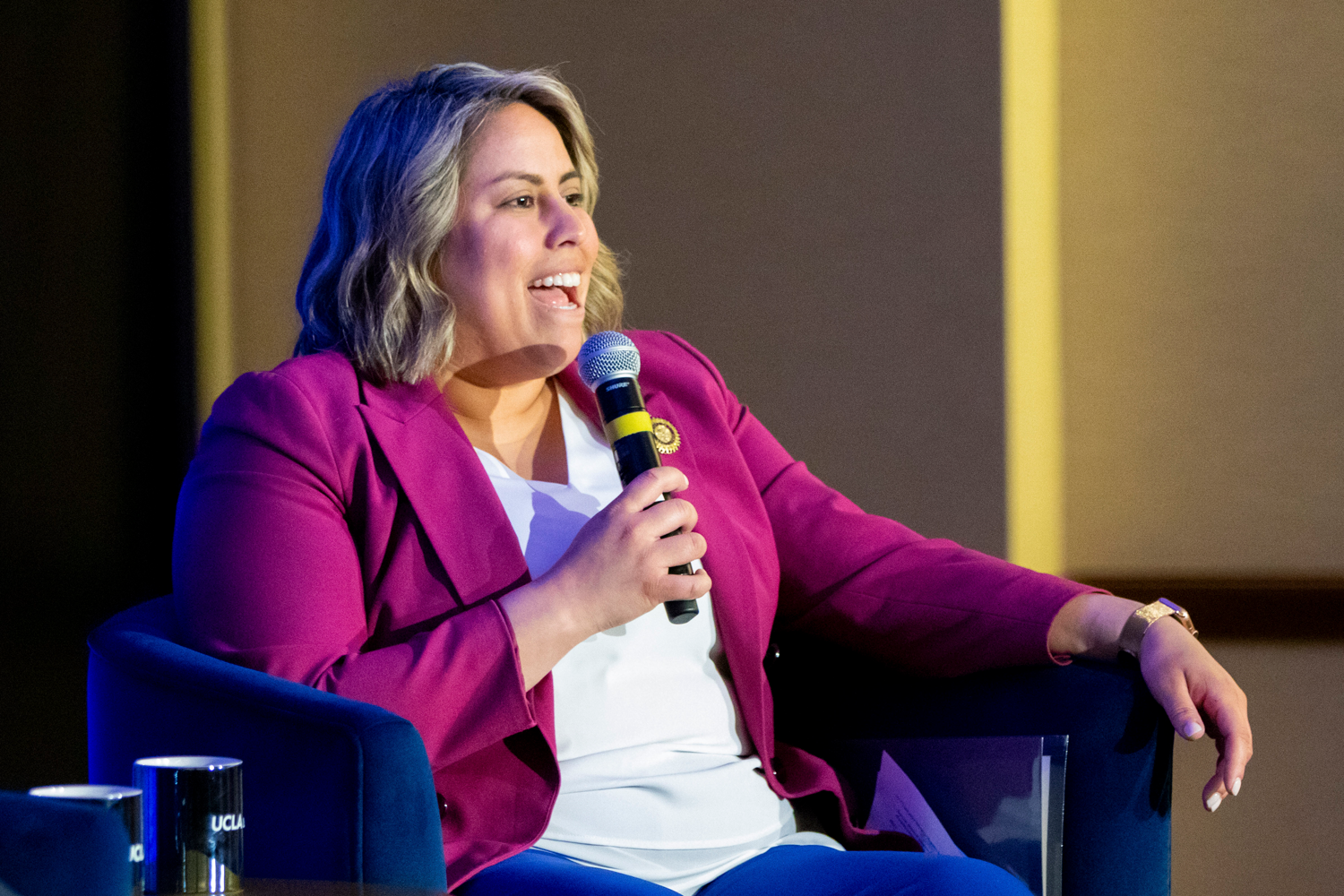
“As a first-generation college graduate, I did not intend to get into this field,” Castro Ramírez recalled March 7 during a Meyer and Renee Luskin Lecture Series event that included State Sen. Caroline Menjivar MSW ’18 and Assemblymember Isaac Bryan MPP ’18. “In fact, I didn’t even know that this field existed.”

Now Castro Ramírez is the point person for Los Angeles Mayor Karen Bass on housing and homelessness, working on an issue that has reached crisis proportions after too little national policy attention for decades.

“I do feel that there is hope. We are now finally seeing housing policy in action, getting the attention that it requires,” the 1996 UCLA urban planning master’s graduate told faculty, students, alumni and others at the Luskin Conference Center.

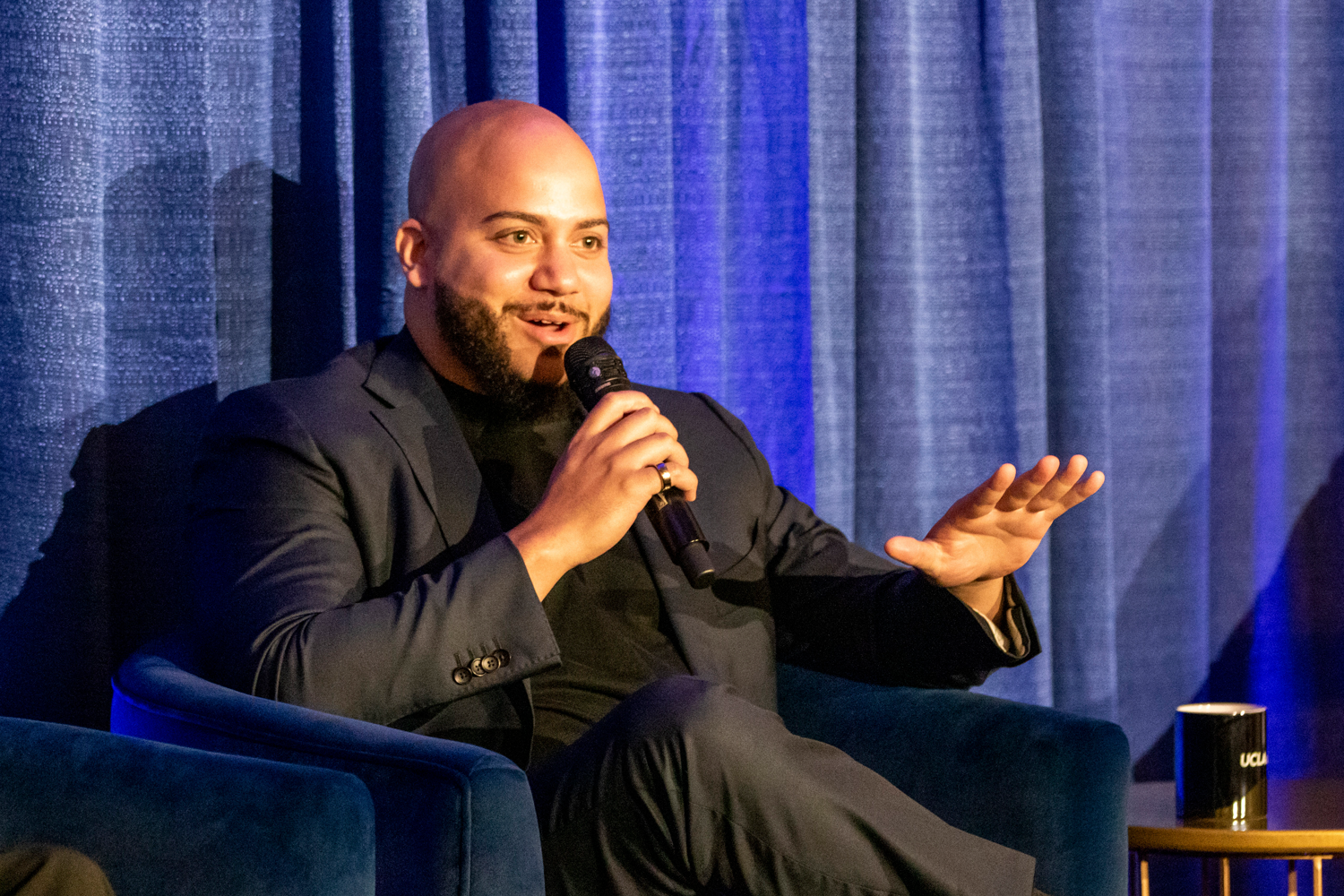
“Homelessness is the greatest moral and humanitarian crisis of our lifetime,” Bryan said. “We’re at a crisis position even though [California has] more billionaires than anywhere in the world. But that is the Los Angeles that we have created. 

“And it didn’t just happen. I don’t want to believe it was on purpose because it would be too painful to believe that somebody wanted tens of thousands of poor and disproportionately Black people sleeping on our streets,” he said. “I don’t want to believe that it was intentional. But neglect isn’t an excuse to not make it right.”

Bryan represents a district near the 405 and 10 freeways mostly to the east and south of UCLA that includes some of the L.A.’s wealthiest neighborhoods — and some of its poorest. He talked about the irony of needing to raise money by speaking to rich donors in the mansions of Beverly Hills and then returning to his rented apartment in a modest-but-affordable neighborhood just a few miles away. 

He has experienced housing precarity first-hand, including during his UCLA education. 

“I remember walking across the stage on graduation day. I was very proud. I was very excited,” Bryan recalled. “And there was a faculty member in the audience who knew that I couldn’t pay my rent that month. And she wrote the personal check to make sure that I could stay afloat till I found a job.”

Bryan was able to get his UCLA degree in part because he received a grant from the David Bohnett Foundation, which seeks to improve society through social activism and since 2007 has been providing awards that include a position in the L.A. Mayor’s Office for three selected fellows. Longtime adjunct instructor and UCLA Luskin Board of Advisors member Michael Fleming is the founding director of the Bohnett Foundation. He served as the moderator for a Q&A with Castro Ramírez, Bryan and Menjivar, who like Bryan is a former Bohnett fellow and a master’s degree recipient from the UCLA Luskin School of Public Affairs. All three talked about income disparity and how their personal experiences relate to affordable housing issues in California.  

Menjivar said her large family of Salvadoran immigrants struggled to make ends meet while living in one- or two-bedroom apartments in low- to middle-income communities like Tarzana. Her mother worked as a house cleaner. 

“I would commute to school and sometimes get a ride from my mom,” Menjivar recalled. “She would drop me off — her firstborn, first-generation student at UCLA, the No. 1 public university in the world — and then she would go down the street to clean a mansion.”

That perspective is never far from her mind.

“Now, I represent 1 million people in the state legislature, looking to bring more affordable housing,” said Menjivar, whose district includes Burbank and many working-class neighborhoods in the San Fernando Valley. “So, when [policymakers] talk about eviction protections and housing affordability, I don’t just speak on it. I’ve lived through that.”

Their lived experiences affect the decisions that Menjivar and Bryan are making and the issues they choose to advance as elected officials in Sacramento. Both have been involved in efforts tied to their backgrounds in public policy and social services. (Menjivar noted that, like herself, Mayor Bass was educated as a social worker.) 

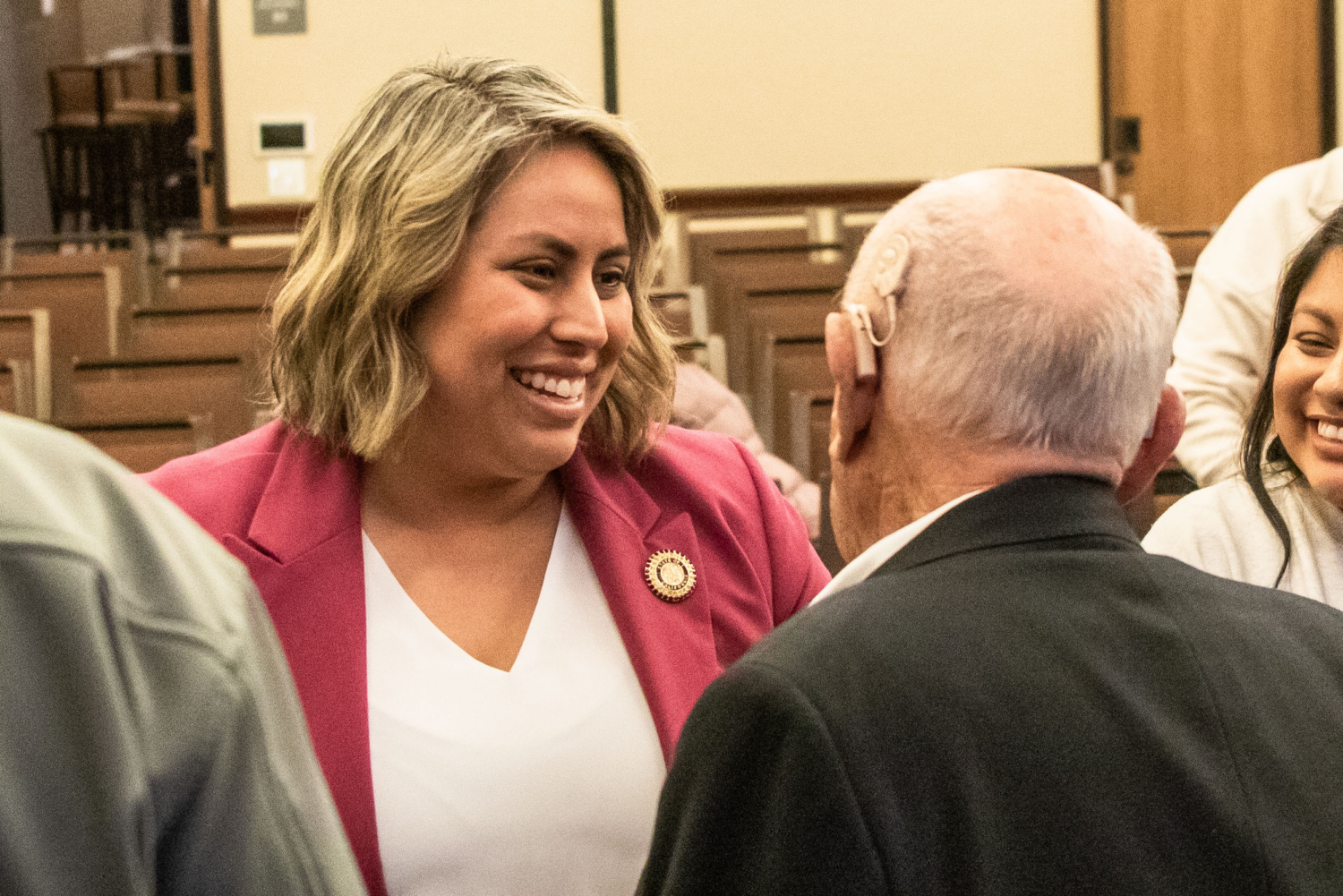
Lourdes Castro Ramírez spoke about her role as the chief of housing and homelessness solutions for Los Angeles.
woman in pink jacket smiles while talking with an older man whose back is to the camera

In prepared remarks that preceded the panel discussion, Castro Ramírez spoke about her fondness for UCLA and why she was happy to accept the speaking invitation.

“Just walking into this space and seeing UCLA in the background, and seeing so many people I know here, just makes me really proud of my parents, where I come from and this university that invested in me,” she told an audience that included current colleagues on the Luskin School’s Board of Advisors.

It was a UCLA professor who first encouraged her to look into affordable housing as a potential career path, she said, and that led to roles as a practitioner and policymaker at the municipal level in Ventura and San Antonio, at the U.S. Department of Housing and Urban Development under the Obama administration, and later in Sacramento as Gov. Gavin Newsom’s secretary of the Business, Consumer Services and Housing Agency. 

“And now I’m back in L.A., back to my hometown … and working on the issues that are really important and critical to our city, to our state, and to our country as chief of housing and homelessness solutions,” she said.

Castro Ramírez spoke about harmonizing federal, state and local government efforts, a process that the mayor’s office characterizes as “locking arms” to address the housing crisis.

The overall number of people falling into homelessness continues to outpace the number who are being housed, but this is not because individual efforts have been unsuccessful. 

“In fact, there are incredible nonprofit organizations, housing authorities, housing groups who are doing amazing work,” she said, noting that a supportive housing approval process that used to take six months now takes an average of 43 days. Almost 14,000 affordable units have been approved for Los Angeles. 

“This is what the intersection of policy and programming implementation looks like, being able to move with a sense of urgency, being able to implement the idea that having a place to call home is fundamental,” Castro Ramírez said. 

Public service can be frustrating work, charged with philosophical disagreement and subject to constant second-guessing often motivated by political opportunism. Fleming asked the panel what makes the aggravation worthwhile. 

“I want to make my community, my city, my state, my country better. And that is an awesome privilege that I try to never take for granted,” said Bryan, noting that his chief of staff is another Class of 2018 UCLA Luskin graduate, Caleb Rabinowitz. “And when we walk out of the Capitol, we can kind of ask ourselves, ‘Is the state better this week because we were here?’” 

Menjivar said she is motivated by her family history. 

“My mom came to this country for a better future for her kids not knowing that the future for our family tree would lead from house cleaner to state senator in one generation,” she said.

But there have been hurdles along the way, and that’s also a motivation.

“I was born with what I call the Triple L — a lady, a Latina and a lesbian. So you can imagine I have a handful of stories around discrimination, around facing barriers and overcoming them, and I know that others helped in getting me to the point that I am now.” 

Her lived experiences are vital to her success.

“I think about every barrier that I went through to get to this point, every ‘No’ that I got, even when I was running for office. And for every “No’ that I was given, I’m here now to ensure that other people like me don’t get those ‘Nos’ anymore.”

Castro Ramírez said she is grateful to have gone “to an amazing university and to step into a role that I never thought that I was prepared to step into.”  Glancing at her fellow alumni, she continued, “And I’ve been able to see the power of our collective ability to make change and to make a difference.”

She paused for a moment, then spoke again, softly. 

“I guess the last thing — and the reason I’m hesitating is because, you know, this is a very personal reason for me — I am the mother of three children. I had a son; he was 11 years old when he passed away due to cancer. He was really an incredible, talented individual who craved … leaving his mark in this world. And that didn’t happen.

“And I feel like every day that I wake up, every day that I show up to work, show up to address the work that needs doing, I feel like I’m showing up for him.”

The UCLA Luskin School of Public Affairs hosts the Luskin Lecture Series to enhance public discourse on topics relevant to the betterment of society. This presentation was also part of an ongoing series of events in the 2023-24 academic year to commemorate 25 years since the first graduating class from UCLA Luskin Public Policy was sent into the world equipped to make changes for the better.

View photos of the event. 

Luskin Lawmakers

School Travels to State Capital for Research Briefing and Alumni Gathering Back-to-back events in Sacramento provide networking opportunities and showcase scholarly works

February 21, 2024/1 Comment/in Alumni, Business and the Environment, Development and Housing, Environment, For Faculty, For Policymakers, For Students, For Undergraduates, Politics, Public Policy, Public Policy News, School of Public Affairs, Urban Planning Anastasia Loukaitou-Sideris, Gregory Pierce, Michael Lens /by Les Dunseith

In mid-February, a contingent of more than 30 people from UCLA Luskin made the trip to northern California in an effort to connect with alumni, government officials and policy experts involved in state government.

The two-day gathering in Sacramento was envisioned as the first of what will become an annual feature of the Luskin’s School’s outreach efforts, pairing an alumni get-together in the state capital with a research-focused briefing for elected officials and their staffs.

The UCLA Luskin Briefing at UC Center Sacramento took place during the time when new bills were being finalized for the next legislative session, and the hope is that the research of UCLA Luskin and its various research centers can put current and future legislative leaders in a better position to make data-informed decisions.

“It was very well attended by elected and appointed officials,” noted Interim Dean Anastasia Loukaitou-Sideris, who made the effort a priority for this academic year and actively participated in the planning process. “The elected officials I talked to afterward were very appreciative for the event and told me that they hope to see more such events from our School.”

Two briefing sessions were held. A session on water management highlighted research by Adjunct Associate Professor Gregory Pierce MURP ’11 PhD UP ’15, co-executive director of the UCLA Luskin Center for Innovation. A session on affordable housing was led by Associate Professor Michael Lens, associate faculty director of the Lewis Center for Regional Policy Studies.
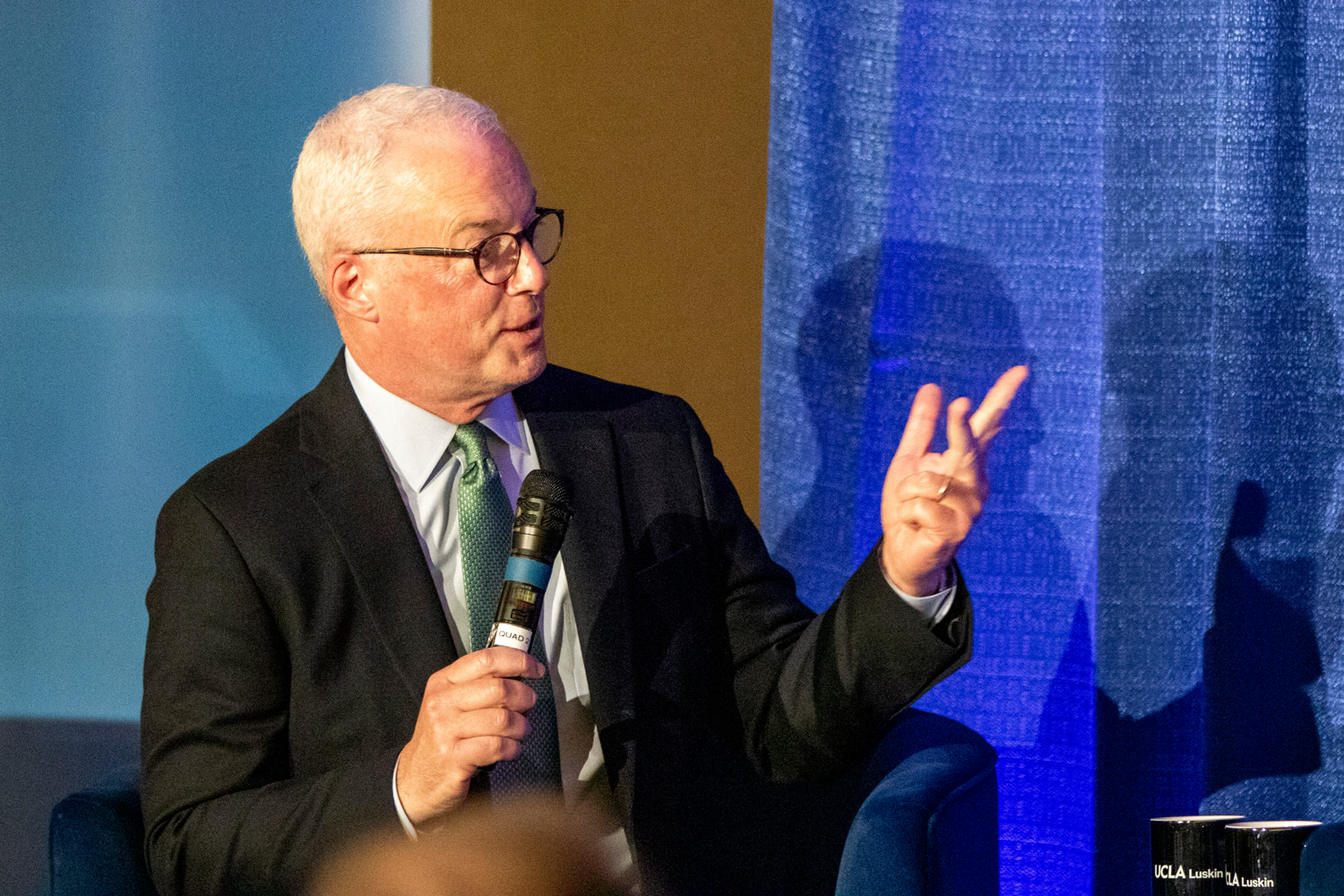
The briefing and the Alumni Regional Reception, which took place the evening before, brought together faculty, staff or alumni from all four departments — Public Policy, Social Welfare, Urban Planning and the Undergraduate Program — as well as members of the Luskin School’s Board of Advisors.

A group of about 20 current Master of Public Policy students also made the trip, getting an opportunity to connect directly with alumni whose footsteps they may hope to follow, including Assemblyman Isaac Bryan MPP ’18, a member of the affordable housing panel.

Find out more about the briefing and view the bios of the 12 people who participated as speakers or panelists.

View photos from the alumni reception

Sacramento Alumni Regional Reception 2024

View photos from the research briefing

Sacramento Briefing 2024


UCLA Hosts Its Largest Activist-in-Residence Cohort Five advocates for social change will be on campus through May to ‘turn the university inside out’

January 31, 2024/0 Comments/in Alumni, Diversity, For Faculty, For Policymakers, For Students, For Undergraduates, School of Public Affairs, Social Welfare, Social Welfare News, Urban Planning Ananya Roy /by Les Dunseith

By Les Dunseith

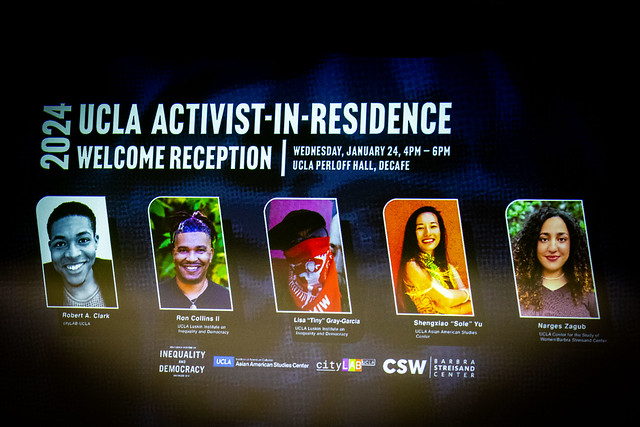
The UCLA Activist-in-Residence program welcomed five more changemakers — the largest cohort in the program’s seven-year history — to campus with a reception Jan. 24 at DeCafe in Perloff Hall.

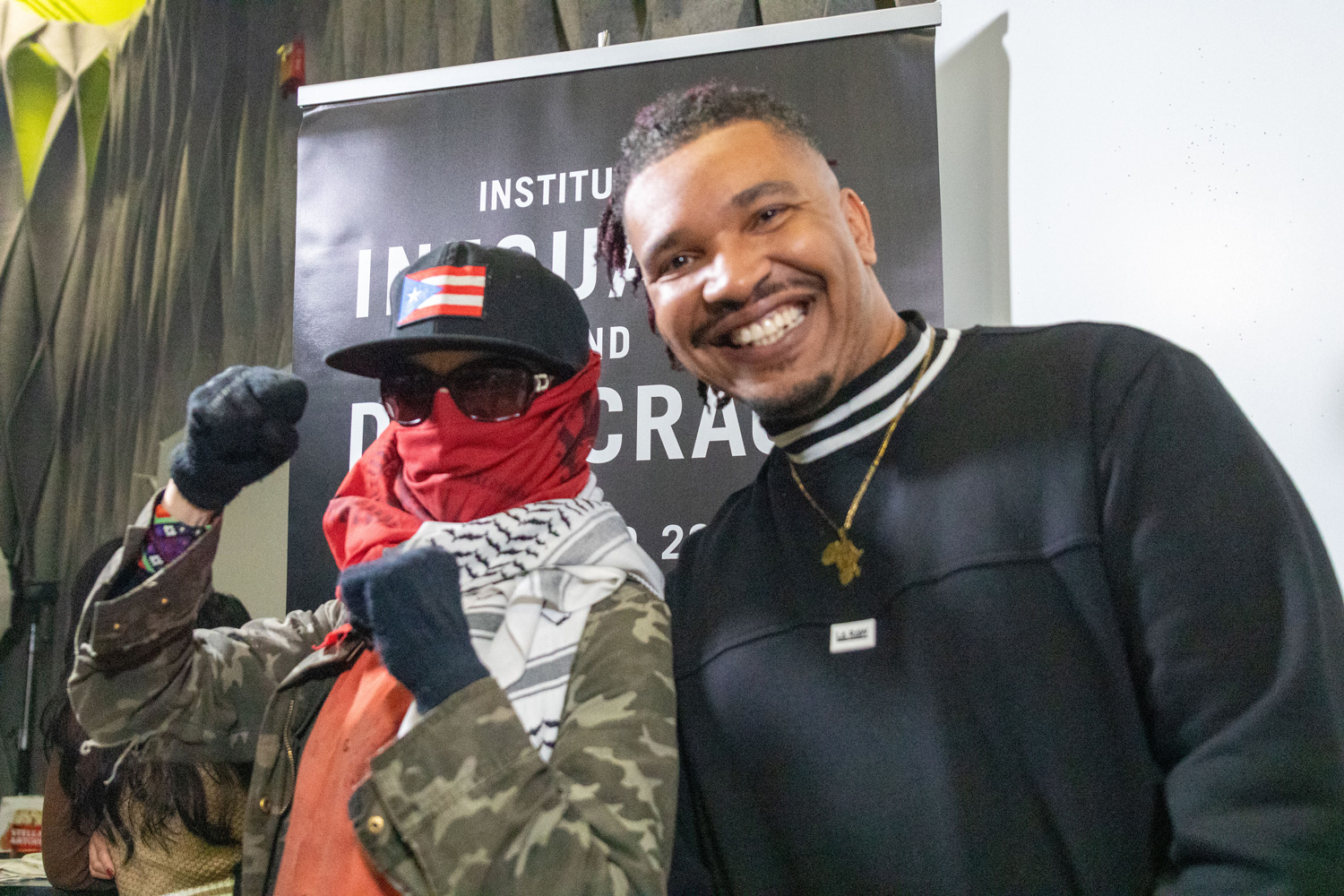
The UCLA Luskin Institute on Inequality and Democracy, which has selected at least one activist since 2017, is hosting community organizer Ron Collins II and revolutionary writer Lisa “Tiny” Gray-Garcia during this academic year. 

The UCLA Asian American Studies Center, also a longtime participant in the program, is hosting writer and social justice educator Shengxiao “Sole” Yu. 

In its second year with the Activist-in-Residence program, cityLAB-UCLA is hosting Robert A. Clarke, a designer and educator practicing at the intersection of culture, identity and architecture. 

A new addition to the program for 2024 is the UCLA Center for the Study of Women|Barbra Streisand Center, which is hosting Narges Zagub B.A. Anthropology ’20, a movement worker and facilitator.

Opening remarks for the reception were provided by UCLA Luskin Professor Ananya Roy, who created the residency program soon after arriving at UCLA as the director of the UCLA Luskin Institute on Inequality and Democracy. 

She conceptualized the program as a sabbatical for participants, allowing them time and space to reflect, envision new projects, and connect with UCLA faculty, students and staff. 

“More than ever, I am reminded, in these difficult times, that the residency is our effort to turn the university inside out,” Roy told the crowd. “At the Institute, we organize knowledge within, against and beyond the university. The Activist-in-Residence program brings to the university the movement scholars and public intellectuals who are teachers and guides for this praxis.”

a dozen people gathered in advance of a group photo laugh while one of them holds a dog in the foregroundStaff, faculty and friends of the UCLA Luskin Institute on Inequality and Democracy share a laugh together while recognizing this year’s activists. In back, from left, are César J. Ayala, Will Sens Jr., Giselle Harrell, Lisa “Tiny” Gray-Garcia, Ron Collins II, Kristy Lovich, Sam Lutzker and Marisa Lemorande; in front, Ananya Roy and Carla Orendorff are on either side of Paisley Mares, who holds a dog named Lavi.
a dozen people gathered in advance of a group photo laugh while one of them holds a dog in the foreground
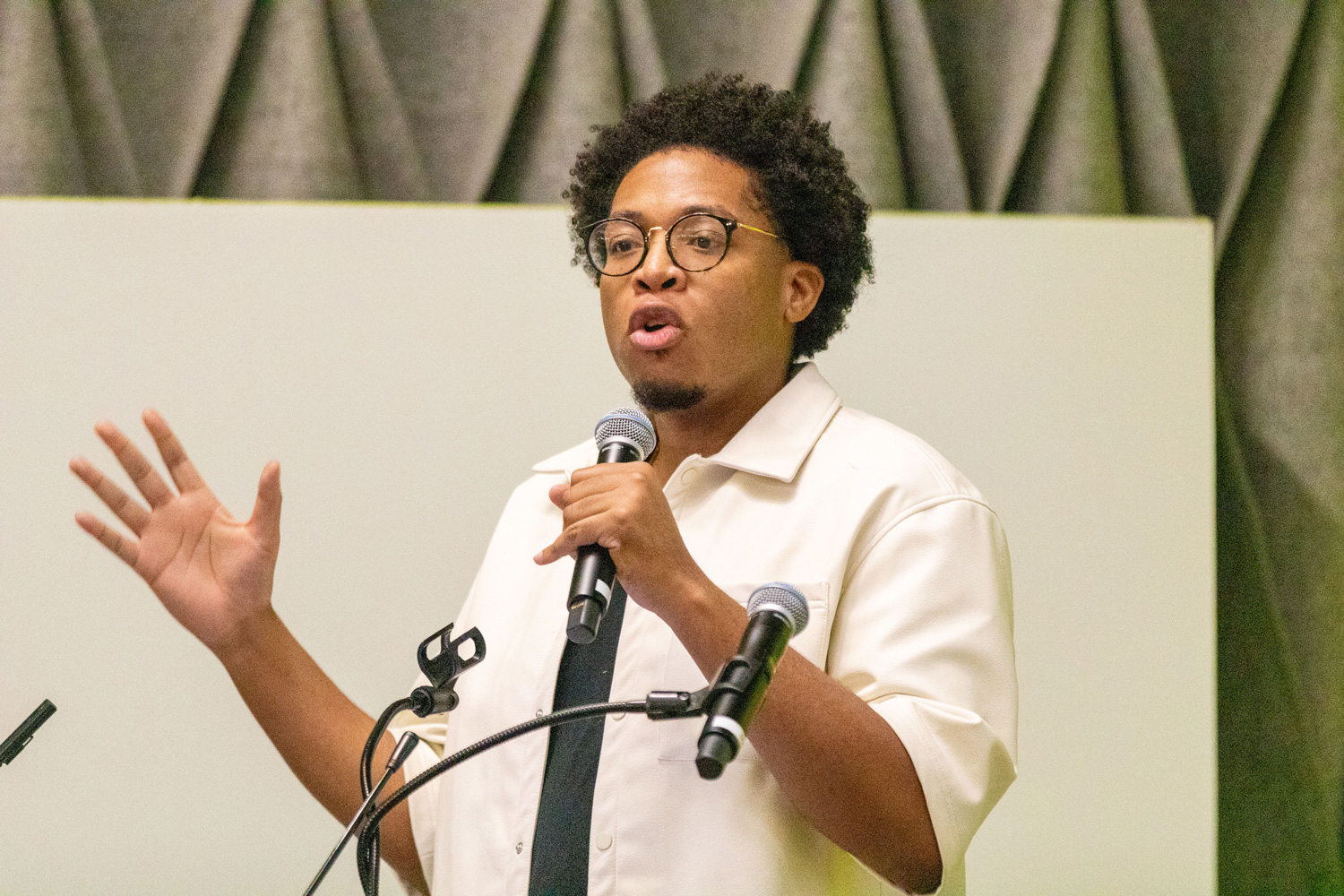
African American man gestures as he speaks with a microphone in hand
young Asian woman smiles broadly while speaking with someone to her right
the two activists pose for a photo in front of a backdrop for the UCLA Luskin Institute on Inequality and Democracy
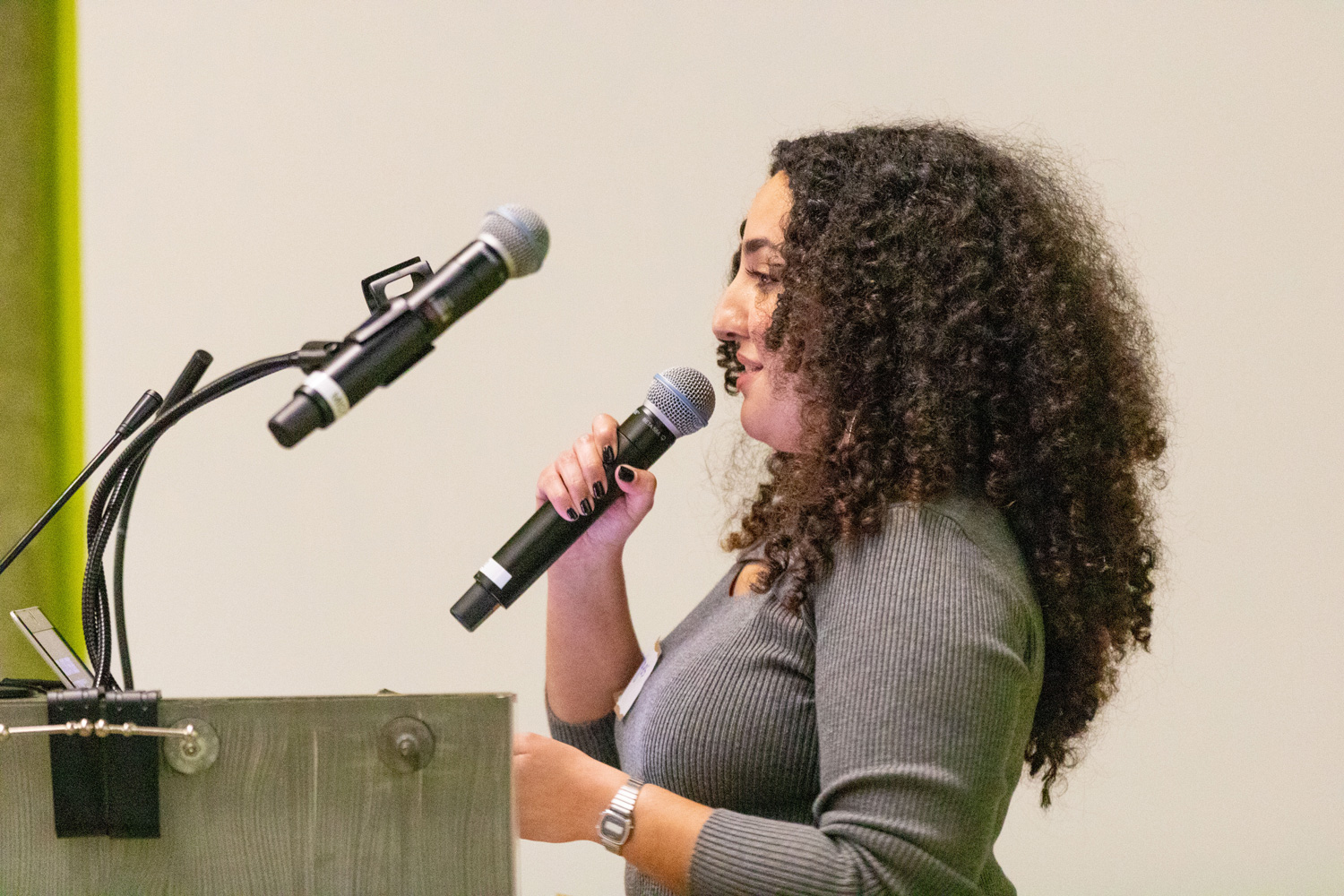
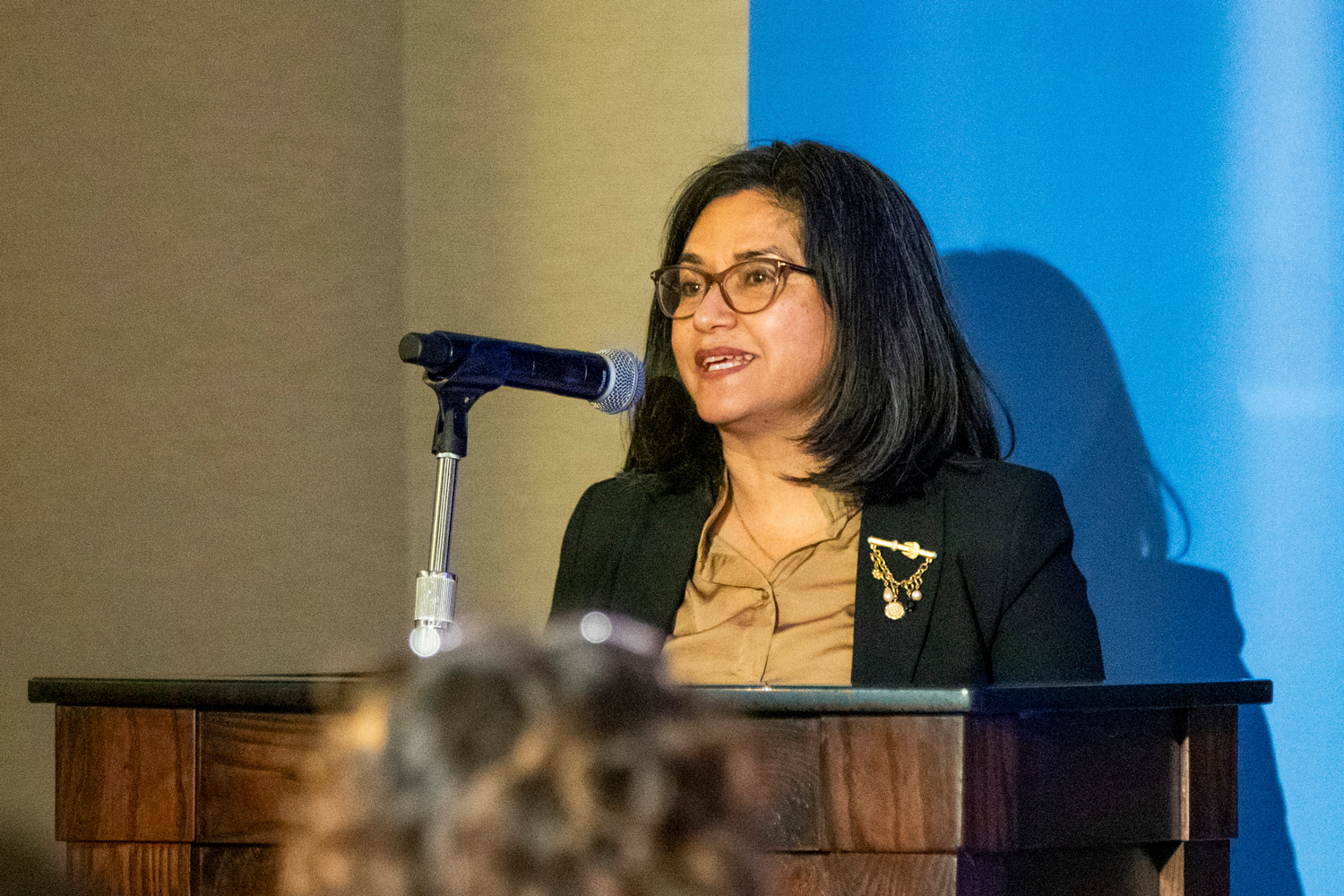
woman with dark curly hair is shown in profile at a podium while speaking

Roy and other representatives of the four UCLA sponsors then introduced the individual activists, each of whom spoke briefly about their previous experiences and their plans for the next few months. 

The first activist to speak this year was Gray-Garcia, who is a formerly unhoused and incarcerated poverty scholar who prefers to keep their face covered in public. Their rousing remarks were presented in the form of spoken word poetry.

The next activist to speak was Collins, a native of South Los Angeles who is has experience as a social justice strategist and movement builder. Collins’ work advances racial and social justice with a particular focus on Black, LGBTQ and environmental justice issues.

Yu is the creator of Nectar, an online space where she provides political education and healing justice workshops. She spoke of her efforts to combat misinformation and disinformation, particularly when it targets the Chinese-speaking community such as. harmful narratives attacking affirmative action and Black-on-Asian crime tropes during the COVID pandemic.

In his work with cityLAB-UCLA, Clarke said he aims to further efforts to canonize Black aesthetics, helping to authenticate it as a lens through which to practice architecture. Clarke is co-founder of a design practice that explores ways to unearth new aesthetics specific to African American culture, experience and identity.

Narges is a UCLA alumna who gained experience in student and community organizing as part of her undergraduate activities. Their background as a Muslim, queer person from an immigrant family from Libya has helped shape their understanding of community. 

Find out more about this year’s activists and their plans.

View photos from the reception on Flickr.

Activists-in-Residence 2024

Master of Real Estate Development Receives Final Approval From UC The one-year degree program will stress instruction on the ethical underpinnings of a growing profession

January 30, 2024/0 Comments/in Alumni, Development and Housing, Diversity, Education, For Faculty, For Policymakers, For Students, For Undergraduates, Global Public Affairs, School of Public Affairs, Urban Planning Vinit Mukhija /by Les Dunseith

By Stan Paul and Les Dunseith

Beginning in the fall of 2025, the UCLA Luskin School of Public Affairs will enroll students in a new Master of Real Estate Development, or MRED, program.

“We are delighted and excited to receive approval for the MRED, which we envision as building a better future for our cities,” said Interim Dean Anastasia Loukaitou-Sideris, distinguished professor of urban planning. “We see the MRED as a transformative opportunity to train and diversify a new generation of real estate professionals who can best respond to the needs for more and more affordable housing, climate-adaptive and green-building technologies, and age-friendly developments.”

The Office of the President of the University of California notified the Luskin School of the degree’s final approval on Jan. 23. It has been working its way through the approval processes at UCLA and UC for about two years.

Led by Vinit Mukhija, a professor and former chair of urban planning, the program will be a one-year, full-time, self-supporting degree program that emphasizes the ethical underpinnings of a growing profession.

Mukhija said urban real estate development is “one of the most powerful forces shaping buildings, neighborhoods, cities and their suburbs, and metropolitan regions.

“From planning to finance to design, development decisions about what to build and where to build influence equity and urban sustainability in ways that are often neglected in traditional real estate development programs.”

 “Success in real estate development will require a nuanced understanding and ethical response to underlying environmental and social challenges.” —Professor Vinit Mukhija

The MRED will provide key practical skills, integrating students into real-world development projects. It will take advantage of UCLA’s location in the nation’s second-largest city, Los Angeles.

Mukhija also noted the profound role that development has in addressing global grand challenges.

“Success in real estate development will require a nuanced understanding and ethical response to underlying environmental and social challenges,” he said.

Coursework will be led by faculty experts from UCLA Urban Planning, the Anderson School of Management and UCLA Law. An inaugural class of 25 students is expected, growing to about 40 students in the program over time. 

The MRED will be a full-time (44 units minimum), primarily on-campus program spanning 11 months, with students in residence during the fall, winter and spring quarters, which is consistent with other real estate development programs in the United States. 

Applicants to the MRED program at UCLA Luskin must possess a bachelor’s degree or equivalent. At least two years of experience in real estate, urban development or a related field is preferred. 

Unlike other real estate development programs, Mukhija said the UCLA program will be distinguished with an Urban Development core requirement that situates the MRED program’s training within the broader terrain of urban governance and urban life, including the challenges and opportunities presented by concerns about equity and sustainability.

Mukhija expects that many of the applicants will be mid-career professionals who are not typically served by state-supported programs. A significant share of international applicants is anticipated, with some coming from countries with growing urbanization rates and thus facing  new challenges relating to urban growth.

In addition, the program proposes to prepare real estate development professionals who understand the fundamentals of development, as well as the context of urban development and the effect of real estate and urban development on urban life and economic opportunities.

Senate faculty will teach at least 30% of the courses, joined by distinguished and innovative real estate and urban development practitioners. These industry experts with practical experience in real estate will provide the development and experiential knowledge that is “crucial and essential for the holistic, integrative perspective that we intend to cultivate in our students,” according to the documentation prepared by UCLA Luskin in support of the program. 

Although situated within UCLA Luskin Urban Planning, coursework will also touch upon issues taught in the School’s social welfare, public policy and public affairs degree programs, which share a common thread of social justice and a desire to make society better. And the Lewis Center for Regional Policy Studies based at UCLA Luskin will play a role in the research component.

In addition to conducting research on real estate and urban development, the MRED students will receive training to become real estate development professionals who can recognize and address the challenges of inclusive urbanization.

“It’s part of our mission,” Mukhija said.

Bruin Excellence in Civic Engagement Awards Recognize Public Service Leadership Eight with ties to the Luskin School are among 40 honored by the UCLA Alumni Association

November 27, 2023/0 Comments/in Alumni, For Faculty, For Policymakers, For Students, For Undergraduates, Public Policy, Public Policy News, School of Public Affairs, Urban Planning /by Mary Braswell
By Madeline Adamo

A week to the day after starting her new role as Los Angeles Mayor Karen Bass’s chief housing and homelessness officer, UCLA alumna Lourdes Castro Ramírez traveled to campus for an occasion of utmost importance to the public servant of 30 years.

To say the double Bruin had a packed schedule that day might be an understatement. Besides being a week into her new job, Castro Ramírez was in the midst of relocation, having picked up her life in Sacramento to move to Los Angeles.

Castro Ramírez, one of 40 awardees being recognized by the UCLA Alumni Association for distinctions in public service, said despite her circumstances, she wasn’t about to miss the ceremony and networking reception for the Bruin Excellence in Civic Engagement awards.

“I’m really proud to be part of this first cohort with a number of distinguished alumni,” said Castro Ramírez, who had been serving as Gov. Gavin Newsom’s appointed secretary for the California Business, Consumer Services and Housing Agency since March 2020. “For me, the focus on civic leadership is really important.”

The award reception, which took place Nov. 13, included a certificate presentation and remarks from the association’s leadership. Darnell Hunt, the executive vice chancellor and provost at UCLA, also was in attendance. The honorees included eight Luskin School alumni: Castro Ramírez MURP ’96, Norma E. Fernandez MURP ’06, Oceana R. Gilliam MPP ’19, Rayne Laborde Ruiz MURP ’21, Teresa Magula MPP ’04, Veronica Melvin MPP ’01, Aaron Ordower MURP ’15 and Regina Wallace-Jones MPP ’99. Wallace-Jones was presented with her award during a speaking engagement on campus the week before.

‘Once you go to Luskin, you’re family for life.’ — Oceana R. Gilliam MPP ’19

The Bruin Excellence in Civic Engagement awards, which will be awarded to a new class annually, is the brainchild of UCLA Alumni Association board member Matt Kaczmarek. He said he was inspired by the association’s Bruin 100 awards, launched in 2022, which recognize alumni fostering positive social change in the private sector. Kaczmarek felt a comparable program for civic service was needed.

“People who devote their careers to public service generally don’t seek recognition for their work, even though their impact can be significant,” said Kaczmarek, who earned a bachelor’s degree in geography and political science with a minor in public affairs in 2005.

Having held senior appointments in the administration of former President Barack Obama and in the international finance division of the U.S. Treasury Department, Kaczmarek knows the gravitas of being in public service. He also served as White House liaison for John Kerry during the politician’s term as secretary of state.

“As a student at UCLA, I learned the opportunity to have the greatest impact comes through dialogue, listening and pragmatic problem solving,” Kaczmarek, now a director and global head of market strategy and sustainable investing for the asset management firm BlackRock. “I’ve met Bruins at all levels of government who consistently excel based on those same values.”

One of those Bruins is Gilliam, chief of staff for Tennessee state Rep. Justin J. Pearson. The Democrat gained national attention in April, when he and Rep. Justin Jones protested on the chamber floor in support of stricter gun-control regulations. A few months prior, Gilliam had led Pearson’s campaign to victory, focusing on policies to eradicate gun violence, alleviate poverty and enhance community safety.

Gilliam wears many hats in the civic realm, including serving as senior program manager for the Center for Justice Innovation, a nonprofit that strives for a more equitable criminal legal system. She’s proud of the work she does at the center, building alternatives to incarceration.

“Even at a young age, I’ve always had this servant leader’s heart,” said Gilliam, whose next endeavor is law school, a step toward fulfilling her childhood dream of being a criminal court judge. Gilliam said her family’s involvement with the criminal justice system has informed her career trajectory.

She was honored to be named an award recipient last month. Though she had planned to return to Tennessee following a business trip, she changed her flights to ensure a stop in Los Angeles for the reception.

“Once you go to Luskin, you’re family for life,” Gilliam said. It still strikes her when she’s on a video call with Los Angeles County for work — and she sees the face of one of her Luskin School peers on the other end.

“This recognition program not only brings more awareness to what UCLA grads or Luskin grads are doing, but what so many other people are doing in the field of public service and civic engagement,” she said.

At the reception, Gilliam caught up with fellow alumna Castro Ramírez, who earned her master’s degree in urban and regional planning from the Luskin School in 1996. Castro Ramírez has sustained a strong connection with the school, sitting on its advisory board as co-chair of the Equity, Diversity and Inclusion Subcommittee, where she helps students get support with fellowships.

“I benefited tremendously from the support that I received as a student,” said Castro Ramírez, who was the first in her family to attend college when she earned her bachelor’s degree in political science and Chicano studies at UCLA in 1994. “I think it’s important for us to continue understanding the needs and the support that is necessary for students of color and students of underprivileged or underrepresented backgrounds.”

Read the full story.

Learn more about all 40 recipients of the inaugural Bruin Excellent in Civic Engagement awards and stay up to date about 2024 nomination submissions. 

Increasing Urbanization Contributes to Racial and Gender Pay Inequality, Study Shows Newly published research finds that an 'urban wage premium' in large cities primarily benefits white and male workers

November 20, 2023/0 Comments/in Diversity, For Faculty, For Policymakers, For Students, For Undergraduates, Global Public Affairs, Latinos, Research Projects, School of Public Affairs, Urban Planning Michael Storper /by Les Dunseith
By Les Dunseith

Researchers who study cities have long documented an “urban wage premium,” whereby workers in denser, larger cities tend to have higher wage and salary incomes. But a new study by a UCLA scholar is providing fresh insight into how growing population density in urban areas contributes to pay inequalities by race and gender.

In research published this month in the Journal of Urban Affairs, Max Buchholz, a postdoctoral researcher working with Professor Michael Storper of the UCLA Luskin School of Public Affairs, shows that this wage premium primarily benefits white and male workers, with significantly less positive impacts for Black workers, and possibly none for Latino and female workers.

Furthermore, gender-based wage inequality related to urbanization tends to be significant between men and women who have children but relatively insubstantial between men and women without children.

“My findings suggest there is something about cities that makes it particularly difficult for women to manage the dual responsibilities of child care and having a career,” Buchholz said.

He also looked at the constraints and tradeoffs that arise when urban workers balance employment opportunities with choices about housing quality and affordability, commuting and other activities. These “congestion costs” have been shown to have negative impacts disproportionately borne by women and people of color.

In particular, Buchholz found that the relationship between density and pay inequality became stronger when commute times to and from work also increased. Moreover, as urban areas get denser, commute times for Black workers and Asian American and Pacific Islander workers increase relative to white workers. But female–male commuting inequality decreases.

“This suggests that rising density doubly disadvantages Black workers with relatively lower wages and longer commutes, prompts AAPI workers to commute longer for pay that is equal to white workers, and constrains women’s access to jobs that suit their skills and qualifications,” Buchholz said.

The research was supported by a postdoctoral research fellowship from the National Science Foundation.

UCLA School of Public Affairs Among Charles E. Young’s Lasting Legacies Former colleagues recall the late chancellor and his role in the 1994 consolidation of degree programs

October 24, 2023/0 Comments/in Public Policy, School of Public Affairs, Social Welfare, Urban Planning Anastasia Loukaitou-Sideris, Archie Kleingartner, Charles Young, Daniel J.B. Mitchell, Fernando Torres-Gil, Zev Yaroslavsky /by Stan Paul

By Stan Paul

Charles E. Young, the former UCLA chancellor who passed away Sunday at his home in Sonoma, California, at age 91, was instrumental in the creation of what later became the Luskin School of Public Affairs.

During a time of budgetary constraints, the long-established schools of Social Welfare and Urban Planning were combined in 1994 with a new graduate department — Public Policy — in one new school. In recognizing Young’s legacy and significance at UCLA Luskin, Interim Dean Anastasia Loukaitou-Sideris said it was his vision that made today’s Luskin School possible.

And, as she wrote to the UCLA Luskin community, “placing his faculty appointment in our Public Policy department, he immediately elevated the visibility of our School in its very early days.” Loukaitou-Sideris noted that Young always kept a great interest in “his school” long after his official retirement. “As late as June 25, 2023, he emailed me to express his pleasure and congratulations for Urban Planning having been ranked as No. 1 in the nation.”

Several others who knew Young and his relationship with UCLA Luskin offered their remembrances.

Daniel J.B. Mitchell, professor emeritus of management and public policy, was on the faculty at UCLA at the time of the transition. He said Young supported the final result, but the original idea was different.

“Originally, the idea was to create an interdisciplinary research center — not a school — for faculty with a general interest in public policy,” recalled Mitchell, who served as chair of public policy from 1996 to 1997.

In the aftermath of the 1992 civil unrest in Los Angeles following the Rodney King verdict, and in response to budgetary pressures coming from the state that would require rethinking some programs at UCLA, Young appointed a committee to take on the task. It was headed by Archie Kleingartner, professor emeritus of management and public policy, who would become the School’s founding dean.

“Young expanded the task to include creation of a full school of public affairs. He felt that public policy, particularly aimed at state and local concerns, should have a distinct presence at UCLA, both for research and for the production of professionals in the field,” Mitchell said.

Kleingartner said Young had reached the conclusion in the early 1990s that UCLA could and should do much more in the field of public policy. As a premier university, UCLA had an obligation to provide research and teaching at a high level in public policy, said Kleingartner, noting that although Young’s master’s and doctoral degrees from UCLA were in political science, his personal academic research interest was in public policy.

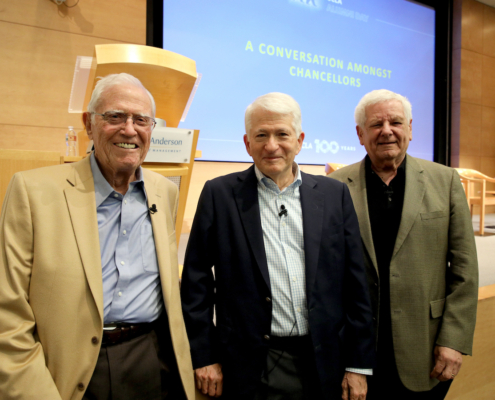
Young with current Chancellor Gene Block and former Chancellor Al Carnesale.

After the decision on a new public affairs school was reached, top-level attention turned to how to go about creating a public policy entity and what it should look like, Kleingartner said. “The chancellor was interested in something big and impactful.”

A second strategic decision was based on the fact “that very little by way of new funding would be available, that the main resources would have to be found from within the university,” he said. “So, a really big issue was to reorganize in a way that generated savings.”

Kleingartner said the late Andrea Rich headed up the administrative and financial aspects of the restructuring, and he led the academic and faculty aspects.

“But many faculty and administrators got involved because it was quite a complex undertaking,” he said.

At that time, a number of schools and institutes were reorganized as part of the Professional School Restructuring Initiative, or PSRI, and it was done amid a great deal of internal opposition from existing schools, institutes and their faculties. But “the chancellor remained firm despite the extensive opposition.”

The School — with a different name but in essentially its current form — was officially launched on July 1, 1994. That wouldn’t have happened without Charles E. Young, and “I think at this point, most people are quite satisfied with what was created,” Kleingartner said.

Zev Yaroslavsky, director of the Los Angeles Initiative at the Luskin School, has known Young since Yaroslavsky’s days as an undergraduate in the late 1960s. That association continued during his career as a Los Angeles City Council member and Los Angeles County supervisor representing districts including the Westwood campus.

At a time of declining state support for higher education, Yaroslavsky pointed out that Young “saw what was coming” and took steps to help UCLA remain competitive as a top public university, according to a story posted by UCLA Newsroom.

“Chuck was a bold and visionary leader who catapulted UCLA to one of the world’s great research universities,” Yaroslavsky commented. “Moreover, under his stewardship this university became a consequential player in its own backyard — Westwood and the greater Los Angeles community. As an elected official who represented UCLA for four decades, I never had a better partner.”

Stewardship and partnerships were a hallmark of his work and affiliations on campus.

“Chancellor Young welcomed me personally when I was recruited to UCLA,” said Fernando Torres-Gil, professor emeritus of social welfare and public policy. He recalled Young’s graciousness and interest in his career, which would include a number of leadership roles at UCLA Luskin.

“Since that time, I took great joy in calling him ‘Chuck’ and experiencing the great university he helped to create. Very few individuals have the good fortune to see a legacy grow and flower, and Chancellor Young could enjoy his creation on his many visits to campus post-retirement,” Torres-Gil said.

Read more about the life and career of the former chancellor on UCLA Newsroom.

A Festive Welcome to UCLA Luskin The entire School community comes together to make connections and celebrate the launch of a new academic year

October 2, 2023/0 Comments/in Alumni, Diversity, Education, For Faculty, For Students, For Undergraduates, Public Policy, Public Policy News, School of Public Affairs, Social Welfare, Social Welfare News, Urban Planning /by Mary Braswell

Students, alumni, faculty, staff and friends of UCLA Luskin connected at a series of events kicking off the 2023-2024 academic year.

An orientation for graduate students brought public policy, social welfare and urban planning students together to learn about resources provided by the university and the Luskin School.

The undergraduate program hosted a luncheon for majors, pre-majors and students interested in learning more about the bachelor of arts in public affairs.

And the Block Party tradition continued for the 12th year, with the entire UCLA Luskin community gathering to make connections, learn about opportunities and organizations, enjoy the flavors of Los Angeles, and greet the School’s benefactors, Meyer and Renee Luskin.

View photos from:

Graduate Student Orientation

Graduate Student Orientation 2023

Undergraduate Open House 

Undergraduate Open House 2023

12th Annual UCLA Luskin Block Party

Block Party 2023


For access to the Block Party 360 Videos and Roamer Booth images, contact events@luskin.edu. 

UC Grant Will Fund EV Research by UCLA Luskin Center for Innovation Team led by a Fielding School professor gets nearly $2 million to pursue an equitable model for electrical vehicle charger placement

September 6, 2023/0 Comments/in Alumni, Climate Change, Electric Vehicles and Alternative Fuels, Environment, For Faculty, For Policymakers, For Students, For Undergraduates, Luskin Center, Public Policy, Public Policy News, Research Projects, School of Public Affairs, Social Welfare News, Sustainable Energy, Transportation, Urban Planning Gregory Pierce /by Les Dunseith

The UCLA Luskin Center for Innovation will be a key contributor to research recently funded through a partnership between the University of California and the state intended to spur real-world solutions relating to climate change in California.

A team from the Center for Innovation, or LCI, will focus on community engagement relating to a project led by Yifang Zhu, professor of environmental health sciences at the UCLA Fielding School of Public Health, that will look at how efforts to reduce greenhouse gases can better enable residents of disadvantaged communities to adopt electric vehicles more readily. 

A $1.99 million grant under Zhu’s direction will fund the study of EV usage in communities that have historically lacked access to charging stations. The LCI researchers will work with local residents and community-based organizations to identify barriers, improve knowledge and awareness of EVs, and design plans for deploying and installing charging stations in underserved areas. 

To date, the siting of EV chargers has been a top-down process driven by business priorities rather than community needs and preferences. Gregory Pierce, adjunct associate professor of urban planning and co-executive director of LCI, said researchers will partner with three community-based organizations in the Los Angeles area to co-design the first-ever procedurally equitable process for placement of EV chargers. 

“We hope that this project leads to a new community co-designed model for placing electric vehicle charging stations throughout California that can accelerate our transition to a zero-emissions transportation future,” Pierce said. 

The UCLA Luskin-affiliated team will be co-led by Rachel Connolly, project director for air quality and environmental equity research at LCI. The effort will include surveys and a three-part workshop process relating to the siting of EV chargers and future investments in coordination with the Los Angeles Department of Water and Power and other partners. Connolly, who earned doctorate and master’s degrees in environmental health sciences from UCLA, has been working at LCI since 2017. 

In all, $83.1 million in California Climate Action grants were awarded to a total of 38 projects involving researchers from across the UC system, as well as California State University campuses, private universities and community, industry, tribal and public agencies. The two-year grants are part of $185 million allocated by the state for UC climate initiatives that advance progress toward California’s climate goals.

Read about other UCLA research funded by California Climate Action grants

Page 7 of 45«‹56789›»

Recent Posts

  • Stoll on the Factors Influencing Migration Patterns within the U.S. January 9, 2026
  • Northern California Maintains Nation’s Lowest ICE Arrest Rate Despite National Surge January 9, 2026
  • One Year After the Fires, Recovery Remains Uneven January 8, 2026
  • Oil and Gas Companies Sacrificing Plastic-Burdened Communities January 7, 2026
  • A sixth-generation Altadena resident presents a community recovery roadmap after the fires January 7, 2026

Contact

UCLA Luskin School of Public Affairs

3250 Public Affairs Building - Box 951656
Los Angeles, CA 90095-1656

Campus Resources

  • Maps, Directions, Parking
  • Directory
  • Contact
  • Academic Calendar
  • Careers
  • Diversity
  • University of California
  • Terms of Use

Follow

The statements on this page represent the views of people affiliated with the Luskin School of Public Affairs and do not necessarily represent the views of the University of California, or UCLA or its Chancellor.

Posts and comments by individuals at UCLA on social media channels may not reflect the opinions or policies of UCLA, the University of California or the Luskin School, nor its benefactors and academic partners.

Scroll to top